Chapter 18 O Chem test prep
Which of the following correctly describes the bond angle and hybridizations present in formaldehyde?
A) C, sp2; O, sp3; HCO, ~120°
B) C, sp2; O, sp2; HCO, ~120°
C) C, sp2; O, sp2; HCO, ~109.5°
D) C, sp3; O, sp2; HCO, ~109.5°
E) C, sp3; O, sp3; HCO, ~109.5°
B) C, sp2; O, sp2; HCO, ~120°
The positively polarized carbon atom of a carbonyl group acts as:
A) an electrophile and a Lewis base.
B) a nucleophile and a Lewis base.
C) an electrophile and a Lewis acid.
D) a nucleophile and a Lewis acid.
E) both a Lewis acid and a Lewis base.
C) an electrophile and a Lewis acid
The double bond between carbon and oxygen is similar to an alkene CC, except that C=O is:
A) shorter and weaker.
B) shorter and stronger.
C) longer and weaker.
D) longer and stronger.
E) longer.
B) shorter and stronger.
Another name for β-methoxybutyraldehyde is:
A) 2-methoxypropanal.
B) 3-methoxypropanal.
C) 2-methoxybutanal.
D) 3-methoxybutanal.
E) 2-methoxypentanal.
D) 3-methoxybutanal

What is the correct IUPAC name for the following compound?
A) 2-oxocyclohex-3-ene carbaldehyde
B) 5-formylcyclohex-2-enone
C) 2-formylcyclohex-5-enone
D) 3-oxocyclohex-4-enal
A) 2-oxocyclohex-3-ene carbaldehyde
Which of the following represents the correct ranking in terms of increasing boiling point?
A) n-butane < 1-butanol < diethyl ether < 2-butanone
B) n-butane < 2-butanone < diethyl ether < 1-butanol
C) 2-butanone < n-butane < diethyl ether < 1-butanol
D) n-butane < diethyl ether < 1-butanol < 2-butanone
E) n-butane < diethyl ether < 2-butanone < 1-butanol
E) n-butane < diethyl ether < 2-butanone < 1-butanol
Which of the following compounds is most soluble in water?
A) acetone
B) cyclohexanone
C) 2-butanone
D) 3-butanone
E) benzophenone
A) acetone
When a carbonyl is part of a conjugated π-network, the CO stretch:
A) has a higher frequency than in a nonconjugated system.
B) has a lower frequency than in a nonconjugated system.
C) always occurs at 1710 cm-1.
D) occurs around 2700 cm-1.
E) cannot be distinguished from the CO stretch in a nonconjugated system
B) has a lower frequency than in a nonconjugated system.
What name is given to the linear polymer which contains many formaldehyde units?
A) trioxane
B) formalin
C) paraformaldehyde
D) polyacetaldehyde
E) polyalal
C) paraformaldehyde
What reagent can be used to convert 2-methylbutan-1-ol into 2-methylbutanal?
A) LiAlH4
B) Na2Cr2O7
C) O3
D) KMnO4
E) PCC
E) PCC
What reagents can be used to convert 1-hexyne into 2-hexanone?
A) 1. Sia2BH; 2. H2O2, NaOH
B) Hg2+, H2SO4, H2O
C) 1. O3; 2. (CH3)2S
D) 1. CH3MgBr; 2. CO2
E) 1. H2, Ni; 2. Na2Cr2O7, H2SO4
B) Hg2+, H2SO4, H2O
Oxidation of a 1° alcohol with chromic acid results in the production of ________.
A) an ester
B) a ketone
C) an aldehyde
D) an ether
E) none of the above
E) none of the above
Oxidation of a 2° alcohol with chromic acid results in the production of ________.
A) an ester
B) a ketone
C) an aldehyde
D) an ether
E) none of the above
B) a ketone
Oxidation of a 1° alcohol with pyridinium chlorochromate results in the production of ________.
A) an ester
B) a ketone
C) an aldehyde
D) an ether
E) none of the above
C) an aldehyde
Whcih of the following reactions will not yield a ketone product?
The THF reagent one
Oxidation of a 3° alcohol with chromic acid results in the production of ________.
A) an ester
B) a ketone
C) an aldehyde
D) an ether
E) none of the above
Answer: E
E) none of the above
Treatment of a nitrile with a Grignard reagent followed by hydrolysis results in ________.
A) an ester
B) a ketone
C) an aldehyde
D) an ether
E) an alcohol
B) a ketone
Which of the following describes a synthesis of an aldehyde?
A) hydrogenation of an acid chloride using Pd/BaSO4/S as a poisoned catalyst
B) reaction of a primary alcohol with Na2Cr2O7
C) reaction of a ketone with ozone
D) treatment of an alkene with Sia2BH
E) none of the above
A) hydrogenation of an acid chloride using Pd/BaSO4/S as a poisoned catalyst
Which series of reactions described below, if any, will result in the formation of 2-methylpentan-3-one starting with 1-propanol?
A) 1. (CH3)2CHMgBr/ diethyl ether
2. dilute H3O+
3. PCC
B) 1. Na2Cr2O7/H2SO4 and heat
2. SOCl2
3. 2 (CH3)2CHMgBr/ diethyl ether
4. H3O+
C) 1. Na2Cr2O7/H2SO4 and heat
2. (CH3)2CHMgBr/ diethyl ether
3. dilute H3O+
4. LiAlH4
D) 1. PCC
2. (CH3)2CHLi/ diethyl ether
3. dilute H3O+
4. Na2Cr2O7/H2SO4 and heat
E) none of the above
D) 1. PCC
2. (CH3)2CHLi/ diethyl ether
3. dilute H3O+
4. Na2Cr2O7/H2SO4 and heat
When the carbonyl group of a neutral ketone is protonated,:
A) the resulting species becomes more electrophilic.
B) the resulting species is activated toward nucleophilic attack.
C) subsequent nucleophilic attack on the resulting species is said to occur under acid-catalyzed conditions.
D) the resulting species has a positive charge.
E) all of the above
E) all of the above
Consider the equilibrium of each of the carbonyl compounds with HCN to produce cyanohydrins. Which is the correct ranking of compounds in order of increasing Keq for this equilibrium?
A) H2CO < cyclohexanone < CH3CHO < 2-methylcyclohexanone
B) CH3CHO < 2-methylcyclohexanone < cyclohexanone < H2CO
C) cyclohexanone < 2-methylcyclohexanone < H2CO < CH3CHO
D) cyclohexanone < 2-methylcyclohexanone < CH3CHO < H2CO
E) 2-methylcyclohexanone < cyclohexanone < CH3CHO < H2CO
E) 2-methylcyclohexanone < cyclohexanone < CH3CHO < H2CO
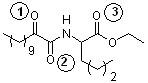
The following compound has been found effective in treating pain and inflammation (J. Med. Chem. 2007, 4222). Which sequence correctly ranks each carbonyl group in order of increasing reactivity toward nucleophilic addition?
A) 1 < 2 < 3
B) 2 < 3 < 1
C) 3 < 1 < 2
D) 1 < 3 < 2
B) 2 < 3 < 1
Rank the following compounds in order of their propensity to become a hydrate in water (i.e., start with the least easy to hydrate: CH3COCH2CH3, H2CO, Cl3CCHO, and CH3CH2CHO
CH3COCH2CH3 < CH3CH2CHO < H2CO < Cl3CCHO
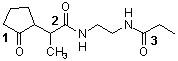
Which sequence ranks the following carbonyl compounds in order of increasing rate of nucleophilic addition?
A) 2 < 3 < 1
B) 3 < 2 < 1
C) 2 < 1 < 3
D) 1 < 3 < 2
A) 2 < 3 < 1
An ylide is a molecule that can be described as a:
A) carbanion bound to a negatively charged heteroatom.
B) carbocation bound to a positively charged heteroatom.
C) carbocation bound to a carbon radical.
D) carbocation bound to a diazonium ion.
E) carbanion bound to a positively charged heteroatom.
Answer: E
E) carbanion bound to a positively charged heteroatom
Which of the following is also known as a Schiff base?
A) an imine
B) a cyanohydrin
C) a hydrate
D) sodium hydroxide
E) an aldehyde
A) an imine
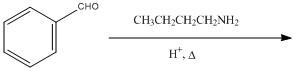
What product will result from the reaction shown?
A) imine
B) amino acid
C) amino alcohol
D) hydrazine
E) hydroxylamine
A) imine

What product will result from the reaction shown?
A) acetal
B) hydrazine
C) ester
D) ylide
E) ketone
A) acetal
Acetals will react with ________.
A) H3O⊕
B) NaOCH3
C) PhLi
D) CH3CH2MgBr
E) NaBH4
A) H3O⊕
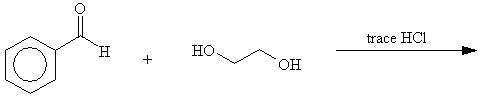
What would be the product of the following reaction?
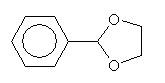
A)
Why do acetal-forming reactions that use ethylene glycol have more favorable equilibrium constants than those using methanol?
A) Ethylene glycol reacts more rapidly.
B) They are more favorable on entropy grounds.
C) They are more favorable on enthalpy grounds.
D) Ethylene glycol is acidic and catalyzes the reaction.
E) The ethylene acetal can serve as a protecting group.
B) They are more favorable on entropy grounds
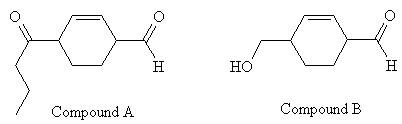
Which series of reactions described below will result in the formation of compound A, starting with compound B?
A) 1. HO-(CH2)2-OH /trace H3O+
2. DMSO (COCl2)/Et3N, CH2Cl2
3. MgBr-(CH2)2-CH3/diethyl ether
4. work-up with H3O+
B) 1. PCC
2. SOCl2
3. LiCu-((CH2)2-CH3)2
4. work-up with H3O+
C) 1. Na2Cr2O7/H2SO4
2. SOCl2
3. 2 MgBr-(CH2)2-CH3/diethyl ether
4. work-up with H3O+
D) both A and B
E) both B and C
A) 1. HO-(CH2)2-OH /trace H3O+
2. DMSO (COCl2)/Et3N, CH2Cl2
3. MgBr-(CH2)2-CH3/diethyl ether
4. work-up with H3O+
What intermediate occurs when a ketone undergoes a Wolff-Kishner reduction?
A) a cyanohydrin
B) a hydrated aldehyde
C) a carboxylate
D) a semicarbazone
E) a hydrazone
E) a hydrazone
The reagent which converts a carbonyl group of a ketone into a methylene group is ________.
A) Na, NH3, CH3CH2OH
B) LiAlH4
C) NaBH4, CH3CH2OH
D) Zn(Hg), conc. HCl
E) LiAlH[OC(CH3)3]3
D) Zn(Hg), conc. HCl
Which of the following carbonyl compounds may be made from 1,3-dithiane?
1) methyl vinyl ketone
2) 2-pentanone
3) 3,3-dimethyl-2-butanone
4) 2-phenylethanal
A) 1 & 4
B) 2 only
C) 2 & 3
D) 2 & 4
D) 2 & 4