Chapter 12 A&P
After Joe has a stroke, his doctor asks Joe to touch his right pointer finger to his chin—but Joe is unable to move his right hand. However, when the doctor stimulates Joe's pointer finger with a painful stimulus, Joe's muscles quickly move his hand away from the stimulus. The doctor concludes that ______.
the stroke caused damage to Joe's frontal eye field which interfered with his effort to touch his chin
the stroke caused damage to Joe's right primary motor cortex
the stroke caused damage to Joe's left premotor cortex
based on the doctor's observations, none of the listed answers are correct conclusions
based on the doctor's observations, none of the listed answers are correct conclusions
A patient reports that she has become completely deaf—she can't hear anything. Thorough tests on her ears indicate that her ears have not been damaged. Additional tests reveal that her deafness has been caused by damage to her ______.
primary somatosensory cortex
auditory association area
somatosensory association cortex
None of the listed responses is correct.
None of the listed responses is correct.
At age 79, Mrs. X is diagnosed with a disorder that severely impairs her logical judgment. Medical imaging techniques show that this has been most likely caused by brain damage in a ______.
parietal lobe
frontal lobe
temporal lobe
premotor cortex
frontal lobe
Which of the following hypothalamic control centers would you predict is the LEAST important for survival?
suprachiasmatic nucleus
autonomic control center
temperature control center
thirst center
suprachiasmatic nucleus
Specific motor and sensory functions are localized in specific areas called domains, whereas memory and language have overlapping domains.
True
False
t
The RAS is comprised of specific pathways primarily in the limbic system.
True
False
f
The first obvious sign that the nervous system is forming in the embryo is the thickening of the surface ectoderm to form the neural plate.
True
False
t
The left cerebral hemisphere is usually dominant.
True
False
t
The limbic system acts as our emotional, or affective, brain.
True
False
t
The canal connecting the third and fourth ventricles and running through the midbrain is the foramen of Monro.
True
False
f
A disturbance of posture, muscle tremors at rest, and uncontrolled muscle contraction are all symptoms of damage to the basal nuclei.
True
False
t
Projection fibers in the brain mainly connect the right and left hemispheres.
True
False
f
The primary visual cortex contains a map of visual space.
True
False
t
One functional center found within the medulla oblongata is a respiratory center involved in the control of the rate and depth of breathing.
True
False
t
Sorting of sensory information and relaying it to the appropriate cerebral sensory area occurs in the hypothalamus.
True
False
f
Embryonic damage to the mesencephalon could result in improper formation of the midbrain.
True
False
t
Nuclei of cranial nerves V, VI, and VII are found in the ________.
midbrain
pons
cerebrum
medulla
pons
The arbor vitae refers to ________.
flocculonodular nodes
the pleatlike convolutions of the cerebellum
cerebellar white matter
cerebellar gray matter
cerebellar white matter
The brain stem consists of the ________.
cerebrum, pons, midbrain, and medulla
midbrain only
midbrain, medulla, and pons
pons, medulla, cerebellum, and midbrain
midbrain, medulla, and pons
The primary auditory cortex is located in the ________.
parietal lobe
temporal lobe
prefrontal lobe
frontal lobe
temporal lobe
What cells line the ventricles of the brain?
epithelial cells
astrocytes
neurons
ependymal cells
ependymal cells
The vital centers for the control of heart rate, respiration, and blood pressure are located in the ________.
medulla
midbrain
cerebrum
pons
medulla
Which fissure separates the cerebral hemispheres?
lateral fissure
longitudinal fissure
parieto-occipital fissure
central fissure
longitudinal fissure
Which of the following best describes the cerebrum?
visceral command center
decussation center
executive suite
motor command center
executive suite
A shallow groove on the surface of the cortex is called a ________.
gyrus
sulcus
furrow
fissure
sulcus
Which of the following generalizations does not describe the cerebral cortex?
The cerebral cortex contains three kinds of functional areas.
Each hemisphere is chiefly concerned with sensory and motor functions of the contralateral side of the body.
The hemispheres are exactly equal in function.
No functional area of the cortex works alone.
The hemispheres are exactly equal in function.
The central sulcus separates which lobes?
temporal from parietal
frontal from parietal
frontal from temporal
parietal from occipital
frontal from parietal
Which of these would you not find in the cerebral cortex?
unmyelinated axons
cell bodies
fiber tracts
dendrites
fiber tracts
Which of the following is not a role of the basal nuclei?
initiating protective reflex actions
inhibiting unnecessary or antagonistic movements
regulating attention and cognition
controlling starting and stopping movements
initiating protective reflex actions
Ridges of tissue on the surface of the cerebral hemispheres are called ________.
ganglia
gyri
fissures
sulci
gyri
The frontal lobe is separated from the temporal lobe by the ________.
lateral sulcus
central sulcus
cranial fossa
longitudinal fissure
lateral sulcus
Two terms for the massive motor tracts serving voluntary movement are ________.
supplementary and cerebellar-pontine
pyramidal and corticospinal
segmental and nigrostriatal
extrapyramidal and rubrospinal
pyramidal and corticospinal
Broca's area ________.
is considered a motor speech area
corresponds to Brodmann's area 8
serves the recognition of complex objects
is usually found in the right hemisphere
is considered a motor speech area
Which part of the cerebral cortex is involved in intellect, cognition, recall, and personality?
prefrontal cortex
limbic association area
posterior association area
combined primary somatosensory cortex and somatosensory association cortex
prefrontal cortex
The blood-brain barrier is effective against ________.
alcohol
nutrients such as glucose
anesthetics
metabolic waste such as urea
metabolic waste such as urea
All of the following are structures of the limbic system except the ________.
cingulate gyrus
caudate nucleus
hippocampus
amygdaloid nucleus
caudate nucleus
The brain area that regulates activities that control the state of wakefulness or alertness of the cerebral cortex is the ________.
thalamus
limbic system
reticular formation
pyramids
reticular formation
Injury to the hypothalamus may result in all of the following except ________.
loss of proprioception
loss of body temperature control
pathologic sleep
production of excessive quantities of urine
loss of proprioception
Important nuclei of the indirect (multineural) system that receive impulses from the equilibrium apparatus of the inner ear and help to maintain balance by varying muscle tone of postural muscles are the ________.
superior colliculi
vestibular nuclei
reticular nuclei
red nuclei
vestibular nuclei
Tremor at rest, shuffling gait, stooped posture, and expressionless face are characteristics of ________.
Parkinson's disease
Huntington's disease
spinal cord disease
cerebellar disease
Parkinson's disease
Which of the following is (are) involved with motor activity (either initiation or coordination)?
red nuclei
gustatory cortex
postcentral gyrus
Wernicke's area
red nuclei
White matter (myelinated fibers) is found in all of the following locations except the ________.
corticospinal tracts
cerebral cortex
corpus callosum
outer portion of the spinal cord
cerebral cortex
Loss of ability to perform skilled motor activities such as piano playing, with no paralysis or weakness in specific muscles, might suggest damage to the ________.
spinal cord
rubrospinal tracts
primary motor cortex
premotor cortex
premotor cortex
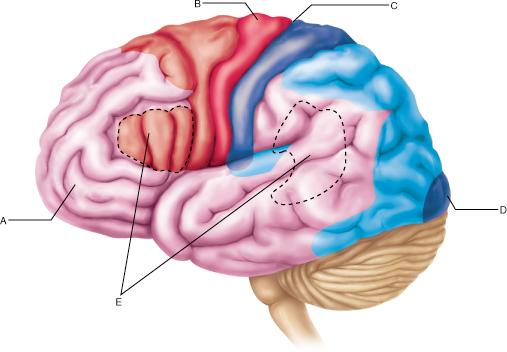
Which letter indicates the primary visual cortex?
A
B
C
D
D
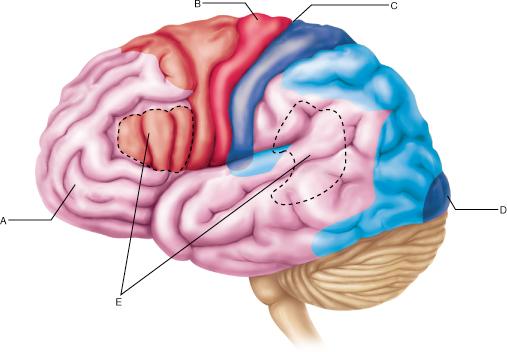
Region A includes which of the following?
Pre-frontal cortex
Primary somatosensory cortex
Broca's area
Primary motor cortex
Pre-frontal cortex
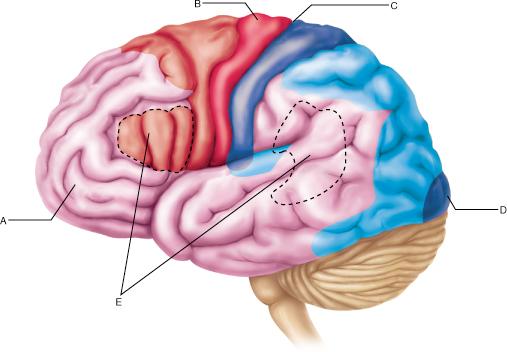
The groove indicated by C is the _____________.
central sulcus
post-central gyrus
longitudinal fissure
transverse fissue
central sulcus
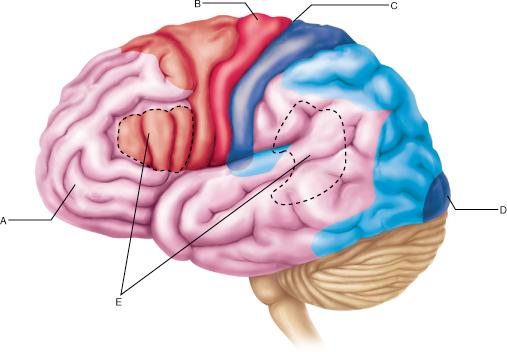
Which of the following is NOT associated with region B?
conscious control of skeletal muscles
origin of corticospinal tracts
cell bodies of pyramidal neurons
post-central gyrus
post-central gyrus
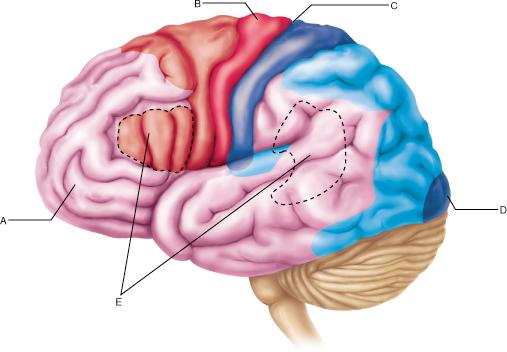
The cortical regions indicated by E are involved in which functions?
The control centers for homeostatic and endocrine functions.
The production and interpretation of language.
The generation of emotional responses.
The storage of motor patterns for skilled movements of skeletal muscles.
The production and interpretation of language.
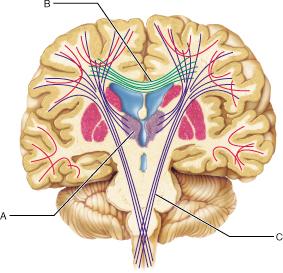
The letter A in the above figure represents which of the following structures?
medulla
thalamus
midbrain
hypothalamus
thalamus
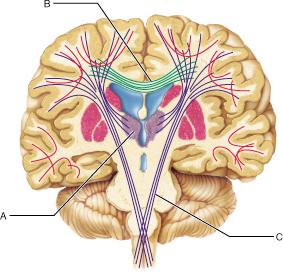
What structure is indicated by B?
association fibers
lateral ventricles
pyramidal tracts
corpus callosum
corpus callosum
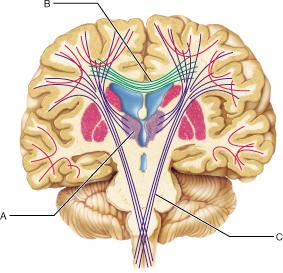
Which of the following describes the specific projection fibers indicated by C?
upper motor neurons
third-order sensory neurons
lower motor neurons
first-order sensory neurons
upper motor neurons
Nuclei relating to the startle reflex are located in the corpora quadrigemina of the midbrain.
True
False
t
The three basic regions of the cerebrum are the cerebral cortical gray matter, internal white matter, and the superior and inferior colliculi.
True
False
f
Commissural fibers connect the cerebrum to the diencephalon.
True
False
f
Which brain nucleus is the body's "biological clock"?
lentiform nucleus
suprachiastmatic nucleus
dorsomedial nucleus
subthalamic nucleus
suprachiastmatic nucleus
If the caudal portion of the neural tube failed to develop properly the ________.
cranial nerves would not form
telencephalon would cease development
hindbrain would not be present
spinal cord may be affected
spinal cord may be affected
Which of the following statements is a false or incorrect statement?
Damage to the primary auditory cortex results in the inability to interpret pitch, loudness, and location.
Damage to the primary motor cortex results only in the loss of both voluntary muscle control and reflexes.
Damage to the premotor cortex results in loss of motor skills programmed in that area but movement is still possible.
Damage to the primary visual cortex results in functional blindness.
Damage to the primary motor cortex results only in the loss of both voluntary muscle control and reflexes.
The area of the cortex that is responsible for sensations of the full bladder and the feeling that your lungs will burst when you hold your breath too long is the ________.
visceral sensory area
gustatory cortex
vestibular cortex
olfactory cortex
visceral sensory area
Which part of the brain is the "executive suite" for all brain activity?
cerebral cortex
cerebellum
diencephalon
brain stem
cerebral cortex
Which parts of the brain constitute the "emotional brain" known as the limbic system?
diencephalic and brain stem structures
cerebral and diencephalic structures
cerebral and brain stem structures
diencephalic and mesencephalic structures
cerebral and diencephalic structures
Which type of white matter fiber tract connects the two cerebral hemispheres?
association fibers
internal capsules
projection fibers
commissures
commissures
Which part of the brain is considered the "gateway" to the cerebral cortex?
thalamus
mesencephalon
hypothalamus
pons
thalamus
Which of the following best describes the hypothalamus?
relay station for the special senses
visceral control center of the body
somatic motor control center
gateway to the cerebellum
visceral control center of the body
Which part of the brain stem houses the reflex centers for respiration and cardiovascular functioning?
medulla oblongata
midbrain
pons
reticular formation
medulla oblongata
Which part of the brain processes inputs received from the cerebral motor cortex, brain stem nuclei, and various sensory receptors, and then uses this information to coordinate somatic motor output so that smooth, well-timed movements occur?
diencephalon
pons
thalamus
cerebellum
cerebellum
The middle primary brain vesicle, the mesencephalon, gives rise to which adult brain structure?
diencephalon
cerebrum
medulla oblongata
midbrain
midbrain
Which of the following is true of the cerebral hemispheres of the human brain?
The longitudinal fissure separates the cerebral hemispheres from the cerebellum.
The cerebral hemispheres account for about 83% of total brain mass.
Nearly the entire surface of the cerebral hemispheres is marked by elevated ridges called sulci.
Nearly the entire surface of the cerebral hemispheres is marked by shallow grooves called gyri.
The cerebral hemispheres account for about 83% of total brain mass.
Which of the following is NOT one of the three types of functional areas within the cerebral cortex?
visual areas
sensory areas
association areas
motor areas
visual areas
Which of the following are motor areas of the cerebral cortex that lie in the posterior part of the frontal lobes and control voluntary movement?
Broca's area; posterior association area; auditory areas; visual areas
primary motor cortex; premotor cortex; Broca's area; frontal eye field
primary somatosensory cortex; somatosensory association cortex; visual areas
primary motor cortex; premotor cortex; prefrontal cortex; gustatory cortex
primary motor cortex; premotor cortex; Broca's area; frontal eye field
Which of the following areas of the brain is responsible for spatial discrimination?
vestibular cortex
gustatory cortex
Broca's area
primary somatosensory cortex
primary somatosensory cortex
Which of the following areas of the brain controls voluntary movement of the eyes?
primary visual cortex
frontal eye field
visual association area
gustatory cortex
frontal eye field
Parkinson's disease results from degeneration of the dopamine-releasing neurons of the __________.
reticular formation
substantia nigra
basal nuclei
hypothalamic nuclei
substantia nigra
Which of the following is NOT a function of the hypothalamus?
regulation of body temperature
emotional responses
regulation of food intake
secretion of the hormone melatonin
secretion of the hormone melatonin
__________ causes a person to lapse abruptly into REM sleep from the awake state.
Sleep apnea
Epilepsy
Narcolepsy
Syncope
Narcolepsy
Patients who have lesions involving Broca's area __________.
do not understand written communications, but they can speak clearly and intelligibly
do not understand language
can communicate through writing or sign language, but they cannot speak
can understand language, but have difficulty speaking
can understand language, but have difficulty speaking
Which meninx is a delicate connective tissue membrane that clings tightly to the brain like cellophane wrap following its every convolution?
periosteal layer of the dura mater
pia mater
arachnoid mater
meningeal layer of the dura mater
pia mater
Select the true statement regarding first-order neurons.
First-order neuron cell bodies reside in a ganglion.
First-order neurons have cell bodies in the thalamus.
First-order neuron cell bodies reside in the dorsal horn of the spinal cord.
First-order neuron cell bodies reside in the anterior horn of the spinal cord.
First-order neuron cell bodies reside in a ganglion.
During an epileptic seizure, the triggering of convulsions would not directly involve the uncontrolled activity of neurons located in the ______.
pyramidal tracts
primary motor cortex
thalamus
medulla oblongata
thalamus
Which of the following is a characteristic of a coma but is NOT a characteristic of sleep?
absence of brain waves ("flat EEG")
irreversible brain damage
continuously reduced mitochondrial activity in brain neurons
All of the listed responses are correct.
continuously reduced mitochondrial activity in brain neurons
Which of the following does not occur during a narcoleptic sleep episode?
increased heart rate
REM sleep
increased oxygen use
increased gastrointestinal activity
increased gastrointestinal activity
In anterograde amnesia ______.
there is an inhibition of afferent inputs to the cerebral cortex
LTM (long term memory) is not disrupted
communication between the medial temporal lobe and the association cortex remains unaffected
declarative memory is not significantly altered
LTM (long term memory) is not disrupted
NREM sleep normally exhibits four distinct stages, which appear to alternate.
True
False
T
A flat EEG is a good indication of deep sleep.
True
False
F
The terms fainting and syncope describe the same thing.
True
False
True
Nondeclarative memories preserve the circumstances in which they are learned.
True
False
F
Which category of memory is involved when playing the piano?
declarative
motor
emotional
procedural
procedural
Declarative memory ________.
is hard to unlearn when learned once
is the ability to learn specific information
usually involves motor skills
is best remembered in the doing
is the ability to learn specific information
Which statement is not true?
Stage 4 sleep increases in old age.
Sleep requirements decline from infancy to early adulthood, level off, then decline again in old age.
Half of infant sleep is composed of REM sleep.
Ten-year-olds are in REM sleep about 1.5-2 hours per night.
Stage 4 sleep increases in old age.
Which statement about epilepsy is most accurate?
Absence seizures typically begin in adolescence and is often severely disabling.
During seizures, sensory messages are processed normally but responses are blocked.
Epilepsy is often genetically induced but also frequently caused by head trauma, stroke, infection, and tumor.
The aura in tonic-clonic seizures typically occurs as the patient regains consciousness.
Epilepsy is often genetically induced but also frequently caused by head trauma, stroke, infection, and tumor.
Which brain waves are not normal for awake adults but are common for children?
Beta
Theta
Delta
Alpha
Theta
The process of linking new facts with old facts already stored in the memory bank is called ________.
long-term memory
rehearsal
automatic memory
Association
Association
REM sleep is associated with ________.
decreased activity of the brain, especially the cerebral cortex
decreased oxygen use, especially in the cerebral cortex
temporary skeletal muscle inhibition except for ocular muscles and diaphragm
decreased vital signs, such as heart rate and blood pressure
temporary skeletal muscle inhibition except for ocular muscles and diaphragm
Which of the following structures is probably not directly involved in memory?
medulla
hippocampus
prefrontal cortex
thalamus
medulla
Which statement about coma is true?
Coma is neurologically identical to syncope.
Coma may be caused by widespread cerebral or brain stem trauma.
Coma is a form of deep sleep.
During coma, brain oxygen consumption resembles that of a waking state.
Coma may be caused by widespread cerebral or brain stem trauma.
__________ forms a liquid cushion for CNS structures.
The pia mater
Cerebrospinal fluid
The dura mater
The blood-brain barrier
Cerebrospinal fluid
__________ is a progressive degenerative disease of the brain in which beta-amyloid peptide deposits and neurofibrillary tangles appear and that ultimately results in dementia (mental deterioration).
Alzheimer's disease
mad cow disease
Parkinson's disease
Huntington's disease
Alzheimer's disease
During meningitis, which of the following is the most likely to be a direct source of pathogens that may spread to the brain?
pia mater
arachnoid mater
dura mater
arachnoid villi
pia mater
Meningitis is the most accurate term for inflammation of neurons.
True
False
False
Cerebrospinal fluid circulates within the ventricles of the brain and in the subarachnoid space outside the brain.
True
False
T
The subarachnoid space lies between what two layers of meninges?
arachnoid and dura
arachnoid and epidura
arachnoid and pia
dura and epidura
arachnoid and pia
Which of the following would you not find in normal cerebrospinal fluid?
glucose
protein
red blood cells
potassium
red blood cells
Which of the following is not a function of the CSF?
reduction of brain weight
initiation of some nerve impulses
protection from blows
nourishment of the brain
initiation of some nerve impulses
Which of the following is the mildest consequence of traumatic brain injury?
swelling
hemorrhage
concussion
contusion
concussion
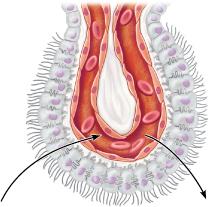
What CNS associated structure is illustrated in this figure?
choroid plexus
Which protective covering of the brain provides passageways for cerebrospinal fluid (CSF) to drain into the superior sagittal sinus?
arachnoid mater
membranous part of the dura mater
periosteal part of the dura mater
pia mater
arachnoid mater
In general, information flows from sensory receptors to the appropriate primary sensory cortex.
True
False
True
The term cerebral dominance designates the hemisphere that is dominant for language.
True
False
True
Which of the following is not a site where a tumor is likely to cause hydrocephalus?
fourth ventricle
cerebral aqueduct
pia mater
subarachnoid space
pia mater
Spastic paralysis suggests involvement of the ________.
lower motor neurons
upper motor neurons
neuromotor junction
spinal nerve roots
upper motor neurons
An individual who could trace a picture of a bicycle with his or her finger but could not recognize it as a bicycle is most likely to have sustained damage to the ________.
lateral geniculate body
calcarine cortex
visual association area
primary visual area
visual association area
Mrs. Sagalov has recently been diagnosed with Alzheimer's disease. What clinical symptoms is she likely to show?
She will show increasing cognitive deficits, including difficulties with memory and attention, and personality changes such as irritability, moodiness, and confusion.
She will show wild, jerky, and continuously "flapping" movements, and mental deterioration.
She will show a persistent tremor, forward-bent walking posture, shuffling gait, and stiff facial expression.
She will show difficulty in communicating, forming relationships with others, and responding appropriately to the environment.
She will show visual disturbances, problems controlling muscles, speech disturbances, and urinary incontinence.
She will show increasing cognitive deficits, including difficulties with memory and attention, and personality changes such as irritability, moodiness, and confusion.
A patient is admitted to the rehabilitation unit five days after having a stroke. The nurse assesses his muscle strength and determines that he has right-sided weakness. Based on this assessment data, what part of the brain was injured?
There was damage to localized areas of the premotor cortex in the right cerebral hemisphere.
There was damage to localized areas of the prefrontal cortex in the right cerebral hemisphere.
There was damage to localized areas of the primary motor cortex in the left cerebral hemisphere.
There was damage to localized areas of the primary motor cortex in the right cerebral hemisphere.
There was damage to localized areas of the premotor cortex in the left cerebral hemisphere.
here was damage to localized areas of the primary motor cortex in the left cerebral hemisphere.
Which of the following regions of the brain provides the precise timing and appropriate patterns of skeletal muscle contraction for the smooth, coordinated movements and agility that are needed for our daily living?
medulla oblongata
pons
midbrain
cerebellum
cerebellum
Emotional state, rehearsal, association, and automatic memory are all factors that affect the transfer of information from short-term memory (STM) to long-term memory (LTM).
True
False
T
Cell bodies of the somatic motor neurons of the spinal nerves are located in the ventral horn of the spinal cord.
True
False
T
The adult spinal cord ends between L1 and L2.
True
False
T
Most of the ascending and descending pathways to and from the brain cross over from one side of the body to the other.
True
False
T
Spinocerebellar tracts ________.
terminate in the spinal cord
give rise to conscious experience of perception
are found in the dorsal columns of the spinal cord
carry proprioceptive inputs to the cerebellum
carry proprioceptive inputs to the cerebellum
Cell bodies of the sensory neurons of the spinal nerves are located in ________.
sympathetic ganglia
the ventral root ganglia of the spinal cord
the dorsal root ganglia of the spinal cord
the thalamus
the dorsal root ganglia of the spinal cord
Neural tracts that convey life-saving information to the brain concerning burning pain would be ________.
posterior spinothalamic
anterior spinothalamic
lateral spinothalamic
reticulospinal
lateral spinothalamic
The white matter of the spinal cord contains ________.
myelinated and unmyelinated nerve fibers
myelinated nerve fibers only
soma that have both myelinated and unmyelinated nerve fibers
unmyelinated nerve fibers only
myelinated and unmyelinated nerve fibers
An individual accidentally transected the spinal cord between T1 and L1. This would result in ________.
spinal shock only
quadriplegia
hemiplegia
paraplegia
paraplegia
Second-order neurons of both the specific and nonspecific ascending pathways terminate in the ________.
somatosensory cortex
medulla
thalamus
spinal cord
thalamus
Death from amyotrophic lateral sclerosis usually results from respiratory infection secondary to compromised respiratory function. Why?
When the impulses to the ciliated cells are inhibited, the ciliary escalator no longer functions, causing respiratory infection.
The reflexes in the respiratory system for expelling particles will no longer function due to damage to the dorsal horn motor neurons, causing respiratory infection.
It is actually more common for the person to die from paralysis of the muscles controlling breathing than from respiratory infection.
When the lungs have difficulty fully expanding, secretions may develop, causing respiratory infection.
When the lungs have difficulty fully expanding, secretions may develop, causing respiratory infection.
Which of the following is NOT a feature of the major spinal cord tracts (pathways)?
somatotopy
memory
decussation
relay
memory
What part of the spinal cord represents the collection of nerve roots at the inferior end of the vertebral canal?
lumbar enlargement
cervical enlargement
conus medullaris
cauda equina
cauda equina
The hypothalamus is the area where afferent impulses from all senses and all parts of the body are sorted out and then relayed to the appropriate area of the sensory cortex.
True
False
F
Which of the following is the LEAST likely to be structurally affected if spina bifida develops in a fetus?
cauda equina
roots of sacral spinal nerves
sacrum
laminae of thoracic vertebrae
laminae of thoracic vertebrae
In spina bifida, the cerebrum and part of the brain stem never develop.
True
False
F
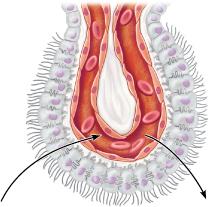
What process is indicated by the arrow on the right?
formation of cerebro-spinal fluid
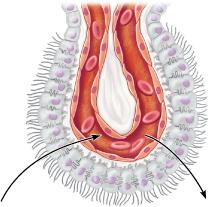
Where is the illustrated structure located?
in each ventricle
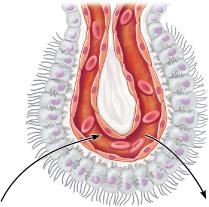
Which type of glial cells are shown in this figure?
ependymal cells
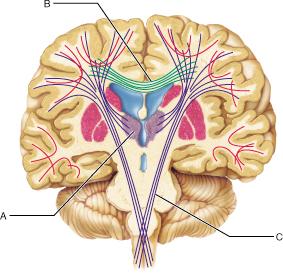
The neural fibers connecting structure A to the cerebral cortex can be described by which of the following?
third-order sensory neurons
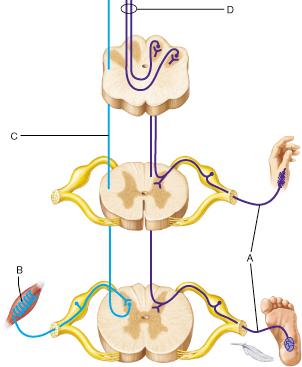
Which of the following accurately describes the collection of spinal cord tracts illustrated in the figure?
ascending tracts
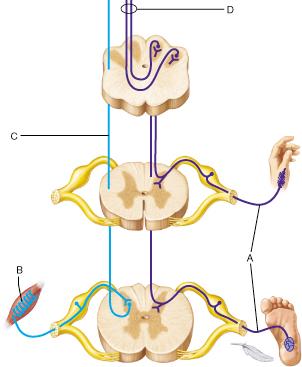
Which of the following describes the nerve fibers indicated by the letter A?
first-order sensory neurons
What type of receptor is indicated by the letter B?
proprioceptor
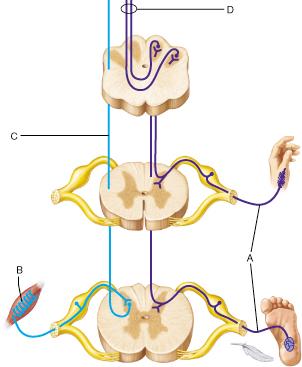
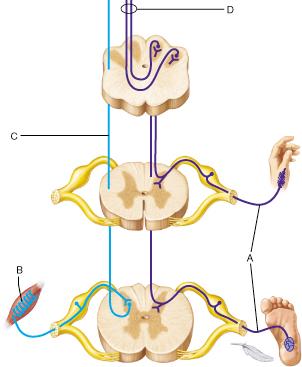
What function is most closely associated with the spinal cord tract indicated by the letter C?
coordination of skeletal muscle movements
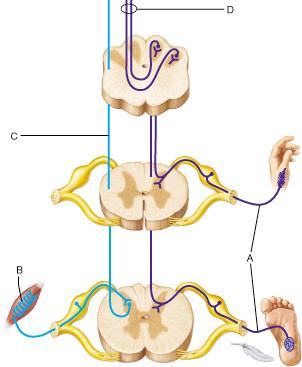
The fiber tracts indicated by the letter D will terminate in the ______.
thalamus
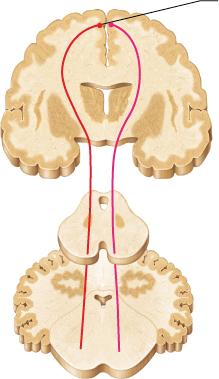
What descending pathway originates at the position indicated by the leader line?
pyramidal tracts
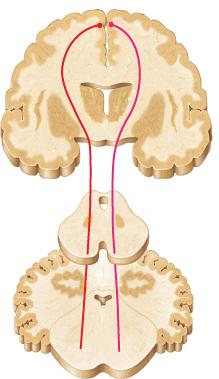
Many of the descending fibers indicated in this figure cross over (decussate) to the opposite side of the body in which of the following?
medulla
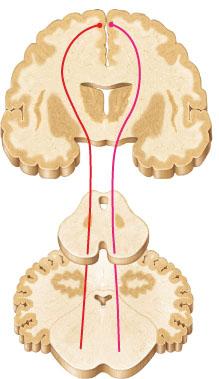
The descending fibers in the figure provide for which of the following functions?
conscious control of skeletal muscle