3063 chapter 3 part 4
Syntax and Morphology
Syntax and Morphology
An individual’s ability to rapidly and
automatically process the rules of syntax and morphology
(morphosyntax) has long been viewed as something that is hard-wired in
the brain, referred to as a language instinct (Pinker, 1994), or,
alternatively, the language acquisition device (Chomsky, 1978). By
many accounts, this uniquely hu-
man faculty is possible because
of the genetically-based adaptation of the human brain for processing
the universal grammar of language. As some experts contend,
evolutionary history has equipped humans with an innate,
species-specific ability to represent the discrete rule-governed
syntactic rules of a universal grammar. This remarkable
neurophysiological capacity explains young children’s uncanny ability
to rapidly and effortlessly acquire the small, finite set of
morphosyntactic rules that ultimately allow them to produce and
understand an infinite variety of sentences, regardless of the
specific language they develop.
nonhuman
The possibility of a distinct morphosyntactic brain module is
supported by at least three lines of research. First, studies of
language learning in nonhuman primates revealed that other species can
develop a reasonably sized lexicon, but that grammatical learning
eludes them, a finding that supports the likelihood of a specialized
neurophysiological module for morphosyntactic acquisition in the human
brain (Aboitiz & Ricardo, 1997)
morphosyntactic
Second, the likelihood of a specialized morphosyntactic processor is
supported by study results showing specific impairments in
morphosyntax as a function of focal brain damage, particularly
in Broca’s area (see
Bookheimer, 20
Individuals with damage to Broca’s area can retain the ability to
produce syntactically correct speech “automatisms” (or clichés;
e.g., “Oh, my good-
ness!” “Good morning”), which suggests that
well-rehearsed sentences and phrases are represented as whole units in
the right hemisphere (Glezerman & Balkoski,
1999), whereas
processing discrete morphosyntactic elements of language involves a
specialized brain function in Broca’s area
..
morphosyntactic
Third, the results of a number of studies of morphosyntactic
processing showed increased activation of the language areas of the
left hemisphere, notably Wernicke’s
area (for grammatical
processing) and Broca’s area (for formulating grammatically ordered
speech output), as well as the parietal lobes. Likewise, the results
of studies involving attempts to isolate semantic processing from
syntactic processing showed distinct neuroanatomical correlates for
processing complex syntax; these correlates correspond to the inferior
left frontal lobe in Broca’s area (Bookheimer, 2002). This region
appears to be specialized for not only processing the morphosyntactic
elements of language, but also selectively attending to syntax, such
as examining whether a sentence uses a “legal” syntactic structure
even when the sentence is
devoid of meaning (e.g., “Twas
brillig, and the slithy toves . . .”; Friederici, Opitz, &
von Cramon, 2000).
Nonetheless, researchers heartily disagree as to whether
morphosyntactic processing should be represented as the function of a
single domain-specific module, or by connectionist models that
emphasize interactivity of various regions of the brain. Grammatical
production and comprehension requires a person to combine
fixed
semantic representations into novel and complex representations of
sentences; it also involves nonlinguistic symbolic and conceptual
thought, as well as planning and reasoning (Glezerman & Balkoski,
1999). When individuals engage in complex
linguistic tasks,
left-hemisphere frontal, temporal, and parietal regions are activated,
which shows an interaction of executive, semantic, and morphosyntactic
processing (Bookheimer, 2002). In light of such evidence,
morphosyntactic processing might best be conceived as a complex
cognitive ability served by a variety of separate and
specialized cortical areas transcending the right and left
hemispheres. In evolutionary terms, a primitive human grammar may have
once resided in a distinct language
area of the brain (e.g.,
Broca’s area). However, the higher-level complex grammar in modern-day
language requires integration of the traditional language areas of the
brain with other cognitive systems via complex interconnections of the
parietal,
temporal, and frontal lobes (Brennan & Pylkkänen, 2012).
..
Phonology
Phonology
Processing speech sounds is qualitatively and
quantitatively different from processing nonspeech sounds because
speech comprises a series of overlapping, rapidly changing, and
rapidly produced phonetic segments (Golumbic, Poeppel, &
Schroeder,
2012). Whereas, the capacity of the human brain to
process sequences of nonspeech sounds is fairly limited (about 7–9
units/second), speech processing occurs
at much higher rates
(50–60 units/second; Lieberman, 1991)
phonetic module
Some experts contend that the human brain has evolved a specialized
processor, sometimes called
the phonetic module, designed
specifically for processing the phonetic segments
of speech
(Liberman & Mattingly, 2014). Experts view this specialized
processor as a “biologically coherent system, specialized from top to
bottom” to process the phonetic segments of speech (Liberman, 2000, p. 115).
Experts view this specialized processor
as a “biologically
coherent system, specialized from top to bottom” to process the
phonetic segments of speech (Liberman, 2000, p. 115). The phonetic
segments of spoken language are channeled through the human ears along
the auditory pathway that culminates in the primary and secondary
auditory cortices of the temporal
lobe. Rapid analysis of the
temporal characteristics of the speech sounds occurs in the auditory
centers of the left temporal lobe, whereas the spectral
characteristics of speech sounds are processed in the right temporal
lobe. Therefore, both hemispheres seem to be involved in speech–sound
processing, although the auditory re-
gions of the left temporal
lobe appear to be critical locations for phonetic analyses of speech
sounds (Frackowiak et al., 2004).
..
..
Once speech sounds are phonetically analyzed, they must be processed
as
linguistic units, or phonemes
phonological processing
This level of processing, which occurs in Broca’s
area, is
termed phonological processing; it involves analyzing phonological
seg-
ments and working memory
neuroanatomical model
Neuroimaging data confirm historical neuroanatomical
models in
which phonological processing and speech production are located at the
site of Broca’s area in the motor cortex of the left hemisphere.
Nevertheless, Broca’s area does not work alone to process and produce speech.
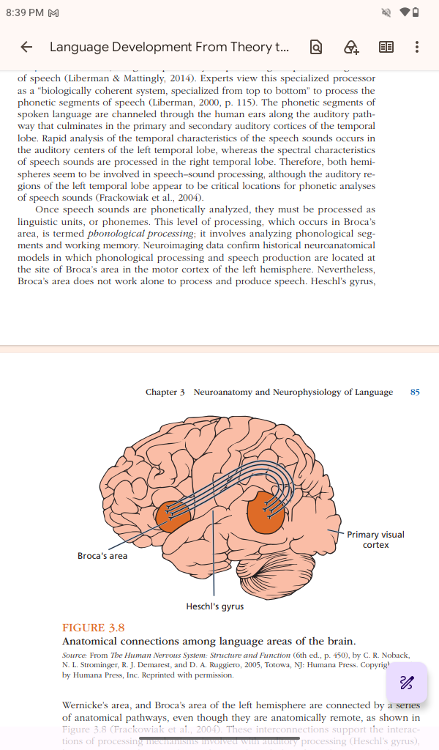
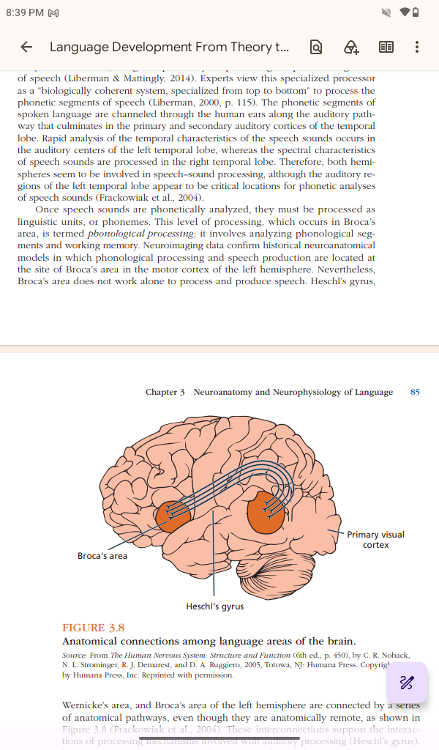
Heschl’s gyrus, Wernicke’s area, and Broca’s area of the left
hemisphere are connected by a series
of anatomical pathways,
even though they are anatomically remote, as shown in Figure 3.8
(Frackowiak et al., 2004). These interconnections support the
interactions of processing mechanisms involved with auditory
processing (Heschl’s gyrus),
language comprehension (Wernicke’s
area), and phonological processing (Broca’s
area).
..
Recall from previous sections that Broca’s area is also the site of
sensorimotor encoding of phonological (speech) output, with efferent
pathways to organize the controlled, voluntary production of speech
sounds. The shared neurophysiology for both phonological processing
and phonological production suggests that
the motoric production
of speech may play a role in phonological development
(Bookheimer, 2002).
..
Pragmatics
Pragmatics
The pragmatics of language involves using language as
a social tool. It concerns understanding the rules of communication,
which include following conventions related to the quantity, quality,
manner, and relevance of language during communication. Although the
aspects of language discussed thus far involve a significant
investment of the traditional language areas of the brain (e.g.,
Heschl’s gyrus,
Wernicke’s area, Broca’s area), pragmatic
ability draws primarily on frontal lobebfunctions. In other words, an
individual who sustains damage to the language areas of the brain that
results in significant impairment of semantic, phonological, and
morphosyntactic abilities may have fully intact pragmatic skills.
Conversely, an
individual with frontal lobe damage may have
intact semantic, phonological, and morphosyntactic abilities, yet use
language in odd and idiosyncratic ways.
The frontal lobe
As discussed previously, one major function of the frontal lobe is to
control human executive functions, including reasoning, problem
solving, planning, hypothesizing, social awareness, and rationalizing.
These functions involve the organized, goal-directed, and controlled
execution of critical human behaviors. Pragmatic abilities involve the
organized, goal-directed, and controlled use of language as a means
for communication with other people. Thus, when these more
general executive functions are impaired, the social use of language
is often undermined.
neurophysiological
The results of brain-imaging studies indicate that many human
executive functions involve not only the frontal lobe, but also other
neurophysiological functions
of the brain. For example, consider
the case of willful attention
Willful attention
Willful attention is
what people use to maintain attention to a
given task when competing stimuli are present (Frackowiak et al.,
2004). Your attention to reading this chapter likely in- volves some
degree of willful attention if competing thoughts (e.g., thinking
about an upcoming exam) or events in the environment (e.g., friends
talking, music play-
ing) exist
Both parietal and frontal lobe regions are involved in willful
attention.
Together, they impose a hierarchy of control over the
competing forces for attention in that the parietal lobe is involved
with processing incoming stimuli, whereas then frontal lobe forces
attention to the particular stimulus selected for attention (e.g.,
the words you are reading; Frackowiak et al., 2004).
..
Consider an individual whose
frontal lobe functions are
compromised, perhaps as a result of frontal lobe injury. During
communication with another person (one competing force for attention),
he or she may be distracted by other competing forces for attention
(e.g., noises in the
environment), which thus degrades his or
her ability to sustain the communication topic. Therefore, the
pragmatic aspects of language are compromised
..
What are Neurophysiological and
Neuroanatomical Sensitive Periods?
What are Neurophysiological and
Neuroanatomical Sensitive
Periods?
Thus far in this chapter, we have presented the brain as
if it were a static neuroanatomical structure. This representation is
far from the truth. As a human develops prenatally and postnatally,
the brain undergoes significant changes as a result of experience. In
short, our experiences change our brain over time. In this section, we
consider the brain as a dynamic organ that changes during growth,
dealing specifically with the concept of neurophysiological and
neuroanatomical sensitive periods, with a particular focus on how
these periods affect the capacity for language.
Sensitive Periods Defined
Sensitive Periods Defined
As applied to the development of the
human brain, a sensitive period is a time frame of development during
which a particular aspect of neuroanatomy or neurophysiology
underlying a given sensory or motoric capacity undergoes growth or
change. For instance, the results of a classic study showed that
depriving kittens
of visual input during the first 6 weeks of
life resulted in permanent blindness, indicating this developmental
time frame is a critical window of opportunity for visual development
in kittens (Hubel & Wiesel, 1970).
In a human analog, studies of birth defects in children born to
pregnant women exposed to radiation in Nagasaki
and Hiroshima
during World War II showed brain damage (i.e., mental retardation,
microcephaly) to be most serious when radiation exposure occurred
between 56 and 105 days postovulation (Huttenlocher, 2002). This time
frame corresponds to
a period of significant prenatal growth in
neuron numbers in the forebrain (Schull,
1998). Thus, at least
for in utero humans, the period between 56 and 105 days postovulation
corresponds to a window of opportunity for supporting the child’s
neural development prenatally; it is also a time of significant risk.
..
As these examples show, sensitive periods have the following three features:
Sensitive periods correspond to a time of active neuroanatomical and neurophysiological change.
Sensitive periods correspond to a time of active neuroanatomical and
neurophysiological change. Other terms used to describe this time
include critical period, window of opportunity, critical moment, and
sensitive phase (Bruer, 2001). Although the term critical period is
prevalent in the literature, it carries the connotation that
changes occurring in a critical period are irreversible and
permanent, which is often not the case. For instance, monkeys that
experience visual deprivation during a visual critical period can
regain nearly normal visual function with intense remediation
(e.g., suturing closed the normal eye; Bruer, 2001). Therefore,
many scientists prefer the term sensitive period, which carries the
“window of opportunity” connotation, but allows that change is
possible beyond the sensitive period (Bruer, 2001).
Sensitive periods are a phase not only of opportunity but also of risk.
Sensitive periods are a phase not only of opportunity but also of
risk. Some experts identify critical periods as a phase in which
“normal development is most sensitive to abnormal environmental
conditions” (Bruer, 2001, p. 9). Studies of sensitive periods are
important not only for improving researchers’ fundamental
understanding of human brain development, but also for identifying
periods during which
the brain is most vulnerable to risks. This
knowledge is useful for prevention—for instance, ensuring that women
prior to and in the several months following conception ingest
adequate levels of folic acid to support the embryo’s neural tube
development. Sensitive periods therefore correspond to times in which
an individual’s developmental trajectory can be changed for better or
for worse.
Sensitive periods have a beginning and an end point, and the length of a period
Sensitive periods have a beginning and an end point, and the length
of a period varies for different aspects of neuroanatomy and
neurophysiology. In the previous example, the sensitive period for
neural tube development in prenatal human embryos is about 32 days;
thus, this period is one of significant risk to the developing embryo
if neural tube development is compromised in some way, which
occurs with inadequate folic acid consumption by the mother
(Huttenlocher, 2002). In contrast, the sensitive period for language
acquisition is much longer, perhaps as long as 12 years for the
development of grammar.
Neuroanatomical and Neurophysiological
Concepts Related to
Sensitive Periods
Neuroanatomical and Neurophysiological
Concepts Related to
Sensitive Periods
Synapses provide the means for neurons within the CNS to
communicate, and the synaptic connections forged among neurons during
development result in the complex neural circuitry that allows
information processing in the human brain (Hut-
tenlocher, 2002).
synaptogenesis
Rather, synaptogenesis (the forma-
tion of synaptic connections)
is driven by sensory and motoric experiences after birth and occurs
most rapidly in the first year of life (Huttenlocher, 2002).
synaptic pruning
At about the end of the first year, the infant’s brain contains
approximately twice as many synaptic connections as an adult’s; from
this time to adolescence, excess synapses
are pruned, a process
called synaptic pruning.
Neural plasticity
Neural plasticity is a term pertaining to the malleability of the CNS, and it relates primarily to the capacity of the sensory and motor systems to organize and reorganize themselves by generating new synaptic connections or by using existing synapses for alternative means.
Consider that infants with significant left-hemisphere
brain damage that destroys the language areas can achieve
typical or near-typical
language abilities by recruiting other
neural functions to serve the purposes of lan-
guage; neural
plasticity accounts for this possibility (Huttenlocher, 2002).
Older children and adults who sustain a similar type of brain damage
often cannot achieve normal language in their lifetime, which suggests
that brain plasticity varies with
time. Hence, plasticity
relates to sensitive periods because the plasticity of the brain for
reorganizing itself and for resolving injury or damage to its
neurophysiology and neuroanatomy varies during development.
..
Plasticity is often categorized into two types: experience-expectant plasticity and experience-dependent plasticity. These two types of plasticity differentiate the effects of the environment on changes in the brain (Lent & Tovar-Moll, 2015).
..
Experience-expectant plasticity
Experience-expectant plasticity refers to the ongoing sculpting of
brain structures that occur as a result of normal experiences. As the
infant develops, multitudes of synapses are present in the brain,
expectantly waiting for certain normal experiences to occur for them
to organize themselves into functioning circuits. This type of
plasticity uses the basic hardware that is provided to sculpt the
brain as
experiences amass. This type of plasticity develops
“obligatory cortical functions” (Huttenlocher, 2002, p. 176) that
organize basic sensorimotor neural systems, such as vision, hearing,
and language. Most infants develop these experience-expectant
functions because the basic stimuli needed to foster their development
are pres-
ent in the typical environment. Once the sensitive
period for a given experience expectant brain function has passed,
though, environmental experiences no longer readily modify cortical
circuits, possibly because few (if any) unspecified synapses remain.
Acquisition of language grammar occurs as a function of
experience-
expectant plasticity.
experience-expectant plasticity
In contrast with experience-expectant plasticity,
experience-dependent plasticity is unique to a given individual; this
type of functional brain modification requires highly specific types
of experiences for change. This type of plasticity is
what
permits humans to “learn from our personal experience, and store
information derived from that experience to use in later problem
solving” (Bruer & Greenough,
2001, p. 212)
dendritic sprouting
Learning new information (whether it is novel information or
infor-
mation that must be relearned after brain injury) requires
three mechanisms: the formation of new synaptic connections among
neurons (dendritic sprouting), the generation of new neurons, and an
increase in synaptic strength (Huttenlocher,
2002).
Unlike experience-expectant plasticity, experience-dependent plasticity is a brain capacity available independent of age because, through time, the human brain retains most of its capacity to learn through experience and to adapt to change
..
Sensitive Periods and Language Acquisition
Sensitive Periods and Language Acquisition
You probably have
some knowledge of how sensitive periods relate to language
acquisition. For instance, if you attempted to learn a new language in
high school and found it exceedingly difficult, you may have
attributed the difficulty to your being past the “window of
opportunity” for learning a new language. Moreover, you are
likely aware of (or have even attended) an immersion preschool
program, in which children are exposed to two or more languages (e.g.,
English and Spanish) simultaneously in an effort to take advantage of
sensitive periods for language acquisitio
In this section, we consider the evidence on whether sensitive
periods for language acquisition are a scientific reality, that is,
whether humans have a relatively brief window of time in which to
acquire language, beyond which language cannot be learned. In some
respects, identifying sensitive periods for language acquisition
is a scientific challenge because of the ethical impossibility
of actively manipulating children’s language-learning environments to
study the effects of language deprivation at different points to
identify such periods. Nonetheless, some “natural” experiments have
occurred that help scientists identify sensitive periods for language
acquisition by the brain
..
Linguistic Isolation
Linguistic Isolation
Linguistic isolation occurs when a child
develops with little or no exposure to a spoken or sign language. A
few cases of “feral children” (children deprived of language exposure
as a result of abuse and neglect) provide support for a sensitive
period for language acquisition. The most notable case is that
of Genie, an adolescent in California who was discovered by social
workers after having been locked in a bedroom for her entire life and
presumably beaten for her attempts to vocalize or communicate. Despite
substantial language therapy in subsequent years, Genie
never
developed age-appropriate grammatical skills. However, the extent to
which concomitant cognitive disabilities combined with years of
neglect may have affected Genie’s capacity for language cannot be
determined; thus, her case provides inconclusive support for sensitive
periods for language.
Evidence on sensitive periods for language acquisition is more
conclusive in studies of children who are deaf who are not exposed to
a language, whether spoken or sign (e.g., American Sign Language
[ASL]), until sometime beyond infancy and toddlerhood. Newport and her
colleagues examined ASL fluency for three groups of individuals who
were deaf: those who learned ASL from
birth, those who learned
it between ages 4 and 6 years, and those who learned it after age 12
years. They found that age of ASL learning was associated with ASL
fluency: Individuals who acquired ASL at birth exhibited nativelike
language fluency, whereas those who acquired it later in life
exhibited significant deficits in language ability, particularly in
the area of grammar (see Newport,
Bavelier, & Neville,
2001). Such evidence points to the period of birth through early
adolescence as a sensitive period for language acquisition. Although
language skills can be acquired after this period, many individuals
are unlikely to acquire
nativelike fluency.
..
There are, regrettably, also situations today in which children are
reared in institutionalized environments in which they receive very
little linguistic stimulation (van Ijzendoorn, Luijk, & Juffer,
2008). Children most typically left to institutional- ized care are
those who are born with a developmental disability that makes care
for them difficult (e.g., blindness, cerebral palsy, Down
syndrome), or creates a social stigma, when the parents do not have
the financial or emotional resources to care for the child, or when
the parents are deceased (as in cases of orphans with AIDS/HIV).
Countries with high rates of poverty, and that experience traumatic
events are particularly affected. In Haiti, for instance, it is
estimated that there
are more than 750,000 orphans since the
major earthquake of 2010. Although the provision of institutionalized
care for young children, whether in orphanages or foster homes, has
long been a reality, the linguistic environments of some of these
children may well constitute a type of linguistic isolation. This
stems from cultural
patterns of care within institutionalized
settings (in which adult–child conversation seldom occurs), but is
also due to discontinuity in care, in which a child may receive care
from up to 50 different caregivers in a 24-hour period and have little
opportunity to form stable attachments (Vorria et al., 2003).
..
Second Language Learners
Second Language Learners
One interesting approach to estimating
sensitive periods for language acquisition is to compare the language
abilities of groups of individuals who learned a second language at
different times of life. Flege and colleagues conducted such an
investigation (Flege, Yeni-Komshian, & Liu, 1999) by examining two
aspects of language
skill among Koreans who varied in their age
of arrival (AOA) to the United States: phonology (specifically, the
extent to which they exhibited a foreign accent) and grammar (that is,
skills in applying syntactic rules). Interestingly, accents seemed to
be governed by a sensitive period, in that later AOAs were
associated with stronger foreign accents. On the other hand, this was
not the case for syntax. AOA was less strongly associated with English
syntactic skill than other variables, such as one’s
use of
English and one’s amount of education in the United States. The
authors suggest that experience using one’s second language, as well
as educational experience are more important to second language
acquisition than constraints imposed
by a sensitive period.
Sensitive Periods and Early Intervention
Sensitive Periods and Early Intervention
Children exhibit
tremendous growth in their language
abilities in the first
several years of development. This
period largely coincides with
the explosion of synap-
togenesis within the cerebral cortex,
which begins in
the weeks just prior to birth (during the third
prenatal
trimester) and then declines around the third birthday.
In this so-called sensitive period of development,
chil-
dren exhibit the greatest ease in acquiring language.
As discussed in Chapter 2, children examine the
child-directed speech (CDS) that occurs around them
to
develop their lexicon, grammar, and phonology and
to learn how
language is used pragmatically as a so-
cial tool within their
cultural community. However, after
the third birthday, synapses
that were not formed be-
gin to be eliminated through the process
of synaptic
pruning. Consequently, children’s ability to acquire
language also declines as their brains become less
plastic.
..
What does the notion of sensitive period mean to
the practice
of early intervention? Early intervention
is the implementation
of practices and programs to
enhance the early development of
children experi-
encing risk. This risk may be environmental,
such as
being reared in extreme poverty, or it may be
devel-
opmental, such as having a profound hearing loss.
Regardless, the sensitive period implies that
interven-
tion should be implemented as early as possible so it
coincides with the explosion of synaptogenesis within
the
developing brain. Theoretically, early intervention
implemented
intensively in the first few years of life will capitalize upon the
natural advantages that synapto-
genesis affords and therefore
will be more effective
Scientists have tested whether this is indeed the
case when
applied to early intervention practices. In
the Bucharest Early
Intervention Project (Nelson et al.,
2007), which we discussed
in Chapter 1, scientists
tested the hypothesis that early
intervention imple-
mented earlier in children’s lives has
greater impacts
on children’s language and cognitive abilities
as com-
pared to intervention offered later. In this study, 136
abandoned children residing in Romanian orphan-
ages were
randomly assigned to either stay in insti-
tutionalized care (68
children) or be moved into foster
homes. For the latter group,
the age of placement oc-
curred at different times: from birth to
18 months (14
children), between 18 and 24 months (14 children),
between 24 and 30 months (22 children), or after 30
months
(9 children). When the children were 42 and
54 months of age,
the scientists assessed their lan-
guage and cognitive abilities
and found that children
placed in foster homes earliest received
significantly
higher scores than those placed in foster homes
later.
In general, placement prior to 2 years of age seemed
to provide the greatest developmental advantage (a
difference of about 10 IQ points), a finding consistent
with what we might expect based on development of
the
cerebral cortex. This study provides exceedingly
strong evidence
of the importance of early interven-
tion as a means for
mitigating early risks to develop-
ment of language and cognition.
..
Other studies, including those on the language development of
children who must acquire a new language (and lose their first)
following a foreign-birth adoption, have also failed to identify a
sensitive period for language acquisition, relative
to learning
a second language. In fact, these studies have shown that “even by 7
or 8 years of age, plasticity in language areas is still sufficiently
high to promote an essentially complete recovery of normal language”
(Pallier et al., 2003,
p. 159). Thus, although young children
unequivocally exhibit a unique propensity for learning language, and
although the capacity of the brain for rapid language acquisition
slows with time, a growing number of scientists argue that “the view
of a biologically constrained and specialized language acquisition
device that is turned
off at puberty is not correct” (Hakuta,
2001, p. 204). See Language Diversity and Differences: International
Adoption and Language Acquisition for a discussion of
foreign-birth adoption and sensitive periods.
..
Plasticity and Language
Plasticity and Language
Evidence on sensitive periods for
language acquisition suggests that researchers must consider both
experience-expectant and experience-dependent plasticity to understand
the capabilities of the brain for language during the life span.
Whereas experience-expectant plasticity provides the immature
brain with capacities well beyond those evident as people age,
experience-dependent plasticity provides the human brain—even at
advanced ages—with the capacity to grow and adapt not only to new
experiences, but also to illness, disease, and injury to the brain.
Although some development periods correspond to time
frames in
which language learning is easiest (particularly infancy through early
adolescence), researchers’ inability to identify a putative end point
to the sensitive period for language acquisition likely reflects the
experience-dependent abilities of the human brain to adapt and modify
itself in response to the environment.
Foreign-birth adoptions in the United States—an es-
timated
7,000 such cases occurred in 2013 (U.S.
Department of State,
2014)—provides an important
avenue for scientists to explore the
possibility of iden-
tifying sensitive periods for language
acquisition. In a
foreign-birth adoption, a child is adopted
from over-
seas, often from an institution. In the United States,
most foreign-birth adoptions are from China, Ethiopia,
Russia, South Korea, and Ukraine (U.S. Department
of
State, 2014). In addition to the developmental chal-
lenges
children experience during institutionalized
care, in which they
may have relatively little contact
with adults and thus few
experiences with healthy at-
tachment and language–cognitive
stimulation, these
children often come from countries plagued by
limited
prenatal care and maternal exposure to infectious
dis-
eases (Glennen, 2015). Although the risks these
chil-
dren encounter early in life are substantial, the results
of
studies of outcomes for foreign adoptees suggest that
many will achieve healthy developmental outcomes in
cognitive and physical achievements (Glennen, 2015)
..
In this chapter, we discuss the concept of
expe-
rience-expectant brain plasticity. In contrast with
ex-
perience-dependent plasticity, experience-expectant
plasticity is the developmental mechanism of the brain
for
achieving basic processes, including language,
in relatively
short time periods. Experts have failed to
identify a specific
end point for the sensitive period for
language acquisition,
which would presumably cor-
respond to a loss of
experience-expectant plasticity.
Nevertheless, this sensitive
period extends from at
least birth to age 5 years, if not
beyond, and during
this period the brain exhibits an amazing
capacity to
make amends for early delays in language, as shown
by studies of foreign-birth adoptees
..
Studies of children adopted from Eastern Eu-
ropean orphanages
into homes within the United
States reveal that most of these
children exhibit early
and significant lags in language
development, cor-
responding to their apparently limited exposure
to
language stimulation during their period of
institu-
tionalized care (Glennen & Masters, 2002). However,
when these children are followed over time, studies
tend
to show that their skills in their second language
eventually
become in line with typical non-adopted
children. Glennen (2015)
has followed 44 children
who were adopted from Russia,
Kazakhstan, Hun-
gary, and Romania into American homes. All had
lived in institutionalized care for at least one year
prior to being adopted. At ages 5 to 7 years, the
chil-
dren were given a battery of language assessments;
as
a group, the children had language skills in the
average range
across multiple measures of vocab-
ulary, syntax, and morphology.
What’s particularly
remarkable about these children’s
performance on
language assessments in the early primary grades
is that a larger percentage of children than would
be
expected scored in the above average range on
these measures.
For instance, on a grammar test,
nearly 25% of children scored
in the above average
range; normative references would suggest
that 16%
of children would score in this range. Among this
group of international adoptees, a large proportion
of
children had superior language skills than would
be expected! To
understand this phenomenon, it
is important to point out that
children who are ad-
opted internationally tend to be adopted
into homes
that are quite advantaged. Parents who adopt
chil-
dren internationally tend to be financially well off and
highly motivated towards parenting. Consequently,
the
language advantages for international adoptees
may, in part,
reflect their arrival to highly stimulating
language-learning
environments. Nonetheless, data
such as these reveal the
experience-expectant plas-
ticity of the brain for acquiring
language during
..
Language, a complex and distinctly human behavior,
resides in
the neuroanatomical and neurophysiologi-
cal architecture of the
human brain. Neuroscience is
a branch of science that focuses on
the anatomy and
physiology of the nervous system, described
respec-
tively as neuroanatomy and neurophysiology. The
human nervous system includes the central nervous
system
(comprising the brain and the spinal cord) and
the peripheral
nervous system (comprising the cranial
and spinal nerves, which
carry information inward to
and outward from the brain and the
spinal cord). The
billions of highly specialized cells that
compose the
nervous system are neurons. A neuron is functionally
divided into four components: cell body, axon,
presyn-
aptic terminal, and dendrites. The cell body is the
cen-
ter of the neuron, containing its nucleus. The axon and
the dendrites are extensions from the cell body. The
axon
transmits information away from the cell body;
the presynaptic
terminals of the axon are the sites at
which the axonal
connection of one neuron corre-
sponds with another neuron.
Dendrites are the afferent
extensions of a neuron, bringing
nerve impulses into
the cell body from the axonal projections of
other neu-
rons. The synapse is the site where two neurons meet.
For two neurons to communicate, the nerve impulse
must
cross the synapse.
..
The brain, which contains more neurons than any
other organ in
the human body, consists of two mir-
ror-image hemispheres. Aptly
named, the right hemi-
sphere and the left hemisphere are
separated by a long
cerebral crevice (or fissure) called the
longitudinal
fissure. The corpus callosum is a band of fibers
that
connects the two hemispheres, serving as a conduit for
communication between the hemispheres. The brain
is
further divided into six lobes: one frontal lobe, one
occipital
lobe, two temporal lobes, and two parietal
lobes. Each lobe has
functional specializations. The
frontal lobe is the site of
complex executive behaviors
(e.g., reasoning, planning, problem
solving), and con-
tains in its left hemisphere an important site
for speech
production and phonological processing: Broca’s area.
The occipital lobe is the site of visual perception and
processing. The two parietal lobes are the site for not
only perceiving and integrating sensory and percep-
tual
information, but also comprehending oral and
written language
and performing mathematical calcu-
lations. The two temporal
lobes contain sites critical to
auditory processing, as well as
language comprehen-
sion; language is lateralized to the left
hemisphere in
Wernicke’s area.
.
Many theorists have argued that the brain exhibits
a sensitive
period for language acquisition because the
experience-expectant
brain plasticity used in language
development is available for a
relatively short duration.
In contrast, experience-dependent
plasticity is the ability
of the brain to adapt itself to new
information with time.
Some evidence—including that attained
from studies of
feral children, children who are deaf, and
second lan-
guage learners—suggests that birth to early
adolescence
is a sensitive period for language acquisition.
Neverthe-
less, researchers have not yet been able to identify a
putative end point for this sensitive period, probably
be-
cause the experience-dependent plasticity of the brain
endures (more or less) throughout life. Thus, although
infants, toddlers, and young children acquire language
remarkably easily, the capacity to learn language (or
re-
learn language following brain damage) is present for
the entire human life span.
..