Critically Ill Patients with Neurological Disorders Chapter 39 FA Davis
Which statement by the patient would indicate an understanding of teaching regarding atorvastatin (Lipitor) for stroke prevention?
1.“This medication will keep my platelets from sticking together.”
2.“This medication thins out my blood to prevent clotting.”
3.“This is a medication that will keep my blood pressure under control.”
4.“This medication decreases my cholesterol to help prevent stroke.”
4.“This medication decreases my cholesterol to help prevent stroke.”
A client has developed syndrome of inappropriate antidiuretic hormone (SIADH) after experiencing a stroke. Which electrolyte imbalance would support that diagnosis?
1.Hyperkalemia
2.Hyponatremia
3.Hypercalcemia
4.Hypophosphatemia
2.Hyponatremia
Which type of stroke would be classified as a hemorrhagic?
1.Embolic
2.Cryptogenic
3.Small vessel (lacunar)
4.Intracerebral hematoma
4.Intracerebral hematoma
A patient has been treated with tissue plasminogen activator (t-PA) for an ischemic stroke. Which action should the nurse take? Select all that apply.
1.Use an electric razor for shaving.
2.Use a soft toothbrush for oral hygiene.
3.Never rotate IV sites.
4.Keep the blood pressure (BP) cuff on one arm only.
5.Avoid taking rectal temperature.
1.Use an electric razor for shaving.
2.Use a soft toothbrush for oral hygiene.
5.Avoid taking rectal temperature.
The nurse is caring for a patient whose progressive confusion and increasing lethargy has gone to unresponsiveness. Which additional assessments are consistent with cerebral herniation?
1.Focal contralateral motor weakness
2.No change in vital signs
3.Unilateral pupillary dilation without reaction
4.Sluggish pupillary reaction with ovoid shape
3.Unilateral pupillary dilation without reaction
The nurse is caring for a patient with a severe traumatic brain injury. Which Glasgow Coma Score will the patient most likely have?
1.15
2.13
3.9
4.4
4.4
The nurse is caring for a patient with a ventriculostomy. At which location should the nurse place the transducer device?
1.Level of the brain stem
2.Level of the heart
3.Level of the external auditory meatus
4.Level of the sinus cavity
3.Level of the external auditory meatus
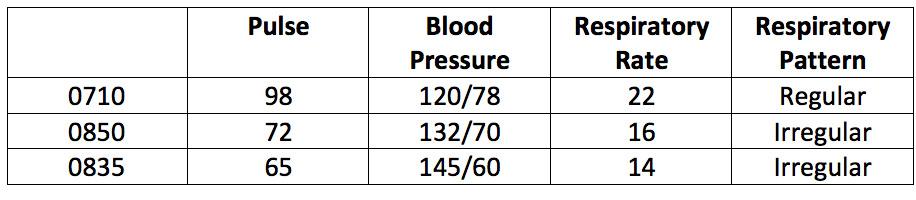
The nurse is caring for a patient with a brain injury. Vital signs are recorded in this graph. Which conclusion can the nurse make?
1.The patient is sleeping more soundly.
2.The patient may have experienced brainstem herniation.
3.An antihypertensive medication is needed.
4.A sedative is needed.
2.The patient may have experienced brainstem herniation.
A patient has a mean arterial pressure (MAP) of 65 mm Hg. The cerebral perfusion pressure (CPP) is 50 mm Hg. What is the patient’s intracranial pressure (ICP)? Record your answer using a whole number. Enter numeral only.
Correct :15
65-50=15
Correct :15
Which assessment finding would the nurse expect in a patient who experienced uncal brain herniation following a large hemorrhagic stroke?
1.Negative Babinski reflex
2.Cushing’s triad
3.One dilated pupil
4.Abnormal posturing
3.One dilated pupil
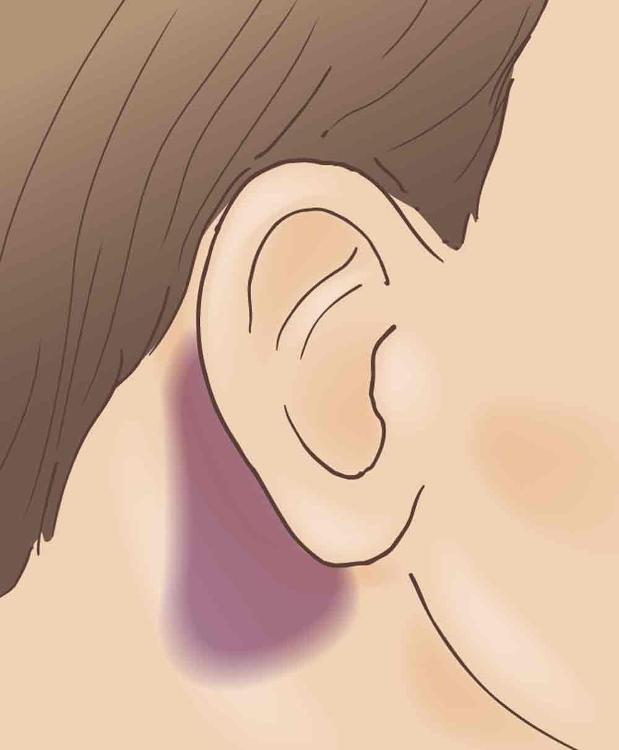
The nurse performs an assessment on a patient and discovers the finding in the image. Which does it likely represent?
1.Basilar skull fracture
2.Epidural hematoma
3.Hemorrhagic stroke
4.Fracture in the anterior fossa
1.Basilar skull fracture
When caring for a patient with a ventriculostomy, which intervention by the nurse would be appropriate?
1.Shave the hair around the catheter site
2.Culture the CSF daily
3.Use clean technique when handling the site
4.Keep a transparent dressing over the site
4.Keep a transparent dressing over the site
The nurse is caring for a patient with traumatic brain injury. It is noted that there is clear fluid draining from the ears. After notifying the provider, which action should the nurse take?
1.Pack ear canal with gauze.
2.Turn the patient onto his or her side to allow for drainage.
3.Collect the fluid using a loosely applied gauze.
4.Suction the fluid using a suction catheter.
3.Collect the fluid using a loosely applied gauze.
The nurse is assessing for increased intracranial pressure (ICP). Which change is the first indication of a problem?
1.Confusion
2.Hypertension
3.Pupillary change
4.Irregular breathing pattern
1.Confusion
A 59-year-old patient arrives at the emergency department and is diagnosed with a stroke. The nurse screens for inclusion criteria for thrombolytic therapy. Select the patient’s assessment findings that are consistent with each criterion. Select all that apply.
1.Measurable neurological deficit using NIHSS
2.No hemorrhage on head CT
3.Time since the patient was seen to be normal is within 3 to 4.5 hours
4.Symptoms present for 30 minutes, not rapidly improving or attributable to another cause
5.Imaging of head is consistent with an acute ischemic stroke, not hemorrhage or brain tumor
1.Measurable neurological deficit using NIHSS
2.No hemorrhage on head CT
3.Time since the patient was seen to be normal is within 3 to 4.5 hours
4.Symptoms present for 30 minutes, not rapidly improving or attributable to another cause
5.Imaging of head is consistent with an acute ischemic stroke, not hemorrhage or brain tumor
Which factor would increase the risk of experiencing a subarachnoid hemorrhagic stroke?
1.Being male
2.Social drinking
3.Being a premenopausal female
4.Uncontrolled hypertension
4.Uncontrolled hypertension
A patient is experiencing severe hypotension after a spinal cord injury. Which medication should the nurse anticipate will be ordered?
1.Lorazepam
2.Atropine
3.Mannitol
4.Norepinephrine
4.Norepinephrine
The nurse is assisting with the placement of an intracranial pressure monitor. Which condition is an indication for initiation of this type of monitor? Select all that apply.
1.Brain surgery
2.Traumatic brain injury (TBI)
3.Glasgow Coma Scale of 8 or less
4.Flat electroencephalogram (EEG)
5.Intracranial hemorrhage
2.Traumatic brain injury (TBI)
3.Glasgow Coma Scale of 8 or less
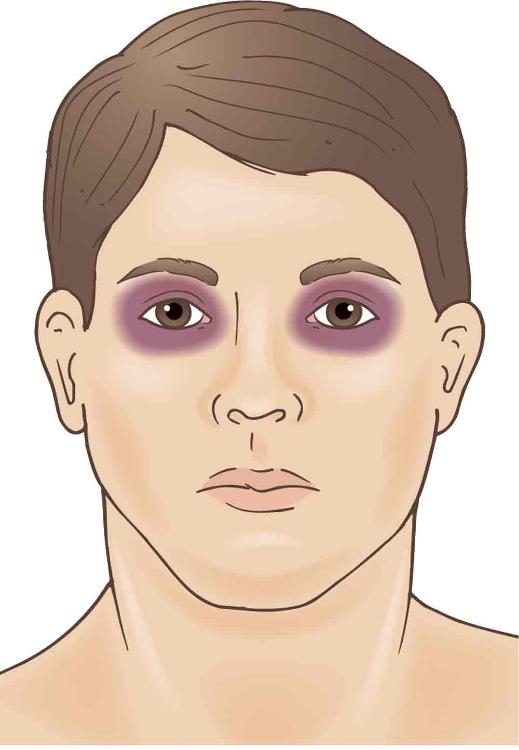
The nurse performs an assessment on a patient and discovers the finding in the image. Which condition does it represent?
1.Basilar skull fracture
2.Epidural hematoma
3.Fracture in the middle fossa
4.Fracture in the anterior fossa
1.Basilar skull fracture
The nurse is caring for a patient with increased intracranial pressure (ICP). Which position should the nurse place the patient in?
1.Trendelenburg
2.Prone and flat
3.Supine and flat
4.Head of bed at 45 degrees
4.Head of bed at 45 degrees
The nurse is reviewing a patient’s symptoms as they rate on the Hunt and Hess Grading Scale for a subarachnoid hemorrhage (SAH). Which symptoms are consistent with a Grade IV hemorrhage?
1.Slight headache and neck stiffness
2.Headache and neck stiffness
3.Stupor and posturing
4.Coma and posturing
3.Stupor and posturing
The nurse notes neglect on one side of the body in a patient who recently had a stroke. Which term describes this condition?
1.Apraxia
2.Agnosia
3.Battle’s sign
4.Hemianopia
2.Agnosia
The nurse is caring for a patient with a Glasgow Coma Scale of 5 from a traumatic brain injury. The patient has an intracranial pressure monitor in place. Which is a priority of care?
1.Aggressively suction the endotracheal tube (ETT) to prevent pneumonia.
2.Placement of artificial tears to prevent corneal injury.
3.Secure wrist restraints to prevent pulling of ETT.
4.Allow continuous visitation of family.
2.Placement of artificial tears to prevent corneal injury.
The primary healthcare provider orders IV recombinant tissue plasminogen activator (rt-PA) therapy for a patient. Which condition does the patient most likely have?
1.Neurogenic shock
2.Acute ischemic stroke
3.Traumatic brain injury
4.Increased intracranial pressure
2.Acute ischemic stroke
Which type of cerebral herniation syndrome is most likely to lead to stroke in the tissue surrounding the anterior cerebral artery?
1.Uncal herniation
2.Central herniation
3.Tonsillar herniation
4.Subfalcine herniation
4.Subfalcine herniation
Which type of cerebral edema would be caused by failure of the sodium-potassium pump?
1.Peripheral edema
2.Cytotoxic edema
3.Vasogenic edema
4.Transependymal edema
2.Cytotoxic edema
Which notable characteristic would differentiate a transient ischemic attack (TIA) from other types of stroke?
1.TIA presents with vague clinical manifestations different from ischemic stroke.
2.Clinical manifestations of TIA resolve on their own within 24 hours.
3.TIA is caused by bleeding in the brain.
4.MRI is not used to help diagnose TIA like it is for other kinds of stroke.
2.Clinical manifestations of TIA resolve on their own within 24 hours.
The nurse suspects lower cranial nerve dysfunction in a patient with hemorrhagic stroke. Which finding supports the nurse’s suspicion?
1.Impaired swallowing
2.Impaired family coping
3.Impaired physical mobility
4.Impaired verbal communication
1.Impaired swallowing
Which statements is true regarding brain perfusion? Select all that apply.
1.A normal intracranial pressure (ICP) should be greater than 15 mm Hg.
2.A normal cerebral perfusion pressure (CPP) is above 60 mm Hg
3.Cerebral perfusion pressure (CPP) – mean arterial pressure (MAP) = ICP.
4.When the intracranial pressure (ICP) climbs, cerebral perfusion pressure (CPP) drops.
5.An intraventricular catheter is the gold standard for measuring ICP.
2.A normal cerebral perfusion pressure (CPP) is above 60 mm Hg
4.When the intracranial pressure (ICP) climbs, cerebral perfusion pressure (CPP) drops.
5.An intraventricular catheter is the gold standard for measuring ICP.
When caring for a patient diagnosed with acute ischemic stroke, which finding would indicate administration of t-PA would be appropriate?
1.Signs and symptoms of stroke started five hours ago
2.No hemorrhage is noted on the CT scan
3.Patient reports having a GI bleed two weeks ago
4.There is no neurological deficit noted on the NIHSS assessment
2.No hemorrhage is noted on the CT scan
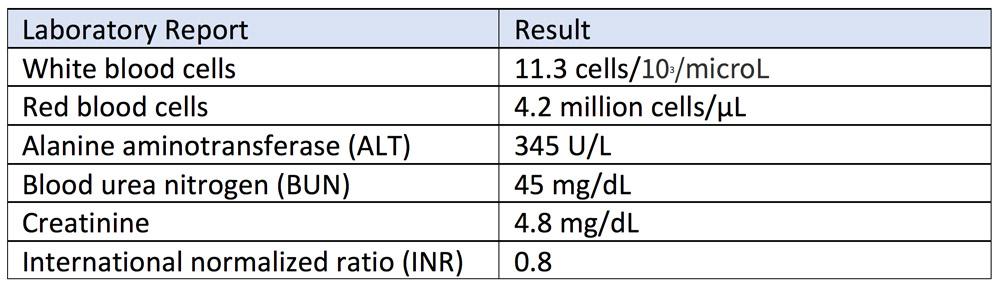
A patient has a mean arterial pressure (MAP) of 77 mm Hg. The cerebral perfusion pressure (CPP) is 61 mm Hg. What is the patient’s intracranial pressure (ICP)? Record your answer using a whole number. Enter numeral only.
MAP 77- CPP 61= 16
16
The nurse is caring for a patient with hemiplegia and hemiparesis of the right leg after a recent stroke. Which nursing action is the priority?
1.Preventing foot drop
2.Reposition often
3.Aspiration precautions
4.Active range of motion (ROM) of the right side
2.Reposition often
When caring for a patient who experienced a hemorrhagic stroke a few hours previous, which nursing intervention would be appropriate?
1.Perform neurological assessments every 6 hours.
2.Monitor the patient closely for hypernatremia.
3.Administer thrombolytic medications as ordered.
4.Elevate the head of the bed to 45 degrees.
4.Elevate the head of the bed to 45 degrees.
While reviewing the diagnostic test reports of a patient suspected of having a basilar skull fracture, the healthcare provider finds that blood is collecting between the skull and the dura mater. Which condition is the patient most likely experiencing?
1.Hematoma
2.Battle’s sign
3.Fracture in the middle fossa
4.Fracture in the anterior fossa
1.Hematoma