chapter 6 review
If you jump to the floor from the top of a table, it is less hurtful
when you bend your
knees as you hit the ground (as compared to if
you keep them straight and rigid),
because:
a- There is less
change in momentum in the fall.
b- The impulse is reduced.
c- The landing, and thus the change in momentum, takes longer.
A 5.00 kg object is moving to the right at 5.00 m/s and collides with
a 2.00 kg object
moving to the left at 2.00 m/s. The objects
collide and stick together and move to the
right at 3 m/s. This
collision is a case of:
a. Elastic Collision.
b. In-Elastic
Collision.
c. Perfectly In-Elastic Collision.
d. Multi-step collision
If you throw a ball and it hits a wall with a speed V, in which case
will the change in
momentum of the ball be greatest:
a- When
the ball bounces back with a speed = V/2.
b- When it
bounces back with speed = V.
c- When it sticks to the
wall (does not bounce back).
When a gun is fired, it experiences a recoil which is explained on
the basis of:
a- Conservation of kinetic energy.
b-
Conservation of sum of kinetic and potential energy.
c-
Conservation of Momentum.
d- Conservation of mass.
In a Perfectly In-Elastic Collision between two objects:
a- The two objects stick and move off together.
b- Momentum of the two objects is not conserved.
c- The two
objects reverse their directions after the collision.
d- Sum of
the Kinetic energy of the two objects is conserved
When a gun fires a bullet, the gun will recoil backward. The
magnitude of the
momentum of the gun will be __________ that of
the bullet.
a- Greater than
b- Equal to
c- Less than
A 5-kg object is moving to the right at 4 m/s and collides with
another object of unknown mass moving to the left at 4 m/s. The
objects collide and stick together. After the collision, which one of
the following statements will always be true about the combined
object?
Group of answer choices
it has less kinetic energy than the system had before the collision.
it has less momentum than the system had before the collision.
is moving to the left.
is at rest.
is moving to the right.
Flag question: Question
2
Question 21 pts
A 70-kg man is standing in a 20-kg boat.
The man steps to the right thinking he is stepping out onto the dock.
However, the following will actually happen (ignore the friction of
the water or air on the boat or the man):
Group of answer choices
The man only moves a short distance to the right while the boat moves a larger distance to the left.
None of the above.
The boat doesn't move and the man moves to the right.
The man actually stays still while the boat moves toward the
left.
Flag question: Question 3
Question 31
pts
A moderate force will break an egg. However, an egg dropped
on the road usually breaks, while one dropped on the grass usually
doesn't break. This is because for the egg dropped on the
grass:
Group of answer choices
the time interval for stopping is greater.
the change in momentum is greater.
the time interval for stopping is less.
the change in momentum is less.
Flag question: Question
4
Question 41 pts
A valid unit for momentum is which of the
following?
Group of answer choices
N×m
kg/m²
kg×m/s
kg×m/s²
Flag question: Question 5
Question 51
pts
In a two-body collision, if the kinetic energy of the system
is conserved, then which of the following best describes the momentum
after the collision?
Group of answer choices
is doubled in value
must be less
must also be conserved
may also be conserved
Flag question: Question
6
Question 61 pts
The impulse experienced by a body is
equivalent to its change in:
Group of answer choices
momentum.
velocity.
None of the above choices are valid.
kinetic energy.
Flag question: Question 7
Question
71 pts
In a two-body collision, the momentum of the system is
always conserved. Which of the following best describes the kinetic
energy after the collision?
Group of answer choices
may or may not be conserved
must also be conserved
is doubled in value
must be less
Flag question: Question 8
Question 81
pts
When a collision is perfectly inelastic, then:
Group of
answer choices
the total momentum is zero.
the participants stick together.
all the kinetic energy is conserved.
all the kinetic energy is gone.
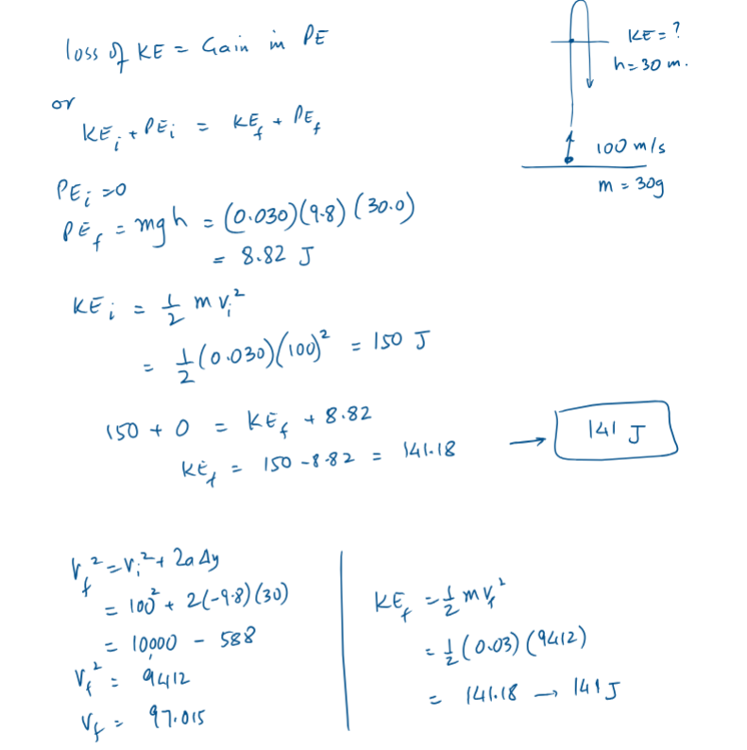
A bullet of mass 30.0 gram is fired vertically upwards at a speed of 100 m/s. What will be its kinetic energy when it is at a height of 30.0 meters?
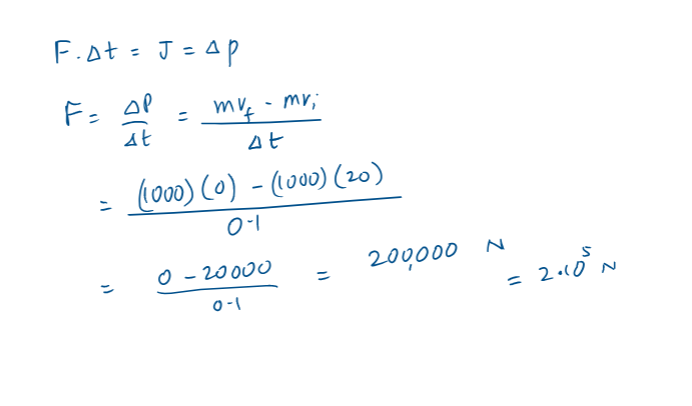
A car crashes into a solid wall. The mass of the car is 1000 kg, its
speed before the
collision was 20.0 m/s, and the car stops in a
time 0.100 s (i.e. the collision takes 0.100s). What is the average
value of the magnitude of the force on the car during the
collision?
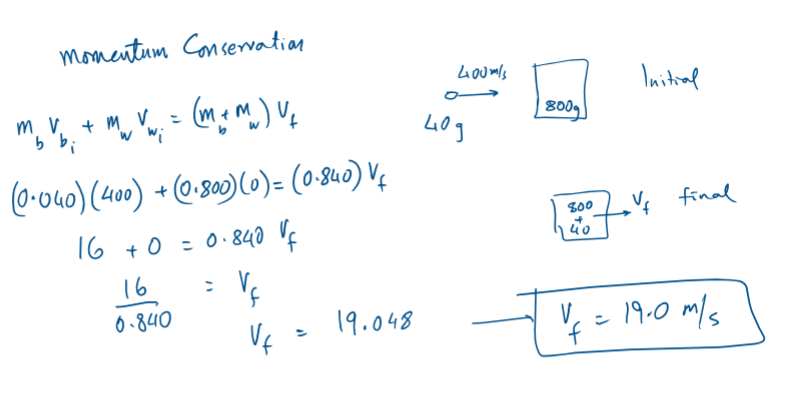
A 40-g bullet moving at 400 m/s is fired horizontally at a block of wood of mass 800 grams. It gets lodges inside the block. If the block had been originally at rest and is free to move, what is its resulting speed of the block+bullet? Ignore friction.