chapter 3 PRACTICE
A jogger runs halfway around a circular path with a radius of 17 m. What is the magnitude of the displacement?
34
A jogger runs halfway around a circular path with a radius of
12 m.
What is the magnitude of the
displacement?
Answer: 24 m
- A jogger runs halfway around a circular path with a radius of 9 m. What is the magnitude of the displacement? Answer: 18 m
A jogger runs halfway around a circular path with a radius of
20 m.
What is the magnitude of the
displacement?
Answer: 40 m
A jogger runs halfway around a circular path with a radius of
6 m.
What is the magnitude of the
displacement?
Answer: 12 m
A ball is rolled horizontally off a table with an initial speed of 0.6 m/s. A stopwatch measures the ball's trajectory time from table to the floor to be 0.35 s. What is the height of the table? (g = 9.8 m/s2 and air resistance is negligible)
0.6
A ball is rolled horizontally off a table with an initial speed of
0.8 m/s.
A stopwatch measures the ball's
trajectory time from table to the floor to be 0.40
s.
What is the height of the table?
(g = 9.8
m/s² and air resistance is negligible)
Answer: 0.78 m
A ball is rolled horizontally off a table with an initial speed of
0.5 m/s.
A stopwatch measures the ball's
trajectory time from table to the floor to be 0.30
s.
What is the height of the table?
(g = 9.8
m/s² and air resistance is negligible)
Answer: 0.44 m
A ball is rolled horizontally off a table with an initial speed of
1.2 m/s.
A stopwatch measures the ball's
trajectory time from table to the floor to be 0.50
s.
What is the height of the table?
(g = 9.8
m/s² and air resistance is negligible)
Answer: 1.23 m
- A ball is rolled horizontally off a table with an initial speed of 0.7 m/s. A stopwatch measures the ball's trajectory time from table to the floor to be 0.25 s. What is the height of the table? (g = 9.8 m/s² and air resistance is negligible) Answer: 0.31 m
A baseball thrown from the outfield is released from shoulder height (take as 1.50 m) at an initial velocity of 26 m/s at an initial angle of 30.0° with respect to the horizontal. What is the maximum vertical displacement that the ball reaches during its trajectory?
10.12
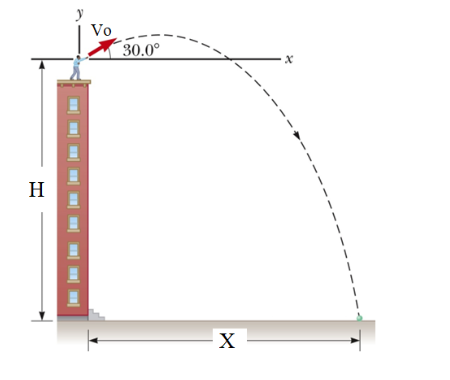
In the figure, if Vo = 6 m/s, and H = 29, after how much time (in seconds) will the ball hit the ground?
2.76
In the figure, if Vo = 9 m/s, and H = 29, how far out (i.e. X in the figure) will the ball hit the ground?
22.8
In the figure, if Vo = 7 m/s, and H = 30, what is the maximum height above the ground that the ball will rise to (in meters)?
30.6
A baseball leaves the bat with a speed of 49 m/s and an angle of 30.0° above the horizontal. A 4-m-high fence is located at a horizontal distance of 130 m from the point where the ball is struck. Assuming the ball leaves the bat 1.0 m above ground level, by how much does the ball clear the fence? Write your answer in meters to 2 decimal places.
26.1
A boat moves at 10 m/s relative to the water. If the boat is in a river where the current is 4 m/s, how long does it take the boat to go downstream a distance of 1940 meters? Write your answer in terms of seconds.
139
A boat moves at 8 m/s relative to the water.
If the boat is in a river where the current is 3 m/s,
how long does it take the boat to go downstream a distance of
1100 meters?
Write your answer in terms of
seconds.
Answer: 100 s
A boat moves at 12 m/s relative to the water.
If the boat is in a river where the current is 5 m/s,
how long does it take the boat to go downstream a distance of
1700 meters?
Write your answer in terms of
seconds.
Answer: 100 s
A boat moves at 9 m/s relative to the water.
If the boat is in a river where the current is 2 m/s,
how long does it take the boat to go downstream a distance of
990 meters?
Write your answer in terms of seconds.
Answer: 90 s
A boat moves at 7 m/s relative to the water.
If the boat is in a river where the current is 3 m/s,
how long does it take the boat to go downstream a distance of
1500 meters?
Write your answer in terms of
seconds.
Answer: 150 s
A boat moves at 9 m/s relative to the water.
If the boat is in a river where the current is 3 m/s,
how long does it take the boat to go upstream a distance of
1200 meters?
Write your answer in terms of
seconds.
Answer: 200 s
A boat moves at 10 m/s relative to the water.
If the boat is in a river where the current is 2 m/s,
how long does it take the boat to go upstream a distance of
1600 meters?
Write your answer in terms of
seconds.
Answer: 200 s
A boat moves at 7 m/s relative to the water.
If the boat is in a river where the current is 2 m/s,
how long does it take the boat to go upstream a distance of
750 meters?
Write your answer in terms of
seconds.
Answer: 150 s
A boat moves at 12 m/s relative to the water.
If the boat is in a river where the current is 5 m/s,
how long does it take the boat to go upstream a distance of
1400 meters?
Write your answer in terms of
seconds.
Answer: 200 s
A boat moves at 8 m/s relative to the water. If the boat is in a river where the current is 4 m/s, how long does it take the boat to go upstream a distance of 1340 meters? Write your answer in terms of seconds.
335
A boat moves at 7 m/s relative to the water. If the boat is in a river where the current is 4 m/s, how long does it take the boat to make a complete round trip to a place that is of 1950 m upstream (i.e. it goes upstream, and then downstream the same distance)? Write answer in seconds.
827
A boat moves at 9 m/s relative to the water.
If the boat is in a river where the current is 3 m/s,
how long does it take the boat to make a complete round trip to a
place that is 1800 m upstream (i.e. it goes upstream,
and then downstream the same distance)?
Write answer in
seconds.
Answer: 600 s
A boat moves at 10 m/s relative to the water.
If the boat is in a river where the current is 4 m/s,
how long does it take the boat to make a complete round trip to a
place that is 1200 m upstream (i.e. it goes upstream,
and then downstream the same distance)?
Write answer in
seconds.
Answer: 400 s
A boat moves at 8 m/s relative to the water.
If the boat is in a river where the current is 2 m/s,
how long does it take the boat to make a complete round trip to a
place that is 1500 m upstream (i.e. it goes upstream,
and then downstream the same distance)?
Write answer in
seconds.
Answer: 375 s
A river flows due east at 3 m/s. A boat crosses the 480-m-wide river by maintaining a constant velocity of 6 m/s due north relative to the water. If no correction is made for the current, how far downstream does the boat move by the time it reaches the far shore?
240
A river flows due east at 2 m/s.
A boat
crosses the 300-m-wide river by maintaining a
constant velocity of 5 m/s due north relative to the
water.
If no correction is made for the current, how far
downstream does the boat move by the time it reaches the far
shore?
Answer: 120 m
A river flows due east at 4 m/s.
A boat
crosses the 600-m-wide river by maintaining a
constant velocity of 8 m/s due north relative to the
water.
If no correction is made for the current, how far
downstream does the boat move by the time it reaches the far
shore?
Answer: 300 m
A river flows due east at 1.5 m/s.
A boat
crosses the 200-m-wide river by maintaining a
constant velocity of 4 m/s due north relative to the
water.
If no correction is made for the current, how far
downstream does the boat move by the time it reaches the far
shore?
Answer: 75 m
a river flows due east at 3.5 m/s.
A boat
crosses the 420-m-wide river by maintaining a
constant velocity of 7 m/s due north relative to the
water.
If no correction is made for the current, how far
downstream does the boat move by the time it reaches the far
shore?
Answer: 210 m
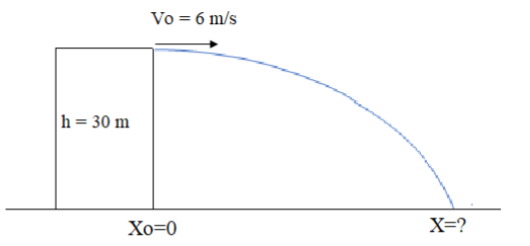
A ball is thrown in the horizontal direction from the top of a building that is 30.0 m high, with a velocity = 6.00 m/s at 0°. How far from the base of the building will the ball hit the ground?
14.8m
A ball is thrown in the horizontal direction from the top of a
building that is 20.0 m high, with a velocity =
5.00 m/s at 0°.
How far from the base of the
building will the ball hit the ground?
Answer:
10.1 m
A ball is thrown in the horizontal direction from the top of a
building that is 45.0 m high, with a velocity =
8.00 m/s at 0°.
How far from the base of the
building will the ball hit the ground?
Answer:
24.3 m
A ball is thrown in the horizontal direction from the top of a
building that is 25.0 m high, with a velocity =
7.00 m/s at 0°.
How far from the base of the
building will the ball hit the ground?
Answer:
15.8 m
A ball is thrown in the horizontal direction from the top of a
building that is 60.0 m high, with a velocity =
10.0 m/s at 0°.
How far from the base of the
building will the ball hit the ground?
Answer:
35.0 m
- If your cell phone slips off the table and falls to the ground, how much time would it take to hit the ground? The table is 80.0 cm high. (Ignore air resistance.) Answer: 0.40 s
- If your cell phone slips off the table and falls to the ground, how much time would it take to hit the ground? The table is 200.0 cm high. (Ignore air resistance.) Answer: 0.64 s
- If your cell phone slips off the table and falls to the ground, how much time would it take to hit the ground? The table is 150.0 cm high. (Ignore air resistance.) Answer: 0.55 s
- If your cell phone slips off the table and falls to the ground,
how much time would it take to hit the ground?
The table is 95.0 cm high.
(Ignore air resistance.)
Answer: 0.44 s
If your cell phone slips off the table and falls to the ground, how much time would it take to hit the ground? The table is 120.0 cm high. (Ignore air resistance.)
t= 0.495s
An airplane has to take off from a runway that has a total length of 2.00 km. The plane starts from one end of the runway from a state of rest, and it must attain a speed of 200 km/hour to take off. What must be the acceleration of the plane, and how much time does it take to traverse the runway? Give your answers in SI units, i.e., m/s² and seconds.
a= 0.772m/s²
t= 72.0s
An airplane has to take off from a runway that has a total length of
1.50 km.
The plane starts from one end of the
runway from a state of rest, and it must attain a speed of 180
km/hour to take off.
What must be the acceleration of
the plane, and how much time does it take to traverse the
runway?
Give your answers in SI units, i.e., m/s² and
seconds.
Acceleration = 0.83 m/s²
Time = 60 s
- An airplane has to take off from a runway that has a total length of 2.50 km. The plane starts from one end of the runway from a state of rest, and it must attain a speed of 220 km/hour to take off. What must be the acceleration of the plane, and how much time does it take to traverse the runway? Give your answers in SI units, i.e., m/s² and seconds.
- Answer: Acceleration = 0.75 m/s² Time = 81 s
- An airplane has to take off from a runway that has a total length of 1.20 km. The plane starts from one end of the runway from a state of rest, and it must attain a speed of 150 km/hour to take off. What must be the acceleration of the plane, and how much time does it take to traverse the runway? Give your answers in SI units, i.e., m/s² and seconds.
- Answer: Acceleration = 0.72 m/s² Time = 58 s
- An airplane has to take off from a runway that has a total
length of 3.00 km.
The plane starts from one end of the runway from a state of rest, and it must attain a speed of 250 km/hour to take off.
What must be the acceleration of the plane, and how much time does it take to traverse the runway?
Give your answers in SI units, i.e., m/s² and seconds.
-
Answer:
Acceleration = 0.80 m/s²
Time = 87 s
Q]) A spring gun is placed horizontally on top of a table. It shoots a ball at a velocity of 4.00 m/s in the horizontal direction. The height of the gun above the floor is 1.50 m. Find the time that is takes to hit the ground, and the distance from the table where it hit the ground?
Time: 0.553
Distance: 2.21m
- A spring gun is placed horizontally on top of a table. It shoots a ball at a velocity of 3.00 m/s in the horizontal direction. The height of the gun above the floor is 1.20 m. Find the time that it takes to hit the ground, and the distance from the table where it hit the ground. Time: 0.49 s Distance: 1.47 m
A spring gun is placed horizontally on top of a table.
It
shoots a ball at a velocity of 5.00 m/s in the
horizontal direction.
The height of the gun above the floor is
2.00 m.
Find the time that it takes to hit
the ground, and the distance from the table where it hit the ground.
Time: 0.64 s
Distance: 3.20 m
A spring gun is placed horizontally on top of a table.
It
shoots a ball at a velocity of 2.50 m/s in the
horizontal direction.
The height of the gun above the floor is
0.80 m.
Find the time that it takes to hit
the ground, and the distance from the table where it hit the ground.
Time: 0.40 s
Distance: 1.00 m
A spring gun is placed horizontally on top of a table.
It
shoots a ball at a velocity of 6.00 m/s in the
horizontal direction.
The height of the gun above the floor is
1.80 m.
Find the time that it takes to hit
the ground, and the distance from the table where it hit the ground.
Time: 0.61 s
Distance: 3.66 m
Q2) The same spring gun is now set up so that it shoots the ball at
an angle of 30° above the horizontal. The gun is still 1.50 m above
the ground. Find the time that is takes to hit the ground, and the
distance from the table where it hit the ground?
(2+2)
Time: 0.794s
Distance: 2.75m
The same spring gun is now set up so that it shoots the ball at an
angle of 25° above the horizontal.
The gun is
still 1.20 m above the ground.
The ball is
fired with a speed of 4.50 m/s.
Find the time
that it takes to hit the ground, and the distance from the table where
it hit the ground.
Time: 0.71 s
Distance: 2.89 m
The same spring gun is now set up so that it shoots the ball at an
angle of 40° above the horizontal.
The gun is
still 1.50 m above the ground.
The ball is
fired with a speed of 5.00 m/s.
Find the time
that it takes to hit the ground, and the distance from the table where
it hit the ground.
Time: 0.93 s
Distance: 3.56 m
The same spring gun is now set up so that it shoots the ball at an
angle of 35° above the horizontal.
The gun is
still 1.00 m above the ground.
The ball is
fired with a speed of 4.00 m/s.
Find the time
that it takes to hit the ground, and the distance from the table where
it hit the ground.
Time: 0.69 s
Distance: 2.26 m
The same spring gun is now set up so that it shoots the ball at an
angle of 20° above the horizontal.
The gun is
still 1.80 m above the ground.
The ball is
fired with a speed of 6.00 m/s.
Find the time
that it takes to hit the ground, and the distance from the table where
it hit the ground.
Time: 0.78 s
Distance: 4.40 m
A bullet is fired at an angle of 60° with a speed of 100 m/s. Calculate:
After how much time will it be at a height of 30.0 m, going
up?
After how much time will it be at a height of 30.0 m, going
down?
What is its horizontal component of velocity when it is at
30.0 m, going up?
What is its vertical component of velocity when
it is at 30.0 m, going down?
a) 0.353 s
b) 17.325 s
c) 50 m/s
d) −83.1 m/s
A bullet is fired at an angle of 55° with a speed of
80 m/s. Calculate:
a) After how much time
will it be at a height of 25.0 m, going up?
b)
After how much time will it be at a height of 25.0 m,
going down?
c) What is its horizontal component of velocity when
it is at 25.0 m, going up?
d) What is its
vertical component of velocity when it is at 25.0 m,
going down?
Answers:
a) 0.393 s
b) 12.981 s
c) 45.9 m/s
d) −61.7 m/s
A bullet is fired at an angle of 45° with a speed of
120 m/s. Calculate:
a) After how much time
will it be at a height of 40.0 m, going up?
b)
After how much time will it be at a height of 40.0 m,
going down?
c) What is its horizontal component of velocity when
it is at 40.0 m, going up?
d) What is its
vertical component of velocity when it is at 40.0 m,
going down?
Answers:
a) 0.485 s
b) 16.832 s
c) 84.9 m/s
d) −80.1 m/s
A bullet is fired at an angle of 70° with a speed of
90 m/s. Calculate:
a) After how much time
will it be at a height of 20.0 m, going up?
b)
After how much time will it be at a height of 20.0 m,
going down?
c) What is its horizontal component of velocity when
it is at 20.0 m, going up?
d) What is its
vertical component of velocity when it is at 20.0 m,
going down?
Answers:
a) 0.240 s
b) 17.020 s
c) 30.8 m/s
d) −82.2 m/s
A bullet is fired at an angle of 35° with a speed of
110 m/s. Calculate:
a) After how much time
will it be at a height of 30.0 m, going up?
b)
After how much time will it be at a height of 30.0 m,
going down?
c) What is its horizontal component of velocity when
it is at 30.0 m, going up?
d) What is its
vertical component of velocity when it is at 30.0 m,
going down?
Answers:
a) 0.494 s
b) 12.382 s
c) 90.1 m/s
d) −58.2 m/s
Q4) A boat moves at 6.00 m/s in still water. It is used in a river
that is flowing at 3.00 m/s. How long will it
take the boat to
cover a distance of 2.00 km along the river:
(2+2)
a) When the boat is going downstream?
Answer: 222s
b) When
the boat is going upstream?
Answer:667s
1
A boat moves at 8.00 m/s in still water.
It
is used in a river that is flowing at 2.00 m/s.
How long will it take the boat to cover a distance of 1.80
km along the river:
a) When the boat is going downstream?
Answer: 180 s
b) When the boat is going upstream?
Answer:
300 s
2
A boat moves at 10.00 m/s in still water.
It
is used in a river that is flowing at 4.00 m/s.
How long will it take the boat to cover a distance of 2.40
km along the river:
a) When the boat is going downstream?
Answer: 171 s
b) When the boat is going upstream?
Answer:
400 s
A boat moves at 7.00 m/s in still water.
It is
used in a river that is flowing at 3.00 m/s.
How long will it take the boat to cover a distance of 1.50
km along the river:
a) When the boat is going downstream?
Answer: 150 s
b) When the boat is going upstream?
Answer:
375 s
A boat moves at 9.00 m/s in still water.
It is
used in a river that is flowing at 2.00 m/s.
How long will it take the boat to cover a distance of 2.10
km along the river:
a) When the boat is going downstream?
Answer: 191 s
b) When the boat is going upstream?
Answer:
300 s