Wanderers in Space, Key Terminology
what does modern science offer answers to?
fundamental questions about the universe and our place within it
what do we know about the universe according to modern science?
basic content and scale of the universe
ages of Earth and the universe
scale of the universe
size and extent of the universe
- includes basic content and structure
history of the universe
development and changes in universe from its beginning to the present
star
a large, glowing ball of charged gas that generates heat and light through nuclear fusion in its core
"nuclear furnace"
solar / stellar system
a star and all the materials that orbit it -- including planets and moons
Milky Way galaxy
- our galaxy
- the band of light we see in the sky when we look into the plane of our galaxy
galaxy
- great "island" of stars in space
- all held together by gravity
- orbit a common center
local group
group of about 40 galaxies to which Milky Way galaxy belongs
- one of the two largest among them is Milky Way
galaxy clusters
collection of a few dozen or more galaxies bound together by gravity
- smaller collections called groups
superclusters
clusters of galaxy clusters
largest known structures in the universe
Laniakea
local supercluster
translates to "immense heaven"
light year & kilometers conversion
1 light-year = 9.46 trillion km
astronomical unit
average distance (semimajor axis) from Earth to the Sun
~93 million miles (150 million kilometers)
light year
distance that light can travel in one year
approx. 10 trillion kilometers
the farther away we look in the distance...
the further back we look in time
structure of galaxies and galaxy clusters
arranged in giant chains and sheets with huge voids between them
planet
- moderately large object that orbits a star
- shines primarily by reflected light (from its star)
may be rocky, icy, or gaseous in composition
moon
object that orbits a planet
satellite
any object orbiting another object
asteroid
relatively small & rocky object that orbits a star
comet
relatively small & ice rich object that orbits a star
small solar system body
asteroid, comet, or other object that orbits a star
too small to qualify as a planet or dwarf planet
universe
sum total of all matter and energy
- all galaxies and everything in between them
observable universe
portion of the entire universe that can be seen from Earth
exoplanet
planets in other solar systems around other stars
nebula
interstellar cloud of gas and dust
how stars and stellar systems are formed
TNOs
dwarf planets
trans-neptunian objects
rotation
spinning of an object around its axis
orbit (revolution)
orbital motion of one object around another due to gravity
measured age of the universe
14 billion years
boundary of our observable universe
expansion (of the universe)
increase in average distance between galaxies as time progresses
levels of the universe
earth -> inner solar system -> outer solar system -> closest stars -> Milky Way -> local group -> laniakea -> local superclusters -> observable universe
solar day
time for the sun to return to the meridian
avg. 24 hours
sidereal day
time for a distant star to return to the meridian after a rotation
23 hours, 56 minutes, 4 seconds
*Earth's TRUE rotation rate*
why are the solar day and sidereal day different?
Earth also has to revolve around the Sun in our orbit and have to turn a tiny bit more to face the sun again
north celestial pole
directly above Earth's North Pole
ecliptic
the Sun's apparent annual path around the celestial sphere
geocentric universe
ancient belief that universe is "Earth-centered"
ie. Earth is center of universe and all other celestial bodies orbit around Earth
ecliptic plane
Earth's orbital path
celestial sphere
puts stars and constellations onto an imaginary sphere around us
*not realistic, just how it appears to us from Earth
earth moves from
west -> east
what direction do the sun, moon, planets, and stars all appear to rise and set?
east -> west
what direction does earth spin?
counterclockwise (when viewed from above the North Pole)
how much is earth's axis tilted?
23.5 degrees (from a line perpendicular to the ecliptic plane)
earths axis remains pointed...
in the same direction in space throughout the year
earths orbit moves...
in the same counterclockwise direction as its rotation
earth's axis points toward the star...
Polaris
- the North Star, always found in a direction of due north
earths distance from the sun...
varies slightly over the course of the each year
earth orbits the sun in the same direction that...
it rotates on its axis
local solar neighborhood
region of the Sun and nearby stars
dark matter
matter inferred to exist from gravitational effects, but no light has been detected
- dominates total mass of the universe
dark energy
energy that could be causing the expansion of the universe to accelerate
virtually every galaxy outside the local group is moving...
away from us
the more distant the galaxy...
the faster it appears to be racing away
raisin cake
analogy to explain expansion of universe
expansion of cake causes raisins to move away from local raisin -- more distant raisins move away faster
distant galaxies are all moving away from us, with more distant ones moving faster...
indicating that we live in an expanding universe
how do observations of expansion allow us to measure the age of the universe?
faster the rate of expansion, the more quickly galaxies reach their current position -- therefore the younger the universe must be
problems with raisin cake analogy
- cake has center and edges; same may not be true for the universe ( no place is more central than any other place)
-can't see galaxies moving apart with time
Doppler shifts
way of measuring speeds of galaxies via spreading their light into these spectra
constellations
region of the night sky with well-defined borders
familiar star patterns help us find them
south celestial pole
point directly over Earth's South Pole
celestial equator
projection of Earth's equator into space
- makes a complete circle around the celestial sphere
Milky Way
band of light that circles around celestial sphere
- traces our galaxy's disk of stars-- the galactic plane-- as it appears from our location within the galaxy
local sky
sky as seen from wherever you happen to be standing
horizon
boundary between earth and sky
zenith
point directly overhead (in sky)
meridian
imaginary half-circle stretching from horizon due south, through the zenith, to the horizon due north
direction
one of two coordinates needed to pinpoint an object in the local sky
altitude
(above horizon) the angular distance between the horizon and an object in the sky
declination
north-south location on sky (like latitude)
(degrees, arcminutes, arcseconds)
right ascension
east-west location on sky (like longitude)
hours, minutes, seconds
angular size
(of an object) the angle it appears to span in your field of view
- also depends on distance
angular distance
(between objects) angle that appears to separate them
celestial sphere appears to rotate...
east to west
circumpolar
star that always remains above the horizon for a particular latitude
stars near south celestial pole...
never rise above horizon at all
0 point for right ascension
where the sun crosses the celestial equator on the march equinox
the farther away an object is...
the smaller its angular size
stars near North Pole are...
circumpolar, meaning that they remain perpetually above the horizon, circling (counterclockwise) around the north celestial pole each day
stars near south celestial pole...
never rise above the horizon at all
others stars have daily circles that are...
partly above the horizon & partly below
why they appear to rise in the east and set in the west
positive declination
north of the equator
negative declination
south of the equator
relationship between angular size (in degrees), physical size, and distance
angular size/360 degrees = physical size / 2pi x distance
does the sky vary with latitude or longitude?
latitude
the altitude of the celestial pole in your sky =
your latitude
the constellations visible at a particular time of night...
change as we orbit the Sun
Earth's axis points in the same direction all year round, which means...
its orientation relative to the Sun changes as Earth orbits the Sun
If Earth did not have an axis tilt...
we would NOT have seasons
summer solstice (June solstice)
occurs around June 21st
moment when the Northern Hemisphere is tipped most directly toward the Sun
- receives the most direct sunlight
winter solstice (December solstice)
occurs around December 21st
the moment when the Northern Hemisphere receives the least direct sunlight
spring/ vernal equinox (March equinox)
Northern Hemisphere goes from being tipped slightly away from the Sun to being tipped slightly toward the sun
fall/ autumnal equinox (September equinox)
moment when the Northern Hemisphere first starts to be tipped away from the sun
we use equinoxes and solstices to mark...
the progression of the seasons
equinox
sun rises precisely due east and sets precisely due west
solstice
Sun rises and sets farthest to the north of due east and due west
high latitudes have...
more extreme seasons
precession
gradual wobble that alters the orientation of Earth's axis in space
the tilt of Earth's axis remains close to 23.5 degrees, but...
the direction the axis points in space changes slowly with the 26,000-year cycle of precession
what causes precession?
gravity's effect on a tilted, rotating object
lunar phases
Moon's appearance in the sky changes as its position relative to the sun changes
the sun comes from essentially the same direction...
all along the Moon's orbit
moon phase takeaways
- we always see the same side of the moon facing Earth
- as moon orbits Earth, we see different combinations of its bright and dark faces
the phase of the moon depends on...
its position relative to the Sun as it orbits Earth
the moon's phase affects not only its appearance but also...
its rise and set times
new moon

rises and sets with sun
waning crescent
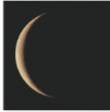
rise: before dawn
highest: mid-morning
set: mid-afternoon
third quarter
rise: midnight