IGCSE Biology 5 | Environment
Describe the flow of energy through living organisms
Sun's light energy captured by producers (plants) during photosynthesis and converted to chemical energy. T
his chemical energy is then transferred through food chains as organisms consume others, moving from producers to primary, secondary, and tertiary consumers.
When organisms die, energy stored in their biomass is returned to the environment by decomposers, continuing the cycle.
Define a food chain
A diagram showing the transfer of energy from one organism to the next, beginning with a producer.
Define a food web
A network of interconnected food chains
Define a producer
An organism that makes its own organic nutrients, usually using energy from sunlight, through photosynthesis
Define a consumer
An organism that gets its energy by feeding on other organisms.
Define herbivore, carnivore and decomposers
Herbivore : an animal that gets its energy by eating plants
Carnivore : an animal that gets its energy by eating other animals
Decomposer : an organism that gets its energy from dead or waste organic material
Use food chains and food webs to describe the impact humans have through overharvesting of food species and through introducing foreign species to a habitat
Impact of Overharvesting
- Reduces Food Availability: the organisms that rely on it as a food source experience a decline in available food.
- Cascading Effects: This reduction in food can lead to a decrease in the populations of other species at higher trophic levels in the food chain.
- Biodiversity Loss: The domino effect from a significant reduction in one species can cause other species to become endangered or even extinct, leading to a loss of biodiversity.
- Keystone Species:If a keystone species (a species with a large impact on its environment) is overharvested, the disruption to the food web can be particularly severe.
Impact of Introducing Foreign Species
- Competition for Resources: Non-native species often compete with native species for essential resources like food, water, and habitat, putting native populations under pressure.
- Predation : Introduced predators can prey on native species that have not evolved defences against them, causing a decline in native populations.
- Disruption of Food Web Dynamics:The introduction of a foreign species can alter predator-prey relationships and food web structures, making the ecosystem less stable and resilient.
Discuss the advantages of using a pyramid of biomass rather than a pyramid of numbers to, and why energy rather than pyramids of numbers or biomass. describe each.
A pyramid of energy shows the continuous, unidirectional flow of energy through an ecosystem's trophic levels, always upright and decreasing in width at each level due to energy loss, with producers at the base and apex predators at the top.
A pyramid of numbers displays the total count of individual organisms at each trophic level, which is typically upright but can be inverted, like in a tree-based ecosystem where one tree supports many insects.
Pyramid of biomass
- Upright shape:For most terrestrial (land-based) ecosystems, the pyramid of biomass is upright because the biomass of producers is significantly larger than the biomass at higher trophic levels.
- Energy loss:The pyramid shape reflects the loss of energy at each trophic level, as only about 10% of the energy is transferred from one level to the next.
- Aquatic ecosystems:While typically upright, marine ecosystems can sometimes have an inverted pyramid of biomass, with a smaller biomass of producers (phytoplankton) supporting a larger biomass of consumers (zooplankton).
A pyramid of biomass is superior to a pyramid of numbers because it accounts for the size of organisms, providing a more accurate representation of the living matter and energy flow in an ecosystem, preventing misleading results caused by large numbers of small organisms.
Energy is more accurate, is always upright, universal, shows energy loss and energy in ecosystem directly. more accurate then mass or numbers.
Define a trophic level
The position of an organism in a food chain, food web or ecological pyramid.
Explain why the transfer of energy from one trophic level to another is often not efficient
- During cellular respiration, a key metabolic process, a significant amount of this energy is released as heat and cannot be used by the next trophic level.
- Undigested Material:Not all parts of an organism can be digested by its predator and are excreted as waste, and the energy within them does not pass to the next consumer.
- Uneaten Biomass: Not every organism in a lower trophic level is eaten. When organisms die from causes other than predation, their energy and biomass are not transferred to the next level; instead, they are utilized by decomposers.
- Energy Stored in Non-Edible Parts: Predators may not consume entire portions of their prey, leading to a loss of energy. For example, a lion might not eat the hide and bones of an antelope, thereby missing the energy-rich bone marrow.
Describe the carbon cycle
1. Plants photosynthesis
2. Animals feed on them
3. Respiration : All living organisms carry out aerobic respiration. During respiration, organic compounds are broken down to release energy, and carbon dioxide is returned to the atmosphere as a waste product.
4. Decomposition when they die : Decomposers also undergo respiration, releasing carbon dioxide back into the soil and atmosphere.
5. Formation of Fossil Fuels
- Under specific conditions, dead organic matter that is not fully decomposed can become buried in the Earth.
- Over millions of years, immense pressure and heat transform this trapped carbon into fossil fuels, such as coal, oil, and natural gas.
6. Combustion when fuels burned
Describe the nitrogen cycle
- Nitrogen fixation converts atmospheric nitrogen gas (N₂), which is unusable by most organisms, into ammonia or other organic compounds that plants can absorb as they are more reactive. By lightning or bacteria, or chemically in manual production.
- Lightning : The high energy of a lightning strike breaks the strong bonds in nitrogen gas molecules, allowing them to react with oxygen and water to form nitrates and nitrites, which are then mixed with rain and carried to the soil.
- Fixing bacteria lives in soil and turns nitrogen gas in air spaces to ammonia directly, using their enzymes. These bacteria often form symbiotic relationships with plants, like legumes. these ammonium compounds are converted into nitrates in the soil.
- Absorption of nitrate ions by plants who use it to produce amino acids and proteins. Animals feed and digestion of proteins when they eat plants.
- Deamination is the process by which excess amino acids are broken down in the liver. before excretion. The amino group (NH2) is removed and converted into ammonia (NH3), which is then converted into urea.
- Nitrogen from living organisms is returned to the soil in the form of ammonia by the action of decomposers, such as bacteria and fungi.
- Plants can’t absorb ammonium ions so, in order for the nitrogen to be made available again to plants, nitrifying bacteria convert ammonia into nitrites, and then further oxidises into nitrates, which can be taken up again by plants.
- Denitrification : bacteria convert nitrate ions in soil and water into nitrogen gas, releasing it back into the atmosphere.
State the roles of microorganisms in the nitrogen cycle
decomposition, nitrification, nitrogen fixation and denitrification
Describe a population
A group of organisms of one species, living in the same area, at the same time.
Describe a community
All of the populations of different species in an ecosystem.
Describe an ecosystem
A unit containing the community of organisms and their environment, interacting together.
State the factors affecting the rate of population growth
- food supply
- competition
- predation
- disease
phases in the sigmoid curve of population growth
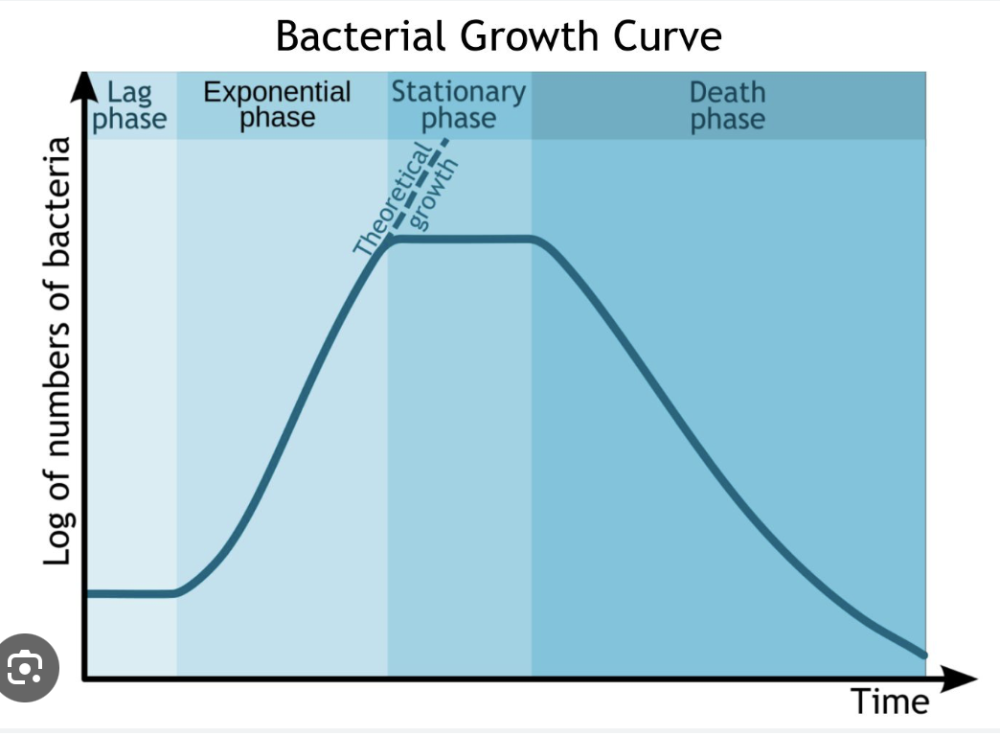
The Lag Phase is a slow initial growth period, followed by the Exponential (Log) Phase of rapid population increase. As limiting factors intensify, growth slows leading to a stable Stationary Phase where the population size remains constant at the carrying capacity (K). A Death Phase may occur if the population exceeds the carrying capacity, causing a crash due to resource depletion
Describe how humans have increased food production
(a) agricultural machinery to use larger areas of land and improve efficiency
(b) chemical fertilisers to improve yields
(c) insecticides to improve quality and yield
(d) herbicides to reduce competition with weeds
(e) selective breeding to improve production by crop plants and livestock
Describe the advantages and disadvantages of large-scale monocultures of crop plants
Advantages:
- Efficient Resource Use : Farmers can more efficiently manage resources like machinery, fertilisers, and water when growing only one type of crop.
- Easier Management : Cultivating a single crop requires less specialised knowledge and experience compared to managing multiple diverse crops.
- This leads to higher yields and lower costs due to economies of scale.
Disadvantages:
- Reduced Biodiversity : Monocultures replace diverse ecosystems with a single crop, leading to a significant loss of plant and animal species.
- Increased Pest and Disease Vulnerability : A large population of a single host species makes it easier for pests and diseases to spread rapidly, requiring heavy reliance on pesticides.
- Soil Degradation : Continuous cultivation of the same crop can deplete specific soil nutrients, reducing soil fertility over time and requiring more fertiliser inputs.
- Environmental Pollution : The heavy use of fertilizers and pesticides can lead to soil and water pollution, harming the environment and potentially human health.
Describe the advantages and disadvantages of intensive livestock production
Advantages
- Increased Productivity and Efficiency : Intensive farming methods are designed to maximise output and efficiency, producing large quantities of meat, milk, and eggs quickly and reliably.
- Produces a higher amount
- Lower Costs : The system aims to minimise production costs, resulting in more affordable animal products for consumers.
- Reduced Labor : Automation and concentrated animal housing can reduce the amount of manual labor required by farmers.
Disadvantages
- Poor Animal Welfare
- Environmental Damage:
- Pollution: Animal waste and fertilizers can pollute water sources, and the breakdown of urine and feces releases greenhouse gases like methane and nitrous oxide, contributing to global warming.
- Habitat Destruction: To support intensive farming, land is often cleared, leading to deforestation and loss of biodiversity.
- Health Risks:
- Antibiotic Resistance: The widespread use of antibiotics in intensive farms can contribute to the development of antibiotic-resistant bacteria, posing a serious threat to public health.
- Zoonotic Diseases: Crowded conditions can increase the risk of diseases spreading from animals to humans (zoonotic diseases), such as certain strains of bird flu.
Describe biodiversity
The number of different species that live in an area.
Describe the reasons for habitat destruction
(a) increased area for housing, crop plant production and livestock production
(b) extraction of natural resources
(c) freshwater and marine pollution, agricultural runoff, industrial pollution, o il spills and o cean acidification
Explain the undesirable effects of deforestation
reducing biodiversity, extinction, loss of soil, flooding and increase of carbon dioxide in the atmosphere
Explain the process of eutrophication of water
1. Increased availability of nitrate and other ions:This is the initial trigger, often caused by agricultural runoff containing fertilizers high in nitrogen (nitrate).
2. Increased growth of producers:With more nutrients available, algae and other aquatic plants experience rapid growth, forming a "bloom".
3. Increased decomposition after death of producers:As the algae and other plants die, they decompose.
4. Increased aerobic respiration by decomposers:Bacteria and other decomposers increase in number to break down the dead organic matter, consuming oxygen in the process.
5. Reduction in dissolved oxygen:Due to the increased respiration by decomposers, the amount of dissolved oxygen in the water decreases.
6. Death of organisms requiring dissolved oxygen:Aquatic organisms like fish and other invertebrates that need oxygen to survive start to die as the water becomes oxygen-depleted.
Describe the effects of non-biodegradable plastics, in both aquatic and terrestrial ecosystems
Non-biodegradable plastics harm terrestrial and aquatic ecosystems by polluting environments, directly injuring and killing wildlife through entanglement and ingestion, and contaminating soil and water with toxic chemicals that disrupt food chains and reduce fertility. In water, plastic debris causes blockages, malnutrition, and drowning in marine animals, while on land, it degrades soil quality and can be mistaken for food by animals.
Describe the effects of untreated sewage and excess fertiliser on aquatic ecosystems
Thick algal blooms can block sunlight, preventing submerged plants like seagrasses from photosynthesising and surviving.
eutrophication of water disrupts food chain, and reduces biodiversity
Pathogens and Disease:
Describe the sources and effects of pollution of the air by methane and carbon dioxide, limited to: the enhanced greenhouse effect and climate change
- Natural Greenhouse Effect: The atmosphere naturally contains greenhouse gases that trap some of the Earth's heat, a process essential for life as we know it.
- Enhanced Greenhouse Effect: An increase in the atmospheric concentration of human-emitted CO₂ and CH₄ intensifies this effect.
- Increased Heat Trapping: These gases absorb and re-emit thermal energy, preventing it from escaping into space and warming the Earth's surface
Effects of this warming include melting ice caps, rising sea levels, more extreme weather events, and habitat disruption.
Co2 sources : fossil fuel combustion
methane sources : Livestock, w aste decomposition: decomposition of organic matter in landfills and wastewater treatment plants produces methane. Fossil Fuels: Methane is released during the extraction and processing of oil and gas.
Describe a sustainable resource
A recourse which is produced as rapidly as it is removed from the environment so that it does not run out.
Explain how forests can be conserved
education, protected areas, quotas and replanting
Explain how fish stocks can be conserved
education, closed seasons, protected areas, controlled net types and mesh size, quotas and monitoring
Explain why organisms become endangered or extinct.
Climate change, habitat destruction, hunting, over harvesting, pollution and introduced species.
Describe how endangered species can be conserved
(a) monitoring and protecting species and habitats
(b) education
(c) captive breeding programmes
(d) seed banks
Describe the reasons for conservation programmes
(a) maintaining or increasing biodiversity
(b) reducing extinction
(c) protecting vulnerable ecosystems
(d) maintaining ecosystem functions, limited to nutrient cycling and resource provision, including food, drugs, fuel and genes
8 Describe the use of artificial insemination (AI) and in vitro fertilisation (IVF) in captive breeding programmes
Artificial Insemination (AI) is the direct placement of sperm into a female's reproductive tract, allowing for sperm to be collected from one male and used on multiple females or transported globally to breed with distant males without the stress of moving the animals themselves.
In Vitro Fertilisation(IVF) involves fertilising eggs with sperm in a lab and then implanting the resulting embryo into a female, which helps maintain genetic diversity and can be used to breed animals that are otherwise incompatible for natural reproduction.
Explain the risks to a species if its population size decreases
A species with decreased population size and genetic variation is at higher risk of extinction because it has a reduced ability to adapt to environmental changes and a greater susceptibility to diseases. Less diversity means fewer individuals may possess the right traits to survive new challenges like disease outbreaks, climate change, or food shortages. Additionally, smaller populations are more prone to inbreeding, which can lead to harmful genetic mutations, reduced fertility, and overall weaker offspring.
what bacteria is useful in and why
bacteria are useful in biotechnology and genetic modification due to their rapid reproduction rate and their ability to make complex molecules.
(a) few ethical concerns over their manipulation and growth
(b) their ability to readily accept and express foreign genes within their small, circular DNA structures called plasmids.
Describe the role of anaerobic respiration in yeast during the production of ethanol for biofuels and bread making.
Fermentation, where yeast breaks down glucose in the absence of oxygen to produce ethanol and carbon dioxide.
Bio fuel is ethanol mixed with petrol.
In bread making the co2 creates bubbles of air causing the bread to rise, alcohol is destroyed in baking. The glucose in the bread is the food for the yeast.
Describe the use of enzymes in fruit juice production
- Pectin's Role: Fruits contain a jelly-like substance called pectin in their cell walls, which helps hold cells together and contributes to the juice's thickness and cloudiness.
- Enzyme Action: Pectinase breaks down the pectin in the fruit's cell walls through hydrolysis and other chemical reactions.
- Cell Wall Degradation: This breakdown weakens the cell structure, making it easier to release the juice contained within the fruit and less cloudy.
Investigate and describe the use of biological washing powders
Biological washing powders use enzymes—biological catalysts—to break down large, insoluble stain molecules like proteins, fats, and starches into smaller, water-soluble ones, allowing them to be easily washed away. This action is effective at lower temperatures, which saves energy and allows for the cleaning of delicate fabrics. The specific types of enzymes include proteases (for protein stains like blood), lipases (for fat and grease), and amylases (for starch stains).
- Energy Savings:Enzymes work efficiently at lower temperatures (e.g., 40°C), reducing the need for high-temperature washes and saving on heating costs.
- Effectiveness on Tough Stains:They are particularly good at removing stains from food, blood, and grass, which are made of proteins and fats.
- Fabric Protection:Washing at lower temperatures is gentler on delicate fabrics, which can be damaged or shrink in hot water.
Explain how to produce lactose-free milk
Lactase is added to milk to break down lactose, the sugar in milk, into simpler sugars: glucose and galactose. People who are lactose intolerant lack sufficient lactase enzyme in their digestive systems, so this pre-digested milk can be safely consumed without causing digestive upset.
The added lactase acts as a catalyst, speeding up the breakdown of lactose, making the milk sweeter and digestible for lactose-intolerant individuals.
Describe how fermenters can be used for the large-scale production and which 3 useful products
insulin, penicillin and mycoprotein
How Fermenters Work
- Sterilization: The fermenter and its contents are thoroughly sterilized, often with steam, to eliminate any unwanted microorganisms that could contaminate the culture or compete for nutrients.
- Nutrient Supply: A nutrient-rich broth is introduced, providing the bacteria or fungi with the essential resources they need for rapid growth and reproduction.
-
Optimal Conditions:
- Temperature: A water jacket or heating/cooling system maintains the optimal temperature for the specific microorganism's enzymes to function efficiently as when microorganisms respire they produce heat.
- pH: Probes monitor the pH, which is adjusted with acids or alkalis to ensure it remains at the optimum level for enzyme action and growth. The Co2 from microorganisms respiration lowers the Ph.
- Oxygenation: For aerobic processes, an air inlet provides oxygen, and stirrers ensure the even distribution of oxygen, nutrients, and microorganisms throughout the tank.
- Microbial Culture: The desired microorganism (e.g., genetically modified E. coli for insulin or Penicillium fungus for penicillin) is put into the sterile nutrient medium within the fermenter.
- Product Formation: The microorganisms grow and reproduce.
- Harvesting: Once the desired amount of product is made, it is extracted and purified from the fermenter.
Define genetic modification
Changing the genetic material of an organism by removing, changing or inserting individual genes.
Outline the process of genetic modification
1. identify required gene in human DNA and use restriction enzymes to cut it out leaving sticky ends.
2. cutting of bacterial plasmid DNA with the same restriction enzymes, forming complementary sticky end (that match)
3. Insert human DNA into bacterial plasmid DNA using DNA ligase (an enzyme that joins the DNA ends firmly together) to form a recombinant plasmid.
4. Recombinant plasmids are inserted into bacteria which multiplies.
5. The bacteria then use the genetic information in the human gene to synthesize the desired human protein.
Outline examples of genetic modification
(a) the insertion of human genes into bacteria to produce human proteins
(b) the insertion of genes into crop plants to confer resistance to herbicides
(c) the insertion of genes into crop plants to confer resistance to insect pests
(d) the insertion of genes into crop plants to improve nutritional qualities
Discuss the advantages and disadvantages of genetically modifying crops and 3 common ones.
soya, maize and rice
Advantages : increased yields, pest and herbicide resistance, enhanced nutritional value, and tolerance to harsh conditions, cheaper / less time-consuming for farmers .
Disadvantages :
- Herbicide-resistant weeds (development of "superweeds" that also become resistant to the herbicides as small chance gene will pass to the weeds).
- Reduced biodiversity (fewer plant species when herbicides have been used – this can impact insects and insect-eating birds)
- Economic Burden: GM seeds are often expensive so harder for smaller farmers to compete with large companies who can afford it. The herbicides that crops are resistant to – often made by the same companies that produce the seed are more expensive to buy.
- Potential Health Concerns:While many studies suggest GMOs are safe, some concerns persist regarding potential allergenicity and long-term health effects, such as stomach inflammation, though conclusive evidence is debated.
- Environmental Impact on Non-Target Species:Pest-resistant GM crops might produce toxins that, while safe for humans, could harm beneficial insects and other non-target organisms.