MOD 6
True or False: Although viruses may contain their genome within an enclosed space (much like the nucelus of a cell), it is considered neither eukaryotic or prokaryotic.
True
Describe the two basic components of a virus.
Genetic material (either DNA or RNA) and a capsid (a membrane-like protective structure that conatins/encloses the genetic material)
The envelope surrounds the ______ of some viruses.
capsid
True or False: You would expect to see a viral envelope on a virus infecting a bacterial cell.
False
Rank the following viruses based on their size from largest to smallest:
Paramyxovirus
Poliovirus
Smallpox virus
Smallpox virus (~200nm) > Paramyxovirus (100-150nm) > Poliovirus (~30nm)
True or False: Viral replication occurs after it attatches and enters the host cell.
True
Place the following viral life cycle steps in order beginning with viral attatchment and provide a description of each step.
Uncoating:
Release:
Replication:
Attachment:
Entry:
New infection:
1. Attachment: Viral receptors bind to host proteins on the surface of the cell
2. Entry: The virus fuses with the host membrane and enters the cell
3. Uncoating: The viral capsid disassembles
4. Replication: The viral genome is replicated and the virus makes new copies of itself. The genome codes for the necessary proteins
5. Release: New virus particles are made and leave the cell
6. New infection: Newly produced viruses that leave the host cell can now go on to infect new cells
A virus that infects bacteria is called [answer 1] and contains a [answer 2]-sided polygon capsid.
1. bacteriophage
2. 20
True or False: Structurally, bacteriophages are distinct from viruses that infect plant or animal cells.
True
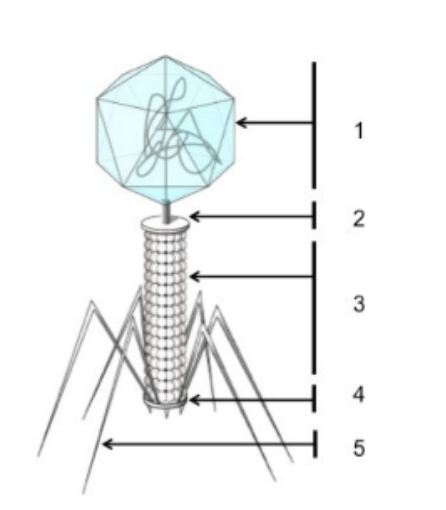
Identify the following components of a bacteriophage.
1. Capsid
2. Collar
3. Tail
4. Base plate
5. Tail fibers
Describe the main differences between lytic and temperate phages.
Lytic bacteriophages replicate within the host bacteria until it lysis or ruptures, effectively destorying the bacterial cell, whereas temperate (or lysogenic) bacteriophages exist in a non-replicative state. Its viral genome is integrated into the host genome and replication of the viral genome will occur, but it will not be transcribed and translated into protein (it'll be suppressed). Thus, the host cell may carry this type of phage without the risk of lysis.
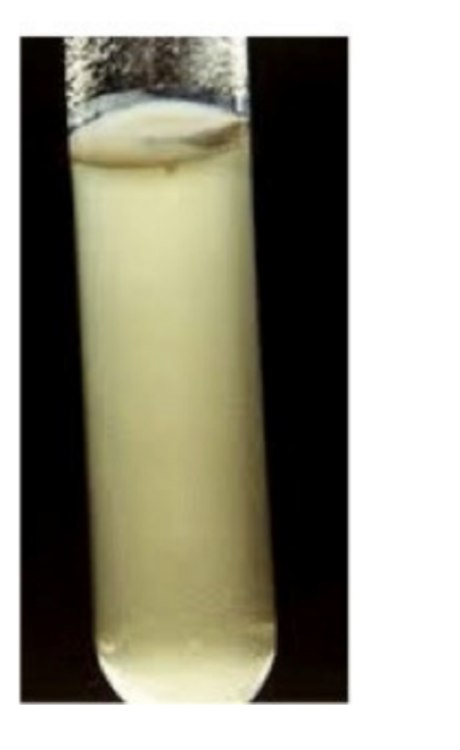
Based on the following image, would you expect the viral tither to be high or low? Why?
Low. The solution shows some cloudiness to it, meaning there is not a lot of bacterial cell lysis going on, so we would expect the viral titer to be low. The viral titer is the quantitative amount of virus present in a sample. Turbidity is a function of the number of intact bacterial cells present in the media, and because turbidity is low in this sample, we know that the bacterial cells are not readily undergoing lysis, thus meaning there are not many viruses present that are causing them to lyse, which would give rise to a low titer.
*More turbidity -> more intact bacterial cells
As the bacterial cells undergo lysis, the solution becomes clearer
Which of the following can be spread via airborne particles:
Measles
Mumps
Rubella
A and B
All of the above
All of the above
*Measles, mumps and rubella can be spread via airborne particles formed while coughing, sneezing, etc.
True or False: A patient infected with rubella is only considered infectious when the trademark rash is visible.
False.
*A patient infected with rubella is infectious one week before and one week after the appearance of the rash.
A patient diagnosed with German measles may additionally experience what disease? Select all that apply.
Impetigo
Conjunctivitis
Rheumatic fever
Inlfuenza-like symptoms
Conjunctivitis
Influenza-like symptoms
*A patient may experience a combination of symptoms such as fever, flu-like symptoms (influenza), cough, conjunctivitis, and a red blotchy skin rash.
Which of the following diseases does a linear, single-stranded RNA virus cause?
Measles
Mumps
Rubella
B and C
All of the above
All of thr above
What disease displays as a secondary characteristic swelling of the testes/ovaries and pancreas?
Mumps
Describe two ways chickenpox can be spread.
1. Through air-borne droplets (sneezing/coughing)
2. Or through direct contact with the blisters of an infected individual
True or False: The development of shingles is most often seen in an older adult population (>60 years old).
True
True or False: Similar to chickenpox, the blisters that appear with shingles can cover the entire body.
False
A person who has neither previously had chickenpox nor been administered the VZV vaccine is exposed to someone with an active VZV(shingles) outbreak and becomes infected. Explain why (or why not) the person will only develop shingles.
The infected individual will develop chickenpox, not shingles. Individuals who have never been exposed or vaccinated to the virus will develop chickenpox first since shingles is the reactivation of the dormant VZV virus from the initial chickenpox infection.
While traveling abroad, should you be worried about coming into contact with either the Variola major or Variola minor viruses?
No, you do not need to worry about coming into contact with these viruses. Both of these viruses are variants of smallpox and were eradicated in 1977.
What small (~30nm), single-stranded, non-enveloped RNA virus targets the CNS (central nervous system), causing potentially catastrophic damage to motor neurons?
Polio
By whom and where was the first polio vaccine developed?
The first polio vaccine was developed by Jonas Salk at the Univeristy of Pittsburgh in 1955
Which subtype of Influenza is the most virulent?
Influenza A
A drug company is trying to develop a new drug that will inhibit the release of newly produced virus particles. Would the drug company target hemagglutinin proteins or neuraminidase proteins? Why?
The drug company should target neuramindiase proteins because these are the proteins that are involved in the budding and release of new viral particles.
Hemagglutinin proteins are involved in viral attatchment and entry into the host cell, so these are not the best target proteins.
Explain why the flu shot given each year may not be 100% effective at preventing the flu?
The vaccine may not include all of the viral strains. Unfortunately, in a given season, there are many variants, and the flu vaccine doesn't vaccinate against all of them. The variants included in the flu vaccine are predicted based on current trends and available data relative to the most common circulating strains, but it is not always completely accurate, and you may have became infected with a strain that the flu vaccine did not vaccinate against.
True or False: The viral capsid of HIV is cone shaped and conatins ~2,000 copies of the viral protein p24.
True
The HIV surface glycoprotein gp41 binds what host cell receptor?
CD4
CXCR4
CD3
CXCR5
CXCR4
An individual infected with HIV is placed on anti-retroviral medication. What is the general purpose of this medication?
To inhibit the lifecyle of the retrovirus. Anti-retroviral medications inhibit certain steps in HIV's lifecycle. If the retrovirus cannot complete its lifecycle, new viral particles cannot be made and the viral load of the patient will be lower.