IGCSE Physics 1 | Motion, Forces, Energy
Scalar quality vs vector quality
A scalar quantity has magnitude(size) only and that a vector quantity has magnitude and direction.
Know that the following quantities are scalars:distance, speed, time, mass, energy and temperature.
Know that the following quantities are vectors: force, weight, velocity, acceleration, momentum, electric field strength and gravitational field strength
State that the acceleration of free fall
approximately constant and is approximately 9.8 m/s2
Calculate speed, acceleration, and distance from graphs
- Speed is the gradient of a distance-time graph
- Acceleration is the gradient of a speed-time graph
- Distance is area under a speed-time graph
Define acceleration and equation
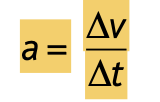
change in velocity per unit of time
change in velocity / change in time
terminal velocity
When the force of air resistance becomes equal to the force of weight, then the object stops accelerating and falls at a constant speed
Calculate impulse and change in momentum
define impulse
Impulse = change in momentum
Impulse = force (N) x time force acts
Momentum = mass x velocity
Change in momentum = (mass(kg) x final velocity) - (mass x initial velocity)
calculate force
Force = ma
mass x acceleration
calculate kinetic energy
KE = ½ mv2
Kinetic energy = ½ x mass x velocity2
Calculate density
ρ = m / V
density = mass / volume
Define specific latent heat of fusion an equations
The amount of thermal energy required to change the state of 1 kilogram of a substance from solid to liquid at its melting point, without changing the temperature.
E = mc(Δ)T
Energy = mass x heat capacity x change in temperature
Energy = mass x specific latent heat
calculate the amount of heat energy (E) required to change the temperature of a substance by a certain amount.
E = mc(Δ)T
Energy = mass x heat capacity x change in temperature
Define gravitational field strength, recall and use the equation
force per unit mass
g = W/m
gravitational field strength (N/kg) = weight (newtons) / mass (kg)
Define density, recall and use the equation
Mass per unit volume.
Density = m/v
Define the spring constant, recall and use the equation
force per unit extension. measures the stiffness of a spring, higher the k the more stiff
k = F/x
spring constant = Force / extension
Spring experiment
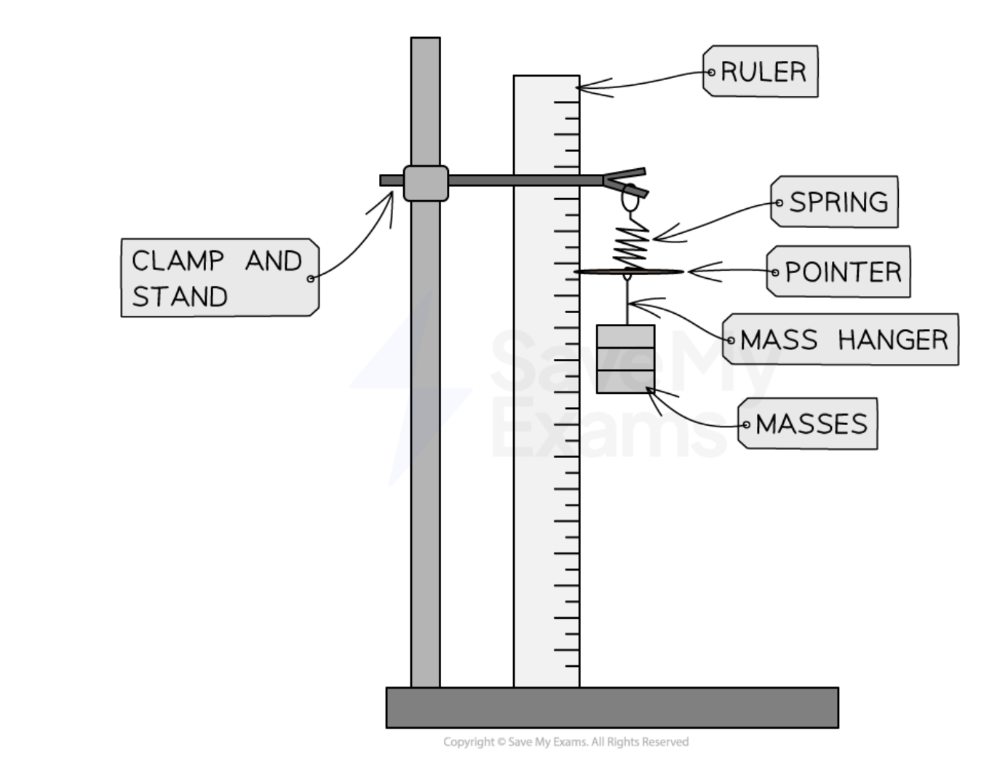
- Align the marker to a value on the ruler with no mass added to the spring, and record this initial length of the spring
- Add the 100 g mass hanger onto the spring
- Record the mass (in kg) and position (in cm) from the ruler now that the spring has extended
- Add another 100 g to the mass hanger
- Record the new mass and position from the ruler now that the spring has extended further
- Repeat this process until all masses have been added
- The masses are then removed and the entire process is repeated again until it has been carried out a total of three times, and an average length is calculated
- multiply each mass by gravitational field strength, g = 9.8 N/kg, to calculate the force, F
- plot it against extension to form a force-extension graph.
Rules for force perpendicular to an object in a circular path.
- A greater mass requires a greater force when the speed and radius are constant.
- A faster-moving object requires a greater force when the mass and radius are constant.
- A smaller radius requires a greater force to keep the speed and radius constant.
Describe solid friction
The force between two surfaces that may impede motion and produce heating.
Friction (drag) acts though a liquid or a gas.
Define a moment and the equation
A moment is the turning effect of a force. It acts around a pivot.
moment = force × perpendicular distance from the pivot
experiment for equilibrium of a moment
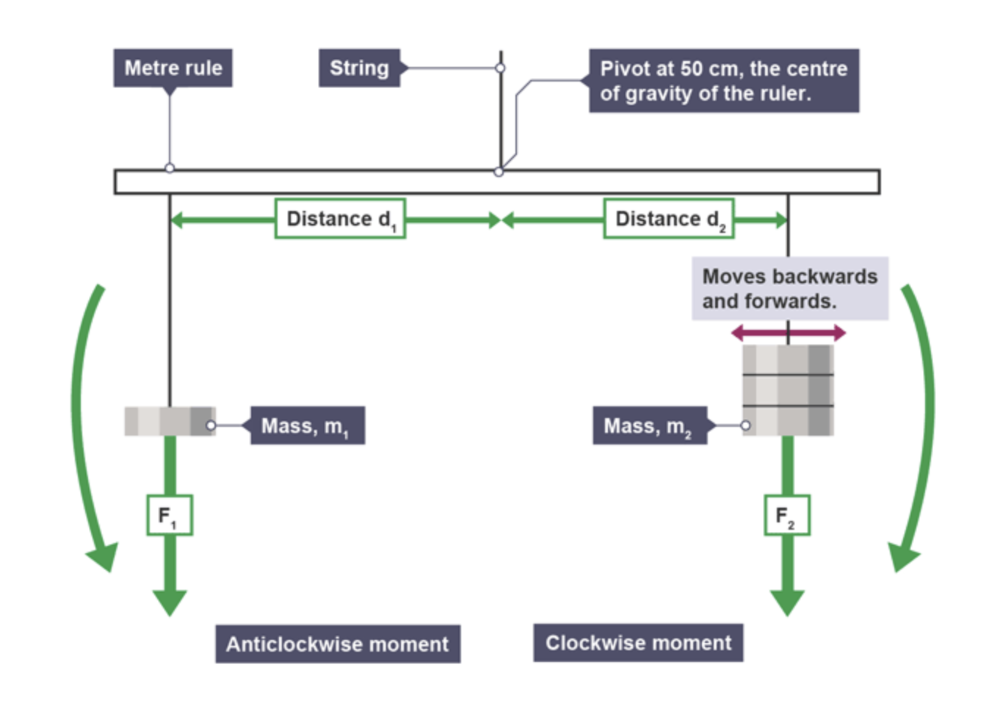
- Suspend the metre rule at the 50 cm mark so that it is balanced horizontally. The ruler is said to be in equilibrium. The 50 cm mark is the pivot.
- Suspend a mass, m1, from one side of the ruler a distance, d1, from the pivot. Read the distance d1 in cm. Record in a suitable table. Record the value of mass m1 in kg in the table too.
- Suspend a second mass, m2, from the other side of the pivot. Carefully move this mass backwards and forwards until the ruler is once more balanced horizontally. Record the distance and mass in the table too.
- Repeat several times using different masses and distances.
- Calculate the turning forces, F1 and F2, using W = mg.
- Calculate the clockwise and anticlockwise moments.
State what is meant by centre of gravity
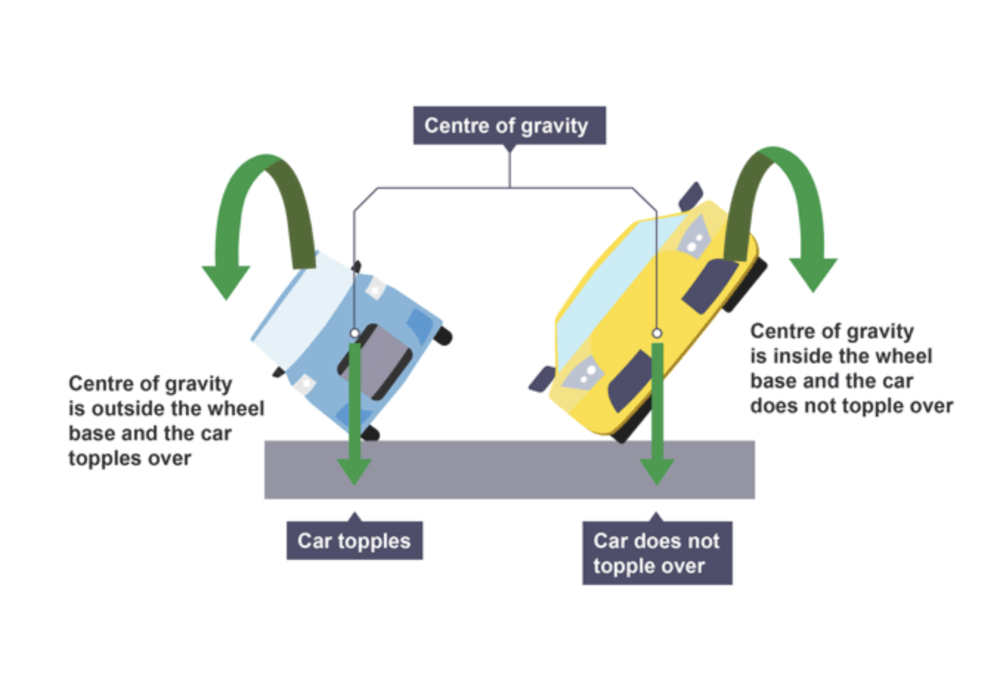
The point through which the weight of an object acts.
An object will topple over if its centre of gravity is 'outside' the base, or edge, on which it balances.
Describe an experiment to determine the position of the centre of gravity of an irregularly shaped plane lamina.
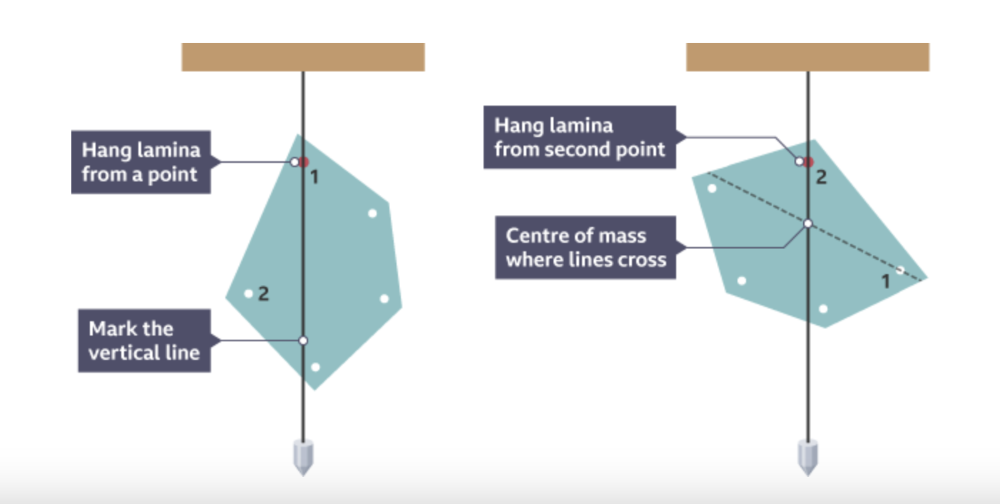
- A small hole is made at the top of the plane lamina.
- The plane lamina is hung from this hole to allow it to pivot.
- The plumb line is also hung from here and will fall vertically downwards.
- A dotted line is draw along the plumb line to the mass.
- The second hole can be made anywhere close to the edge of the shape and does not specifically need to be at the bottom.
- The above steps are repeated.
- The centre of gravity is where the lines cross.
Define resultant force, recall and use the equation
The change in momentum per unit time.
F = ∆p/∆t
Resultant force = change in momentum / change in time
Types of energy stores
kinetic, gravitational potential, chemical, elastic (strain), nuclear, electrostatic and internal (thermal)
Recall and use the equation for the change in gravitational potential energy
change in gravitational potential energy (J) = mass x acceleration due to gravity x change in height (m)
Recall and use the equation for Work done (J)
W = Fd = ∆E
Work done (J) = Force x displacement = Energy change (J)
Describe how useful energy may be obtained
(a) chemical energy stored in fossil fuels
(b) chemical energy stored in biofuels : Biofuels are derived from renewable plant materials. Similar to fossil fuels, they contain stored chemical energy that can be released through combustion which can then be used to drive turbines and generate electricity.
(c) water, including the energy stored in waves, in tides, and in water behind hydroelectric dams
(d) geothermal resources : generate steam, which drives turbines and produces electricity.
(e) nuclear fuel : Nuclear energy is obtained by splitting atoms (fission) in nuclear reactors. The energy released during this process is used to heat water, which then generates steam to drive turbines and produce electricity.
(f) light from the Sun to generate electrical power (solar cells) : using photovoltaic cells.
(g) infrared and other electromagnetic waves from the Sun to heat water (solar panels) and be the source of wind energy
when a turbine, powered by falling water, wind, or steam from boiling water, spins a generator, which converts this mechanical motion into electrical energy.
Nuclear fission vs. fusion
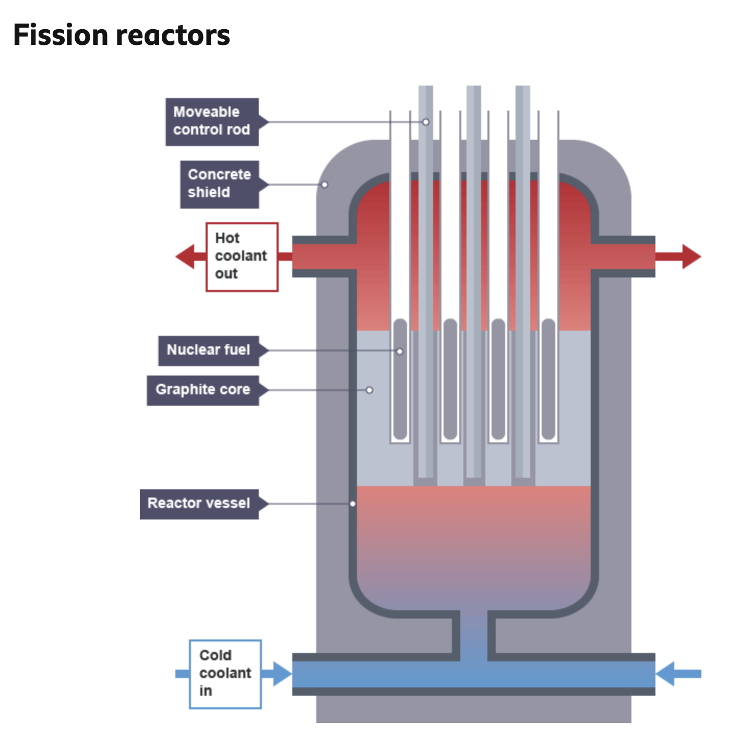
Fission: Uranium or plutonium isotope that will split when triggered by an incoming neutron.
Nuclear fusion is when two small, light nuclei join together to make one heavier nucleus. Fusion reactions occur in stars where, for example, two hydrogen nuclei fuse together under high temperatures and pressure to form a nucleus of a helium isotope. Energy is released by nuclear fusion in the Sun.
Energy efficiency equations
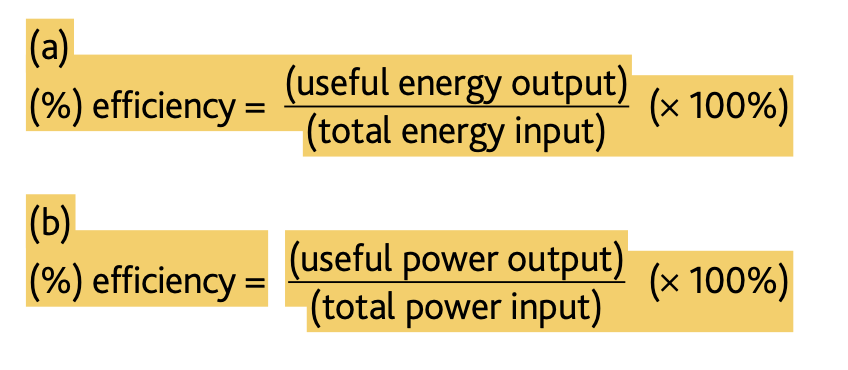
2 power definitions and equations
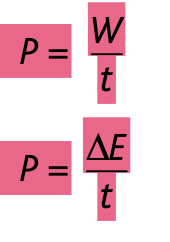
Define power as work done per unit time and also as energy transferred per unit time.
Define pressure, recall and use the equation
as force per unit area
Pressure = force/area
Recall and use the equation for the change in pressure beneath the surface of a liquid
change in pressure beneath the surface of a liquid (Pascals (Pa) = density x acceleration due to gravity x change in height
Define mass
a measure of the quantity of matter in an object at rest relative to the observer
Define weight
a gravitational force on an object that has mass
Define ‘limit of proportionality
the point on a force-extension graph where force and extension are no longer directly proportional
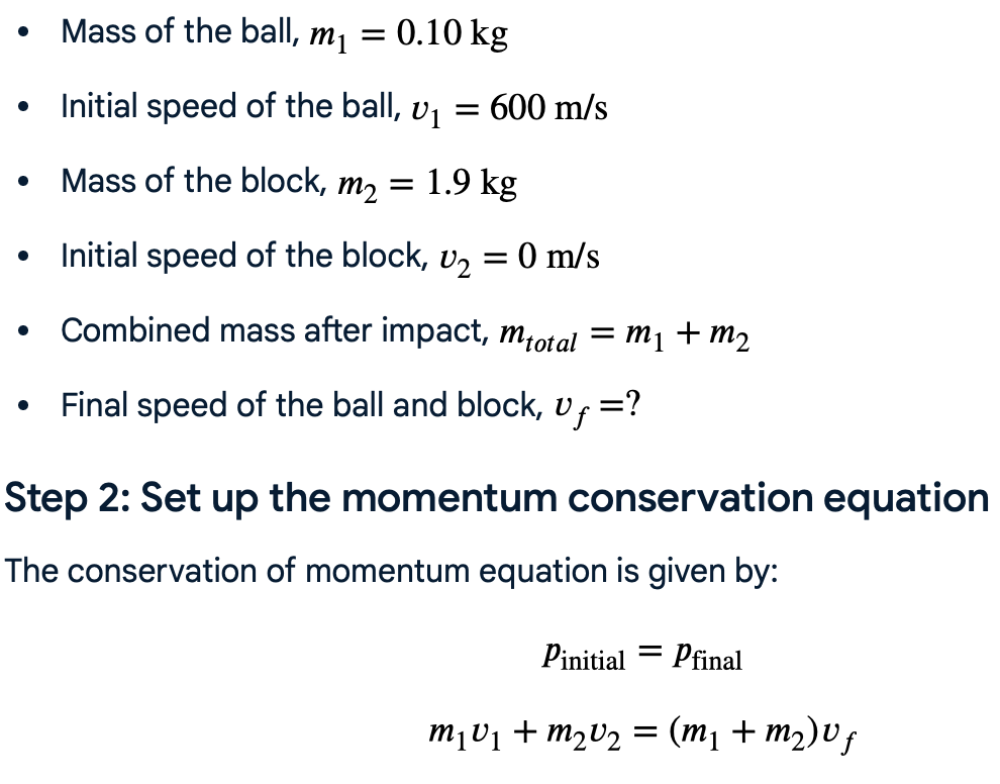
How to calculate change in speed when an object is moving towards another with force and they move off together as one.