Solution-Focused Therapy Overview
Strength-building model
- Clients are assumed to have the necessary capacities to solve their own problems.
- Focus of treatment is bolstering motivation and resources.
- When deficits are identified as a substantial barrier to change, then skill building is introduced.
Helping process
Engagement, problem exploration, solution exploration, goal setting, taking action, and termination.
Solution focused therapy
- Influenced by the philosophies of constructivism and social constructionism.
- Language is used to influence the way
clients view their problems.
- Help them see the potential for solutions.
- Create an expectancy for change.
- Development of solutions derived from non-problem times rather than a problem focus.
Constructivism
Reality does not exist as an objective phenomenon; instead, it is a mental construction comprised from the assumptions that people hold about themselves and the world.
Social constructionism
Mental constructions are formed through social interaction.
Milton Erickson
- Believed individuals possess the strengths and resources to resolve their problems and that the practitioner’s job is to help clients discover these resources and activate them.
- Involves amplification of symptomatic behavior through the use of paradoxical directives.
Strengths-based perspective
- Strengths, abilities, and resources are emphasized.
- Resources found by eliciting and exploring times when the problem does not exert its negative influence and/or when the client has coped successfully.
- Attention is oriented to a future without the problem to build vision, hope, and motivation for the client.
- Extensive history not necessary because understanding the past will not change the future with- out action.
Exception-finding
Past is explored only for exception finding; conversation aimed to discover how these exceptions—when problems do not occur—can be applied in the future.
Solution-focused therapy assumptions
- Small change is all that is necessary as a “spiral effect” takes place.
- Behaving differently and thinking differently are part of the processes of change.
- No one holds the objective truth, individuals are valued for their unique perspectives, with the right to determine their own goals
Evidence basis
- Assumptions underlying constructivism, such as the importance of subjec- tive meaning and the use of language to form meaning, are antithetical to the positivist, quantitative roots of treatment outcome research.
- Five well-controlled studies identified showed positive outcomes for solution focused therapy.
Use of language to influence perception
- Place problems in the past as if they are no longer exerting their negative influence.
- For example, “So you were losing your temper?” replaces “So you lose your temper?”
- The implication is that change is already in process.
- Social constructivist roots: language is the medium by which reality is shaped.
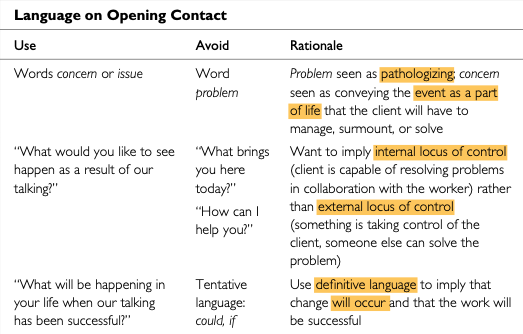
Definitive Phrasing
- Employment of words such as when and will implies that change will occur.
- “When you are better, what will you be doing?”
Possibility Phrasing
- Use of words such as if and could is used only for the purposes of preparing clients to prevent further problems.
- “If you feel the urge to use drugs, what could you do to prevent it from going any further?”
Joining Process
- Assessing the relationship the client has with the helping process.
- Solution- focused therapy acknowledges the different reasons clients may present for treatment and services.
- Uses idiosyncratic language, relationship questions, and complimenting.
- Three different client relationships are posed within the model: the customer, the complainant, and the visitor.
The Customer
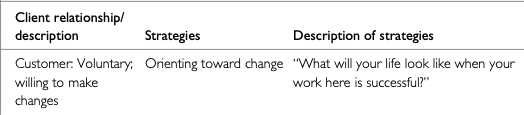
- The client who is motivated and willing to participate in the change process.
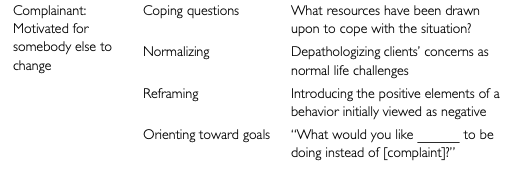
The Complainant
- Motivated chiefly for change in another person rather than for change in the self.
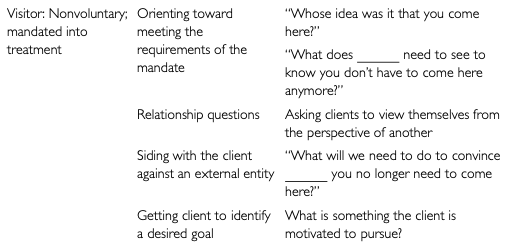
The Visitor
- Typically unmotivated and is attending only because he or she has been mandated to do so.
Language on Opening Contact
Strategies to engage clients: Customer
Strategies to engage clients: Complainant
Strategies to engage clients: Visitor
Strategies to engage clients: All
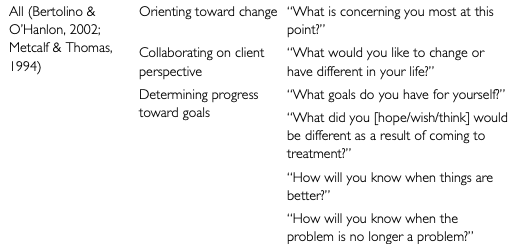
Encouraging Collaboration
- “What will indicate to you that coming here has been successful?”
- “How will you know when you no longer need to come here?”
- “What will be happening that will indicate to you that you can manage things on your own?” (Bertolino & O’Hanlon, 2002, pp. 83, 91)
- “What ideas do you have about how I can help you?”
- “In what ways do you see me helping you reach your goals?”
- “Are there certain things that you want to be sure that we talk about?”
- “How has this conversation been helpful?”
- “In your opinion, do we need to meet again?” (to further empower the client regarding the continuation of therapy based on his/her choice)
- “How will you know when we can stop?” (a collaborative question to define client criteria for termination)
- “What did we do today that you felt make a difference?” (to learn what is instigating change and what is helpful in the process)
Idiosyncratic Language
- Practitioners should attune themselves to the idiosyncratic phrasing of the client and adopt this language.
- Clients feel understood when the worker uses their language.
- Professional jargon should be avoided as it emphasizes the practitioner’s “expert” role instead of allowing clients to be the experts on their own lives.
Relationship Questions
- Relationship questions ask clients to view themselves from the perspective of another.
- Derived from the family systems therapy intervention of circular questioning.
- Nonthreatening to clients because the questions are posed in such a way that one comments on a situation from the view of an outside observer.
- Added advantage of allowing people to increase their ability to take on other people’s perspectives and see the impact of their behavior on other people.
Compliments
- Clients may feel defensive when they first see a practitioner, expecting to be judged and criticized.
- Enhances their cooperation rather than defensiveness and resistance.
- Clients are usually more willing to search for, identify, and amplify solution patterns.
- Should be generous with compliments throughout the change process to reinforce the strengths and resources that individuals display.
Indirect Complimenting
- Positive traits and behaviors are implied.
- Examples: “How were you able to do that?” or “How did you figure that out?”