Ch.9 BICH
Lipids and proteins are mobile, and can
diffuse laterally in the membrane
Saturated fatty acids are saturated with hydrogens which means
they have all single bonds
meaning of (n:x)
-n=
-x=
-number of carbons
-amount of double bonds
What is the structure of myristic acid?
(14:0)
What is the structure of palmitic acid?
(16:0)
What is the structure of stearic acid?
(18:0)
Unsaturated fatty acid have
double bonds
Oleic acid structure____
(18:1)
Linoleic acid structure ___
(18:2)
Arachidonic acid structure___
(20:4)
Δx
x means its the location of the double bonds
Double bonds are cis and
unconjugated
When unsaturated fatty acids have one or more unconjugated double bonds,
the fatty acid can not fully extend
Saturated chains optimally pack tightly and form
more stable, rigid, ordered aggregates
Unsaturated chains bend and pack in a less ordered way with greater potential
greater potential for motion
Higher order means more stability and higher
melting temperature, Tm
Triacylglycerols (TAG's) are considered to be
1. The most reduced form of carbon in nature (oxidation releases energy)
2. No solvation with water (dehydrated, weighs less)
3. Efficient packing (not just because dehydrated, also van Der Waals)
TAG's are a major
energy source for many organisms
Most fatty acids in plants and animals exist in the form of
triacylglycerols
If all fatty acids are the same, the molecule is called a
simple triacylglycerol
If two or three fatty acids are different, it is called
mixed triacylglycerols
a 1,2-diacylglycerol that has a phosphate group esterified at C3 of the glycerol backbone is a
glycerophospholipid
Glycerophospholipid are ____lipids and are essential components of cell membranes
structural
All head groups start with
-OH groups
Look at table 9-2
Phospholipases A1 and A2 cleave fatty acids from glycerophospholipids producing
lysophospholipids
Phospholipases C and D hydrolyze on either side of the phosphate in
the polar head group
Phospholipids play important roles such as
giving chemical signals in and on cells
Lipid signals act _______, and have short lifetimes
locally within or near the cell
Ether glycerophospholipids (PAF) properties:
1. a potential mediator in inflammation, allergic response, and shock
2. Has a beneficial effect on toxic shock syndrome
3. involved in implantation of the egg in the uterine wall
4. stimulates production of fetal lung surfactant
Sphingolipids are frequently present in
animal cell membranes
Has 18-carbon alcohol, forms the backbone of these lipids
sphingosine
A fatty acid that is joined to sphingosine is linked in
amide group and is called a ceramide
Are ceramides with one or more sugars in beta glycosidic linkage at the hydroxyl group
Glycosphingolipids
Glycosphingolipids with one sugar and a single sugar headgroup
cerebrosides
Glycosphingolipids with 3 or more sugars, and one of which is a sialic acid
Gangliosides
Sphingolipids increase Tm, and
pack together well
Terpenes are a class of lipids formed from combinations of
isoprene units
Isoprene units have two possible linkages
1) head-to-tail
2) tail-to-tail
Steroids are isoprene-based molecules built on a core structure of
three 6-membered ring and one 5-membered ring fused together
What is the most common steroid in animals and precursor for all other steroids?
Cholesterol
What are the functions of steroid hormones?
salt balance, metabolic and sexual function
Cortisol provides control of
carbohydrates, protein, and lipid metabolism
testosterone is
the primary male sex steroid hormone
Estradiol is
the primary female sex steroid hormone
Progesterone is a precursor of
testosterone and estradiol
Bile salts/acids including cholic and deoxycholic acid are
detergent molecules secreted in bile from the gallbladder
Are insoluble in water, and serve as water repellant
waxes
Classes of lipids
1. Triacylglycerols: energy storage; fats
2. Glycerophospholipids: structural and signaling
3. Sphingolipids: structural
4. sterols (terpenes): structural and signaling
Functions of membranes :
- barrier to toxic molecules
- Transport and accumulation of nutrients
- energy transduction
- facilitation of cell motion
-reproduction
- signal transduction
-cell-cell interactions
Biological membranes contain as much as ______% protein or as little as _____% protein
75-80%, 15-20%
Lipids self-associate to form membranes because of
hydrophobic effect
Lipids spontaneously form ordered structures in
water
What is the phospholipid bilayer?
fluid matrix
Two classes of proteins:
-peripheral proteins( extrinsic )
-integral proteins ( intrinsic )
Slow transverse diffusion of lipids and proteins ______. By contrast lateral diffusion is ______.
preserves membrane asymmetry, rapid
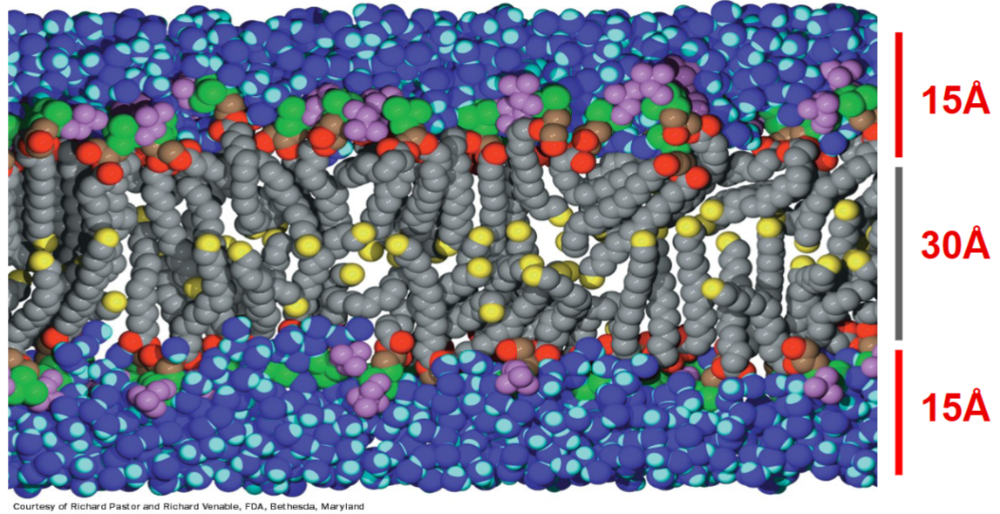
Bilayer core dimensions
Peripheral membrane proteins:
-can be dissociated with high salt concentration
- insert hydrophobic loop or amphiphilic alpha helix
- form ionic interactions and H bonds
Integral membrane proteins are strongly embedded in lipid bilayer and
-can be removed from the membrane by denaturing
- secondary structure neutralizes the highly polar N-H and C=O functions of the peptide backbone through H-bond formation
Transmembrane segment is alpha-helical and consists of
19 hydrophobic acids
Bacteriorhodopsin (bR) is found in ____ and consists of____
purple patches of Halobacterium, 7 transmembrane helical segments
The sequence of a transmembrane protein is adapted to the transition from water to the
hydrophobic core and then to water again
Trp, His, and Tyr are mixtures of
polar and non-polar parts
Each alpha helix requires____ per transmembrane strand. Each beta strand requires only ___ per transmembrane strand.
21-25, 9-11
Four types of lipid-anchored proteins:
1. Amide-linked myristoyl anchors
2. Thioester-linked fatty acid anchors
3. Thioether-linked prenyl anchors
4. Glycosyl phosphatidylinositol anchors
Amide-linked myristoyl anchors are always linked to the alpha-amino N of Gly residue and
always myristic acid and N-terminal
Thioester-linked and acyl anchors are always linked to Cys and
myristate, palmitate, stearate, and oleate
Ethanolamine link to an oligosaccharide linked in turn to
inositol of phosphatidyl inositol (PI)
Always attached to a C-terminal carboxyl group of a recognized sequence,
GPI-linked proteins are found on the cell surface where oligosaccharide links are found
Membranes are asymmetric structures
1. Lateral Asymmetry of Proteins
2. Lateral Asymmetry of Lipids
3. Transverse Asymmetry of Proteins
4. Transverse Asymmetry of Lipids
ATP flipases move PS from the
outer leaflets to the inner leaflets: "flip in"
ATP flopases move lipids including cholesterol, PC< and sphingomyelin from the
inner leaflets to the outer leaflet of the membrane: "flop out"