Geometry
Point
An exact location on a line, in a plane or in a space.
Line
A straight path of many points that goes on forever in two directions.
Line Segment
A part of a line that has two end points.

Ray
A part of a line that goes on forever in one direction.

Plane
A flat surface of points that goes on in all directions and is named by three points.

Angle
Two rays with the same end point.
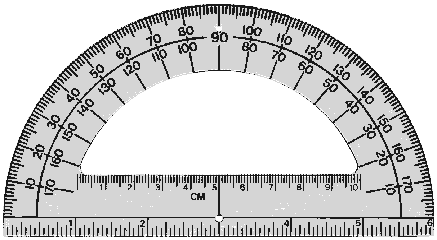
Protractor
A tool used to measure angles.
*
Degree
The unit used to measure the size of an angel.

Right Angle
An angel that measures 90* and forms a square corner.

Acute Angle
An angle that measures less than 90* (cute!)

Obtuse Angle
An angle that measures more than 90* (fat!)
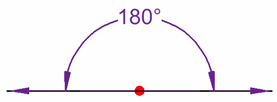
Straight Angle
An angle that measures exactly 180* (line)

Intersecting Lines
Lines that cross each other to form 4 angles.

Parallel Lines
Lines in a plane that never intersect and are ALWAYS the same distance apart.
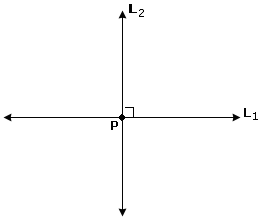
Perpendicular Lines
Lines in a plane that meet and form a RIGHT angle.
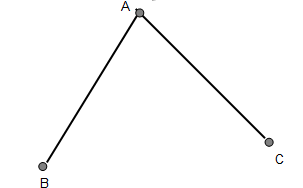
Vertex
The point at which two rays meet to form an angle.

Polygon
A closed plan figure with straight sides.

Triangle
A polygon with three sides.
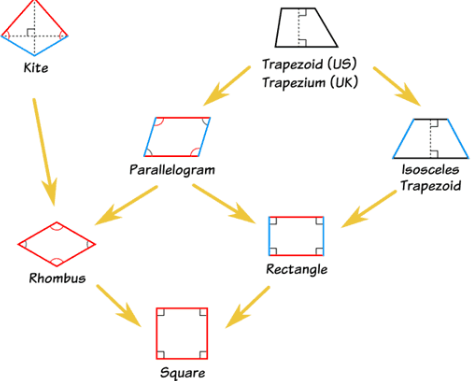
Quadrilateral
A polygon with four sides.
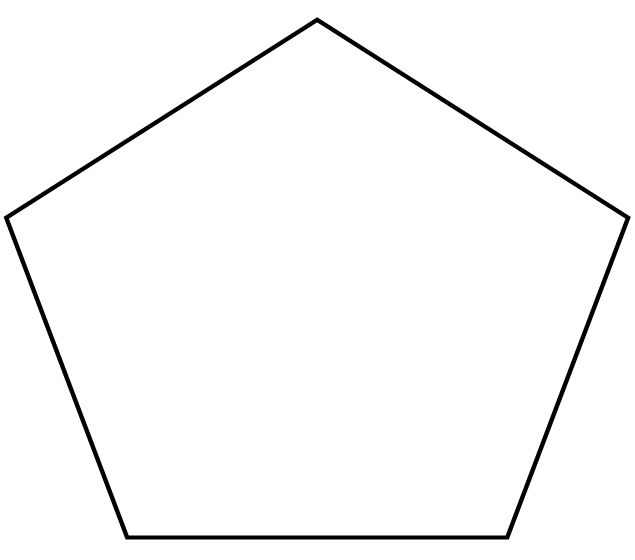
Pentagon
A polygon with five sides.
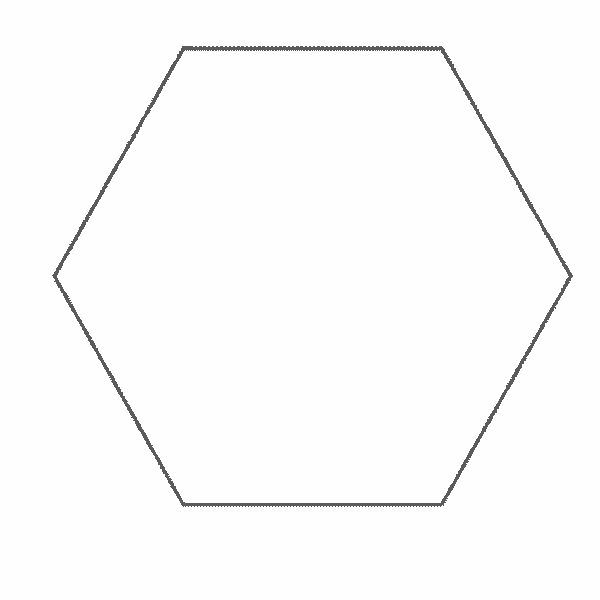
Hexagon
A polygon with six sides.

Octagon
A polygon with eight sides.
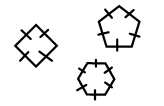
Regular Polygon
A polygon where all sides and angles are equal.
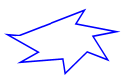
Irregular Polygon
A polygon where all angles and sides are not equal.
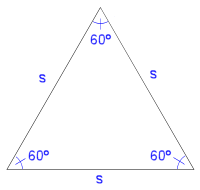
Equilateral Triangle
A triangle with three equal sides.
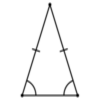
Isosceles Triangle
A triangle with three equal sides.
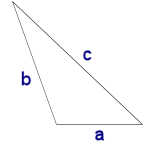
Scalene Triangle
A triangle with no equal length sides.

Right Triangle
A triangle with one right angle.

Acute Triangle
A triangle with 3 acute angles.
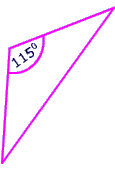
Obtuse Triangle
A triangle with 1 obtuse angle.
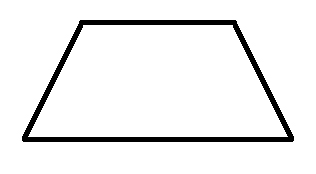
Trapezoid
A quadrilateral with exactly one pair of parallel lines.

Venn Diagram
A diagram that shows relationships (how things are the same and different) between things.

Line Symmetry
What a figure has if it can be folded along a line so that both sides match perfectly.

Rotational Symmetry
What a figure has if it can be turned around a central point and still look the same in two positions.
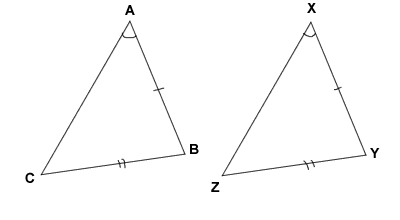
Congruent
Having the same size and shape.

Similar
Having the same shape but different size.
(7,6)
Ordered Pair
Two numbers that are used to locate a point on a coordinate grid.
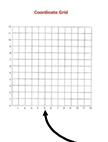
X-Axis
The horizontal line on a coordinate grid. (like a bed)
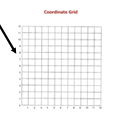
Y-Axis
The vertical side of a coordinate grid. (Think, a pillar)

X-Coordinate
The first number in an ordered pair.

Y-Coordinate
The second number in an ordered pair.
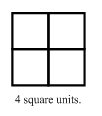
Area
The space inside of a shape. It is measured in square units. The formula is a= l x w (area = length x width)
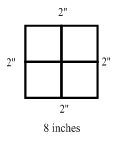
Perimeter
The the sum of all of the sides.

Cone
a solid, pointed figure that has a flat round base.
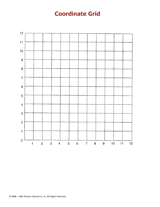
Coordinate Grid
A grid formed by a horizontal line called the x-axis and a vertical line called the y-axis.
Cube
A solid figure with six congruent square faces
Cylinder
A solid figure that is shaped like a can.
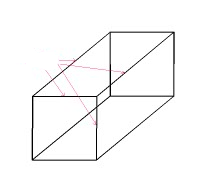
Edge
The line segment where two or more faces of a solid figure meet.
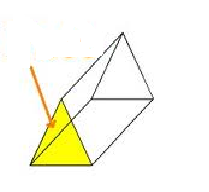
Face
A polygon that is the flat surface of a solid figure.
Net
A two-dimensional (flat) pattern that can be foled to make a three-dimensional figure.
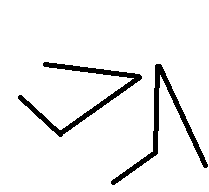
Open figure
A figure that does not begin and end at the same point.
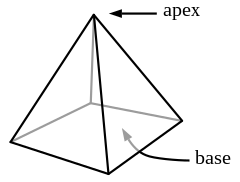
Square Pyramid
A solid figure with a square base and four triangular sides that meet at a single point.

Rectangular Prism
A solid figure in which all six faces are rectangles.

Sphere
A round object whose curved surface is the same distance from the center to all its points.

Triangular Prism
A solid figure that has two triangular bases and three rectangular bases.