Instructions for Side by Side Printing
- Print the notecards
- Fold each page in half along the solid vertical line
- Cut out the notecards by cutting along each horizontal dotted line
- Optional: Glue, tape or staple the ends of each notecard together
biology
front 1 Which of the following terms most precisely describes the cellular process of breaking down large molecules into smaller ones? A) metabolism B) catabolism (catabolic pathways) C) anabolism (anabolic pathways) D) dehydration | back 1 correct answer : B catabolism (catabolic pathways) |
front 2 Which of the following statements about anabolic pathways is true? A) They consume energy to build up polymers from monomers. B) They are usually spontaneous chemical reactions. C) They release energy by degrading polymers to monomers D) They decrease the entropy of the organism and its environment | back 2 correct answer : A They consume energy to build up polymers from monomers. |
front 3 The mathematical expression for the change in free energy of a system is ΔG = ΔH - T ΔS. Which of the following statements is correct? A)ΔS is the change in enthalpy, a measure of randomness. B) ΔG is the change in free energy. C) T is the temperature in degrees Celsius D) ΔH is the change in entropy, the energy available to do work. | back 3 correct answer: B ΔG is the change in free energy. |
front 4 Which of the following statements is true for a system at chemical equilibrium? A)The system releases energy at a steady rate. B)The system consumes energy at a steady rate. C)The system can do no work. D)The kinetic energy of the system is zero. | back 4 correct answer : C The system can do no work. |
front 5 Which of the following statements is true for all exergonic reactions? A)The reaction goes only in a forward direction: all reactants will be converted to products, but no products will be converted to reactants. B)A net input of energy from the surroundings is required for the reactions to proceed. C)The reaction proceeds with a net release of free energy. D)The products have more total energy than the reactants. | back 5 correct answer : C The reaction proceeds with a net release of free energy. |
front 6 A chemical reaction that has a positive ΔG is best described as _____. A) exergonic B) spontaneous C) endergonic D) enthalpic | back 6 correct answer: C endergonic |
front 7 Chemical equilibrium is relatively rare in living cells because metabolic pathways are interconnected. Which of the following statements describes an example of a reaction that may be at chemical equilibrium in a cell? A) an exergonic reaction in which the entropy change in the cell is precisely balanced by an opposite entropy change in the cell's surroundings B) a chemical reaction in which neither the reactants nor the products are being produced or consumed in any metabolic pathway at that time in the cell C) an exergonic reaction in which the free energy at equilibrium is higher than the energy content of the reaction at any point away from equilibrium D) endergonic reaction in an active metabolic pathway where the energy for that reaction is supplied only by heat from the environment | back 7 correct answer: B a chemical reaction in which neither the reactants nor the products are being produced or consumed in any metabolic pathway at that time in the cell |
front 8 Why do hydrolysis reactions occur more readily in solution than dehydration reactions? A)Hydrolysis reactions increase G, or Gibbs free energy of the system. B)Hydrolysis reactions are endergonic and increase entropy of the system. C)Hydrolysis reactions are exergonic and decrease entropy of the system. D)Hydrolysis reactions are exergonic and increase entropy of the system. | back 8 correct answer: D Hydrolysis reactions are exergonic and increase entropy of the system. |
front 9 What type of reaction breaks the bonds that join the phosphate groups in an ATP molecule? A) anabolism b) entropic C) dehydration synthesis D) dehydration decomposition E) hydrolysis | back 9 correct answer: E hydrolysis |
front 10 Which of the following statements describes a central role that ATP plays in cellular metabolism? A) Hydrolysis of the terminal phosphate group stores free energy that is used for cellular work. B) Hydrolysis of ATP provides an input of free energy for exergonic reactions. C) ATP provides energy coupling between exergonic and endergonic reactions. D) Its terminal phosphate bond is stronger than most covalent bonds in other biological macromolecules. | back 10 correct answer : C ATP provides energy coupling between exergonic and endergonic reactions. |
front 11 When chemical, transport, or mechanical work is done by an organism, what happens to the heat generated? A) It is lost to the environment. B) It is captured to store energy as more ATP. C) It is used to power yet more cellular work. D) It is used to generate ADP from nucleotide precursors. | back 11 correct answer: A It is lost to the environment. |
front 12 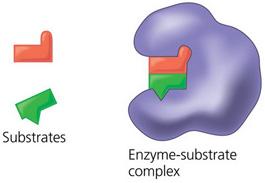 Which statement about the binding of enzymes and substrates is correct? A) Substrate molecules fit into the active site of an enzyme like a key fits into a lock. B) Substrate molecules bind to the active site of the enzyme only by weak bonds, such as hydrogen bonds or hydrophobic attraction. C) When substrate molecules bind to the active site of the enzyme, the enzyme undergoes a slight change in shape. | back 12 correct answer : C When substrate molecules bind to the active site of the enzyme, the enzyme undergoes a slight change in shape. |
front 13 How does an enzyme increase the rate of the chemical reaction it catalyzes? A) An enzyme’s active site binds only the reactants, and not the products of a reaction, pushing the equilibrium for the reaction far to the right. B) An enzyme reduces the free energy of activation (EA) of the reaction it catalyzes. C) An enzyme reduces the free-energy change (ΔG) of the reaction it catalyzes. | back 13 correct answer : B An enzyme reduces the free energy of activation (EA) of the reaction it catalyzes. |
front 14 Which of the following statements about the role of ATP in cell metabolism is true? A) The free energy released by ATP hydrolysis has a much more negative ΔG value than the hydrolysis of phosphate groups from other phosphorylated molecules. B) The phosphate bonds of ATP are unusually strong bonds. C) The energy from the hydrolysis of ATP may be directly coupled to endergonic processes by the transfer of the phosphate group to another molecule. | back 14 correct answer : C The energy from the hydrolysis of ATP may be directly coupled to endergonic processes by the transfer of the phosphate group to another molecule. |
front 15 Some bacteria are metabolically active in hot springs because? A) They use molecules other than proteins or RNAs as their main catalysts. B) High temperatures make catalysis unnecessary. C) Their enzymes have high optimal temperatures. D) Their enzymes are completely insensitive to temperature. E) They are able to maintain a lower internal temperature. | back 15 correct answer : C Their enzymes have high optimal temperatures. |
front 16 If an enzyme in solution is saturated with substrate, the most effective way to obtain a faster yield of products is to? A) add more of the enzyme. B) heat the solution to 90°C. C) add an allosteric inhibitor. D) add a noncompetitive inhibitor. E) add more substrate. | back 16 correct answer : A add more of the enzyme. |
front 17 Which of the following metabolic processes can occur without a net influx of energy from some other process? A) ADP + P i → ATP + H2O B) 6 CO2 + 6 H2O → C6H12O6 + 6 O2 C) amino acids → protein D) glucose + fructose → sucrose E) C6H12O6 + 6 O2 → 6 CO2 + 6 H2O | back 17 correct answer : E C6H12O6 + 6 O2 → 6 CO2 + 6 H2O |
front 18 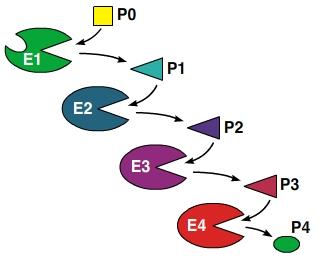 Which of the following statements is most likely to be true in the case of the feedback-regulated enzymatic pathway shown? A) P0 binds E4 and activates it. B) P2 binds E2 and activates it. C) P4 binds E1 and deactivates it. D) P3 binds E2 and activates it E) P4 binds E3 and deactivates it. | back 18 correct answer : C P4 binds E1 and deactivates it. |
front 19 What is the name of the thermodynamic barrier that must be overcome before products are formed in a spontaneous reaction? A) activation energy B) free energy C) entropy D) the equilibrium point | back 19 correct answer : A activation energy |
front 20 During a laboratory experiment, you discover that an enzyme-catalyzed reaction has a ∆G of -20 kcal/mol. If you double the amount of enzyme in the reaction, what will be the ∆G for the new reaction? A)-20 kcal/mol B)-10 kcal/mol C)+20 kcal/mol D)-40 kcal/mol | back 20 correct answer : A -20 kcal/mol |
front 21 Zinc, an essential trace element for most organisms, is present in the active site of the enzyme carboxypeptidase. The zinc most likely functions as _____. A) a noncompetitive inhibitor of the enzyme B) an allosteric activator of the enzyme C) a cofactor necessary for enzyme activity D) a coenzyme derived from a vita | back 21 correct answer : C a cofactor necessary for enzyme activity |
front 22 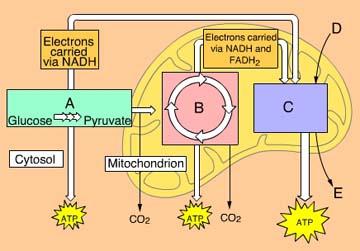 What process occurs in Box A? A) electron transport and oxidative phosphorylation B) the citric acid cycle C) glycolysis D) oxidative phosphorylation E) electron transport | back 22 correct answer : C glycolysis |
front 23 What process occurs within Box B? A) glycolysis B) electron transport C) oxidative phosphorylation D) the citric acid cycle E) photophosphorylation | back 23 correct answer : D the citric acid cycle |
front 24 What molecule is indicated by the letter D? A) water B) glucose C) pyruvate D) oxygen E) ATP | back 24 correct answer : D oxygen |
front 25 Which of the summary statements below describes the results of the following reaction? C6H12O6 + 6 O2 → 6 CO2 + 6 H2O + Energy? A) O2 is oxidized and H2O is reduced. B) O2 is reduced and CO2 is oxidized. C) C6H12O6 is oxidized and O2 is reduced. D) CO2 is reduced and O2 is oxidized. | back 25 correct answer : C C6H12O6 is oxidized and O2 is reduced. |
front 26 Which of the following statements about NAD+ is true? A) NAD+ is reduced to NADH during glycolysis, pyruvate oxidation, and the citric acid cycle. B) NAD+ can donate electrons for use in oxidative phosphorylation. C) NAD+ has more chemical energy than NADH. D) In the absence of NAD+, glycolysis can still function. | back 26 correct answer : A NAD+ is reduced to NADH during glycolysis, pyruvate oxidation, and the citric acid cycle. |
front 27 The oxygen consumed during cellular respiration is directly involved in which of the following processes or events? A) accepting electrons at the end of the electron transport chain B) glycolysis C) the citric acid cycle D) the oxidation of pyruvate to acetyl CoA | back 27 correct answer : A accepting electrons at the end of the electron transport chain |
front 28 Why are carbohydrates and fats frequently considered high-energy foods? A) They contain no nitrogen atoms. B) They contain many oxygen atoms. C) They contain many electrons associated with hydrogen atoms. D) They are strong oxidizing molecules. | back 28 correct answer : C They contain many electrons associated with hydrogen atoms. |
front 29 How many NADH are produced by glycolysis? A) 3 B) 1 C) 4 D) 5 E) 2 | back 29 correct answer : E 2 |
front 30 In glycolysis, ATP molecules are produced by _____.? A) photophosphorylation B) cellular respiration C) oxidative phosphorylation D) photosynthesis E) substrate-level phosphorylation | back 30 correct answer : E substrate-level phosphorylation |
front 31 Which of these is NOT a product of glycolysis? A) FADH2 B) pyruvate C) NADH D) ATP | back 31 correct answer : A FADH2 |
front 32 In glycolysis, what starts the process of glucose oxidation? A) ADP B) hexokinase C) ATP D) NADPH E) FADH2 | back 32 correct answer : C ATP |
front 33 In glycolysis there is a net gain of _____ ATP. A) 4 B) 3 C) 5 D) 1 E) 2 | back 33 correct answer : E 2 |
front 34 Substrate-level phosphorylation accounts for approximately what percentage of the ATP formed by the reactions of glycolysis? A) 38% B) 100% C) 2% D) 0% | back 34 correct answer : B 100% |
front 35 The free energy for the oxidation of glucose to CO2 and water is -686 kcal/mol, and the free energy for the reduction of NAD+ to NADH is +53 kcal/mol. Why are only two molecules of NADH formed during glycolysis when it appears that as many as a dozen could be formed? A) Glycolysis is a very inefficient reaction, with much of the energy of glucose released as heat. B) Most of the free energy available from the oxidation of glucose is used in the production of ATP in glycolysis. C) There is no CO2 or water produced as products of glycolysis. D) Most of the free energy available from the oxidation of glucose remains in pyruvate, one of the products of glycolysis. | back 35 correct answer : D Most of the free energy available from the oxidation of glucose remains in pyruvate, one of the products of glycolysis. |
front 36 Starting with one molecule of glucose, glycolysis results in the net production of which of the following sets of energy-containing products? A) 6 CO2, 2 pyruvate, and 2 ATP B) 4 NADH, 2 pyruvate, and 4 ATP C) 2 NADH, 2 pyruvate, and 2 ATP D) 2 NAD+, 2 pyruvate, and 2 ATP | back 36 correct answer : C 2 NADH, 2 pyruvate, and 2 ATP |
front 37 In glycolysis, for each molecule of glucose oxidized to pyruvate, ________.? A) our molecules of ATP are used, and two molecules of ATP are produced B) two molecules of ATP are used, and six molecules of ATP are produced C) two molecules of ATP are used, and four molecules of ATP are produced D) two molecules of ATP are used, and two molecules of ATP are produced | back 37 correct answer : C two molecules of ATP are used, and four molecules of ATP are produced |
front 38 Which of these enters the citric acid cycle? A) glucose B) pyruvate C) G3P D) NADH + H+ E) acetyl CoA | back 38 correct answer : E acetyl CoA |
front 39 In the citric acid cycle, ATP molecules are produced by _____.? A) photosynthesis B) substrate-level phosphorylation C) cellular respiration D) photophosphorylation E) oxidative phosphorylation | back 39 correct answer : B substrate-level phosphorylation |
front 40 Which of these is NOT a product of the citric acid cycle? A) CO2 B) ATP C) acetyl CoA D) FADH2 E) NADH + H | back 40 correct answer : C acetyl CoA |
front 41 During which of the following metabolic processes is most of the CO2 from the catabolism of glucose is released? A) glycolysis B) the citric acid cycle C) electron transport D) oxidation of pyruvate to acetyl-CoA | back 41 correct answer : B the citric acid cycle |
front 42 Following glycolysis and the citric acid cycle, but before the electron transport chain and oxidative phosphorylation, the carbon skeleton of glucose has been broken down to CO2 with some net gain of ATP. Most of the energy from the original glucose molecule at that point in the process, however, is stored in the form of which of the following molecules? A) NAD+ B) pyruvate C) NADH D) acetyl-CoA | back 42 correct answer : C NADH |
front 43 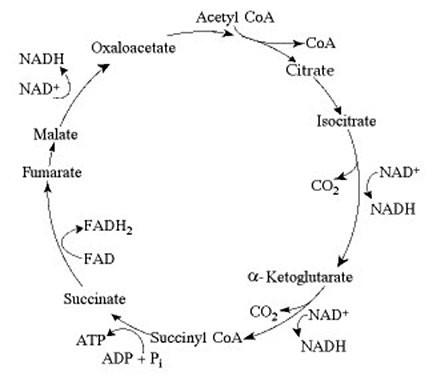 For each mole of glucose (C6H12O6) oxidized by cellular respiration, how many moles of CO2 are released in the citric acid cycle (see the accompanying figure)? A) 2 B) 4 C) 3 D) 2 E) 6 | back 43 correct answer : B 4 |
front 44 In the presence of oxygen, the three-carbon compound pyruvate can be catabolized in the citric acid cycle. First, however, the pyruvate (1) loses a carbon, which is given off as a molecule of CO2, (2) is oxidized to form a two-carbon compound called acetate, and (3) is bonded to coenzyme A. Which of the following sets of products result from these reactions? A) acetyl CoA, NADH, and CO2 B) acetyl CoA, O2, and ATP C) acetyl CoA, FADH2, and CO2 D) acetyl CoA, NAD+, ATP, and CO2Submit | back 44 correct answer : A acetyl CoA, NADH, and CO2 |
front 45 Which one of the following is formed by the removal of a carbon (as CO2) from a molecule of pyruvate? A) ATP B) citrate C) acetyl CoA D) water | back 45 correct answer : C acetyl CoA |
front 46 Which molecule is metabolized in a cell to produce energy "currency" in the form of ATP? A) Glucose B) Phosphate C) Carbon dioxide D) ADP | back 46 correct answer : A Glucose |
front 47 Which process is not part of the cellular respiration pathway that produces large amounts of ATP in a cell? A) Electron transport B) chainGlycolysis C) Krebs cycle D) Fermentation | back 47 correct answer : D Fermentation |
front 48 Which step of the cellular respiration pathway can take place in the absence of oxygen? A) Fermentation B) Electron transport chain C) Krebs cycle D) Glycolysis | back 48 correct answer : D Glycolysis |
front 49 Into which molecule are all the carbon atoms in glucose ultimately incorporated during cellular respiration? A) NADH B) Carbon dioxide C) Water D) ATP | back 49 correct answer : B Carbon dioxide |
front 50 Which of the following statements about the electron transport chain is true? A) The electron transport chain is the first step in cellular respiration. B) Water is the last electron acceptor. C) Electrons gain energy as they move down the chain. D) NADH and FADH2 donate their electrons to the chain. | back 50 correct answer : D NADH and FADH2 donate their electrons to the chain. |
front 51 Which stage of glucose metabolism produces the most ATP? A) Krebs cycle B) Fermentation of pyruvate to lactate C) Glycolysis D) Electron transport and chemiosmosis | back 51 correct answer : D Electron transport and chemiosmosis |
front 52 Which of the following events takes place in the electron transport chain? A) the harnessing of energy from high-energy electrons derived from glycolysis and the citric acid cycle B) substrate-level phosphorylation C) the breakdown of glucose into six carbon dioxide molecules D) the breakdown of an acetyl group to carbon dioxide | back 52 correct answer : A the harnessing of energy from high-energy electrons derived from glycolysis and the citric acid cycle |
front 53 Which of the following statements about the electron transport chain is true? A) It occurs in the cytoplasm of both prokaryotic and eukaryotic cells. B) It consists of a series of redox reactions C) It includes a series of hydrolysis reactions associated with mitochondrial membranes. D) It is driven by ATP hydrolysis. | back 53 correct answer : B It consists of a series of redox reactions |
front 54 Which of the following processes is driven by chemiosmosis? A) reduction of NAD+ to NADH B) substrate-level phosphorylation C) ATP hydrolysis D) oxidative E) phosphorylation | back 54 correct answer : E phosphorylation |
front 55 Which of the following sequences describes the path by which electrons travel downhill energetically in aerobic respiration? A) glucose → pyruvate → electron transport chain → NADH → ATP B) glucose → NADH → electron transport chain → oxygen C) food → glycolysis → citric acid cycle → NADH → ATP D) glucose → pyruvate → ATP → oxygen | back 55 correct answer : B glucose → NADH → electron transport chain → oxygen |
front 56 Where are the proteins of the electron transport chain located? A) mitochondrial inner membrane B) mitochondrial outer membrane C) mitochondrial matrix D) mitochondrial intermembrane space | back 56 correct answer : A mitochondrial inner membrane |
front 57 Water is one of the end products of aerobic respiration. What is the source of the oxygen atom used in formation of the water? A) molecular oxygen (O2) B) pyruvate (C3H3O3 -) C) carbon dioxide (CO2) D) glucose (C6H12O6) | back 57 correct answer : A molecular oxygen (O2) |
front 58 Which of the following statements best describes the primary role played by oxygen in cellular respiration? A) It yields energy in the form of ATP as it is passed down the electron transport chain. B) It serves as the final acceptor for electrons from the electron transport chain. C) It serves as an acceptor for carbon, forming CO2 in the citric acid cycle. D) It oxidizes glucose to form two molecules of pyruvate. | back 58 correct answer : B It serves as the final acceptor for electrons from the electron transport chain. |
front 59 In chemiosmosis, what is the most direct source of energy that is used to convert ADP +Pi to ATP? A) energy released as electrons are transported across the inner mitochondrial membrane B) energy released as electrons flow through the electron transport chain C) energy released from movement of protons through ATP synthase, down their electrochemical gradient D) energy released from substrate-level phosphorylation | back 59 correct answer : C energy released from movement of protons through ATP synthase, down their electrochemical gradient |
front 60 Energy released by the electron transport chain is used to pump H+ ions into which location in eukaryotic cells? A) mitochondrial intermembrane space B) mitochondrial matrix C) cytoplasm adjacent to the mitochondrial outer membrane D) mitochondrial inner membrane | back 60 correct answer : A mitochondrial intermembrane space |
front 61 Which of the following processes generates a proton-motive force in mitochondria? A) the flow of protons through ATP synthase down their concentration gradient B) the reduction of NAD+ by the first electron carrier in the electron transport chain C) lowering of pH in the mitochondrial matrix D) pumping of hydrogen ions from the mitochondrial matrix across the inner membrane and into the intermembrane space | back 61 correct answer : D pumping of hydrogen ions from the mitochondrial matrix across the inner membrane and into the intermembrane space |
front 62 Approximately how many molecules of ATP are produced from the complete oxidation of one molecule of glucose (C6H12O6) in aerobic cellular respiration? A) 2 B) 4 C) 30-32 D) 18-24 | back 62 correct answer : C 30-32 |
front 63 The synthesis of ATP by oxidative phosphorylation, using the energy released by movement of protons across the membrane down their electrochemical gradient, is an example of which of the following processes? A) allosteric regulation B) a reaction with a positive ΔG C) active transport D) coupling of an endergonic reaction to an exergonic reaction | back 63 correct answer : D coupling of an endergonic reaction to an exergonic reaction |
front 64 In muscle cells, fermentation produces _____.? A) carbon dioxide, ethanol, and NAD+ B) pyruvate C) lactate, NADH, and ATP D) lactate and NAD+ E) carbon dioxide, ethanol, NADH, and ATP | back 64 correct answer : D lactate and NAD+ |
front 65 In fermentation _____ is reduced and _____ is oxidized. A) pyruvate ... NADH B) lactate ... NADH C) NAD+ ... pyruvate D) NADH ... lactate E) lactate ... ethanol | back 65 correct answer : A pyruvate ... NADH |
front 66 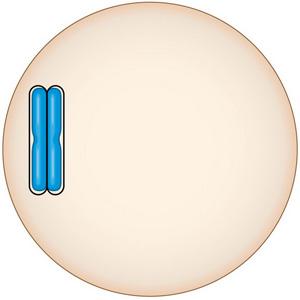 This chromosome has two chromatids, joined at the centromere. What process led to the formation of the two chromatids? A) The two chromatids were formed by synapsis and the formation of a synaptonemal complex. B) The two chromatids were formed by fertilization, bringing together maternal and paternal chromatids. C) The two chromatids were formed by duplication of a chromosome. | back 66 correct answer : C The two chromatids were formed by duplication of a chromosome. |
front 67 A human cell containing 22 autosomes and a Y chromosome is? A) a somatic cell of a female. B) a zygote. C) a sperm. D) a somatic cell of a male. E) an egg. | back 67 correct answer : C a sperm. |
front 68 The two homologs of a pair move toward opposite poles of a dividing cell during? A) fertilization. B) mitosis. C) meiosis I. D) meiosis II. | back 68 correct answer : C meiosis I. |
front 69 Meiosis II is similar to mitosis in that? A) sister chromatids separate during anaphase. B) the daughter cells are diploid. C) homologous chromosomes synapse. D) the chromosome number is reduced. E) DNA replicates before the division. | back 69 correct answer : A sister chromatids separate during anaphase. |
front 70 Which of the following phases make up the stages of mitosis? A) Prophase, prometaphase, metaphase, anaphase, telophase, and cytokinesis B) G1, S, and G2 C) Prophase, prometaphase, metaphase, anaphase, and telophase D) Interphase | back 70 correct answer : C Prophase, prometaphase, metaphase, anaphase, and telophase |
front 71 Which of the following events characterizes metaphase of mitosis? A) condensing of the DNA into discrete chromosomes B) alignment of the chromosomes at the equator C) movement of the chromosomes toward the equator D) separation of sister chromatids | back 71 correct answer : B alignment of the chromosomes at the equator |
front 72 Which of the following statements defines a genome? A) a karyotype B) the complete set of an organism's genes and other DNA sequences C) the complete set of a species' polypeptides D) the complete set of an organism's polypeptides | back 72 correct answer : B the complete set of an organism's genes and other DNA sequences |
front 73 What number and types of chromosomes are found in a human somatic cell? A) 21 autosomes and 2 sex chromosomes B) 44 autosomes and 2 sex chromosomes C) n chromosomes D) 45 autosomes and 1 sex chromosome E) 22 autosomes and 1 sex chromosome | back 73 correct answer: B 44 autosomes and 2 sex chromosomes |
front 74 How are sister chromatids and homologous chromosomes different from each other? A) They are not different. Homologous chromosomes and sister chromatids are both identical copies of each other. B) Homologous chromosomes are closely associated with each other in both mitosis and meiosis. Sister chromatids are only associated with each other during mitosis. C) Homologous chromosomes are identical copies of each other. One sister chromatid comes from the father, and one comes from the mother. D) Sister chromatids are only formed during mitosis. Homologous chromosomes are formed during meiosis. E) Homologous chromosomes contain the same gene loci but may have different alleles of a particular gene. Sister chromatids are identical copies of each other produced during DNA replication. | back 74 correct answer : E Homologous chromosomes contain the same gene loci but may have different alleles of a particular gene. Sister chromatids are identical copies of each other produced during DNA replication. |
front 75 Why do some species employ both mitosis and meiosis, whereas other species use only mitosis? A) They need only mitosis to make large numbers of cells such as sperm. B) They need only meiosis if they produce egg cells. C) They need both if they are producing plant gametes. D) A single-celled organism only needs mitosis. E) They need meiosis if the cells are producing organs such as ovaries. | back 75 correct answer : C They need both if they are producing plant gametes. |
front 76 Which of the following statements is true of a species that has a chromosome number of 2n = 16? A) The species is diploid with 32 chromosomes per cell. B) A gamete from this species has four chromosomes. C) The species has 16 sets of chromosomes per cell. D) Each diploid cell has eight homologous pairs of chromosomes. | back 76 correct answer : D Each diploid cell has eight homologous pairs of chromosomes. |
front 77 A particular organism has 46 chromosomes in its karyotype. Which of the following statements is correct regarding this organism? A) It must be human. B) It must be an animaI C) It reproduces sexually. D) It produces gametes with 23 chromosomes. | back 77 correct answer : D It produces gametes with 23 chromosomes. |
front 78 Which of the following characteristics do homologous chromosomes exhibit? A) They carry information for different characters. B) They align on the metaphase plate in meiosis II. C) They carry the same alleles. D) They carry information for the same characters. | back 78 correct answer : D They carry information for the same characters. |
front 79 Many organisms spend most of their life cycle in the diploid state. If meiosis produces haploid cells, how is the diploid number restored for these types of organisms? A) by synapsis of the homologous pairs of chromosomes during prophase of meiosis I B) by fertilization C) through the transcription of DNA to RNA D) by DNA replication | back 79 correct answer : B by fertilization |
front 80 Meiosis I produces _____ cells, each of which is _____.? A) two... identical to the other B) four ... haploid C) two... diploid D) two ... haploid E) four ... diploid | back 80 correct answer : D two ... haploid |
front 81 Meiosis II typically produces _____ cells, each of which is _____.? A) two ... haploid B) four ... diploid C) two... diploid D) four ... haploid E) four ... identical to the other | back 81 correct answer : D four ... haploid |
front 82 During _____ sister chromatids separate.? A) metaphase I B) prophase I C) interphase D) prophase II E) anaphase II | back 82 correct answer : E anaphase II |
front 83 At the end of _____ and cytokinesis, haploid cells contain chromosomes that each consist of two sister chromatids.? A) telophase B) metaphase II C) telophase I D) telophase II E) interphase | back 83 correct answer : C telophase I |
front 84 Synapsis occurs during _____. A) prophase I B) prophase II C) metaphase II D) telophase I and cytogenesis E) anaphase II | back 84 correct answer : A prophase I |
front 85 Homologous chromosomes migrate to opposite poles during _____.? A) anaphase I B) prophase II C) telophase II and cytokinesis D) metaphase II E) metaphase I | back 85 correct answer : A anaphase I |
front 86 During _____ chromosomes align single file along the equator of a haploid cell? A) telophase I and cytokinesis B) metaphase II C) metaphase I D) prophase I E) anaphase I | back 86 correct answer : B metaphase II |
front 87 At the end of _____ and cytokinesis there are four haploid cells? A) interphase B) prophase I C) telophase II D) prophase II E) anaphase I | back 87 correct answer : C telophase II |
front 88 During _____ a spindle forms in a haploid cell.? A) prophase II B) telophase I and cytokinesis C) prophase I D) metaphase II E) anaphase II | back 88 correct answer : A prophase II |
front 89 In diploid cells: mitosis results in the formation of how many cells; meiosis results in the formation of how many cells? A) two diploid cells ... four haploid cells B) two diploid cells ... two diploid cells C) four haploid cells ... two diploid cells D) two diploid cells ... two haploid cells E) four diploid cells ... four haploid cells | back 89 correct answer : A two diploid cells ... four haploid cells |
front 90 During which of the following processes do sister chromatids separate from each other? A) during both mitosis and meiosis II B) during meiosis II only C) during meiosis I only D) during both mitosis and meiosis I | back 90 correct answer : A during both mitosis and meiosis II |
front 91 The two strands of a DNA double helix are held together by _____ that form between pairs of nitrogenous bases. A) covalent bonds B) disulfide (S−S) bonds C) hydrogen bonds E) ionic bonds | back 91 correct answer : C hydrogen bonds |
front 92 As a result of its involvement in a chemical reaction, an enzyme? A) donates amino acid R groups to its reactants, turning them into products. B) donates electrons to its reactants, turning them into products. C) receives functional groups from reactants, allowing them to become products. D) is unchanged by the reactants or products. | back 92 correct answer : D is unchanged by the reactants or products. |
front 93 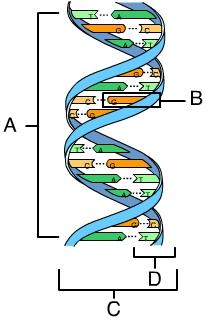 In the accompanying image, a nucleotide is indicated by the letter _____.? A) A B) D C) E D) C E) B | back 93 correct answer : E B |
front 94 Which of these is a difference between a DNA and an RNA molecule? A) DNA contains uracil, whereas RNA contains thymine. B) DNA is usually double-stranded, whereas RNA is usually single-stranded. C) DNA is a polymer composed of nucleotides, whereas RNA is a polymer composed of nucleic acids. D) DNA contains five-carbon sugars, whereas RNA contains six-carbon sugars. E) DNA contains nitrogenous bases, whereas RNA contains phosphate groups. | back 94 correct answer : B DNA is usually double-stranded, whereas RNA is usually single-stranded. |
front 95  This is an image of a(n) _____. A) nucleic acid B) thiol C) amino acid D) none of the above E) nucleotide | back 95 correct answer : E nucleotide |
front 96 The letter A indicates a _____. A) phosphate group B) nitrogenous base C) sugar D) none of the above E) nucleotide | back 96 correct answer : A Phosphate group |
front 97 A nitrogenous base is indicated by the letter _____. A) D B) E C) C D) B E) A | back 97 correct answer : C C |
front 98 You can tell that this is an image of a DNA nucleotide and not an RNA nucleotide because you see a _____. A) phosphate group, not a uracil B) thymine nitrogenous base, not a uracil nitrogenous base C)double-stranded molecule, not a single-stranded molecule D)sugar with two, and not three, oxygen atom E) suracil nitrogenous base, not a thymine nitrogenous base | back 98 correct answer : D sugar with two, and not three, oxygen atom |
front 99 Which of these nitrogenous bases is found in DNA but not in RNA? A) cytosine B) guanine C) uracil D) adenine E) thymine | back 99 correct answer : E thymine |
front 100 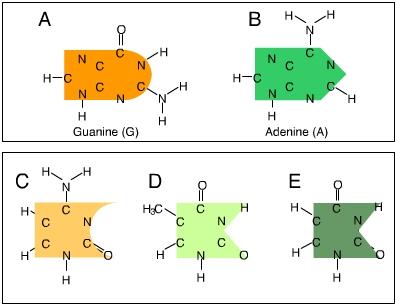 Which of these is(are) pyrimidines? A) A and B B) B, C, and D C) C, D, and E D) A, B, and C E) B and C | back 100 correct answer : C C, D, and E |
front 101 In a nucleotide, the nitrogenous base is attached to the sugar's _____ carbon and the phosphate group is attached to the sugar's _____ carbon. A) 1' ... 2' B) 2' ... 1' C) 2' ... 3' D) 1' ... 5' E) 1' ... 3' | back 101 correct answer : D 1' ... 5' |
front 102 Nucleic acids are assembled in the _____ direction. A) 5' to 3' B) 1' to 5' C) 2' to 3' D) 5' to 1' E) 4' to 5' | back 102 correct answer : A 5' to 3' |
front 103 In a DNA double helix an adenine of one strand always pairs with a(n) _____ of the complementary strand, and a guanine of one strand always pairs with a(n) _____ of the complementary strand. A) cytosine ... uracil B) guanine ... adenine C) cytosine ... thymine D) uracil ... cytosine E) thymine ... cytosine | back 103 correct answer : E thymine ... cytosine |
front 104 Cytosine makes up 42% of the nucleotides in a sample of DNA from an organism. Approximately what percentage of the nucleotides in this sample will be thymine? A) 8% B) 42% C)16% D) 58% | back 104 correct answer : A 8% |
front 105 In the polymerization of DNA, a phosphodiester bond is formed between a phosphate group of the nucleotide being added and which of the following atoms or molecules of the last nucleotide in the polymer? A) the 3' OH B)the 5' phosphate C) C6 D) a nitrogen from the nitrogen-containing base | back 105 correct answer : A the 3' OH |
front 106 After DNA replication is completed, _____.? A) each new DNA double helix consists of one old DNA strand and one new DNA strand B) each new DNA double helix consists of two new strands C) one DNA double helix consists of two old strands and one DNA double helix consists of two new strands D) each of the four DNA strands consists of some old strand parts and some new strand parts E) there are four double helices | back 106 correct answer : A each new DNA double helix consists of one old DNA strand and one new DNA strand |
front 107 The first step in the replication of DNA is catalyzed by _____.? A) primase B) ligase C) DNA polymerase D) single-strand binding protein E) helicase | back 107 correct answer : E helicase |
front 108 The action of helicase creates _____.? A) DNA fragments and replication forks B) primers and DNA fragments C) replication forks and replication bubbles D) primers and replication bubbles E) DNA fragments and replication bubbles | back 108 correct answer : C replication forks and replication bubbles |
front 109 Why is the new DNA strand complementary to the 3' to 5' strands assembled in short segments? A) DNA polymerase can assemble DNA only in the 3' to 5' direction B) only short DNA sequences can extend off the RNA primers C) DNA polymerase can assemble DNA only in the 5' to 3' direction D) the replication forks block the formation of longer strands E) it is more efficient than assembling complete new strands | back 109 correct answer : C DNA polymerase can assemble DNA only in the 5' to 3' direction |
front 110 The synthesis of a new strand begins with the synthesis of a(n) _____. A) Okazaki fragment B) short pieces of DNA C) single-strand binding protein D) RNA primer complementary to a preexisting DNA strand E) poly(A) tail | back 110 correct answer : D RNA primer complementary to a preexisting DNA strand |
front 111 An old DNA strand is used as a _____ for the assembly of a new DNA strand. A) complement B) template C) primer D) source of nucleotides E) model | back 111 correct answer : B template |
front 112 Which of the following statements correctly describes the difference between the leading and the lagging strands of DNA during DNA replication? A) The lagging strand is synthesized continuously, whereas the leading strand is synthesized in short fragments that are ultimately stitched together. B) The leading strand is synthesized in the same direction as the movement of the replication fork, and the lagging strand is synthesized in the opposite direction. C) The leading strand is synthesized at twice the rate of the lagging strand. D) The leading strand is synthesized by adding nucleotides to the 3' end of the growing strand, and the lagging strand is synthesized by adding nucleotides to the 5' end. | back 112 correct answer : B The leading strand is synthesized in the same direction as the movement of the replication fork, and the lagging strand is synthesized in the opposite direction. |
front 113 Why does a new DNA strand elongate only in the 5' to 3' direction during DNA replication? A) The polarity of the DNA molecule prevents addition of nucleotides at the 3' end. B) DNA polymerase can add nucleotides only to the free 3' end. C) DNA polymerase begins adding nucleotides at the 5' end of the template. D) Replication must progress toward the replication fork. | back 113 correct answer : B DNA polymerase can add nucleotides only to the free 3' end. |
front 114 What is the role of DNA ligase in the elongation of the lagging strand during DNA replication? A) It unwinds the parental double helix. B) It synthesizes RNA nucleotides to make a primer. C) It stabilizes the unwound parental DNA. D) It joins Okazaki fragments together. | back 114 correct answer : D It joins Okazaki fragments together. |
front 115 Within a double-stranded DNA molecule, adenine forms hydrogen bonds with thymine, and cytosine forms hydrogen bonds with guanine. What is the significance of the structural arrangement? A) It determines the type of protein produced. B) It permits complementary base pairing. C) It determines the tertiary structure of a DNA molecule. D) It allows variable width of the double helix. | back 115 correct answer : B It permits complementary base pairing. |
front 116 Semiconservative replication involves a template. What is the template? A) one strand of the DNA molecule B) single-stranded binding proteins C) DNA polymerase D) an RNA molecule | back 116 correct answer : A one strand of the DNA molecule |
front 117 DNA contains the template needed to copy itself, but it has no catalytic activity in cells. What catalyzes the formation of phosphodiester bonds between adjacent nucleotides in the DNA polymer being formed during DNA replication? A) ribozymes B) RNA primers C) ATP D) DNA polymerase | back 117 correct answer : D DNA polymerase |
front 118  Referring to the figure, what bases will be added to the primer as DNA replication proceeds? A) 3 T, C, T, G, C, T, G 5 B) 5 C, A, G, C, A, G, A 3 C) 3 G, T, C, G, T, C, T 5 D) 5 A, G, A, C, G, A, C 3 | back 118 correct answer : D 5 A, G, A, C, G, A, C 3 |
front 119 Which of the following statements correctly describes the difference between the leading strand and the lagging strand in DNA replication? A) The leading strand is synthesized continuously in the 5' → 3' direction, while the lagging strand is synthesized discontinuously in the 5' → 3' direction. B) The leading strand requires an RNA primer, whereas the lagging strand does not. C) The leading strand is synthesized in the 3' → 5' direction in a discontinuous fashion, while the lagging strand is synthesized in the 5' → 3' direction in a continuous fashion. D) There are different DNA polymerases involved in elongation of the leading strand and the lagging strand. | back 119 correct answer : A The leading strand is synthesized continuously in the 5' → 3' direction, while the lagging strand is synthesized discontinuously in the 5' → 3' direction. |
front 120 What are chromosomes made of? A) DNA and euchromatin B) DNA C) DNA, RNA, and proteins D) DNA, heterochromatin, and histone proteins E) DNA and proteins | back 120 correct answer : E DNA and proteins |
front 121 Which of the following statements accurately describes the structure of a eukaryotic chromosome? A) It has different numbers of genes in different cell types of an organism. B) It is composed of a single strand of DNA. C) It is a single linear molecule of double-stranded DNA plus proteins. D) It is constructed as a series of nucleosomes wrapped around two DNA molecules. | back 121 correct answer : C It is a single linear molecule of double-stranded DNA plus proteins. |
front 122 What is the basis for the difference in how the leading and lagging strands of DNA molecules are synthesized? A) Helicases and single-strand binding proteins work at the 5 end. B) The origins of replication occur only at the 5 end. C) DNA ligase works only in the 3 → 5 direction. D) DNA polymerase can join new nucleotides only to the 3 end of a pre-existing strand, and the strands are antiparallel. | back 122 correct answer : D DNA polymerase can join new nucleotides only to the 3 end of a pre-existing strand, and the strands are antiparallel. |
front 123 A biochemist isolates, purifies, and combines in a test tube a variety of molecules needed for DNA replication. When she adds some DNA to the mixture, replication occurs, but each DNA molecule consists of a normal strand paired with numerous segments of DNA a few hundred nucleotides long. What has she probably left out of the mixture? A) DNA polymerase B) primase C) Okazaki fragments D) nucleotides E) DNA ligase | back 123 correct answer : E DNA ligase |
front 124 During DNA replication, the leading strand is synthesized continuously, whereas the lagging strand is synthesized as Okazaki fragments. Why is this so? A) DNA polymerases can bind to only one strand at a time. B) There are thousands of origins of replication on the lagging strand but only one on the leading strand. C) DNA synthesis can take place only in the 5' to 3' direction. | back 124 correct answer : C DNA synthesis can take place only in the 5' to 3' direction. |
front 125 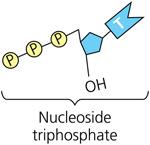 Nucleotides are added to a growing DNA strand as nucleoside triphosphates. What is the significance of this fact? A) Nucleoside triphosphates are more easily transported in the cell than are nucleotides. B) Hydrolysis of the two phosphate groups (P-Pi) and DNA polymerization are a coupled exergonic reaction. C) Nucleoside triphosphates are more abundant in the cell than nucleotides. | back 125 correct answer : B Hydrolysis of the two phosphate groups (P-Pi) and DNA polymerization are a coupled exergonic reaction. |
front 126 What is the best description of the structure of a chromosome in the nucleus of a non-dividing cell? A) One long DNA molecule, with no proteins. B) One long DNA molecule, associated with many proteins. C) Two long DNA molecules wound around each other, associated with many proteins. D) Two long DNA molecules wound around each other, with no proteins. | back 126 correct answer : B One long DNA molecule, associated with many proteins. |
front 127 A human bone marrow cell, in prophase of mitosis, contains 46 chromosomes. How many chromatids does it contain? A) 23 or 46, depending on the portion of prophase examined B) 23 C) 46 or 92, depending on the portion of prophase examined D) 92 E) 46 | back 127 correct answer : D 92 |
front 128 Eukaryotic chromosomes are composed of which of the following macromolecules? A) DNA and RNA B) DNA and proteins C) DNA and phospholipids D) DNA only | back 128 correct answer: B DNA and proteins |
front 129 Starting with a fertilized egg (zygote), a series of six cell divisions would produce an early embryo with how many cells? A) 12 B) 64 C) 32 D) 16 | back 129 correct answer : B 64 |
front 130 If a cell at metaphase of mitosis contains 20 sister chromatids, how many chromosomes will be present in a G1 cell? A) 5 B) 40 C) 20 D) 10 | back 130 correct answer : D 10 |
front 131 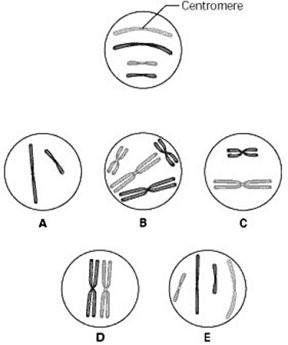 What is the correct chromosomal condition at prometaphase of mitosis? A) C B) E C) D D) B | back 131 correct answer : D B |
front 132 The drug cytochalasin B blocks the function of actin. Which of the following aspects of the animal cell cycle would be most disrupted by cytochalasin B? A) spindle attachment to kinetochores B) movement of chromosomes to the poles during anaphase C) spindle formation D) cleavage furrow formation and cytokinesis | back 132 correct answer : D |
front 133 Which of the following events occurs during interphase of the cell cycle? A) spindle formation B) separation of the spindle poles C) condensation of the chromosomes D) replication of the DNA | back 133 correct answer : D replication of the DNA |
front 134 The mitotic spindle plays a critical role in which of the following processes? A) separation of sister chromatids B) splitting of the cell (cytokinesis) following mitosis C) dissolving the nuclear membrane D) triggering the compaction and condensation of chromosomes | back 134 correct answer : A separation of sister chromatids |
front 135 What is the name of the microtubule-organizing center found in animal cells as an identifiable structure present during all phases of the cell cycle? A) kinetochore B) centriole C) centromere D) centrosome | back 135 correct answer : D centrosome |
front 136 Vinblastine is a standard chemotherapeutic drug used to treat cancer. Because it interferes with the assembly of microtubules, its effectiveness must be related to? A) myosin denaturation and inhibition of cleavage furrow formation. B) disruption of mitotic spindle formation. C) inhibition of regulatory protein phosphorylation. D) inhibition of DNA synthesis. E) suppression of cyclin production. | back 136 correct answer : B disruption of mitotic spindle formation. |
front 137 For a chemotherapeutic drug to be useful for treating cancer cells, which of the following characteristics is most desirable? A) It specifically inhibits rapidly dividing cells. B) It is safe enough to prevent all apoptosis. C) It does not interfere with metabolically active cells. D) It specifically inhibits cells entering G0. | back 137 correct answer : A It specifically inhibits rapidly dividing cells. |
front 138  What is the correct chromosomal condition for one daughter nucleus at telophase of mitosis? A) D B) E C) C E) B | back 138 correct answer : B E |
front 139 Movement of the chromosomes during anaphase would be most affected by a drug that prevents which of the following events in mitosis and cell division? A) shortening of microtubules B) nuclear envelope breakdown C) formation of a cleavage furrow D) elongation of microtubules | back 139 correct answer : A shortening of microtubules |
front 140 A cleavage furrow is _____.? A) a ring of vesicles forming a cell plate B) the space that is created between two chromatids during anaphase C) the separation of divided prokaryotes D) a groove in the plasma membrane between daughter nuclei | back 140 correct answer : D a groove in the plasma membrane between daughter nuclei |
front 141 In a diploid cell with 5 chromosome pairs (2n = 10), how many sister chromatids will be found in a nucleus at prophase of mitosis? A) 5 B) 20 C) 10 D) 40 | back 141 correct answer : B 20 |
front 142 If there are 40 centromeres in a cell at anaphase of mitosis, how many chromosomes will be found in each daughter cell following cytokinesis? A) 20 B) 40 C) 10 D) 80 | back 142 correct answer : A 20 |