Instructions for Side by Side Printing
- Print the notecards
- Fold each page in half along the solid vertical line
- Cut out the notecards by cutting along each horizontal dotted line
- Optional: Glue, tape or staple the ends of each notecard together
chapter 35
front 1 Which part of a plant absorbs most of the water and minerals taken up from the soil? | back 1 root hairs |
front 2 What is the primary function of stems? | back 2 Maximization of photosynthesis by leaves |
front 3 When you eat Brussels sprouts, you are eating _____. | back 3 large axillary buds |
front 4 Some of the largest leaves in the world can be found on plants near
the forest floor of dense | back 4 light |
front 5 Leaf thickness represents a trade-off between _____. | back 5 water retention and carbon dioxide absorption |
front 6 One important difference between the anatomy of roots and the anatomy
of leaves is that | back 6 a waxy cuticle covers leaves but is absent from roots |
front 7 Which of the following was a challenge to the survival of the first land plants? | back 7 desiccation |
front 8 Trichomes _____. | back 8 repel or trap insects |
front 9 Which structure is correctly paired with its tissue system? | back 9 tracheid — vascular tissue |
front 10 The main source of water necessary for photosynthesis to occur in the
leaf mesophyll is | back 10 soil via the xylem |
front 11 The vascular bundle in the shape of a single central cylinder in a root is called the _____. | back 11 stele |
front 12 Which of the following cell types retains the ability to undergo cell division? | back 12 a parenchyma cell near the root tip |
front 13 Which of these is NOT an example of a parenchyma cell? | back 13 support cells near the outside of nonwoody stems |
front 14 Which of the following have unevenly thickened primary walls that
support young, growing | back 14 collenchyma cells |
front 15 Which of the following is correctly paired with its structure and function? | back 15 sclerenchyma — supporting cells with thick secondary walls |
front 16 Which of the following occurs in vascular land plants but not charophytes (stoneworts)? | back 16 lignin |
front 17 Which of the following are water-conducting cells that are dead at functional maturity? | back 17 tracheids and vessel elements |
front 18 Which of the following cells transport sugars over long distances? | back 18 sieve-tube elements |
front 19 Plant meristematic cells _____. | back 19 are undifferentiated cells that produce new cells |
front 20 Which of the following arise, directly or indirectly, from meristematic activity? | back 20 secondary xylem, leaves, dermal tissue, and tubers |
front 21 Compared to most animals, the growth of most plant structure is best described as _____. | back 21 indeterminate |
front 22 What is present in a shoot apical meristem region? | back 22 I, II, and III |
front 23 Shoot elongation in a growing bud is due primarily to _____. | back 23 cell elongation localized in each internode |
front 24 Apical meristems of dicots are at the tips of stems. Apical meristems
of grasses are at ground | back 24 If you mow two inches above ground level, both the apical and
intercalary meristems can |
front 25 In a meristematic region, the cell plate during mitosis is
perpendicular to the side of the stem. | back 25 vertically in height |
front 26 Which of the following cells or tissues arise from lateral meristem activity? | back 26 secondary xylem |
front 27 Cells produced by lateral meristems are known as _____. | back 27 secondary tissues |
front 28 Which of the following can be used to determine a twig’s age? | back 28 Number of apical bud scar rings |
front 29 A plant that grows one year, dies back, and then grows again the
following year, produces | back 29 annual |
front 30 Which of the following is the correct sequence of the zones in the
primary growth of a root, | back 30 zone of cell division, zone of elongation, zone of differentiation |
front 31 The driving force that pushes the root tip through the soil is primarily _____. | back 31 elongation of cells behind the root apical meristem |
front 32 Mitotic activity by the apical meristem of a root makes which of the
following more | back 32 increased delivery of water to the aboveground stem |
front 33 Which of the following root tissues gives rise to lateral roots? | back 33 pericycle |
front 34 As a youngster, you drive a nail in the trunk of a young tree that is
3 meters tall. The nail is | back 34 1.5 |
front 35 You find a plant unfamiliar to you and observe that it has vascular
bundles scattered | back 35 It is probably a monocot. |
front 36 Monocot vascular bundles do not have a vascular cambium between the
xylem and phloem. | back 36 do not produce wood in annual rings |
front 37 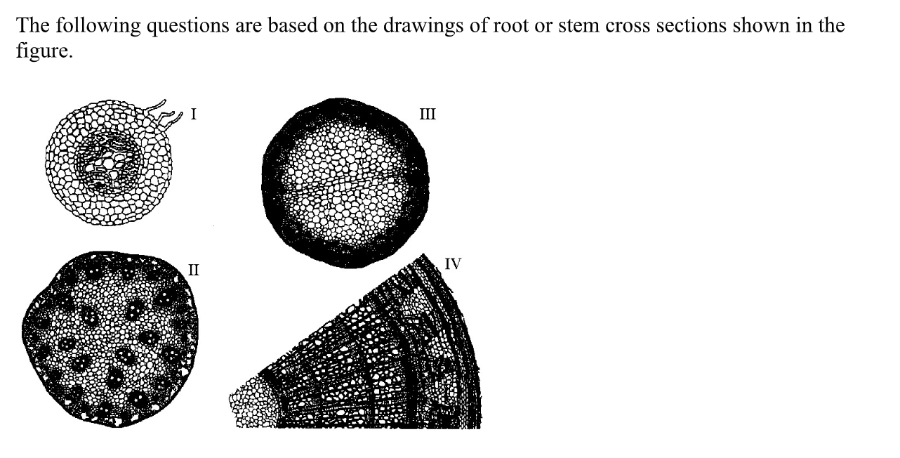 Refer to the figure above. A monocot stem is represented by _____. | back 37 II only |
front 38 Refer to the figure above. A woody eudicot is represented by _____. | back 38 IV only |
front 39 Refer to the figure above. A plant that is at least three years old is represented by _____. | back 39 IV only |
front 40 Canada thistle is a dicot that spreads via growth from lateral roots.
You want to use a root | back 40 a vascular bundle in the center surrounded by parenchyma tissue |
front 41 A student examining leaf cross sections under a microscope finds many
loosely packed cells | back 41 parenchyma |
front 42 The veins of leaves are _____. | back 42 I, II, and III |
front 43 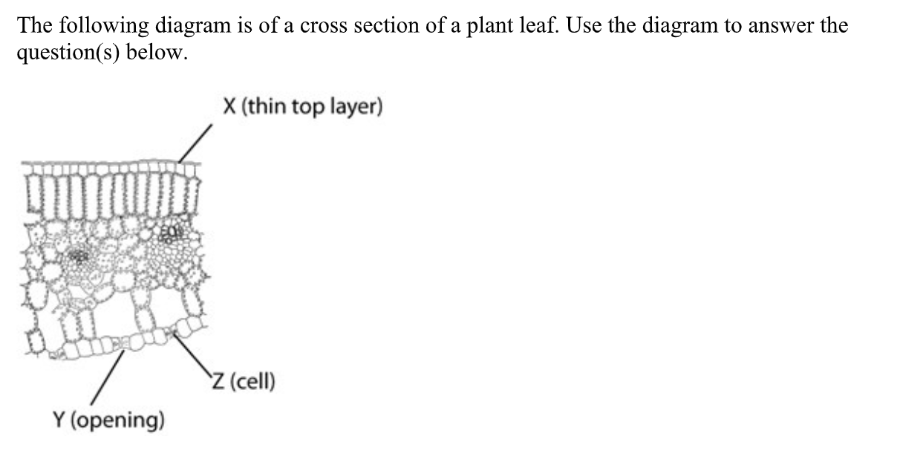 The main function associated with structure X is _____. | back 43 retention of water |
front 44 The main function associated with structure Y is _____. | back 44 absorption of carbon dioxide |
front 45 Increasing the number of stomata per unit surface area of a leaf when
atmospheric carbon | back 45 putting more red blood cells into circulation when atmospheric oxygen levels decline |
front 46 Where is primary growth occurring in an old tree? | back 46 in young branches where leaves are forming |
front 47 What tissue makes up most of the wood of a tree? | back 47 secondary xylem |
front 48 A plant has the following characteristics: a taproot system, several
growth rings evident in a | back 48 woody eudicot |
front 49 If you were able to walk into an opening cut into the center of a
large redwood tree, when | back 49 the annual rings, new xylem, vascular cambium, phloem, and bark |
front 50 Heartwood and sapwood consist of _____. | back 50 secondary xylem |
front 51 Two examples of lateral meristems in plants are _____. | back 51 vascular cambium, producing secondary xylem; cork cambium, producing cork |
front 52 Additional vascular tissue produced as secondary growth in a root
originates from which | back 52 vascular cambium |
front 53 Girdling is a procedure to kill unwanted tress by cutting a groove
into the bark of the tree. | back 53 No sugars can be transported from the leaves to the roots. |
front 54 Where are the youngest wood and the youngest bark in a tree trunk? | back 54 Youngest wood is toward the outside, near the vascular cambium;
youngest bark is the inner |
front 55 The polarity of a plant is established when _____. | back 55 the shoot-root axis is established in the embryo |
front 56 Growth and development of plant parts involves _____. | back 56 I, II, and III |
front 57 Totipotency is a term used to describe a cell's ability to
give rise to a complete new | back 57 cell differentiation depends largely on the control of gene expression |
front 58 Which of the following statements is true? | back 58 Homeotic genes often control morphogenesis. |
front 59 The phase change of an apical meristem from the juvenile to the
mature vegetative phase is | back 59 a change in the morphology of the leaves produced |