Instructions for Side by Side Printing
- Print the notecards
- Fold each page in half along the solid vertical line
- Cut out the notecards by cutting along each horizontal dotted line
- Optional: Glue, tape or staple the ends of each notecard together
A&P Chapter 5 Integumentary System
front 1 The most abundant cells in the epidermis are Answers: a. keratinocytes. b. melanocytes. c. Merkel cells. d.adipocytes. e.Langerhans cells. | back 1 a. keratinocytes. |
front 2 Which of the following statements is false concerning the outermost layer of the epidermis? Answers: a. Its cells are undergoing rapid cell division. b. It is the first to experience any abrasion. c. Keratin provides waterproofing. d.Millions of cells are worn off daily. e.It is called the stratum corneum. | back 2 a. Its cells are undergoing rapid cell division. |
front 3 It is possible to obtain DNA from the nuclei of the cells of the stratum corneum. Answers: a. True b. False | back 3 Selected Answer: b. False |
front 4 The layer of the epidermis that contains cells undergoing division is the Answers: a. stratum germinativum or basale. b. stratum granulosum. c. stratum lucidum. d. stratum spinosum. e. stratum corneum. | back 4 a. stratum germinativum or basale. |
front 5 Which of the following is NOT found in the epidermis? Answers: a. stratified epithelium b. tight cell junctions c. blood vessels d. keratin e. melanin | back 5 c. blood vessels |
front 6 The layer of the epidermis that contains melanocytes is the Answers: a. stratum spinosum. b. stratum granulosum. c. stratum germinativum or basale. d. stratum lucidum. e. stratum corneum. | back 6 Selected Answer: c. stratum germinativum or basale. |
front 7 The two components of the cutaneous membrane are the Answers: a. epidermis and superficial fascia. b. epidermis and hypodermis. c. integument and dermis. d. epidermis and dermis. e. dermis and hypodermis. | back 7 d. epidermis and dermis. |
front 8 Variations in hair color reflect differences in the pigment produced by Answers: a. keratinocytes. b. carotene cells. c. melanocytes. d. dermal papillae. e. soft keratin. | back 8 c. melanocytes. |
front 9 If the papilla of a hair follicle is destroyed, Answers: a. hair production will not be affected. b. the follicle will not produce a hair. c. the hair produced by the follicle will change from terminal to vellus. d. the texture of the hair will become coarser. e. the color of the hair will become lighter. | back 9 b. the follicle will not produce a hair. |
front 10 Newly forming connective tissue in a wound is called Answers: a. granulation tissue b. a scab c. scar tissue d. keloid | back 10 Selected Answer: a. granulation tissue |
front 11 The scab that forms after an injury involving the dermis and epidermis consists mainly of Answers: a. collagen and trapped white blood cells b. fibrin and trapped white blood cells c. fibroblasts that produce fibrin, fibrin and platelets d. collagen and trapped red and white blood cells e. fibrin and trapped red blood cells | back 11 e. fibrin and trapped red blood cells |
front 12 When scar tissue forms in the skin it means that Answers: a. there are more collagen strands in the dermis and fewer capillaries along with a lack of normal dermal structures. b. there is a lack of blood vessels and a lack of the tough fibrous elements of the dermis such as collagen. c. in the derms fibrin strands are regenerating quickly before epithelial cells have a chance to regrow d. more blood vessels have invaded the area and caused a discoloration along with an excess of collagen fibers. | back 12 a. there are more collagen strands in the dermis and fewer capillaries along with a lack of normal dermal structures. |
front 13 Scar tissue is the result of Answers: a. a lack of hair follicles and sebaceous glands in the injured area. b. an abnormally large number of collagen fibers and relatively few blood vessels at the repair site. c. a thickened stratum germinativum in the area of the injury. d. increased numbers of fibroblasts and mast cells in the injured area. e. increased numbers of epidermal layers in the area of the injury. | back 13 b. an abnormally large number of collagen fibers and relatively few blood vessels at the repair site. |
front 14 Vitamin D is required for __________ metabolism. Answers: 1. potassium 2. sulfur 3. zinc 4. phosphorus 5. calcium | back 14 Selected Answer: 5. calcium |
front 15 The pale, crescent-shaped area at the base of a nail is called the Answers: a. lunula. b. hyponychium. c. cuticle. d. eponychium. e. cerumen. | back 15 a. lunula. |
front 16 When the arrector pili muscles contract, Answers: a. the skin changes color. b. shivering occurs. c. "goose bumps" are formed. d. hairs are shed. e. sweat is released from sweat glands. | back 16 Selected Answer: c. "goose bumps" are formed. |
front 17 Hair is made up mostly of Answers: 1. carbohydrates. 2. fats. 3. chitin. 4. calcium 5. keratinized cells. | back 17 5. keratinized cells. |
front 18 When a fair-skinned person blushes, why does his or her skin turn red? Answers: a. The blood supply to the skin decreases. b. The number of red melanocytes in the skin increases. c. Increased heat causes the skin to turn red. d. The blood supply to the skin increases. e. Melanocytes increase production of red pigments. | back 18 d. The blood supply to the skin increases. |
front 19 Eating large quantities of carrots and squash often changes the pigmentation of the skin. This pigmentation is visible because the increased consumption of these orange vegetables Answers: a. causes cyanotic coloration of the epidermis b. can cause carotene to build up in the epidermis of the skin c. can cause carotene to build up in the dermis and subcutaneous layers of the skin d. can cause toxicity and lead to liver failure | back 19 b. can cause carotene to build up in the epidermis of the skin |
front 20 An epidermal layer found only in the skin of the palms of the hands and the soles of the feet is the Answers: a. stratum lucidum. b. stratum spinosum. c. stratum granulosum. d. stratum germinativum. e. stratum corneum. | back 20 a. stratum lucidum. |
front 21 The layer of the skin that provides protection against bacteria as well as chemical and mechanical injuries is the Answers: a. epidermis. b. sebum layer. c. subcutaneous layer. d. stratum basale. e. dermis. | back 21 a. epidermis. |
front 22 Large quantities of keratohyalin would be found in the epidermal layer called the Answers: a. stratum lucidum. b. stratum corneum. c. stratum granulosum. d. stratum germinativum. e. stratum spinosum. | back 22 c. stratum granulosum. |
front 23 Fine peach fuzz that replaces lanugo of fetal development prior to birth is called Answers: a. club hair b. terminal hairs c. cortex hair d. vellus hairs | back 23 d. vellus hairs |
front 24 Which statement below is true regarding hair associated with the scalp? Answers: a. Human are generally born with the number of hairs that they will have for life. They generally lose hair only when there is a serious medical condition. b. Healthy adults shed over 200 hairs per day and may shed more during pregnancy or during stress. c. Healthy adults shed between 50 to 100 hairs per day normally, although they may lose more after pregnancy and during periods of high stress. d. Healthy adults rarely shed many hairs per day except after pregnancy and during periods of high stress. | back 24 c. Healthy adults shed between 50 to 100 hairs per day normally, although they may lose more after pregnancy and during periods of high stress. |
front 25 Scar tissue is the result of Answers: a. a thickened stratum germinativum in the area of the injury. b. an abnormally large number of collagen fibers and relatively few blood vessels at the repair site. c. a lack of hair follicles and sebaceous glands in the injured area. d. increased numbers of epidermal layers in the area of the injury. e. increased numbers of fibroblasts and mast cells in the injured area. | back 25 b. an abnormally large number of collagen fibers and relatively few blood vessels at the repair site. |
front 26 Stretch marks occur when Answers: a. athletes overextend a muscle. b. the skin is so extensively stretched that its elastic capabilities are exceeded. c. the hair follicles cease to produce hairs. d. surgical incisions are made perpendicular to the skin's lines of cleavage. e. the skin is stretched in normal movements. | back 26 b. the skin is so extensively stretched that its elastic capabilities are exceeded. |
front 27 Nail production occurs at the nail Answers: a. body. b. hyponychium. c. bed. d. root. e. cuticle. | back 27 d. root. |
front 28 An albino individual lacks the ability to produce Answers: a. eleidin. b. keratin. c. melanin. d. perspiration. e. carotene. | back 28 c. melanin. |
front 29 The primary function of sensible perspiration is to Answers: a. protect the skin from excess ultraviolet radiation. b. reduce insensible perspiration. c. heat the skin surface. d. cool the surface of the skin. e. raise the temperature of the skin. | back 29 d. cool the surface of the skin. |
front 30 The layer of the skin that contains bundles of collagen fibers and the protein elastin and is responsible for the strength of the skin is the ________ layer. Answers: a. hypodermal b. papillary c. subcutaneous d. epidermal e. reticular | back 30 e. reticular |
front 31 The reticular layer of the dermis is composed of Answers: a. stratified squamous epithelium b. adipose c. dense regular fibrous CT d. areolar CT e. dense irregular fibrous CT | back 31 e. dense irregular fibrous CT |
front 32 Glands that discharge an oily secretion into hair follicles are ________ glands. Answers: a. mammary b. ceruminous c. merocrine sweat d. apocrine sweat e. sebaceous | back 32 e. sebaceous |
front 33 Charlie is badly burned in an accident. When he reaches the emergency room, the examining physician finds that he can remove entire hair follicles from Charlie's arm when he gently pulls on a hair with his forceps. After examining Charlie, the physician would likely order all of the following, except Answers: a. IV (intravenous) fluids and electrolytes. b. a high-nutrient diet. c. tissue samples for possible skin grafts. d. ice packs adjacent to the burn area. e. antibiotics. | back 33 d. ice packs adjacent to the burn area. |
front 34 Cyanosis is indicated by Answers: a. an orange skin coloration. b. a yellowish skin coloration. c. a brown skin coloration. d. a reddish skin coloration. e. a bluish skin coloration. | back 34 e. a bluish skin coloration. |
front 35 Where is Epidermal Growth Factor (EGF) Produced? | back 35 In the Salivary and duodenum glands |
front 36 Where in the body would EGF be utilized? | back 36
|
front 37 What are the functions of EGF? | back 37
|
front 38 What is Epidermal Growth Factor (EGF)? | back 38
|
front 39 Deodorants are used to mask the odor of ________ secretions. Answers: a. sebaceous b. mammary c. apocrine d. merocrine e. ceruminous | back 39 c. apocrine |
front 40 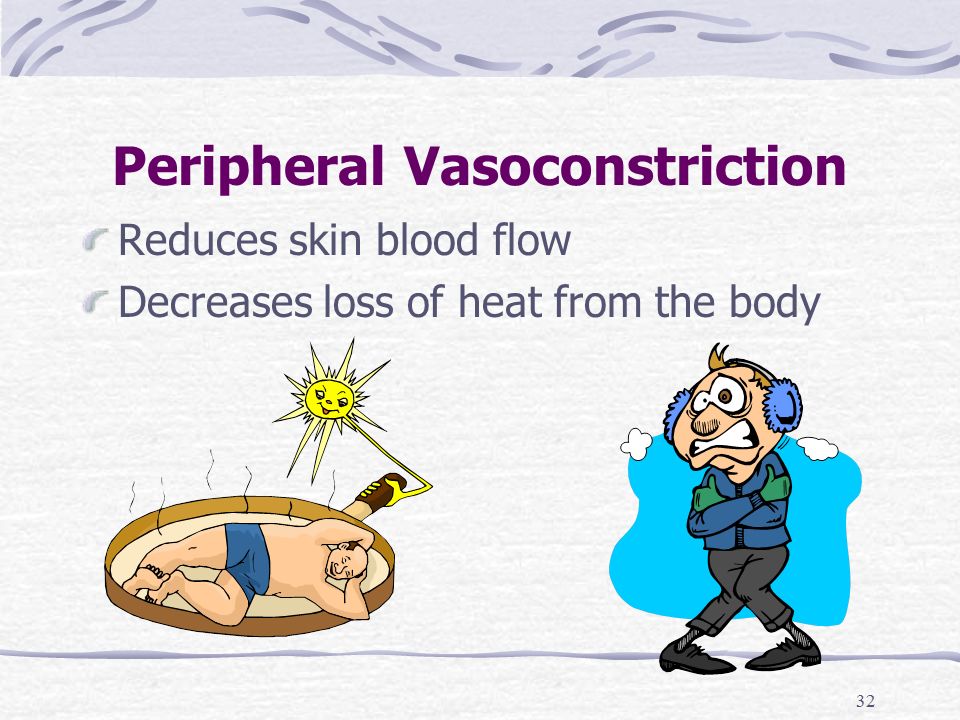 Peripheral vasoconstriction is a response to Answers: 1. hunger. 2. exercise. 3. cold. 4. thirst. 5. heat. | back 40 3. cold. |
front 41  Vasodilation is a response to Answers: a. heat b. cold c. freezing temperatures | back 41 a. heat |
front 42 What condition is caused by Vitamin D3 deficiency? | back 42 Rickets Disease or genetic bone defects. |
front 43 What is Vitamin D3? | back 43
|
front 44 What are the functions of Skin (Epidermis and Dermis)? | back 44
|
front 45 What are the functions of the Epidermis? | back 45
|
front 46 What are the two layers of the Dermis? | back 46
|
front 47 What is the function of the Papillary layer? | back 47
|
front 48 What is the function of the Reticular Layer? | back 48
|
front 49 What cells are most abundant in the Epidermis? | back 49 Keratinocytes |
front 50 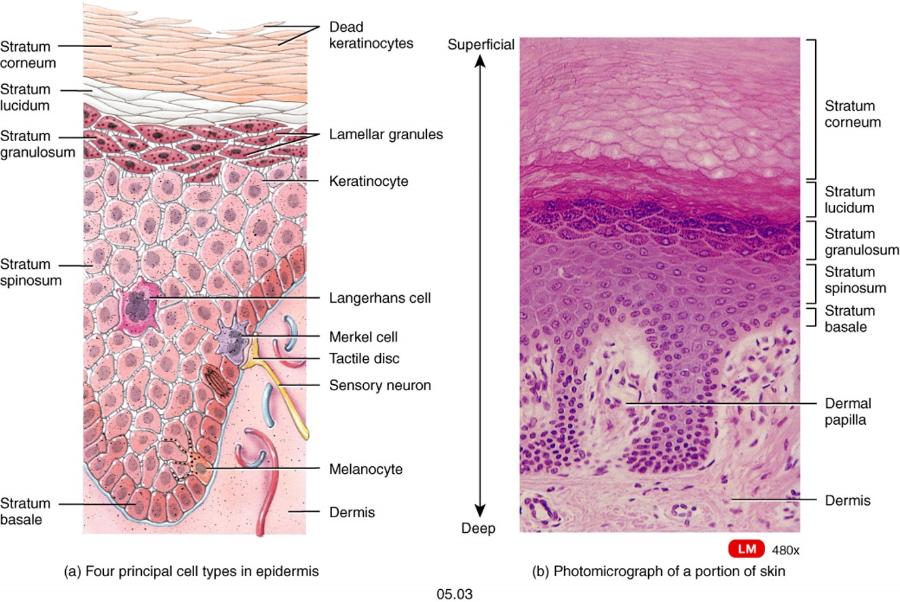 Name the layers found in Thin Skin
| back 50
|
front 51 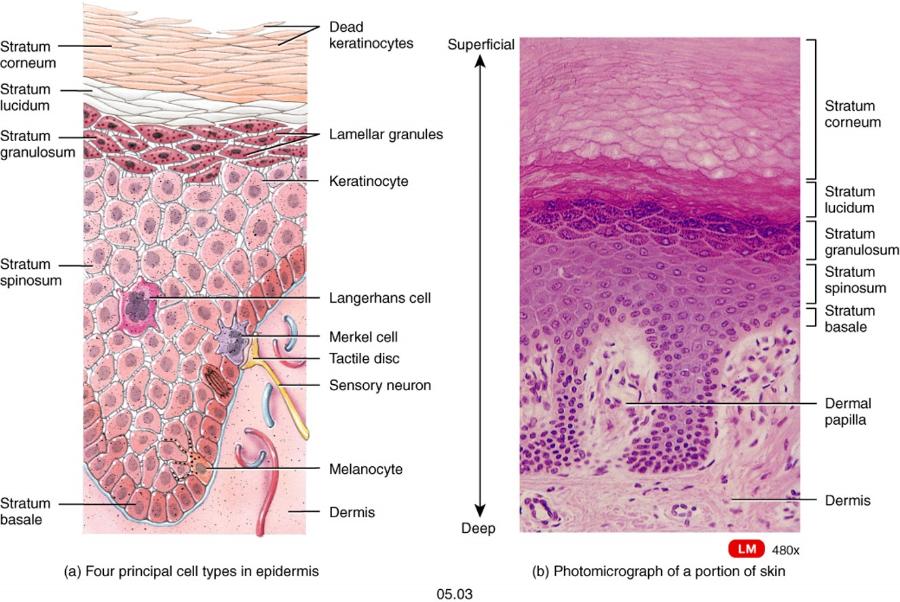 Name the layers found in Thick Skin
| back 51
|
front 52 What attaches the Stratum Basale to the Dermis? | back 52 Hemidesmosomes
|
front 53 What layer of the Epidermis forms Ridges (fingerprints and Dermal papillae (tiny mounds) | back 53 Stratum Basale |
front 54 What two cells are found in the Stratum Germinativum in thick skin? | back 54
|
front 55 Facts to know about Stratum Spinosum (spiny layer) | back 55
|
front 56 Facts to know about Stratum Granulosum (grainy layer) | back 56
|
front 57 What are the functions of Stratum Granulosum? | back 57
|
front 58 What layer is only found in Thick Skin? | back 58
|
front 59 Facts to know about Stratum Cornium | back 59
|
front 60 In what layer of skin does Keratinization take place? | back 60 Stratum Corneum |
front 61 What is Keratinization? | back 61
|
front 62 How many days does it take for cells to Keratinize? | back 62
|
front 63 Name the two types of Persperation | back 63
|
front 64 Which type of Perspiration causes water to excrete by sweat glands causing possible dehydration? | back 64 Insensible Perspiration |
front 65 Which type of Perspiration is caused from damage to the stratum corneum (via blisters or burns) | back 65 Insensible Perspiration |
front 66 Which type of Perspiration is caused from immersion in hypertonic solution (e.g., seawater [osmosis]) | back 66 Insensible Perspiration |
front 67 What two pigments influence skin color? | back 67 Carotene and Melanin |
front 68 Where is Carotene Found in the skin? | back 68 accumulates in epidermal cells and fatty tissues of the dermis |
front 69 What produces Melanin and what layer of epidermis is it found in? | back 69
|
front 70 Info on Dermal Blood Supply | back 70
|
front 71 Facts on Dermis | back 71
|
front 72 Facts on Hypodermis | back 72
|
front 73 Hair Follicle ino | back 73
|
front 74 Arrector Pilli info | back 74
|
front 75 Sebaceous Glands | back 75
|
front 76 Hair root | back 76
|
front 77 Hair Shaft | back 77
|