Instructions for Side by Side Printing
- Print the notecards
- Fold each page in half along the solid vertical line
- Cut out the notecards by cutting along each horizontal dotted line
- Optional: Glue, tape or staple the ends of each notecard together
Bio 2 Ch 52-55 iClicker Questions
front 1 One reason that deserts tend to be found at 30°N and 30°S latitudes is that: a)deserts are dry. b)it’s warmer near the equator. c)global wind and pressure patterns affect where rain falls. d)desert soils are different from tropical rainforest soils. e)mountains change rainfall patterns. | back 1 c) global wind and pressure patterns affect where rain falls |
front 2 Which of the following is not an abiotic factor that organisms could come into contact with? a)salinity b)temperature c)sunlight d)bacteria e)oxygen | back 2 d) bacteria |
front 3 Population ecologists are primarily interested in: a)understanding how biotic and abiotic factors influence populations and how they change. b)the overall vitality of a population of organisms. c)how humans affect the size of wild populations of organisms. d)studying interactions among populations of organisms that inhabit the same area. e)how populations evolve as natural selection acts on heritable variations among individuals and changes in gene frequency. | back 3 a)understanding how biotic and abiotic factors influence populations and how they change. |
front 4 Ecosystem ecology emphasizes: a)movement of energy and cycling of chemicals between organisms. b)movement of energy and cycling of chemicals between organisms and the environment. c)factors that affect population size and how and why this changes over time. d)factors controlling the exchange of energy, materials, and organisms across multiple ecosystems. e)how an organism’s structure, physiology, and behavior allow it to survive. | back 4 b) movement of energy and cycling of chemicals between organisms and the environment. |
front 5 If you were hiking up a mountain, you might observe transitions in biological communities or habitats that are analogous to the changes: a)in biomes at different latitudes. b)in different depths in the ocean. c)in a community through different seasons. d)in an ecosystem as it evolves over time. | back 5 a) in biomes at different latitudes. |
front 6 What is a disturbance? | back 6 an event such as a storm, fire, or human activity that changes a community |
front 7 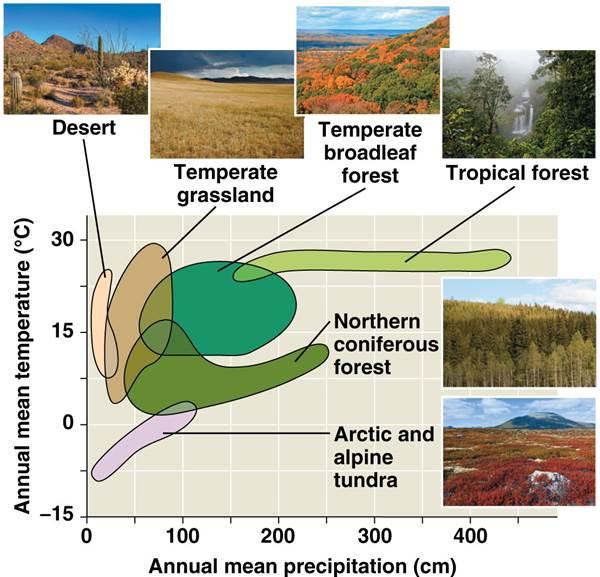 The climograph shows that: a)biomes exist in distinct annual temperature and precipitation ranges and do not overlap. b)biomes are controlled more by annual mean temperature than
by c)tropical forests span the largest precipitation range of any biome. d)deserts span the largest temperature range of any biome. e)the largest biome on Earth, in area, is the temperate grassland. | back 7 c) tropical forests span the largest precipitation range of any biome. |
front 8 The climograph shows that: a)most biomes require at least an average of 200 cm of
precipitation b)most biomes require at least an average annual temperature of 20°C. c)no biomes exist below 0°C. d)the desert biome exists within the most wide range of annual mean precipitation on Earth. e)temperate grasslands exist within the most wide range of annual mean temperature on Earth. | back 8 e) temperate grasslands exist within the most wide range of annual mean temperature on Earth. |
front 9 Biotic factors that affect the distribution of organisms may include: | back 9
|
front 10 Abiotic factors affecting the distribution of organisms include: | back 10
Most abiotic factors vary in space and time |
front 11 Seasons on Earth in the Northern and Southern Hemispheres are caused by: a)the distance from the Earth to the sun changing over the course of a year. b)a change in the angle of tilt of Earth’s axis throughout the year. c)the angle of the sun’s rays striking Earth changing as the Earth orbits the sun with a constant tilt. d)the rotation of the Earth on its own axis. e)a combination of b and e | back 11 c) the angle of the sun’s rays striking Earth changing as the Earth orbits the sun with a constant tilt. |
front 12 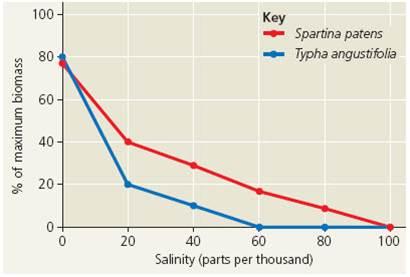 Based purely on the results shown below, at what range of salinities would you expect to find S. patens in the field but not T. angustifolia? a)Only S. patens would grow at salinities between 60
and b)Only S. patens would grow at salinities between 0 and 100 parts per thousand. c)Only S. patens would grow at salinities between 0 and
60 | back 12 a) Only S. patens would grow at salinities between 60
and |
front 13 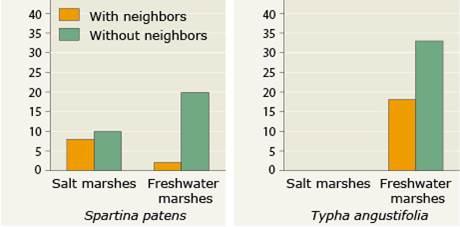 The lowest salinity level in the greenhouse mimics a freshwater marsh. In the field, S. patens is typically absent from natural freshwater marshes. Based on the data, does this appear to be due to salinity or competition? a)Competition; at zero salinity, the % of maximum biomass was higher for T. angustifolia than for S. patens, showing that S. patens would not compete as well in fresh water. b)Competition; it can grow in zero salinity in experimental freshwater marshes without competing neighbors but has reduced biomass in the presence of neighbors. c)Salinity; S. patens can grow in experimental salt
marshes, but d)Salinity; S. patens had less biomass in experimental fresh marshes than in salt marshes. | back 13 b) Competition; it can grow in zero salinity in experimental freshwater marshes without competing neighbors but has reduced biomass in the presence of neighbors. |
front 14 T. angustifolia is not present in natural salt marshes. Does this appear to be due to salinity or competition? a)Salinity; it is absent from experimental salt marshes b)Salinity; it is not present in salt marshes. c)Competition; it grows better without competing neighbors than with them in the experimental marsh. d)Competition; S. patens grows better than T. angustifolia in experimental salt marshes and therefore must outcompete it. | back 14 a)Salinity; it is absent from experimental salt marshes |
front 15 Oligotrophic lakes are | back 15
|
front 16 Eutrophic lakes are | back 16 nutrient-rich and often depleted of oxygen in deep zones or throughout if ice covered in winter |
front 17 Eutrophication: | back 17 nutrients added to a lake to make it eutrophic (causes algal blooms, eventually removing all oxygen from lake, killing larger organisms) |
front 18 Commensalism is ________. | back 18 (+/0 interaction) is an interaction in which one species benefits and the other is neither harmed nor helped Ex: An egret eats insects stirred up by grazing animals |
front 19 Mutualism is ____. | back 19 (+/+ interaction) is a common interspecific interaction that benefits both species Ex: Humans who have pets tend to be healthier than humans who do not have pets. |
front 20 Positive Interactions are those where _____. | back 20 at least one species benefits and neither is harmed Ex: Mutualism (+/+ )and Commensalism (+/0) |
front 21 Parasites that live outside of the body of their host are called _____. | back 21 Ectoparasites |
front 22 Parasites that live within the body of their host are called _____. | back 22 Endoparasites |
front 23 Parasitism is ___. | back 23 (+/– interaction), one organism, the parasite, derives nourishment from another organism, its host, which is harmed in the process Ex: the relationship between a dog and a blood-sucking tick |
front 24 Resource Partitioning is _______. | back 24 differentiation of ecological niches, enabling similar species to coexist in a community |
front 25 Herbivory is _____. | back 25 (+/– interaction) refers to an interaction in which an herbivore eats parts of a plant or alga |
front 26 Competition is _____. | back 26
(–/– interaction) occurs when species compete for a
resource that limits survival and reproduction Ex: both humans and sharks eat fish |
front 27 Predation is _____. | back 27 (+/– interaction) refers to an interaction in which one species, the predator, kills and eats the other, the prey Ex: human eats a deer |
front 28 Müllerian mimicry is _____. | back 28 When two or more unpalatable species resemble each other |
front 29 Batesian mimicry is _____. | back 29 When a palatable or harmless species mimics an unpalatable or harmful model |
front 30 Cryptic coloration is ______. | back 30 Camouflage; makes prey difficult to spot |
front 31 Character displacement is _____. | back 31 the tendency of characteristics to diverge more in sympatric than in allopatric populations. |
front 32 The order of the stages of primary succession beginning with glacial retreat as seen at Glacier Bay, Alaska, are ________. | back 32 Pioneer, Dryas, Alder, and Spruce stages |
front 33 A zoonotic pathogen is _________. | back 33 transferred to humans from other animals |
front 34 Semelparity describes _____. | back 34 an organism that only reproduces once in its lifetime |
front 35 Iteroparity describes _____. | back 35 an organism that reproduces multiple times in its lifetime |
front 36 What does a negative population growth rate tell you about the dynamics of the population?
| back 36 b.) The population size is decreasing instead of increasing. |
front 37 If rmax is doubled, how would the population growth rates change?
| back 37 c.) The population growth rates would double |
front 38 Primary producers are _____. | back 38 Autotrophs |
front 39 A measure of the total biomass accumulation during a given period of time is called the _________. | back 39 Net Ecosystem Production |
front 40 Detritivores are _________. | back 40 Heterotrophs |
front 41 A measure of the total primary production in an ecosystem is called the _________. | back 41 Gross Primary Production |
front 42 The percentage of production transferred from one trophic level to the next-higher level is called ________. | back 42 Trophic efficiency |
front 43 The percentage of energy stored in assimilated food that is not used for respiration is the _________. | back 43 Production efficiency |
front 44 Biological augmentation is a process that _________. | back 44 uses organisms to add essential materials to a degraded ecosystem |
front 45 A measure of production that is calculated by subtracting autotrophic respiration from all primary production in an ecosystem is called _________. | back 45 Net Primary Production |
front 46 The region that transitions between a river and the sea is called a(n) __________. | back 46 Estuary |
front 47 Rooted plants are found only in the _____ zone of a lake. | back 47 Littoral |
front 48 A thermocline is a ____________. | back 48 narrow layer of abrupt temperature change in most lakes and the ocean |
front 49 A _________ compares annual temperatures and rainfall in different _________. | back 49 Climograph; biomes |
front 50 Zonation in aquatic zones includes all of the following except the ________ zone.
| back 50 Detritus |
front 51 The region that is characterized by a vast realm of open, blue water is called the _________ zone. | back 51 oceanic pelagic |
front 52 The region that is periodically submerged between the land and the ocean is called the _________ zone. | back 52 Intertidal |
front 53 An antagonistic social interaction used to defend a bounded physical space is called __________. | back 53 Territoriality |
front 54 An oak tree produces thousands of acorns, but very few grow into mature oak trees. The oak tree exhibits a __________ survivorship curve. | back 54 Type III |
front 55 A population that is growing logistically __________. | back 55 Grows fastest at an intermediate population density |
front 56 Assuming that r has a positive value, in the formula dN/dt = rmaxN (K - N)/K, the factor rN tends to cause the population to __________. | back 56 Grow increasingly rapidly |
front 57 The concept that summarizes the aggregate land and water area required by each person to produce all resources he or she needs and absorb all waste he or she produces is called the _________. | back 57 An ecological footprint |
front 58 Organisms that live in a homogenous abiotic environment and cooperate to avoid being eaten would likely show a(n) __________ pattern of dispersion. | back 58 Clumped |
front 59 Life history traits that are favored in uncrowded environments are known as _________. | back 59 r-selection |
front 60 Life history traits that are favored at high population densities are known as _________. | back 60 K-selection |
front 61 A survivorship curve that represents high death rates for the young is a ________ curve. | back 61 Type III |
front 62 A group of individuals of a single species living in the same general area is called a _________. | back 62 Population |
front 63 A graph that plots the numbers of individuals who are alive at particular ages is called _________. | back 63 a survivorship curve |
front 64 A graph of the number of individuals per unit area or volume is called a ____. | back 64 Density curve |
front 65 A summary of the survival pattern of a population and not a graph is called a _____. | back 65 A life table |
front 66 A group of individuals of the same age, from birth until all the individuals are dead is called a ____. | back 66 Cohort |
front 67 The study of vital statistics of populations and how those statistics change over time is known as____. | back 67 Demography |
front 68 Mechanisms of density-dependent selection include all of the following except _______.
| back 68 The size of the brood |
front 69 The pattern of spacing among individuals within the boundaries of the population is known as _____. | back 69 Dispersion |
front 70 The number of individuals per unit area or volume is known as _____. | back 70 Density |
front 71 The difference between density and dispersion is that __________. | back 71 Density is the number of individuals per unit area or volume. Dispersion is the pattern of spacing among individuals within the boundaries of the population. Density is the overall concentration and dispersion is the spread of the concentration. |
front 72 Fluctuations in the numbers of individuals in a population from year to year are called _________. | back 72 Population dynamics |
front 73 The difference between immigration and emigration is that _________. | back 73 Immigration is the influx of new individuals from other areas whereas emigration is the movement of individuals out of a population |
front 74 The movement of individuals or gametes away from centers of high population density or from their area of origin is called _____. | back 74 Dispersal
|
front 75 What are the five biotic factors that affect the distribution of organisms? | back 75
|
front 76 Abiotic factors affecting the distribution of organisms include: | back 76
|
front 77 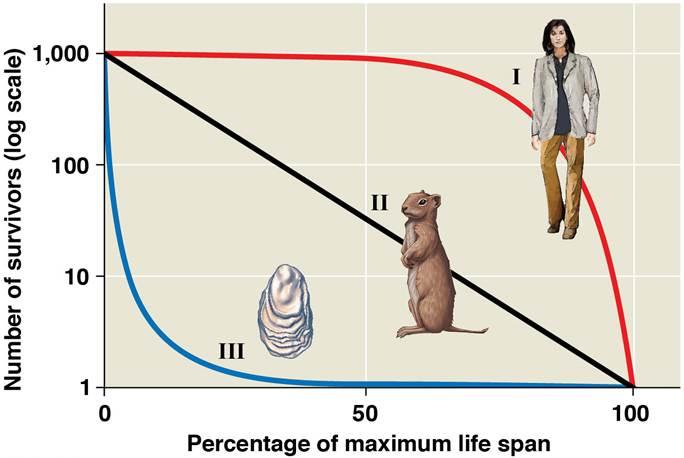 Imagine that a species of fish used to be a broadcast spawner (producing many eggs that then get no subsequent parental care) but has evolved to be a mouthbrooder (holding the eggs in the parent’s mouth until they hatch and then caring for the young for a while). We would expect the survivorship curve of this species to:
| back 77 a) shift from Type III to Type I or II. |
front 78 Population ecologists are primarily interested in a)understanding how biotic and abiotic factors influence the density, distribution, size, and age structure of populations. b)the overall vitality of a population of organisms. c)how humans affect the size of wild populations of organisms. d)studying interactions among populations of organisms that inhabit the same area. e)how populations evolve as natural selection acts on heritable variations among individuals and changes in gene frequency. | back 78 a) understanding how biotic and abiotic factors influence |
front 79 Low death rates during early and middle life and an increase in death rates among older age groups. | back 79 Type I Survivorship Curve |
front 80 A constant death rate over the organism’s lifespan. | back 80 Type II Survivorship Curve |
front 81 High death rates for the young and a lower death rate for survivors. | back 81 Type III Survivorship Curve |
front 82 An organism’s life history entails what three key components? | back 82
|
front 83 In ____________ populations, birth rate and death rate do not change with population density. | back 83 Density-independent |
front 84 In ____________ populations, birth rates fall and death increase with rising population density. | back 84 Density-dependent
|
front 85 Density-dependent birth and death rates are affected by many factors, such as: | back 85
|
front 86 _________ are an example of negative feedback that regulates population growth | back 86 Density-dependent birth and death rates |
front 87 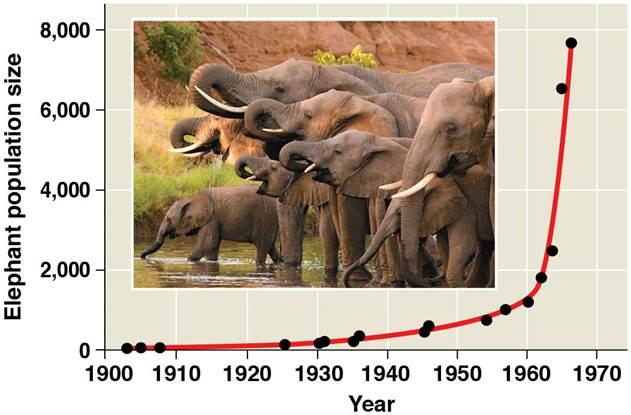 The exponential growth model describes the increase in population size of a population that is not constrained by resources or space. The graph shows the elephant population in Kruger National Park, which appears to have been increasing exponentially from 1900 to 1965. From this graph, you can tell that:
| back 87 a)the vegetation the elephants eat could support more |
front 88 You do a study on elephants and find that there are eight elephants per acre. This is a measurement of: a)density. b)dispersal. c)demographics. d)survivorship. | back 88 a) Density |
front 89 The European starling made it to the Atlantic coast of North America over 100 years ago. Fifty years after that, the bird was found in many states throughout the Midwest. This is an example of: a)density. b)disturbance. c)demographics. d)survivorship. e)dispersion. | back 89 e) Dispersion |
front 90 A population of deer grows from 100 to 200 to 600, and when it gets to 600, it levels off. This population must have reached: a)exponential growth. b)carrying capacity. c)logistic growth. d)exponential capacity. e)unlimited resources. | back 90 b) Carrying Capacity |
front 91 What is the difference between semelparity and iteroparity? a)Semelparous organisms return to their place of birth to reproduce, but iteroparous organisms can reproduce anywhere. b)Semelparous refers only to plants, but iteroparous refers to animals. c)Semelparous organisms live after their first reproduction, but iteroparous organisms die. d)Semelparous organisms die after their first reproduction, | back 91 d) Semelparous organisms die after their first reproduction, |
front 92 What does a negative population growth rate tell you about the dynamics of the population? a)The birth rate equals the death rate. b)The population size is increasing instead of decreasing. c)The population size is decreasing instead of increasing. d)The population is not experiencing competition. e)The population is not limited by resources. | back 92 c) The population is decreasing instead of increasing |
front 93 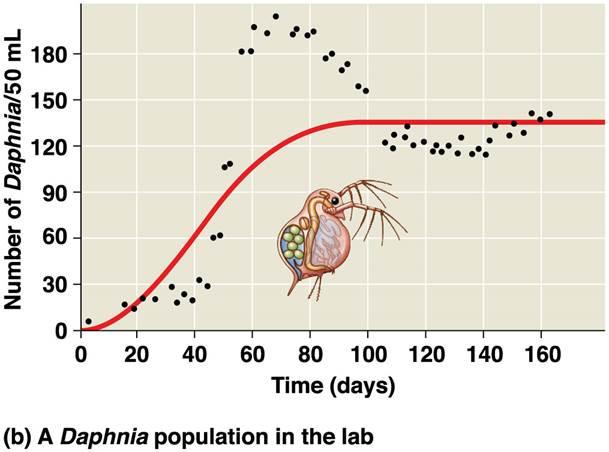 The red line shows the growth predicted by the logistic model, and the black dots show the measured growth of the population. Does the measured growth match the predicted growth pattern? a)No; only a few of the black dots sit on the red line. b)Yes; it matches at the beginning and at the end of the time range. c)No; it is lower than the predicted values in some parts d)Yes; it matches over the whole | back 93 c) No; it is lower than the predicted values in some parts |
front 94 What is the predicted carrying capacity of the Daphnia culture? a)120 Daphnia/50 mL b)135 Daphnia/50 mL c)200 Daphnia/50 mL d)300 Daphnia/50 mL e)190 Daphnia/50 mL | back 94 b) 135 Daphina/50 mL |
front 95 Did the Daphnia population ever experience a negative growth rate? a)From about day 70 to day 105, the population decreased in size, indicating a negative growth rate. b)The population never experienced a negative growth rate because it stabilized after 140 days and never went to zero. c)From about day 20 to day 50 and from day 100 to day 150, the population fell below the predicted values, indicating a negative growth rate. | back 95 a) From about day 70 to day 105, the population decreased |
front 96 What is the best biological explanation for why the Daphnia population growth rate became negative between days 70 and 105? a)The population’s data defined by the black dots have a slope that is negative during that period. b)The population grew larger than the predicted size during that period. c)The population exceeded the carrying capacity and started running out of resources during that period. d)The population’s death rate was greater than the birth rate during that period. | back 96 c) The population exceeded the carrying capacity and |
front 97 How does emigration affect population size? a)The population will increase in size as emigration increases. b)The population can experience loss of individuals who c)The population gains individuals due to births. d) It changes whether the organism shows a random or uniform distribution. e)It causes the population to shift from a clumped to a uniform pattern of dispersion. | back 97 b) The population can experience loss of individuals who |
front 98 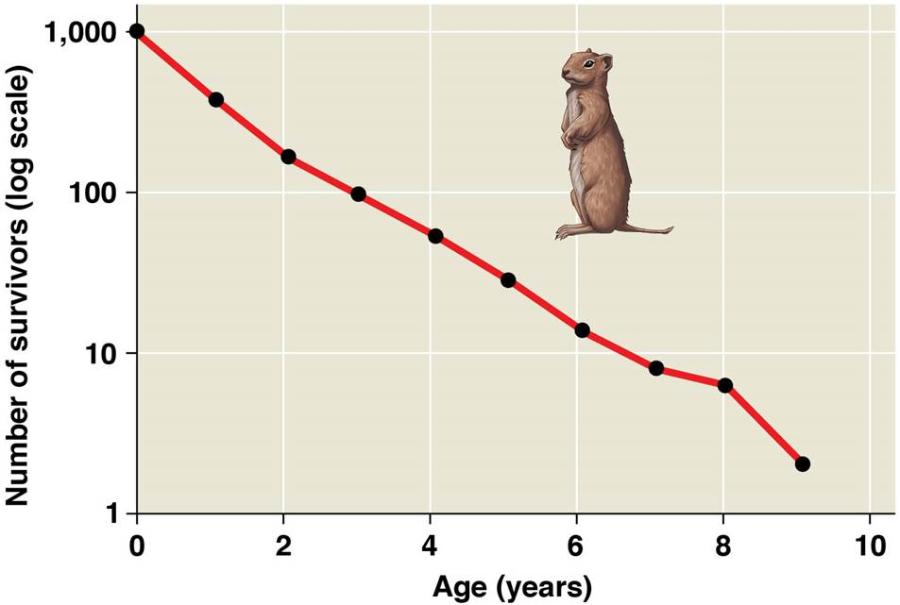 What percentage of female ground squirrels in the diagram below survive to 7 years old? a)10% b)100% c)1% d)25% e)50% | back 98 c) 1% |
front 99 Female sea turtles emerge from the ocean and crawl up the beach, lay about 100 eggs or more per nest, and then cover the eggs with sand. What can you conclude about sea turtle populations? a)The population will increase in size rapidly due to a high reproductive rate. b)The population would exhibit a Type I survivorship curve if graphed. c)The population exhibits high mortality among older age classes. d)The population relies on parental care. e)The population exhibits high mortality among young individuals. | back 99 e) The population exhibits high mortality among young individuals. |
front 100 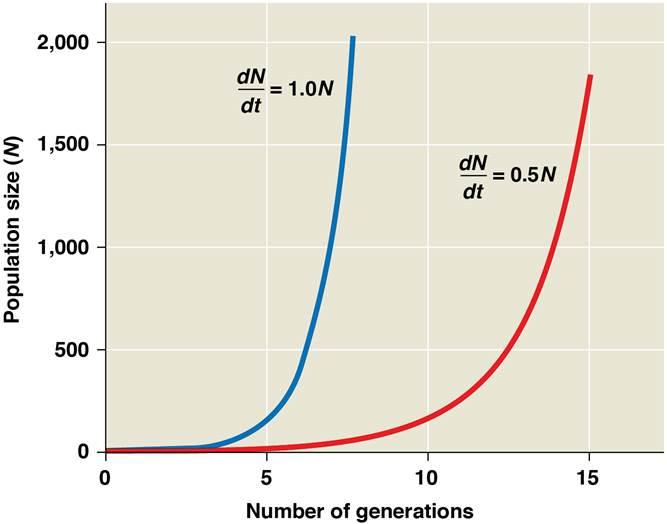 Which of the following statements about the graph below, which shows the increase in numbers of two populations of a species is correct? a)It shows rapid, logistic growth only in one population. b)It shows that the carrying capacity of the two different populations are different. c)The red population (dN / dt = 0.5N) is larger because it continues for more generations. d)Each population size is calculated in an instantaneous manner by considering current size and rate of increase. | back 100 d) Each population size is calculated in an instantaneous manner by considering current size and rate of increase. |
front 101 Which variables define the ecological life history of a species? A) the age at which reproduction begins, the frequency of reproduction, and the number of offspring for each reproductive episode B) the ratio of females to males, the length of the breeding season, and the number of offspring for each reproductive episode C) the number of offspring produced over a lifetime by a breeding pair and the survivability of the offspring D) timing breeding sessions with optimal environmental conditions and the number of offspring produced during each breeding session E) the amount of parental care given after birth, the number of reproductive episodes per year, and the number of years females are capable of producing viable offspring | back 101 A) the age at which reproduction begins the frequency of reproduction, and the number of offspring for each reproductive episode |
front 102 A species’ ________ is the niche potentially occupied by that species, while a species’ ________ is the niche actually occupied by that species | back 102 Fundamental; realized |
front 103 The tendency for characteristics to be more divergent in sympatric populations of two species than in allopatric populations of the same two species is called _____? | back 103 Character Displacement |
front 104 Animals with effective chemical defenses often exhibit bright warning coloration, called _____. | back 104 Aposematic coloration |
front 105 Two-species interactions are classified by the impact each species has on the other. Thus, a competitive interaction is one where the populations of each species are negatively impacted by the presence of the other species, usually because each species uses the same resources. Niche partitioning enables species to coexist by:
| back 105 a) avoiding direct competition. |
front 106 Which of the following best describes resource partitioning? a)Two species can coevolve to share identical niches. b)Competitive exclusion results in the success of the superior species. c)A climax community is reached when no new niches are available. d)Slight variations in niche allow similar species to e)Differential resource utilization results in the decrease in community species diversity. | back 106 d) Slight variations in niche allow similar species to |
front 107 What is one difference between the fundamental niche and the realized niche? a)The realized niche is larger. b)The fundamental niche is determined by competitors. c)The realized niche is determined by abiotic resources. d)Individuals will be found only in the realized niche. e)The difference is called the occupied niche. | back 107 d) Individuals will be found only in the realized niche. |
front 108 How might an ecologist test whether a species is occupying all of its fundamental niche or only a portion of it? a)Observe if the niche size changes after the introduction of a similar species. b)Measure the change in reproductive success when the species is subjected to environmental stress. c)Observe if the species expands its range after the d)Study the temperature range and humidity requirements of the species. | back 108 c) Observe if the species expands its range after the |
front 109 If two species are close competitors, and one species is experimentally removed from the community, the remaining species would be expected to _____. a)change its fundamental niche b)decline in abundance c)become the target of specialized parasites d)expand its realized niche | back 109 d) expand its realized niche |
front 110 The common spiny mouse (Acomys cahirinus) and the golden spiny mouse (A. russatus) can occupy essentially the same ecological niche in rocky habitats of the Middle East and China. They accomplish this by:
| back 110 b) temporal niche partitioning. |
front 111 Character displacement: a)can be observed in sympatric populations of two b)is usually observed in allopatric populations of two species. c)is usually observed for two species living in widely separated habitats. d)is the result of niche partitioning. e)is an interaction between two species in which one generally dominates the competition due to its morphology. | back 111 a) can be observed in sympatric populations of two |
front 112 An obligate mutualism is an interaction in which at least one species cannot survive without the presence of the other species; a facultative mutualism is an interaction that benefits both species but is not required by either species. One reason facultative mutualism is more common is that:
| back 112 e) in an obligate mutualism if the partner becomes extinct, |
front 113 The number of different species in the community is known as ____. | back 113 Species Richness |
front 114 The proportion each species represents of all individuals in the community is the _____. | back 114 Relative abundance |
front 115 The feeding relationships between organisms in a community is the ____. | back 115 Trophic structure |
front 116 The evaporation of water from soil plus transpiration of water from plants is called _____. | back 116 Evapotranspiration
|
front 117 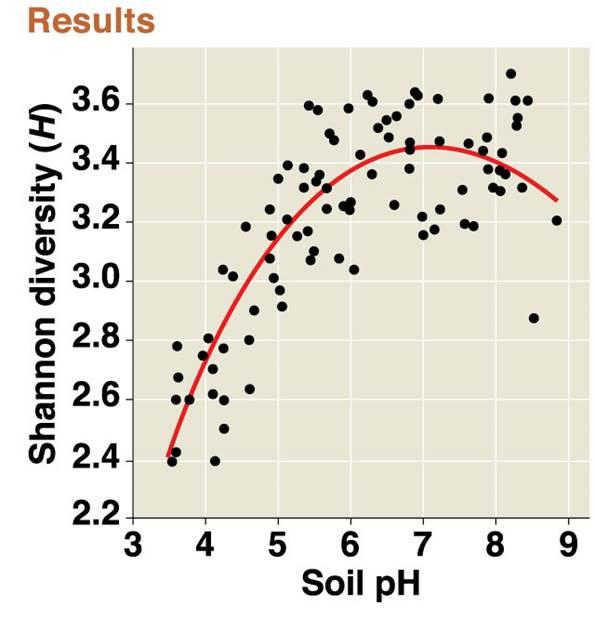 This graph shows the effect of soil pH on microbial diversity. One conclusion you should draw from this figure is:
| back 117 there appears to be an optimal pH value for maximizing microbial diversity |
front 118 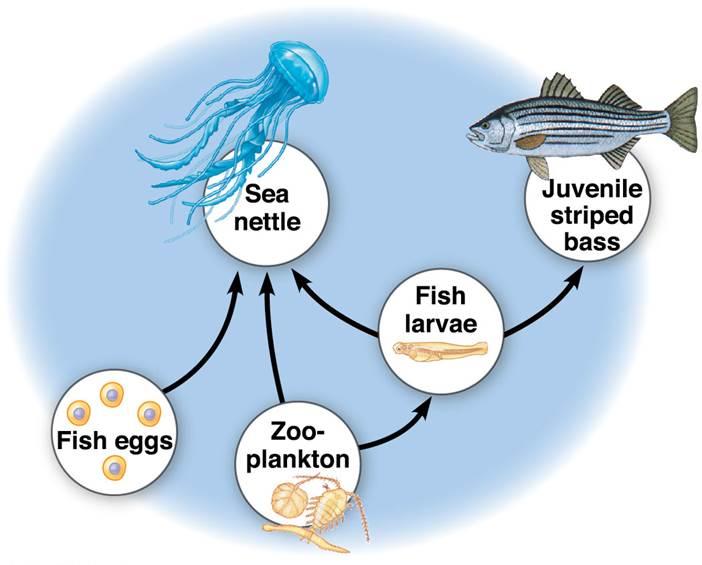 Look at the following figure, which shows a partial Chesapeake Bay food web. If sea nettles disappeared, a)there would be fewer fish eggs. b)there would be more striped bass. c)there would be fewer zooplankton. d)striped bass would have less food to eat. e)fish larvae would decrease in abundance. | back 118 b) there would be more striped bass. |
front 119 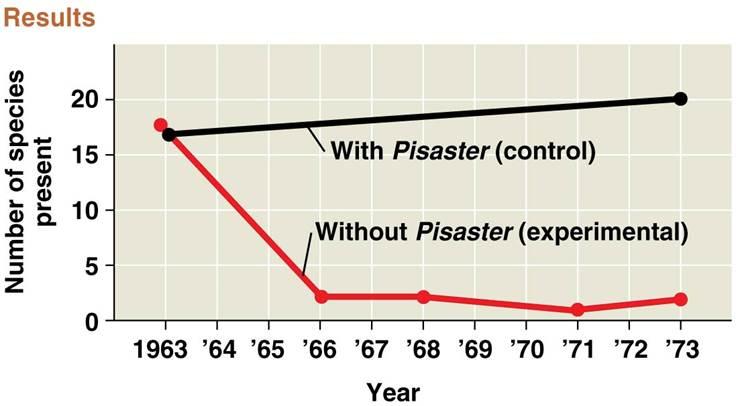 In rocky intertidal communities of western North America, Robert Paine removed Pisaster, an uncommon starfish, and measured species diversity. He found that species diversity dropped dramatically when Pisaster was not present. From this, we can conclude that:
| back 119 c) Pisaster likely consumed the dominant competitors. |
front 120 Disturbance is an important component of succession because it: a)removes keystone species. b)changes the biome from one kind to another. c)introduces invasive species. d)is associated with humans. e)tends to promote earlier successional stages. | back 120 e) tends to promote earlier successional stages |
front 121 Disturbance is hypothesized to be the most beneficial in terms of increasing biodiversity at: a)low levels. b)high levels. c)random intervals. d)moderate levels. e)intense levels. | back 121 d) Moderate levels |
front 122 A unidirectional influence on biomass from lower to higher trophic levels is called: a)an intermediate control. b)a bottom-up model. c)a top-down model. d)a restored state. | back 122 b) a bottom-up model |
front 123 Some birds follow moving swarms of army ants in the tropics. As the ants march along the forest floor hunting insects and small vertebrates, birds follow and pick off any insects or small vertebrates that fly or jump out of the way of the ants. This situation is an example of what kind of species interaction between the birds and the ants?
| back 123 c) commensalism |
front 124 Which of the following defines mutualism: a)−/− b)+/− c)+/+ d)+/0 e)0/0 | back 124 Answer: c. Mutualism is a relationship in which both organisms benefit from the relationship. |
front 125 Plants growing beneath and completely dependent upon the shade and dim light provided by the canopy of tall trees is an example of which kind of species interaction? a)ammensalism b)mutualism c)commensalism d)parasitism e)competition | back 125 c) Commensalism |
front 126 Which of the following terms is used by ecologists to describe the community interaction where one organism makes the environment more suitable for another organism? A) parasitism | back 126 D) facilitation |
front 127 The energetic hypothesis and dynamic stability hypothesis are ideas that attempt to explain: A) plant defenses against herbivores. | back 127 B) the length of food chains |
front 128 The amount of light energy converted to chemical energy by autotrophs during a given time period is _____. | back 128 Primary Production |
front 129 __________ build molecules themselves using photosynthesis or chemosynthesis as an energy source. | back 129 Autotrophs |
front 130 _____________ depend on the biosynthetic output of other organisms | back 130 Heterotrophs |
front 131 Primary producers are _______. | back 131 Autotrophs |
front 132 Primary consumers are _________. | back 132 Herbivores |
front 133 Secondary consumers are _________. | back 133 Carnivores |
front 134 Tertiary consumers are ________. | back 134 Carnivores that feed on other carnivores |
front 135 Detritivores are ______. | back 135 heterotrophs that derive their energy from detritus, nonliving organic matter AKA: decomposers |
front 136 The total primary production is known as the ecosystem’s _____. | back 136 Gross Primary Production (GPP) |
front 137 __________ is GPP minus energy used by autotrophs for respiration (Ra). | back 137 Net Primary Production (NPP) NPP represents new biomass added to the whole ecosystem during a given time NPP = GPP – Ra |
front 138 ___________ is a measure of the total biomass (not just biomass of producers) accumulation during a given period | back 138 Net Ecosystem Production (NEP)
NEP = GPP – RT |
front 139 In marine and freshwater ecosystems, both _____ and______ control primary production. | back 139 light; nutrients |
front 140 _______ is the element that must be added for production to increase in an area. | back 140 Limiting nutrient |
front 141 ________and ________ are the nutrients that most often limit marine production. | back 141 Nitrogen; phosphorous |
front 142 Experiments in the Sargasso Sea in the subtropical Atlantic Ocean showed that the micronutrient _________ can also limit primary production | back 142 Iron |
front 143 In terrestrial ecosystems, __________ and ___________affect primary production on a large scale. | back 143 Temperature; moisture |
front 144 ________ production of an ecosystem is the amount of chemical energy in food converted to new biomass during a given period of time. | back 144 Secondary |
front 145 What is the most important role of photosynthetic organisms in an ecosystem? a)converting inorganic compounds into organic b)absorbing solar radiation c)producing organic detritus for decomposers d)dissipating heat e)recycling energy from other trophic levels | back 145 a) converting inorganic compounds into organic |
front 146 The first law of thermodynamics: a)states that energy can be destroyed. b)states that energy can be created. c)states that energy can be transformed and transferred
but d)states that the total energy in a system will decrease as energy is used up. e)states that energy is cycled within an ecosystem. | back 146 c) states that energy can be transformed and transferred but |
front 147 Imagine that an arctic fox has just captured its prey, an arctic sea bird, and begins to consume it. In what way will the energy in the bird be transferred or transformed?
| back 147 d) both a and b |
front 148 Which of the following is accurate regarding the second law of thermodynamics? a)As energy is transferred or transformed, a certain portion of the energy is destroyed. b)Energy will not cycle within an ecosystem for very long, c)Energy cycles within an ecosystem for long periods of time. d)Incoming solar radiation energy will all be absorbed by plants during photosynthesis. | back 148 b) Energy will not cycle within an ecosystem for very long, |
front 149 Following the second law of thermodynamics, what is inefficient about the fox eating the arctic bird? a)The bird’s energy will only last so long. b)Although all the energy in organic bonds of the flesh of
c)Some of the energy consumed by the fox will be used to generate
ATP in its cells, but another portion of the d)Nothing is inefficient about it. | back 149 c) Some of the energy consumed by the fox will be used to generate
ATP in its cells, but another portion of the |
front 150 Unlike energy, matter cycles within and among ecosystems. This means that: a)an ecosystem cannot lose chemicals from it. b)ecosystems can acquire chemicals that are used up from other ecosystems. c)when models are built for ecosystems, all of the d)matter is being continually converted into heat and back into matter. e)chemicals contain energy, but energy doesn’t contain chemicals. | back 150 c) when models are built for ecosystems, all of the |
front 151 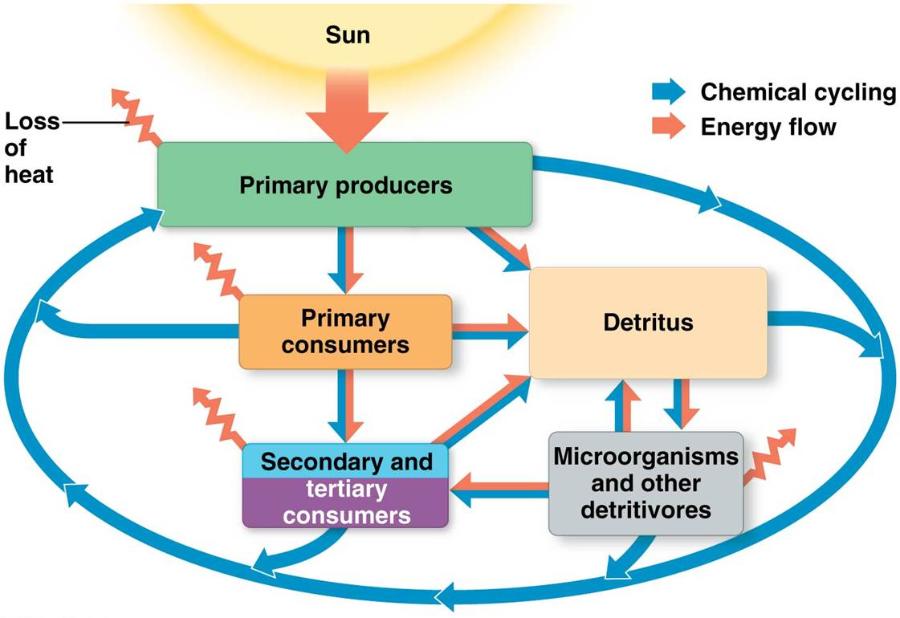 The source of the loss of heat from the primary producers and primary consumers shown below is heat produced during cellular respiration. a) True b) False | back 151 a) True |
front 152 Gross primary productivity is higher than net primary productivity. The difference between the two is: a)the amount of energy producers burn when they b)typically the ratio between the biomass of producers and the biomass of consumers. c)an important measure of ecosystem productivity. d)energy that is lost into outer space due to metabolic inefficiencies. e)energy that is stored in plant tissues. | back 152 a) the amount of energy producers burn when they |
front 153 Why are big, predatory animals rare? Most big, predatory animals are tertiary consumers, which implies that: a)they are typically highly territorial. b)it’s hard for an ecosystem to support many of them c)by overexploitation, humans have caused many predatory species to become endangered. d)it takes a long time for big, predatory animals to evolve. e)it’s hard for a big animal to move through dense vegetation. | back 153 b) it’s hard for an ecosystem to support many of them |
front 154 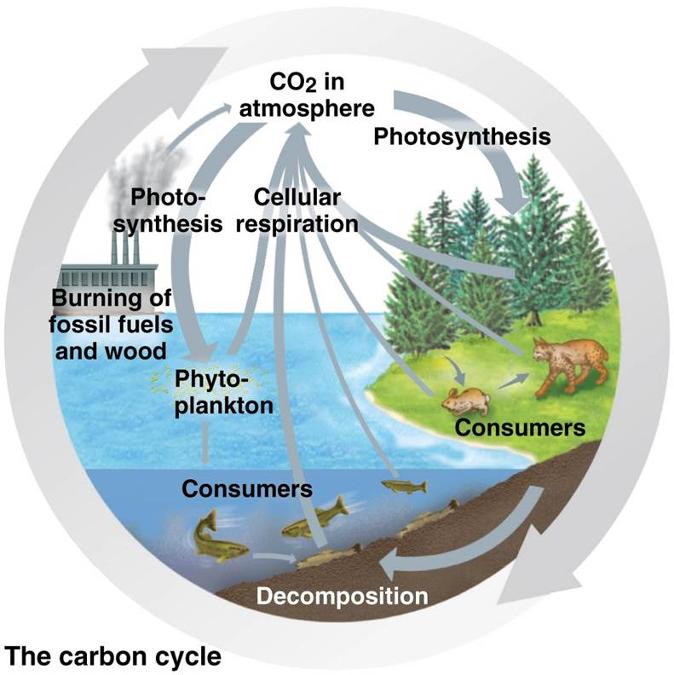 The diagram shows a general model of carbon cycling. All living things contribute to one or more components of this diagram. Which arrow(s) show(s) an activity or activities that is/are performed by every living thing?
| back 154 e) a and d |
front 155 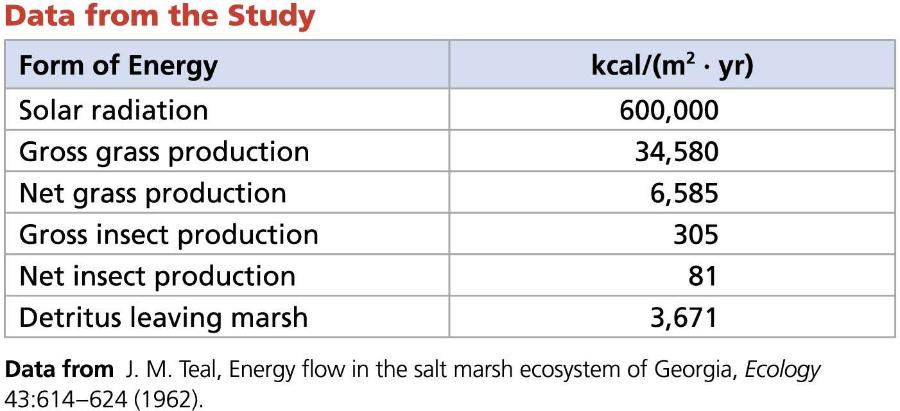 Why is there a difference between gross and net grass production? a)Some of the grass died due to consumption. b)Some energy was lost as heat during respiration. | back 155 b) Some energy was lost as heat during respiration. |
front 156 What percentage of the solar energy that reaches the marsh is incorporated into gross primary production? a)1.1% b)5.8% c)10.3% d)62.4% | back 156 b) 5.8% |
front 157 What percentage of the solar energy that reaches the marsh is incorporated into net primary production? a)0.01% b)0.2% c)1.1% d)12.3% | back 157 c) 1.1% |
front 158 How much energy is lost by primary producers as respiration in this ecosystem? a)3,921 kcal/(m2 • yr) b)6,585 kcal/(m2 • yr) c)13,735 kcal/(m2 • yr) d)27,995 kcal/(m2 • yr) | back 158 d) 27,995 kcal/(m2 • yr) |
front 159 How much energy is lost as respiration by the insect population? a)16 kcal/(m2 • yr) b)85 kcal/(m2 • yr) c)224 kcal/(m2 • yr) d)305 kcal/(m2 • yr) | back 159 c) 224 kcal/(m2 • yr) |
front 160 If all of the detritus leaving the marsh is plant material, what percentage of all net primary production leaves the marsh as detritus each year? a)8% b)20% c)43% d)56% | back 160 d) 56% |