Instructions for Side by Side Printing
- Print the notecards
- Fold each page in half along the solid vertical line
- Cut out the notecards by cutting along each horizontal dotted line
- Optional: Glue, tape or staple the ends of each notecard together
Bio Ch.29
front 1 1) Which of the following could occur only after plants moved from
the oceans to land? | back 1 A) Animals could also move onto land because there were opportunities for new food sources |
front 2 According to the fossil record, plants colonized terrestrial habitats
________. A) in conjunction with insects that pollinated them D) only about 150 million years ago | back 2 B) in conjunction with fungi that helped provide them with nutrients from the soil |
front 3 The most direct ancestors of land plants were probably ________. A)
kelp (brown alga) that formed large beds near the shorelines D) liverworts and mosses | back 3 B) green algae |
front 4 About 450 million years ago, the terrestrial landscape on Earth would
have ________. A) looked very similar to that of today, with flowers,
grasses, shrubs, and trees D) had non-vascular, green plants similar to liverworts forming green mats on rock | back 4 D) had non-vascular, green plants similar to liverworts forming green mats on rock |
front 5 What evidence do paleobotanists look for that indicates the movement
of plants from water to land? C) sporopollenin to inhibit evaporation from leaves | back 5 A) waxy cuticle to decrease evaporation from leaves |
front 6 Which of these events, based on plant fossils, came last (most
recently)? A) extensive growth of gymnosperm forests D) carboniferous swamps with giant horsetails and lycophytes | back 6 C) rise and diversification of angiosperms |
front 7 Why have biologists hypothesized that the first land plants had a
low, sprawling growth habit? A) They were tied to the water for
reproduction, thus needing to remain in close contact with the moist
soil. C) Land animals of that period were small and could not pollinate tall plants. D) There was less competition for space, so they simply spread out flat. | back 7 B) The ancestors of land plants, green algae, lacked the structural support to stand erect in air. |
front 8 Spores and seeds have basically the same function—dispersal—but are
vastly different because spores ________. C) have stored nutrition; seeds do not | back 8 D) are unicellular; seeds are not |
front 9 You find a green organism in a pond near your house and believe it is
a plant, not an alga. The mystery organism is most likely a plant and
not an alga if it ________. C) does not contain vascular tissue | back 9 B) is surrounded by a cuticle |
front 10 Retaining the zygote on the living gametophyte of land plants
________. A) protects the zygote from herbivores D) allows it to be nourished by the parent plant | back 10 D) allows it to be nourished by the parent plant |
front 11 The structural integrity of bacteria is to peptidoglycan as the
structural integrity of plant spores is to ________. C) secondary compounds | back 11 D) sporopollenin |
front 12 According to our current knowledge of plant evolution, which group of
organisms should feature cell division most similar to that of land
plants? C) some charophytes | back 12 C) some charophytes |
front 13 Which taxon is essentially equivalent to the
"embryophytes"? A) Plantae D) Charophycea | back 13 A) Plantae |
front 14 If the kingdom Plantae is someday expanded to include the charophytes
(stoneworts), then the shared derived characteristics of the kingdom
will include ________. C) rings of cellulose-synthesizing complexes, alternation of
generations, and ability to synthesize sporopollenin | back 14 A) rings of cellulose-synthesizing complexes and ability to synthesize sporopollenin |
front 15 Which of the following environmental factors probably helped early
plants to successfully colonize land? C) an increased availability of symbiotic partners | back 15 C) an increased availability of symbiotic partners |
front 16 A student encounters a pondweed that appears to be a charophyte.
Which of the following features would help the student determine
whether the sample comes from a charophyte or from some other type of
green alga? B) molecular structure of enzymes inside the chloroplasts and rings
of cellulose-synthesizing complexes | back 16 D) structure of sperm cells, presence of phragmoplasts, and rings of cellulose-synthesizing complexes |
front 17 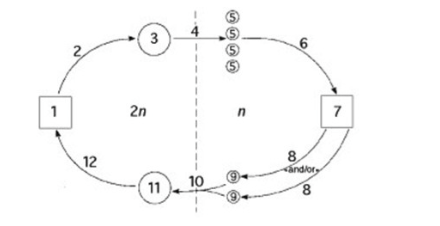 The following question refers to the generalized life cycle for land plants shown in the figure. Each number within a circle or square represents a specific plant or plant part, and each number over an arrow represents meiosis, mitosis, or fertilization. In the figure, which number represents the mature gametophyte? A) 1 B) 3 | back 17 C) 7 |
front 18 The following question refers to the generalized life cycle for land plants shown in the figure. Each number within a circle or square represents a specific plant or plant part, and each number over an arrow represents meiosis, mitosis, or fertilization. In the figure, which number represents an embryo? A) 1 D) 11 | back 18 D) 11 |
front 19 The following question refers to the generalized life cycle for land plants shown in the figure. Each number within a circle or square represents a specific plant or plant part, and each number over an arrow represents meiosis, mitosis, or fertilization. In the figure, meiosis is most likely to be represented by which
number(s)? A) 2 D) 10 and 12 | back 19 B) 4 |
front 20 The following question refers to the generalized life cycle for land plants shown in the figure. Each number within a circle or square represents a specific plant or plant part, and each number over an arrow represents meiosis, mitosis, or fertilization. Which number represents a megaspore mother cell in the figure? A)
1 D) 7 | back 20 B) 3 |
front 21 The following question refers to the generalized life cycle for land plants shown in the figure. Each number within a circle or square represents a specific plant or plant part, and each number over an arrow represents meiosis, mitosis, or fertilization. In the figure, the process labeled "6" involves ________.
A) mitosis D) binary fission | back 21 A) mitosis |
front 22 The fact that both charophytes and green plants contain chlorophylls
a and b demonstrates which of the following? C) The common ancestor of these two groups contained chlorophylls a and b. D) These two groups are not closely related. | back 22 C) The common ancestor of these two groups contained chlorophylls a and b. |
front 23 Which of the following statements about the transition from ocean to
land by plants is most likely to be accurate? C) Rising sea levels favored individuals that were able to survive ever-drier conditions. D) The high light levels of terrestrial systems favored individuals that contained flexible photosynthetic enzyme systems. | back 23 B) The transition to land was likely gradual, with plants evolving traits that let them survive ever-drier conditions. |
front 24 Which of the following statements about the zygotes of plants is most
likely to be accurate? A) Protection of the zygote from the drying
effects of air was important. D) Zygotes in plants are more likely to germinate quickly after release from the parent plant than are zygotes released from algal organisms. | back 24 A) Protection of the zygote from the drying effects of air was important. |
front 25 If animals had alternation of generations like plants,
________. | back 25 D) the products of meiosis would undergo mitosis and become multicellular |
front 26 Apical meristems ________. | back 26 C) occur in both roots and shoots of plants |
front 27 Which of the following statements about stomata is accurate? | back 27 D) Stomata are important in terrestrial plants because they allow CO2 to diffuse into the plant. |
front 28 The presence of vascular tissue allowed plants to ________. | back 28 B) transport nutrients and water from below-ground tissues to above-ground tissues and grow taller |
front 29 Bryophytes (non-vascular plants) ________. | back 29 A) are more similar to ancestral green algae than are vascular plants |
front 30 Grades, as opposed to clades, ________. | back 30 D) represent groups with similar traits |
front 31 31) Stomata ________. | back 31 B) open to allow gas exchange and close to decrease water loss |