Instructions for Side by Side Printing
- Print the notecards
- Fold each page in half along the solid vertical line
- Cut out the notecards by cutting along each horizontal dotted line
- Optional: Glue, tape or staple the ends of each notecard together
PHY CH 2
front 1 Consider a deer that runs from point A to point B. The distance the deer runs can be greater than the magnitude of its displacement, but the magnitude of the displacement can never be greater than the distance it runs. A) True B) False | back 1 A) True |
front 2 Suppose that an object travels from one point in space to another. Make a comparison between the magnitude of the displacement and the distance traveled by this object.
| back 2
|
front 3 Consider a car that travels between points A and B. The car's average speed can be greater than the magnitude of its average velocity, but the magnitude of its average velocity can never be greater than its average speed.
| back 3
|
front 4 When is the average velocity of an object equal to the instantaneous velocity?
| back 4
|
front 5 You drive 6.0 km at 50 km/h and then another 6.0 km at 90 km/h. Your average speed over the 12 km drive will be
| back 5
|
front 6 If the velocity of an object is zero at some point, then its acceleration must also be zero at that point.
| back 6
|
front 7 Which of the following situations is impossible?
| back 7
|
front 8 If the acceleration of an object is zero, then that object cannot be moving.
| back 8
|
front 9 If the velocity of an object is zero, then that object cannot be accelerating.
| back 9
|
front 10 Suppose that a car traveling to the west begins to slow down as it approaches a traffic light. Which of the following statements about its acceleration is correct?
| back 10
|
front 11 An auto manufacturer advertises that their car can go "from zero to sixty in eight seconds." This is a description of what characteristic of the car's motion?
| back 11
|
front 12 An object moving in the +x direction experiences an acceleration of +2.0 m/s2. This means the object
| back 12
|
front 13 Suppose that a car traveling to the east (+x direction) begins to slow down as it approaches a traffic light. Which statement concerning its acceleration must be correct?
| back 13
|
front 14 Suppose that a car traveling to the west (-x direction) begins to slow down as it approaches a traffic light. Which statement concerning its acceleration must be correct?
| back 14
|
front 15 Suppose that an object is moving with a constant velocity. Which statement concerning its acceleration must be correct?
| back 15
|
front 16 Under what condition is average velocity equal to the average of the object's initial and final velocity?
| back 16
|
front 17  A racing car accelerates uniformly from rest along a straight track. This track has markers spaced at equal distances along it from the start, as shown in the figure. The car reaches a speed of 140 km/h as it passes marker 2. Where on the track was the car when it was traveling at half this speed, that is at 70 km/h?
| back 17
|
front 18 When a ball is thrown straight up with no air resistance, the acceleration at its highest point
| back 18
|
front 19 A rock from a volcanic eruption is launched straight up into the air with no appreciable air resistance. Which one of the following statements about this rock while it is in the air is correct?
| back 19
|
front 20 Suppose a ball is thrown straight up and experiences no appreciable air resistance. What is its acceleration just before it reaches its highest point?
| back 20
|
front 21 A ball is thrown straight up, reaches a maximum height, then falls to its initial height. Which of the following statements about the direction of the velocity and acceleration of the ball as it is going up is correct?
| back 21
|
front 22 A ball is thrown downward in the absence of air resistance. After it has been released, which statement(s) concerning its acceleration is correct? (There could be more than one correct choice.)
| back 22
|
front 23 A 10-kg rock and a 20-kg rock are thrown upward with the same initial speed v0 and experience no significant air resistance. If the 10-kg rock reaches a maximum height h, what maximum height will the 20-kg ball reach?
| back 23
|
front 24 A 10-kg rock and 20-kg rock are dropped from the same height and experience no significant air resistance. If it takes the 20-kg rock a time T to reach the ground, what time will it take the 10-kg rock to reach the ground?
| back 24
|
front 25 A 10-kg rock and a 20-kg rock are dropped at the same time and experience no significant air resistance. If the 10-kg rock falls with acceleration a, what is the acceleration of the 20-kg rock?
| back 25
|
front 26 Two objects are dropped from a bridge, an interval of 1.0 s apart. Air resistance is negligible. During the time that both objects continue to fall, their separation
| back 26
|
front 27 From the edge of a roof top you toss a green ball upwards with initial speed v0 and a blue ball downwards with the same initial speed. Air resistance is negligible. When they reach the ground below
| back 27
|
front 28 Ball A is dropped from the top of a building. One second later, ball B is dropped from the same building. Neglect air resistance. As time progresses, the difference in their speeds
| back 28
|
front 29 Two objects are thrown from the top of a tall building. One is thrown up, and the other is thrown down, both with the same initial speed. What are their speeds when they hit the street? Neglect air resistance.
| back 29
|
front 30 Brick A is dropped from the top of a building. Brick B is thrown straight down from the same building, and neither one experiences appreciable air resistance. Which statement about their accelerations is correct?
| back 30
|
front 31 An object is moving with constant non-zero velocity in the +x direction. The position versus time graph of this object is
| back 31
|
front 32 An object is moving with constant non-zero acceleration in the +x direction. The position versus time graph of this object is
| back 32
|
front 33 An object is moving with constant non-zero velocity in the +x direction. The velocity versus time graph of this object is
| back 33
|
front 34 An object is moving with constant non-zero acceleration in the +x direction. The velocity versus time graph of this object is
| back 34
|
front 35 The slope of a position versus time graph gives A) the distance traveled. B) velocity. C) acceleration. D) displacement. | back 35 B) velocity. |
front 36 The slope of a velocity versus time graph gives
| back 36
|
front 37 If the position versus time graph of an object is a horizontal line, the object is
| back 37
|
front 38 If the velocity versus time graph of an object is a horizontal line, the object is
| back 38
|
front 39 If the velocity versus time graph of an object is a straight line making an angle of +30° (counter clockwise) with the time axis, the object is
| back 39
|
front 40 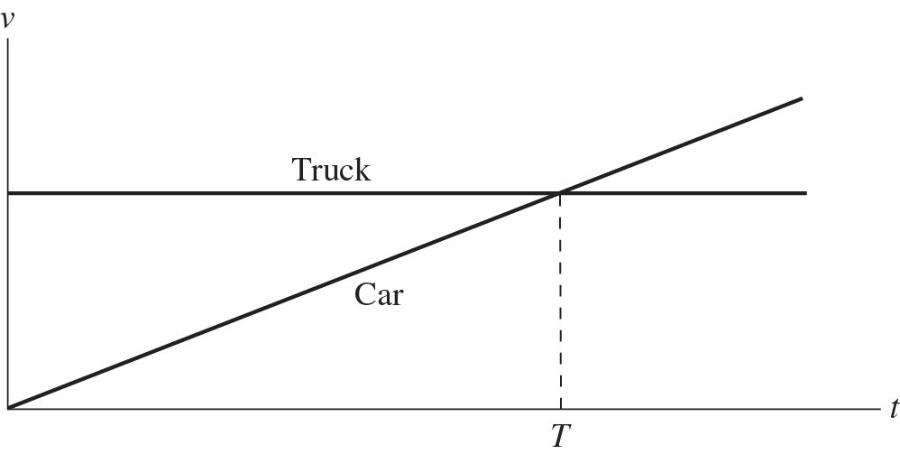 The motions of a car and a truck along a straight road are represented by the velocity-time graphs in the figure. The two vehicles are initially alongside each other at time t = 0. At time T, what is true of the distances traveled by the vehicles since time t = 0?
| back 40
|
front 41 The area under a curve in a velocity versus time graph gives
| back 41
|
front 42 An object moves 15.0 m north and then 11.0 m south. Find both the distance it has traveled and the magnitude of its displacement.
| back 42
|
front 43 What must be your average speed in order to travel 350 km in 5.15 h?
| back 43
|
front 44 A runner ran the marathon (approximately 42.0 km) in 2 hours and 57 min. What was the average speed of the runner in m/s?
| back 44
|
front 45 A light-year is the distance that light travels in one year. The speed of light is 3.00 × 10⁸ m/s. How many miles are there in one light-year? (1 mi = 1609 m, 1 y = 365 d)
| back 45
|
front 46 If you are driving 72 km/h along a straight road and you look to the side for 4.0 s, how far do you travel during this inattentive period?
| back 46
|
front 47 A polar bear starts at the North Pole. It travels 1.0 km south, then 1.0 km east, and then 1.0 km north to return to its starting point. This trip takes 45 min. What was the bear's average speed?
| back 47
|
front 48 A polar bear starts at the North Pole. It travels 1.0 km south, then 1.0 km east, and then 1.0 km north to return to its starting point. This trip takes 45 min. What was the bear's average velocity?
| back 48
|
front 49 You are driving home on a weekend from school at 55 mi/h for 110 miles. It then starts to snow and you slow to 35 mi/h. You arrive home after driving 4 hours and 15 minutes. How far is your hometown from school?
| back 49
|
front 50 A motorist travels 160 km at 80 km/h and 160 km at 100 km/h. What is the average speed of the motorist for this trip?
| back 50
|
front 51 A motorist travels for 3.0 h at 80 km/h and 2.0 h at 100 km/h. What is her average speed for the trip?
| back 51
|
front 52 An airplane travels at 300 mi/h south for 2.00 h and then at 250 mi/h north for 750 miles. What is the average speed for the trip?
| back 52
|
front 53 A runner runs around a track consisting of two parallel lines 96 m long connected at the ends by two semicircles with a radius of 49 m. She completes one lap in 100 seconds. What is her average velocity?
| back 53
|
front 54 A runner runs around a track consisting of two parallel lines 96 m long connected at the ends by two semicircles with a radius of 49 m. She completes one lap in 100 seconds. What is her average speed?
| back 54
|
front 55 You leave on a trip in order to attend a meeting that will start after you begin your trip. Along the way you plan to stop for dinner. If the fastest you can safely drive is 65 mi/h, what is the longest time you can spend over dinner and still arrive just in time for the meeting?
| back 55
|
front 56 A motorist makes a trip of 180 miles. For the first 90 miles she drives at a constant speed of 30 mph. At what constant speed must she drive the remaining distance if her average speed for the total trip is to be 40 mph?
| back 56
|
front 57 An airplane increases its speed at the average rate of 15 m/s2. How much time does it take to increase its speed from 100 m/s to 160 m/s?
| back 57
|
front 58 A car is traveling north at After 12 s its velocity is in the same direction. Find the magnitude and direction of the car's average acceleration.
| back 58
|
front 59 A racquetball strikes a wall with a speed of 30 m/s and rebounds in the opposite direction with a speed of 26 m/s. The collision takes 20 ms. What is the average acceleration of the ball during the collision with the wall?
| back 59
|
front 60 The velocity v(t) of a particle as a function of time is given by v(t) = (2.3 m/s) + (4.1 m/s2)t - (6.2 m/s3)t2. What is the average acceleration of the particle between t = 1.0 s and t = 2.0 s?
| back 60
|
front 61 A certain test car can go from rest to 32.0 m/s in 3.88 s. The same car can come to a full stop from that speed in 4.14 s. What is the ratio of the magnitude of the starting acceleration to the stopping acceleration?
| back 61
|
front 62 A car initially traveling at 60 km/h accelerates at a constant rate of 2.0 m/s2. How much time is required for the car to reach a speed of 90 km/h?
| back 62
|
front 63 A toy rocket is launched vertically from ground level at time t = 0.00 s. The rocket engine provides constant upward acceleration during the burn phase. At the instant of engine burnout, the rocket has risen to 64 m and acquired an upward velocity of The rocket continues to rise with insignificant air resistance in unpowered flight, reaches maximum height, and falls back to the ground. The time interval during which the rocket engine provided the upward acceleration, is closest to
| back 63
|
front 64 A car travels at 15 m/s for 10 s. It then speeds up with a constant acceleration of 2.0 m/s2 for 15 s. At the end of this time, what is its velocity?
| back 64
|
front 65 A cart with an initial velocity of 5.0 m/s to the right experiences a constant acceleration of 2.0 m/s2 to the right. What is the cart's displacement during the first 6.0 s of this motion?
| back 65
|
front 66 A jet plane is launched from a catapult on an aircraft carrier. In 2.0 s it reaches a speed of 42 m/s at the end of the catapult. Assuming the acceleration is constant, how far did it travel during those 2.0 s?
| back 66
|
front 67 A car starting from rest accelerates at a constant 2.0 m/s2 for 10 s. It then travels with constant speed it has achieved for another 10 s. Then it finally slows to a stop with constant acceleration of magnitude 2.0 m/s2. How far does it travel after starting?
| back 67
|
front 68 A car increases its forward velocity uniformly from 40 m/s to 80 m/s while traveling a distance of 200 m. What is its acceleration during this time?
| back 68
|
front 69 An object starts from rest and undergoes uniform acceleration. During the first second it travels 5.0 m. How far will it travel during the third second?
| back 69
|
front 70 An object is moving in a straight line with constant acceleration. Initially it is traveling at 16 m/s. Three seconds later it is traveling at 10 m/s. How far does it move during this time?
| back 70
|
front 71 A car starts from rest and accelerates uniformly at 3.0 m/s2 toward the north. A second car starts from rest 6.0 s later at the same point and accelerates uniformly at 5.0 m/s2 toward the north. How long after the second car starts does it overtake the first car?
| back 71
|
front 72 Starting from rest, a dragster travels a straight 1/4 mi racetrack in 6.70 s with constant acceleration. What is its velocity when it crosses the finish line?
| back 72
|
front 73 A bicyclist starts a timed race at In order to win, he must average Assuming constant acceleration from the start, how fast must he be traveling at the end of the race?
| back 73
|
front 74 A car accelerates from to at a constant rate of How far does it travel while accelerating?
| back 74
|
front 75 An airplane needs to reach a forward velocity of to take off. On a runway, what is the minimum uniform acceleration necessary for the plane to take flight if it starts from rest?
| back 75
|
front 76 Assuming equal rates of uniform acceleration in both cases, how much further would you travel if braking from to rest than from ?
| back 76
|
front 77 Acceleration is sometimes expressed in multiples of g, where is the acceleration of an object due to the earth's gravity. In a car crash, the car's forward velocity may go from to in How many g's are experienced, on average, by the driver?
| back 77
|
front 78 A baseball is hit with a bat and, as a result, its direction is completely reversed and its speed is doubled. If the actual contact with the bat lasts 0.45 s, what is the ratio of the magnitude of the average acceleration of the ball to its original speed?
| back 78
|
front 79 A train starts from rest and accelerates uniformly until it has traveled 5.6 km and acquired a forward velocity of The train then moves at a constant velocity of for 420 s. The train then slows down uniformly at until it is brought to a halt. The acceleration during the first 5.6 km of travel is closest to which of the following?
| back 79
|
front 80 A train starts from rest and accelerates uniformly until it has traveled 2.1 km and acquired a forward velocity of The train then moves at a constant velocity of for 400 s. The train then slows down uniformly at until it is brought to a halt. The distance traveled by the train while slowing down is closest to
| back 80
|
front 81 A car starts from rest and accelerates at a steady 6.00 m/s2. How far does it travel in the first 3.00 s?
| back 81
|
front 82 A car is moving with a constant acceleration. At time t = 5.0 s its velocity is 8.0 m/s in the forward direction, and at time t = 8.0 s its velocity is 12.0 m/s forward. What is the distance traveled in that interval of time?
| back 82
|
front 83 An airplane starts from rest and accelerates at a constant 10.8 m/s2. What is its speed at the end of a 400 m-long runway?
| back 83
|
front 84 A car is moving with a speed of 32.0 m/s. The driver sees an accident ahead and slams on the brakes, causing the car to slow down with a uniform acceleration of magnitude 3.50 m/s2. How far does the car travel after the driver put on the brakes until it comes to a stop?
| back 84
|
front 85 A car is traveling with a constant speed when the driver suddenly applies the brakes, causing the car to slow down with a constant acceleration of magnitude 3.50 m/s2. If the car comes to a stop in a distance of 30.0 m, what was the car's original speed?
| back 85
|
front 86 A car is traveling with a constant speed of 30.0 m/s when the driver suddenly applies the brakes, causing the car to slow down with a constant acceleration. The car comes to a stop in a distance of 120 m. What was the acceleration of the car as it slowed down?
| back 86
|
front 87 A car is traveling at 26.0 m/s when the driver suddenly applies the brakes, causing the car to slow down with constant acceleration. The car comes to a stop in a distance of 120 m. How fast was the car moving when it was 60.0 m past the point where the brakes were applied?
| back 87
|
front 88 Car A is traveling at 22.0 m/s and car B at 29.0 m/s. Car A is 300 m behind car B when the driver of car A accelerates his car with a uniform forward acceleration of 2.40 m/. How long after car A begins to accelerate does it take car A to overtake car B?
| back 88
|
front 89 A stone is thrown with an initial upward velocity of 7.0 m/s and experiences negligible air resistance. If we take upward as the positive direction, what is the velocity of the stone after 0.50 s?
| back 89
|
front 90 A laser is thrown upward with a speed of 12 m/s on the surface of planet X where the acceleration due to gravity is 1.5 m/s2 and there is no atmosphere. What is the maximum height reached by the laser?
| back 90
|
front 91 A laser is thrown upward with a speed of 12 m/s on the surface of planet X where the acceleration due to gravity is 1.5 m/s2 and there is no atmosphere. How long does it take for the laser to reach the maximum height?
| back 91
|
front 92 A hammer is thrown upward with a speed of 14 m/s on the surface of planet X where the acceleration due to gravity is 3.5 m/s2 and there is no atmosphere. What is the speed of the hammer after 8.0 s?
| back 92
|
front 93 Human reaction time is usually greater than 0.10 s. If your friend holds a ruler between your fingers and releases it without warning, how far can you expect the ruler to fall before you catch it, assuming negligible air resistance?
| back 93
|
front 94 A ball is thrown upward at a velocity of 19.6 m/s. What is its velocity after 3.0 s, assuming negligible air resistance?
| back 94
|
front 95 A bullet shot straight up returns to its starting point in 10 s. What is the initial speed of the bullet, assuming negligible air resistance?
| back 95
|
front 96 A ball is thrown straight up with a speed of 36 m/s. How long does it take to return to its starting point, assuming negligible air resistance?
| back 96
|
front 97 A ball is thrown downward from the top of a building with an initial speed of 25 m/s. It strikes the ground after 2.0 s. How high is the building, assuming negligible air resistance?
| back 97
|
front 98 A ball is projected upward at time t = 0 s, from a point on a flat roof 10 m above the ground. The ball rises and then falls with insignificant air resistance, missing the roof, and strikes the ground. The initial velocity of the ball is Consider all quantities as positive in the upward direction. At time the vertical velocity of the ball is closest to
| back 98
|
front 99 A ball is projected upward at time t = 0 s, from a point on a flat roof 90 m above the ground. The ball rises and then falls with insignificant air resistance, missing the roof, and strikes the ground. The initial velocity of the ball is Consider all quantities as positive in the upward direction. The vertical velocity of the ball when it is above the ground is closest to
| back 99
|
front 100 A test rocket at ground level is fired straight up from rest with a net upward acceleration of 20 m/s2. After 4.0 s, the motor turns off but the rocket continues to coast upward with insignificant air resistance. What maximum elevation does the rocket reach?
| back 100
|
front 101 A rock is projected upward from the surface of the Moon, at time t = 0 s, with an upward velocity of 30.0 m/s. The acceleration due to gravity at the surface of the Moon is 1.62 m/s2, and the Moon has no atmosphere. The height of the rock when it is descending with a speed of 20.0 m/s is closest to
| back 101
|
front 102 A ball is thrown straight upward from ground level with a speed of How much time passes before the ball strikes the ground if we disregard air resistance?
| back 102
|
front 103 An object is dropped from a bridge. A second object is thrown downwards 1.0 s later. They both reach the water 20 m below at the same instant. What was the initial speed of the second object? Neglect air resistance.
| back 103
|
front 104 To determine the height of a bridge above the water, a person drops a stone and measures the time it takes for it to hit the water. If the time is 2.3 s, what is the height of the bridge? Neglect air resistance.
| back 104
|
front 105 An astronaut stands by the rim of a crater on the Moon, where the acceleration of gravity is 1.62 m/s2 and there is no air. To determine the depth of the crater, she drops a rock and measures the time it takes for it to hit the bottom. If the time is 6.3 s, what is the depth of the crater?
| back 105
|
front 106 An astronaut stands by the rim of a crater on the Moon, where the acceleration of gravity is 1.62 m/s2 and there is no air. To determine the depth of the crater, she drops a rock and measures the time it takes for it to hit the bottom. If the depth of the crater is 120 m, how long does it take for the rock to fall to the bottom of the crater?
| back 106 An astronaut stands by the rim of a crater on the Moon, where the acceleration of gravity is 1.62 m/s2 and there is no air. To determine the depth of the crater, she drops a rock and measures the time it takes for it to hit the bottom. If the depth of the crater is 120 m, how long does it take for the rock to fall to the bottom of the crater?
|
front 107 An object is thrown upwards with a speed of 16 m/s. How long does it take it to reach a height of 7.0 m on the way up? Neglect air resistance.
| back 107
|
front 108 To determine the height of a flagpole, Abby throws a ball straight up and times it. She sees that the ball goes by the top of the pole after 0.50 s and then reaches the top of the pole again after a total elapsed time of 4.1 s. How high is the pole above the point where the ball was launched? Neglect air resistance.
| back 108
|
front 109 Abby throws a ball straight up and times it. She sees that the ball goes by the top of a flagpole after 0.50 s and reaches the level of the top of the pole after a total elapsed time of 4.1 s. What was the speed of the ball at launch? Neglect air resistance.
| back 109
|
front 110 A car is able to stop in a distance d. Assuming the same braking force (and therefore the same acceleration), what distance does this car require to stop when it is traveling twice as fast?
| back 110
|
front 111 Assuming equal rates of acceleration in both cases, how much longer would it take a car to stop if braking from 56 mi/h than from 28 mi/h?
| back 111
|
front 112 Two cars are traveling at the same speed and hit the brakes at the same time. Car A decelerates (decreases its velocity) at twice the rate of car B. If car B takes time T to stop, how long does it take car A to stop?
| back 112
|