front 1 Which of the following statements concerning utility is correct?
- It is possible to
precisely measure the utility an individual receives from consuming
a particular good or service
- It is always possible to
determine whether Dalene or Juloy gets more utility from consuming
two units of the same good
- The utility of goods can be
measured while the same is not true for services
- Utility is
a subjective measure of satisfaction an individual receives from
consuming a good or service
- It is only useful if there is
no scarcity
| |
front 2 Economists assume people's tastes are
- determined solely by
advertising
- relatively stable over time
- quite
variable
- irrelevant to utility analysis
- identical
| |
front 3 Marginal utility is the
- overall satisfaction
obtained from consuming a good
- additional satisfaction
obtained from consuming one more unit of a good
- average
satisfaction obtained from consuming a good
- the change in
satisfaction obtained from consuming 1 percent more of a good
- additional cost of one more unit of a good
| |
front 4 The law of diminishing marginal utility states that
- total utility falls as
more of a good is consumed, other things constant
- total
utility falls as marginal utility falls, other things constant
- marginal utility falls as total utility increases, other things
constant
- marginal utility falls as more of a good is
consumed, other things constant
- marginal utility falls as
less of a good is consumed, other things constant
| |
front 5 Diminishing marginal utility means that
- as you consume more of a
good, other things constant, the total satisfaction you obtain from
consuming this good tends to fall
- as you hire more labor,
other things constant, the total amount produced begins to fall
- as you hire more labor, other things constant, the marginal
product begins to fall
- as you consume more of a good, other
things constant, the additional satisfaction you obtain from each
additional unit of the good tends to fall
- as you consume
more of a good, other things constant, the extra satisfaction you
obtain from each extra good becomes negative
| |
front 6 Which of the following illustrates the law of diminishing marginal utility?
- The marginal utility of
Diane's second Coke is greater than the marginal utility of her
third pretzel, other things constant.
- The marginal utility
of Diane's second Coke is greater than the marginal utility of Ken's
third pretzel, other things constant.
- The marginal utility
of Diane's second Coke is greater than the marginal utility of her
third Coke, other things constant.
- The total utility of one
Coke is greater than the total utility of two Cokes, other things
constant.
- The marginal utility of Diane's second Coke is
greater than the marginal utility of Ken's third Coke, other things
constant.
| |
front 7 The marginal utility of a second copy of today's New York
Times is
- infinite
- practically zero
- positive and greater than the marginal
utility of the first copy
- equal to the marginal utility of
the first copy
- 50 cents
| |
front 8 "I don't feel so good. I shouldn't have had that last
doughnut." Which statement best describes this situation?
- The marginal utility of
the last doughnut was positive.
- The marginal utility of
doughnuts is still increasing.
- The total utility from
eating doughnuts is negative.
- The marginal utility of the
last doughnut was negative.
- The marginal utility of the
next doughnut will be positive
| |
front 9 Carvel advertises a football-shaped ice cream cake for $7; you can
buy a second one for only $4. What do they know about consumer preferences?
- Consumers would never
buy a second ice cream cake.
- Two cakes are worth less to
the consumer than one.
- Marginal utility of ice cream cakes
diminishes.
- Consumers only value the first cake at $4.
- Consumers value all cakes they eat at $4.
| |
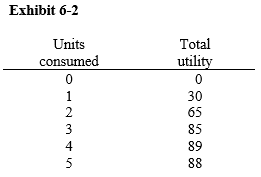
front 10 In Exhibit 6-2, where does marginal utility first begin to diminish?
- sometime after the first
unit consumed
- sometime after the second unit consumed
- sometime after the third unit consumed
- sometime after
the fourth unit consumed
- sometime after the fifth unit
consumed
| |
front 11 If a good is offered to you free of charge, then you
- never stop consuming
it
- stop consuming it when its marginal utility begins to
fall
- stop consuming it when its marginal utility begins to
increase
- stop consuming it when its marginal utility equals
0
- stop consuming it when its total utility equals 0
| |
front 12 If the price of a good is 0, a consumer will
- consume all units that
have positive total utility
- consume an infinite
quantity
- consume all units with positive marginal
utility
- consume the entire amount supplied
- consume
until total utility becomes 0
| |
front 13 Suppose Enid could increase her total utility by purchasing one more
book and one less video rental. Which of the following is true?
- The marginal utility of
video rentals exceeds the marginal utility of books.
- The
marginal utility of books exceeds the marginal utility of video
rentals.
- The marginal utility of video rentals is
negative.
- The marginal utility per dollar spent on books
exceeds that of video rentals.
- Total utility is at a
maximum.
| |
front 14 As a consumer allocates income between good A and good B, total
utility is maximized when
- the marginal utility of
A = the marginal utility of B
- the marginal utility of A =
the marginal utility of B = 0
- the price of A = price of
B
- marginal utility of A/price of A = marginal utility of
B/price of B = 0
- marginal utility of A/price of A =
marginal utility of B/price of B
| |
front 15 When income is allocated to two goods, x and y, consumer equilibrium
occurs when
- MUx =
MUy
- MUx = MUy, and the
budget is exhausted
- TUx/Py =
TUx/Py
- MUx/Py =
MUx/Py, and some money is not spent
- MUx/Px = MUy/Py, and
the budget is exhausted
| |
front 16 Sally is allocating her budget between two goods, A and B. If Sally
has used up the budget on a combination of A and B for which
MUA/PA exceeds MUB/PB, she can
increase total utility by buying
- more A and less B
- more B and less A
- more A without changing her
consumption of B
- less B without changing her consumption of
A
- more B and more A
| |
front 17 If Arnold thinks his last dollar spent golfing yields less
satisfaction than the last dollar spent on movies, and Arnold is a
utility-maximizing consumer, he should
- golf more so that the
total satisfaction from this activity will increase
- spend
less on movies so that the marginal satisfaction from expenditures
in this area will increase
- golf less and spend more on
movies
- eliminate golfing from his schedule
- golf more
since it costs less
| |
front 18 Suppose a glass of orange juice has a price of $2 and a glass of soft
drink has a price of $1. If the consumer is maximizing utility,
- juice must have higher
MU than soda drink
- the soft drink must have higher MU than
juice
- both must have equal MU
- consumers would buy
more soda drink than orange juice
- the consumer would buy
twice as much orange juice as soft drink
| |
front 19 To derive a demand curve using utility analysis,
- change a consumer's
marginal utilities and note the effect of demand curve changes on
market prices
- change a consumer's marginal utilities and
note the effect of supply curve changes on market prices
- change a consumer's marginal utilities and note the effect of
supply and demand curve changes on market prices
- note how
the consumer's utility-maximizing consumption bundle changes in
response to price changes
- note how the consumer's
utility-maximizing consumption bundle changes in response to
demand-curve shifts
| |
front 20 If you buy a good, its expected marginal value to you
- is equal to its
price
is greater than its price
is less than its price
may be less than or equal to but not greater than its price
may be greater than or equal to but not less than its price | |
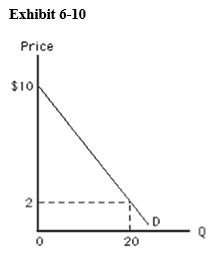
front 21 In Exhibit 6-10, at a price of $2, consumer surplus is
- $4
- $5
- $10
- $80
- $200
| |
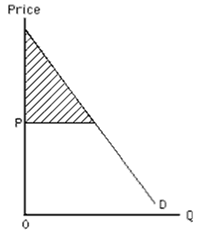
front 22 When the price is P in Exhibit 6-11, the shaded area represents
- a shortage
- producer surplus
- a price floor
- consumer
surplus
- a price ceiling
| |
front 23 Elvis values the first gravy sandwich at $5, the second at $4.50, the
third at $4. If he buys three for $4 each, his consumer surplus is
- $5
- $4
- $1.50
- $9.50
- $12
| |
front 24 What happens to consumer surplus as price falls along a given demand curve?
- It always
increases.
- It always decreases.
- It never
changes.
- It increases only if price increases just a
little.
- It depends on the elasticity of demand and
supply.
| |
front 25 A measure of consumer surplus in any market is
- total expenditure on the
good
- the area above the supply curve and below the price
- the area beneath the demand curve
- the area beneath the
demand curve and above the price
- the market price
| |
front 26 If Ed is willing to pay a maximum of $200 for a tweed sport coat but
buys one for $180, that $20 saved is
- his reservation
price
- the store's producer surplus
- his total
expenditure
- his marginal utility
- his consumer
surplus
| |
front 27 The market demand curve is
- any individual's demand
curve multiplied by the number of consumers in the market
- the relationship between income and quantity demanded
- the horizontal sum of the individual demand curves for all
consumers in the market
- the vertical summation of all
individual demand curves
- the sum of prices paid at each
quantity demanded
| |