Instructions for Side by Side Printing
- Print the notecards
- Fold each page in half along the solid vertical line
- Cut out the notecards by cutting along each horizontal dotted line
- Optional: Glue, tape or staple the ends of each notecard together
Chapter 11
front 1 What defines a short sleeper? a) They are in excellent health b) They can function well on 6 hours of sleep or less c) They are highly productive throughout the day d) They are able to bank longer sleep hours from the weekend as savings for their short sleep during the week | back 1 b) They can function well on 6 hours of sleep or less |
front 2 While it is estimated that less than 5% of the population are short sleepers. a) Less than half of short sleepers carry the genetic mutation b) very few short sleepers lead healthy lifestyles c) An estimated 30% of the population sleep only 6 hours per night or less d) The majority of short sleepers are obese | back 2 c) An estimated 30% of the population sleep only 6 hours per night or less |
front 3 The risks of sleep deprivation include which of the following? a) Memory problems b) Cardiovascular Disease c) Obesity d) All of the above | back 3 d) All of the above |
front 4 The discovery of a gene associated with short sleepers means that a) Humans may eventually need less sleep b) A person's physical environment has no effect on their sleep patterns c) There is potential to manipulate sleep pathways with medication d) Most people dont need 8 hours of sleep per night | back 4 c) There is potential to manipulate sleep pathways with medication |
front 5 Since there is a genetic explanation for short sleepers, you would expect. a) That this trait appears more frequently among family members b) A higher percentage of women to be short sleepers c) That people can learn to be short sleepers d) That short sleepers have higher metabolisms | back 5 a) That this trait appears more frequently among family members |
front 6 1) With or together wight: 2) To love: 3) Change, turn, move: 4) Against: 5) To: 6) Difficult, painful: 7) Of neither gender or type: 8) Many: 9) From, out of, remove: 10) Not: | back 6 1) Co- 2) -Phil (or philo-) 3) Trop- (or -tropic) 4) anti- 5) ad- 6) dys- 7) neutr- 8) poly- 9) de- 10) non- |
front 7 1) One-half 2) enzyme 3) change, after 4) three 5) blood 6) across 7) different, other 8) milk 9) within | back 7 1) semi- 2) -ase 3) meta- 4) tri- 5) hem- (or hemato-) 6) trans- 7) hetero- 8) lact- 9) intra- |
front 8 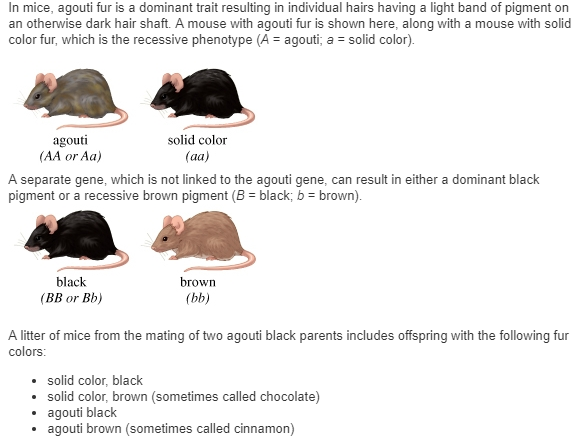 In mammals, hair/fur color is determined by the expression of a number of different genes, each of which has two or more alleles. According to Mendel’s second law, unlinked genes (those that are either on different chromosomes or on the same chromosome but very distant from one another) assort independently because they align independently on the spindle during metaphase I of meiosis. In this tutorial, you will solve genetics problems related to the inheritance of fur color in mice. Part A - A trait governed by two or more genes In mice, agouti fur is a dominant trait resulting in individual hairs having a light band of pigment on an otherwise dark hair shaft. A mouse with agouti fur is shown here, along with a mouse with solid color fur, which is the recessive phenotype (A = agouti; a = solid color). What would be the expected frequency of agouti brown offspring in the litter? a) 1/2 b) 1/8 c) 3/16 d) 1/4 e) 9/16 f) not enough information given | back 8 c) 3/16 Because the two traits are determined by unlinked genes, they assort independently. As a result, you need to use the multiplication rule to calculate the probability of agouti brown offspring (A_ bb) from AaBb parents. The probability of A_offspring is 3/4, and the probability of bb offspring is 1/4. The combined probability is therefore 3/4 x 1/4 = 3/16. |
front 9 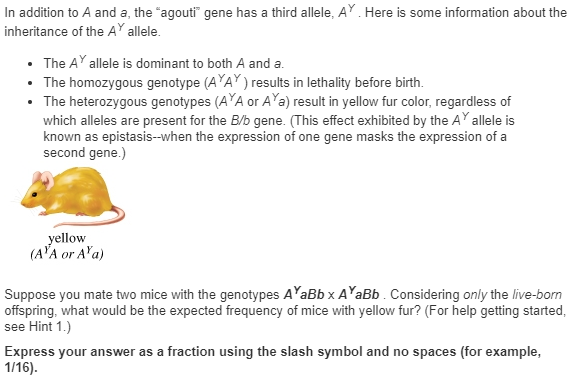 In addition to A and a, the “agouti” gene has a third allele, AY . Here is some information about the inheritance of the AY allele.
Suppose you mate two mice with the genotypes AYaBb x AYaBb . Considering only the live-bornoffspring, what would be the expected frequency of mice with yellow fur? (For help getting started, see Hint 1.) Express your answer as a fraction using the slash symbol and no spaces (for example, 1/16). | back 9 Answer: 2/3 Because the presence of the AY allele is epistatic to (masks expression of) the B/b gene, the B/b gene does not need to be taken into consideration in this problem. For the AYa x AYa cross, 1/4 of the offspring would have the AYAY genotype, which is lethal before birth. For the live-born offspring, 2/3 would be AYa, and thus have yellow fur. |
front 10 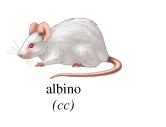 In the same mouse species, a third unlinked gene (gene C/c) also has an epistatic effect on fur color. The presence of the dominant allele C (for color), allows the A/a and B/b genes to be expressed normally. The presence of two recessive alleles (cc), on the other hand, prevents any pigment from being formed, resulting in an albino (white) mouse. Match the phenotypes on the labels at left to the genotypes listed below. Labels can be used once, more than once, or not at all. | back 10 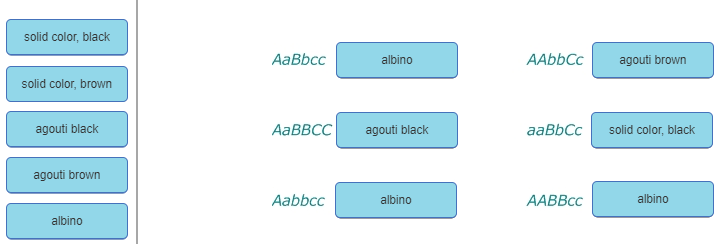 Because the C/c gene is epistatic to both the A/a and B/b genes, any offspring with the ccallele combination will be albino. Otherwise, the A/a and B/b genes are expressed normally. |
front 11 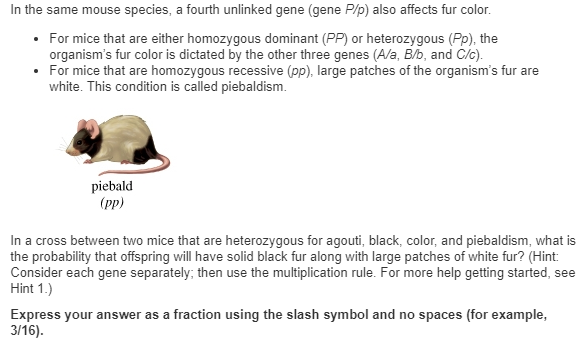 In the same mouse species, a fourth unlinked gene (gene P/p) also affects fur color.
In a cross between two mice that are heterozygous for agouti, black, color, and piebaldism, what is the probability that offspring will have solid black fur along with large patches of white fur? (Hint: Consider each gene separately; then use the multiplication rule. For more help getting started, see Hint 1.) Express your answer as a fraction using the slash symbol and no spaces (for example, 3/16). | back 11 Answer: 9/256 Because each gene segregates independently, you need to determine the probability of each genotype independently and then multiply the four probabilities together. The probability of offspring with solid color (aa) is 1/4; the probability of offspring with black fur (BBor Bb) is 3/4; the probability of colored fur (CC or Cc) is 3/4; and the probability of piebald, or white patches (pp), is 1/4. The combined probability is 1/4 x 3/4 x 3/4 x 1/4= 9/256. |
front 12 What is the difference between heterozygous and homozygous individuals? a) Homozygotes have one chromosome while heterozygotes have two similar chromosomes. b) The homozygote will express the dominant trait and the heterozygote will express the recessive trait. c) All of the gametes from a homozygote carry the same version of the gene while those of a heterozygote will differ. d) Heterozygotes carry two copies of a gene while homozygotes only carry one. | back 12 c) All of the gametes from a homozygote carry the same version of the gene while those of a heterozygote will differ. Since homozygotes carry two identical copies of a gene, all of the gametes will carry the same version. Heterozygotes have two different versions, so there will be two different types of gametes. |
front 13 When constructing a Punnett square, the symbols on the outside of the boxes represent _______, while those inside the boxes represent _______. a) gametes, parents b) progeny, gametes c) parents, gametes d) gametes, progeny | back 13 d) gametes, progeny The Punnett square is representing all of the possible combinations of the gametes from each parent, with the progeny represented in the interior of each box. |
front 14 True or false? The same phenotype can be produced by more than one genotype. a) True b) False | back 14 a) True Since there exist dominant and recessive versions of many genes, a phenotype that is based upon the dominant version will be expressed in both homozygous (AA) and heterozygous (Aa) genotypes. |
front 15 True or false? In diploid organisms, a dominant phenotype will only be expressed if the individual is homozygous dominant for that trait. a) True b) False | back 15 b) False A dominant phenotype is indeed expressed if the individual is homozygous dominant for that trait, but the dominant phenotype is also expressed if the individual is heterozygous for the trait. In fact, heterozygous expression is the definition of dominant. |
front 16 If an organism with the genotype AaBb produces gametes, what proportion of the gametes would be Bb? a) 3/4 b) None c) 1/4 d) 1/2 | back 16 b) None Alleles of the same gene must separate during gamete formation; thus, the two B alleles would be distributed to different gametes. |
front 17 Two mice are heterozygous for albinism (Aa) . The dominant allele (A)codes for normal pigmentation, and the recessive allele (a) codes for no pigmentation. What percentage of their offspring would have an albino phenotype? a) 75 b) 100 c) 25 d) 50 | back 17 c) 25 The offspring would be in a 3:1 ratio of normally pigmented mice to albino mice |
front 18 A tall, purple-flowered pea plant (TtPp) is allowed to self-pollinate. (The recessive alleles code for short plants and white flowers.) The phenotypic ratio of the resulting offspring is 9:3:3:1. What is the genotype of the plant whose phenotype appeared once out of every 16 offspring (the "1" in the 9:3:3:1 ratio)? a) ttpp b) TTPP c) TtPp d) TTpp | back 18 a) ttpp The smallest phenotypic group consists of the homozygous recessive plants, which in this case are short and white flowered. |
front 19 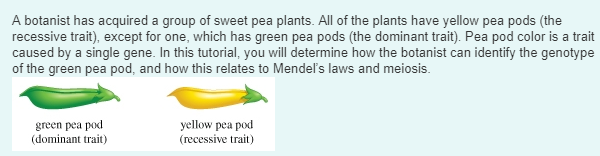 How could the botanist best determine whether the genotype of the green-pod plant is homozygous or heterozygous? a) Cross the green-pod plant with a yellow-pod plant. b) Cross the green-pod plant with another green-pod plant. c) Self-pollinate the green-pod plant. | back 19 a) Cross the green-pod plant with a yellow-pod plant. A cross between a plant of unknown genotype and one that is known to be homozygous recessive is called a test cross because the recessive homozygote tests whether there are any recessive alleles in the unknown. Because the recessive homozygote will contribute an allele for the recessive characteristic to each offspring, the second allele (from the unknown genotype) will determine the offspring’s phenotype. |
front 20 Punnett squares can be used to predict the two possible outcomes of the botanist’s test cross. The Punnett square on the left shows the predicted result if the unknown plant is homozygous (GG); the Punnett square on the right shows the predicted result if the unknown plant is heterozygous (Gg).Drag the labels to the correct locations on the Punnett squares. (G is the symbol for the green-pod allele and g is the symbol for the yellow-pod allele.) You can use a label once, more than once, or not at all. | back 20 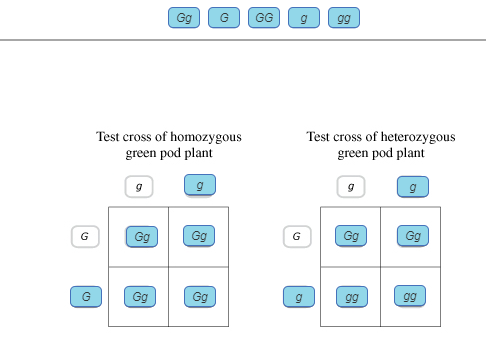 The genotypes in a Punnett square show all the possible combinations of alleles in offspring that could result from the particular cross. A Punnett square reveals the expected probabilities of each genotype among the offspring. For example, the Punnett square on the right reveals that there is a 50% chance that each offspring will have green pods and a 50% chance that each offspring will have yellow pods. |
front 21 This botanist used the same logic to reach her conclusions as Mendel used in his experiments. Suppose that the botanist carried out the test cross described in Parts A and B and determined that the original green-pod plant was heterozygous (Gg). Which of Mendel’s findings does her test cross illustrate? a) law of segregation b) law of independent assortment c) linkage d) chromosome theory of inheritance | back 21 a) law of segregation The law of segregation states that the two alleles for a gene separate during gamete formation, and end up in different gametes. In the case of the heterozygous green-pod plant (Gg), one gamete will receive the dominant allele (G), and the other gamete will receive the recessive allele (g). The law of segregation accounts for the prediction that 50% of the offspring of the test cross will have green pods and 50% will have yellow pods. |
front 22 During which part of meiosis (meiosis I or meiosis II) do the two alleles of a gene separate? During which phase does the separation occur?State your answer as meiosis I or meiosis II followed by a comma and the name of the phase (for example, if your answer is meiosis II and metaphase, enter meiosis II, metaphase). | back 22 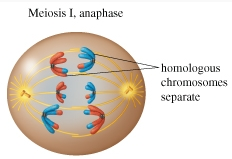 Alleles separate from one another during anaphase of meiosis I, when the homologous pairs of chromosomes separate. |