Print Options

Card layout: ?

← Back to notecard set|Easy Notecards home page

Instructions for Side by Side Printing
  1. Print the notecards
  2. Fold each page in half along the solid vertical line
  3. Cut out the notecards by cutting along each horizontal dotted line
  4. Optional: Glue, tape or staple the ends of each notecard together
  1. Verify Front of pages is selected for Viewing and print the front of the notecards
  2. Select Back of pages for Viewing and print the back of the notecards
    NOTE: Since the back of the pages are printed in reverse order (last page is printed first), keep the pages in the same order as they were after Step 1. Also, be sure to feed the pages in the same direction as you did in Step 1.
  3. Cut out the notecards by cutting along each horizontal and vertical dotted line
To print: Ctrl+PPrint as a list

80 notecards = 20 pages (4 cards per page)

Viewing:

chapter 26

front 1

1) Which is not a major function of the kidney?

  1. a) regulation of blood ionic composition
  2. b) regulation of blood cell size
  3. c) regulation of blood volume
  4. d) regulation of blood pressure
  5. e) regulation of blood pH

Answer: b

back 1

b

front 2

2) This is the formation of a new glucose molecule.

  1. a) glycolysis
  2. b) gluconeogenesis
  3. c) glucosamine
  4. d) glucose
  5. e) calcitriol

back 2

b

front 3

3) Which of the following is a waste product normally excreted by the kidneys?

  1. a) urea
  2. b) glucose
  3. c) insulin
  4. d) cholesterol
  5. e) carbon dioxide

back 3

a

front 4

4) This is smooth dense irregular connective tissue that is continuous with the outer coat of the ureter.

  1. a) adipose capsule
  2. b) renal capsule
  3. c) renal hilus
  4. d) renal cortex
  5. e) renal medulla

back 4

b

front 5

5) The portion of the kidney that extends between the renal pyramids is called the

  1. a) renal columns
  2. b) renal medulla
  3. c) renal pelvis
  4. d) calyces

e) renal papilla

back 5

a

front 6

6) Which is the correct order of blood flow through the kidneys?

  1. a) renal artery > segmental artery > interlobular artery > peritubular capillaries > afferent arterioles
  2. b) interlobar arteries > arcuate arteries > glomerular capillaries > arcuate veins
  3. c) arcuate veins > arcuate arteries > glomerular capillaries > renal vein
  4. d) renal vein > segmental arteries > interlobar arteries > efferent arterioles
  5. e) interlobar veins > afferent arterioles > efferent arterioles > glomerular capillaries

back 6

b

front 7

7) Which is the correct order of filtrate flow?

  1. a) glomerular capsule, proximal convoluted tubule (PCT), nephron loop, distal convoluted tubule (DCT), collecting duct
  2. b) nephron loop, glomerular capsule, PCT, DCT, collecting duct
  3. c) ascending limb of loop, PCT, DCT, collecting duct
  4. d) collecting duct, DCT, PCT, collecting duct, glomerular capsule
  5. e) PCT, glomerular capsule, DCT, collecting duct, nephron loop

back 7

a

front 8

8) Which structure of the nephron reabsorbs the most substances?

  1. a) glomerular capsule
  2. b) nephron loop
  3. c) ascending limb
  4. d) collecting duct
  5. e) proximal convoluted tubule

back 8

e

front 9

9) This is the structure of the nephron that filters blood.

  1. a) glomerulus
  2. b) nephron loop
  3. c) ascending limb
  4. d) collecting duct
  5. e) renal tubule

back 9

a

front 10

10) This term means the return of substances into the blood stream from the filtrate.

  1. a) reabsorption
  2. b) filtration
  3. c) secretion
  4. d) excretion
  5. e) none of these choices

back 10

a

front 11

11) This is a nephron process that results in a substance in blood entering the already formed filtrate.

  1. a) reabsorption
  2. b) filtration
  3. c) secretion
  4. d) excretion
  5. e) none of these choices

back 11

c

front 12

12) Glomerular capillaries and podocytes together form the

  1. a) glomerular endothelial cells
  2. b) filtration membrane
  3. c) pedicels
  4. d) filtration slits
  5. e) slit membrane

back 12

b

front 13

13) This occurs when stretching triggers contraction of smooth muscle walls in afferent arterioles.

  1. a) glomerular filtration rate
  2. b) tubulomerular feedback
  3. c) myogenic mechanism
  4. d) renal autoregulation
  5. e) capsular hydrostatic pressure

back 13

c

front 14

14) This occurs when a substance passes from the fluid in the tubular lumen through the apical membrane, across the cytosol, and then into the interstitial fluid.

  1. a) paracellular reabsorption
  2. b) transcellular reabsorption
  3. c) apical reabsorption
  4. d) basolateral reabsorption
  5. e) active transport

back 14

b

front 15

15) The proximal convoluted tubules reabsorb what percentage of filtered water?

  1. a) 25%
  2. b) 50%
  3. c) 65%
  4. d) 80%
  5. e) 99%

back 15

c

front 16

16) Which of the following is NOT a way angiotensin II affects the kidneys?

  1. a) It increases GFR
  2. b) It can decrease GFR
  3. c) It enhances reabsorption of certain ions
  4. d) It stimulates the release of aldosterone
  5. e) None of these choices

back 16

a

front 17

17) Urea recycling can cause a buildup of urea in the

  1. a) renal capsule
  2. b) nephron loop
  3. c) ascending tubule
  4. d) renal medulla
  5. e) renal pelvis

back 17

d

front 18

18) Increased secretion of hydrogen ions would result in a(n) ______________ of blood ____________?

  1. a) increase, pressure
  2. b) decrease, volume
  3. c) increase, sodium levels
  4. d) decrease, pH
  5. e) increase, urea

back 18

d

front 19

19) Increased secretion of aldosterone would result in a(n) [dropdown 1] of blood [dropdown 2]?

Dropdown 1 choices:

a)decrease

b)increase

Dropdown 2 choices:

a)calcium levels

b)pH

c)potassium

d)sodium

e)volume

back 19

a,d

front 20

20) An analysis of the physical, chemical, and microscopic properties of urine is called

  1. a) urinalysis
  2. b) filtration study
  3. c) concentration study
  4. d) diuretic
  5. e) osmolarity

back 20

a

front 21

21) Water accounts for what percentage of the total volume of urine?

  1. a) 25%
  2. b) 50%
  3. c) 75%
  4. d) 80%
  5. e) 95%

back 21

e

front 22

22) This is a test to measure kidney function.

  1. a) Plasma creatinine
  2. b) Renal study
  3. c) Kidney assay
  4. d) Dialysis
  5. e) Hilus study

back 22

a

front 23

24) This layer of the ureter is composed of connective tissue, collagen and elastic fibers.

  1. a) Mucosa
  2. b) Transitional epithelium
  3. c) Lamina propria
  4. d) Adventitia
  5. e) Lamina elastica

back 23

c

front 24

23) This transports urine from the kidney to the bladder.

  1. a) Urethra
  2. b) Ureter
  3. c) Descending nephron loop
  4. d) Renal hilus
  5. e) None of these choices

back 24

b

front 25

25) This lies in the anterior corner of the trigone of the bladder.

  1. a) Urethral sphincter
  2. b) Adventitia bundle
  3. c) Ureter
  4. d) Internal urethral orifice
  5. e) Muscularis bundle

back 25

d

front 26

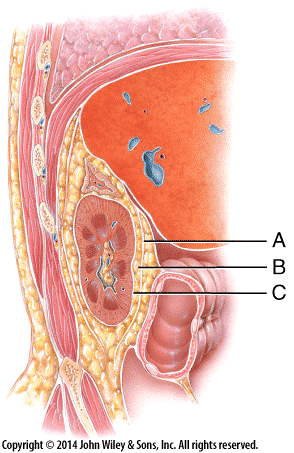
26) This is composed of dense irregular tissue that runs continuous with the ureter

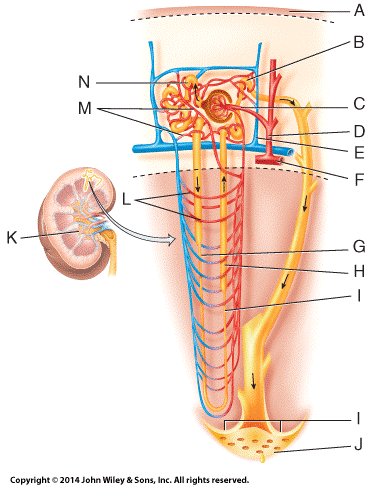
  1. a) A
  2. b) B
  3. c) C

back 26

c

front 27

27) This layer’s main function is to protect the kidney from trauma and hold it in place within the abdominal cavity.

  1. a) A
  2. b) B
  3. c) C

back 27

b

front 28

28) This layer runs deep to the peritoneum on the anterior surface of the kidneys.

  1. a) A
  2. b) B
  3. c) C

back 28

a

front 29

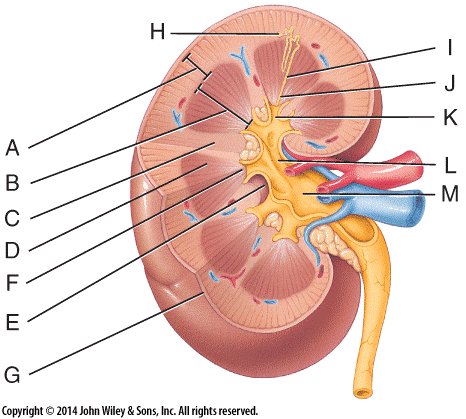
29) This can be divided into the cortical zone and the juxtamedullary zone.

  1. a) A
  2. b) D
  3. c) E
  4. d) F
  5. e) G

back 29

a

front 30

30) Each kidney can have anywhere from 8 to 18 of these.

  1. a) I
  2. b) J
  3. c) K
  4. d) L
  5. e) H

back 30

c

front 31

31) This structure is the apex of a renal pyramid.

  1. a) E
  2. b) D
  3. c) G
  4. d) K
  5. e) L

back 31

a

front 32

32) Urine formed by the nephrons first drains into these.

  1. a) H
  2. b) I
  3. c) J
  4. d) K
  5. e) L

back 32

d

front 33

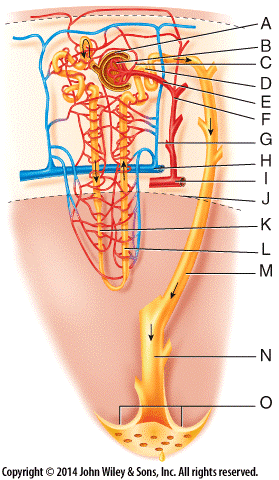
33) What two structures comprise the renal corpuscle?

  1. a) A and B
  2. b) C and D
  3. c) E and F
  4. d) K and L
  5. e) N and O

back 33

a

front 34

34) Where is the distal convoluted tubule?

  1. a) D
  2. b) E
  3. c) J
  4. d) K
  5. e) L

back 34

a

front 35

35) Where is the arcuate vein?

  1. a) E
  2. b) F
  3. c) G
  4. d) H
  5. e) I

back 35

d

front 36

36) Where is the ascending limb of the nephron loop?

  1. a) C
  2. b) D
  3. c) J
  4. d) K
  5. e) L

back 36

e

front 37

37) Where is the corticomedullary junction?

  1. a) G
  2. b) J
  3. c) M
  4. d) N
  5. e) O

back 37

b

front 38

38) Where is the papillary duct?

  1. a) C
  2. b) F
  3. c) H
  4. d) N
  5. e) O

back 38

d

front 39

39) What does line “M” point to?

  1. a) Arcuate artery
  2. b) Arcuate vein
  3. c) Collecting duct
  4. d) Descending loop
  5. e) Efferent arteriole

back 39

c

front 40

40) What is line “C” pointing to?

  1. a) Distal convoluted tubule
  2. b) Interlobular artery
  3. c) Efferent arteriole
  4. d) Arcuate artery
  5. e) Corticomedullary junction

back 40

c

front 41

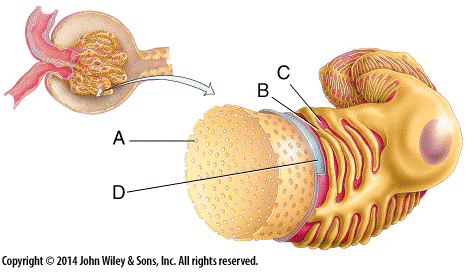
41) What is line “A” pointing to?

  1. a) Fenestration
  2. b) Pedicel
  3. c) Filtration slit
  4. d) Basal lamina

e) Lumen of the glomerulus

back 41

a

front 42

42) What is line “B” pointing to?

  1. a) Fenestration
  2. b) Pedicel
  3. c) Filtration slit
  4. d) Basal lamina
  5. e) Lumen of the glomerulus

back 42

b

front 43

43) What is line “C” pointing to?

  1. a) Fenestration
  2. b) Pedicel
  3. c) Filtration slit
  4. d) Basal lamina
  5. e) Lumen of the glomerulus

back 43

c

front 44

44) What is line “D” pointing to?

  1. a) Fenestration
  2. b) Pedicel
  3. c) Filtration slit
  4. d) Basal lamina
  5. e) Lumen of the glomerulus

back 44

d

front 45

50) Fluid flowing from point N in the figure will go to which structure next?

  1. a) G
  2. b) H
  3. c) C
  4. d) B
  5. e) K

back 45

a

front 46

51) Fluid flowing from point G in the figure will go to which structure next?

  1. a) N
  2. b) H
  3. c) I
  4. d) M
  5. e) K

back 46

c

front 47

52) Fluid flowing from point H in the figure will go to which structure next?

  1. a) L
  2. b) B
  3. c) I
  4. d) G
  5. e) N

back 47

b

front 48

53) Fluid flowing from point B in the figure will go to which of the following structures?

  1. a) J
  2. b) M
  3. c) I
  4. d) G
  5. e) H

back 48

a

front 49

54) Which vessel in the diagram is the afferent arteriole?

  1. a) C
  2. b) D
  3. c) E
  4. d) F
  5. e) L

back 49

a

front 50

55) Which vessel in the diagram is the cortical radiate vein?

  1. a) C
  2. b) D
  3. c) E
  4. d) F
  5. e) L

back 50

c

front 51

56) Which vessel(s) in the diagram are the renal capsule?

  1. a) C
  2. b) D
  3. c) E
  4. d) M
  5. e) A

back 51

e

front 52

57) Which vessel in the diagram is the cortical radiate artery?

  1. a) D
  2. b) E
  3. c) F
  4. d) L
  5. e) C

back 52

a

front 53

58) If an individual goes on a crash diet and loses weight very rapidly, he or she will risk the development of

  1. a) kidney failure
  2. b) kidney stones
  3. c) nephroptosis
  4. d) a urinary tract infection
  5. e) bladder stones

back 53

c

front 54

59) Blood plasma and dissolved substances with molecules that are smaller than most proteins are filtered directly into the

  1. a) renal tubule
  2. b) collecting duct
  3. c) proximal convoluted tubule
  4. d) distal convoluted tubule

e) glomerular capsule

back 54

e

front 55

60) An increase in permeability of the filtration membrane due to disease, injury, or irritation of kidney cells by substances such as bacterial toxins, ether, or heavy metals manifests as which condition?

  1. a) albuminuria
  2. b) lucosuria
  3. c) urobilinogenuria
  4. d) ketonuria
  5. e) bilirubinuria

back 55

a

front 56

61) Anorexia, starvation, or a diet too low in carbohydrates manifests as which condition?

  1. a) albuminuria
  2. b) glucosuria
  3. c) urobilinogenuria
  4. d) ketonuria
  5. e) bilirubinuria

back 56

d

front 57

62) Stress, causing excessive amounts of epinephrine secretion which stimulates glycogen breakdown, manifests as which condition? This condition can also indicate diabetes mellitus.

  1. a) albuminuria
  2. b) glucosuria
  3. c) urobilinogenuria
  4. d) hematuria
  5. e) bilirubinuria

back 57

b

front 58

63) Excessive urine concentration of a normal breakdown product of hemoglobin, caused by pernicious anemia, infectious hepatitis, jaundice or cirrhosis, manifests as which condition?

  1. a) albuminuria
  2. b) glucosuria
  3. c) urobilinogenuria
  4. d) hematuria
  5. e) bilirubinuria

back 58

c

front 59

64) This substance gives bile its major pigmentation:

  1. a) ketone bodies
  2. b) erythrocytes
  3. c) casts
  4. d) bilirubin
  5. e) glucose

back 59

d

front 60

65) These are tiny masses of material, hardened in the lumen of the urinary tubule and are flushed out when filtrate builds up behind them:

  1. a) ketone bodies
  2. b) erythrocytes
  3. c) casts
  4. d) microbes
  5. e) urobilinogen

back 60

c

front 61

66) Candida albicans and E. coli are which type of abnormal constituent of urine:

  1. a) ketone bodies
  2. b) erythrocytes
  3. c) casts
  4. d) microbes
  5. e) urobilinogen

back 61

d

front 62

67) What is the normal pH range of urine in humans?

  1. a) 8.1 – 6
  2. b) 4.6 – 0
  3. c) 1.0 – 0
  4. d) 3.1 – 0
  5. e) 10.0 – 0

back 62

b

front 63

68) What is the normal volume of urine produced in humans?

  1. a) 1-2 L / hr
  2. b) 1-2 L / day
  3. c) 2-3 L / hr
  4. d) 3-4 L / week
  5. e) 10 L / 24 hours

back 63

b

front 64

69) What is the normal specific gravity range of urine in humans?

  1. a) 2.350 – 3.700
  2. b) 0.002 – 1.000
  3. c) 4.6 – 8.0
  4. d) 1.001 – 1.035
  5. e) 1.04 – 2.60

back 64

d

front 65

70) The parasympathetic division of the ANS regulates the flow of blood through the kidney

a) true

b) false

back 65

b

front 66

71) This hormone is released when the blood volume increases.

  1. a) Parathyroid Hormone
  2. b) Renin
  3. c) ADH
  4. d) Atrial Natriuretic Peptide
  5. e) Aldosterone

back 66

d

front 67

72) Consumption of salty food will cause an increase in this hormone.

  1. a) Aldosterone
  2. b) Renin
  3. c) ANH
  4. d) Angiotensin-II
  5. e) ADH

back 67

e

front 68

73) Absence of angiotensin converting enzyme will lead to

  1. a) decreased blood pressure
  2. b) increased blood pressure
  3. c) will not have any effect on blood pressure
  4. d) All of these choices are correct.
  5. e) None of these choices is correct.

back 68

a

front 69

74) In males, both the urinary system and the _________ use the urethra.

  1. a) integument
  2. b) reproductive system
  3. c) respiratory system
  4. d) digestive system
  5. e) cardiovascular system

back 69

b

front 70

75) The kidneys release _________ to raise blood pressure.

  1. a) renin
  2. b) angiotensin II
  3. c) ADH
  4. d) ANP
  5. e) epinephrine

back 70

a

front 71

76) The kidneys convert some of the bilirubin from hemoglobin breakdown to ________, a

yellow pigment.

  1. a) urobilinogen
  2. b) bile
  3. c) stercobilin
  4. d) urobilin

back 71

d

front 72

77) Shock wave lithotripsy is often used to treat which condition?

a) renal calculi

b) urinary tract infections

c) glomerulonephritis

d) polycystic kidney disease

e) urinary bladder cancer

back 72

a

front 73

78) Excessive calcium ingestion and low water intake can lead to which condition?

  1. a) renal calculi
  2. b) urinary tract infections
  3. c) glomerulonephritis
  4. d) polycystic kidney disease
  5. e) urinary bladder cancer

back 73

a

front 74

79) Inflammation of the kidneys is called

  1. a) cystitis
  2. b) nephrotic syndrome
  3. c) pyelonephritis
  4. d) urethritis
  5. e) glomerulitis

back 74

c

front 75

80) Some kidney diseases cause a change in the permeability of glomerular capillaries making them more permeable to plasma proteins. This changes the colloid osmotic pressure, thus drawing water out of the blood and into tissues. The result is

  1. a) dehydration
  2. b) edema
  3. c) overhydration
  4. d) high blood pressure
  5. e) there is no actual change

back 75

b

front 76

81) Another name for the glomerular capsule is _____ capsule.

  1. a) Cowper’s
  2. b) Skene’s
  3. c) Bartholin’s
  4. d) Bowman’s
  5. e) Brenner’s

back 76

d

front 77

82) What type of cells are found in the proximal convoluted tubule?

  1. a) simple squamous
  2. b) simple columnar
  3. c) simple cuboidal
  4. d) stratified squamous
  5. e) stratified cuboidal

back 77

c

front 78

83) The primary site for metabolic recycling is the

  1. a) liver
  2. b) kidney
  3. c) heart
  4. d) intestine
  5. e) spleen

back 78

a

front 79

84) Embryologically, the kidneys differentiate starting which week of development?

  1. a) first
  2. b) second
  3. c) third
  4. d) fourth
  5. e) fifth

back 79

c

front 80

85) As we age, several changes take place in the urinary system. These changes include

  1. a) shrinking of the kidneys
  2. b) decreased blood flow
  3. c) lower filtration rate
  4. d) greater urinary output
  5. e) increase in the number of glomeruli

back 80

a,b,c