Print Options

Card layout: ?

← Back to notecard set|Easy Notecards home page

Instructions for Side by Side Printing
  1. Print the notecards
  2. Fold each page in half along the solid vertical line
  3. Cut out the notecards by cutting along each horizontal dotted line
  4. Optional: Glue, tape or staple the ends of each notecard together
  1. Verify Front of pages is selected for Viewing and print the front of the notecards
  2. Select Back of pages for Viewing and print the back of the notecards
    NOTE: Since the back of the pages are printed in reverse order (last page is printed first), keep the pages in the same order as they were after Step 1. Also, be sure to feed the pages in the same direction as you did in Step 1.
  3. Cut out the notecards by cutting along each horizontal and vertical dotted line
To print: Ctrl+PPrint as a list

92 notecards = 23 pages (4 cards per page)

Viewing:

Campbell Biology Chapter 47 (powell_h)

front 1

1) The structure of the Drosophila gene called Tinman is similar to a gene in humans that also
A) promotes ear development.
B) specifies the location of the heart.
C) determines structures in the eyes.
D) specifies limb elongation points.
E) filters lymphatic fluid.

back 1

Answer: B

front 2

2) As an embryo develops, new cells are produced as the result of
A) differentiation.
B) preformation.
C) cell division.
D) morphogenesis.
E) epigenesis.

back 2

Answer: C

front 3

3) Fertilization of an egg without activation is most like
A) placing the key in the ignition of a car but not starting the engine.
B) resting during halftime of a basketball game.
C) preparing a pie from scratch and baking it in the oven.
D) walking to the cafeteria and eating lunch.
E) dropping a rock off a cliff and watching it land in the valley below.

back 3

Answer: A

front 4

4) Contact of a sperm with signal molecules in the coat of an egg causes the sperm to undergo
A) mitosis.
B) depolarization.
C) apoptosis.
D) vitellogenesis.
E) the acrosomal reaction.

back 4

Answer: E

front 5

5) Even in the absence of sperm, metabolic activity in an egg can be artificially activated by
A) abnormally high levels of carbonic acid in the cytosol.
B) abnormally low levels of extracellular oxygen.
C) injection of calcium ions into the cytosol.
D) exposure to the low pH of the uterus.
E) depletion of its ATP supplies.

back 5

Answer: C

front 6

6) The formation of the fertilization membrane requires an increase in the availability of
A) bicarbonate ions.
B) calcium ions.
C) hydrogen ions.
D) potassium ions.
E) sodium ions.

back 6

Answer: B

front 7

7) A sea urchin zygote undergoes its first cell division
A) 5 seconds after fertilization.
B) 30 minutes after fertilization.
C) 90 minutes after fertilization.
D) 4 hours after fertilization.
E) 24 hours after fertilization.

back 7

Answer: C

front 8

8) A human zygote undergoes its first cell division
A) 5 seconds after fertilization.
B) 30 minutes after fertilization.
C) 90 minutes after fertilization.
D) 4 hours after fertilization.
E) 24 hours after fertilization.

back 8

Answer: E

front 9

9) A reproductive difference between sea urchins and humans is
A) the sea urchin egg completes meiosis prior to fertilization, but meiosis in humans is completed after fertilization.
B) sea urchin eggs are produced by meiosis, but human eggs are produced by mitosis.
C) sea urchin eggs and sperm are of equal size, but human eggs are much bigger than human sperm.
D) sea urchins, but not humans, have a need to block polyspermy because only in sea urchins can there be more than one source of sperm to fertilize the eggs.
E) sea urchin zygotes get their mitochondria from the sperm but human zygotes get their mitochondria from the egg.

back 9

Answer: A

front 10

10) Contact of a sea urchin egg with signal molecules on sperm causes the egg to undergo a brief
A) mitosis.
B) membrane depolarization.
C) apoptosis.
D) vitellogenesis.
E) acrosomal reaction.

back 10

Answer: B

front 11

11) During fertilization, the acrosomal contents
A) block polyspermy.
B) help propel more sperm toward the egg.
C) digest the protective jelly coat on the surface of the egg.
D) nourish the mitochondria of the sperm.
E) trigger the completion of meiosis by the sperm.

back 11

Answer: C

front 12

12) The vitelline layer of the sea urchin egg
A) is outside of the fertilization membrane.
B) releases calcium, which initiates the cortical reaction.
C) has receptor molecules that are specific for binding acrosomal proteins.
D) is first visible only when organogenesis is nearly completed.
E) is a mesh of proteins crossing through the cytosol of the egg.

back 12

Answer: C

front 13

13) In a newly fertilized egg, the vitelline layer
A) opens the egg's nuclear membrane to allow haploid sperm DNA to enter.
B) hardens to form a protective cover.
C) secretes hormones that enhance steroidogenesis by the ovary.
D) reduces the loss of water from the egg and prevents desiccation.
E) provides most of the nutrients used by the zygote.

back 13

Answer: B

front 14

14) From earliest to latest, the overall sequence of early development proceeds in which of the following sequences?
A) first cell division → synthesis of embryo's DNA begins → acrosomal reaction → cortical reaction
B) cortical reaction → synthesis of embryo's DNA begins → acrosomal reaction → first cell division
C) cortical reaction → acrosomal reaction → first cell division → synthesis of embryo's DNA begins
D) first cell division → synthesis of embryo's DNA begins → acrosomal reaction → cortical reaction
E) acrosomal reaction → cortical reaction → synthesis of embryo's DNA begins → first cell division

back 14

Answer: E

front 15

15) The cortical reaction functions directly in the
A) formation of a fertilization envelope.
B) production of a fast block to polyspermy.
C) release of hydrolytic enzymes from the sperm cell.
D) generation of a nerve-like impulse by the egg cell.
E) fusion of egg and sperm nuclei.

back 15

Answer: A

front 16

16) In sea urchins, the "fast block" and the longer lasting "slow block" to polyspermy, respectively, are
A) the acrosomal reaction and the formation of egg white.
B) the cortical reaction and the formation of yolk protein.
C) the jelly coat of the egg and the vitelline membrane.
D) membrane depolarization and the cortical reaction.
E) inactivation of the sperm acrosome.

back 16

Answer: D

front 17

17) In an egg cell treated with EDTA, a chemical that binds calcium and magnesium ions, the
A) acrosomal reaction would be blocked.
B) fusion of sperm and egg nuclei would be blocked.
C) fast block to polyspermy would not occur.
D) fertilization envelope would not be formed.
E) zygote would not contain maternal and paternal chromosomes.

back 17

Answer: D

front 18

18) In mammals, the nuclei resulting from the union of the sperm and the egg are first truly diploid at the end of the
A) acrosomal reaction.
B) completion of spermatogenesis.
C) initial cleavage.
D) activation of the egg.
E) completion of gastrulation.

back 18

Answer: C

front 19

19) Fertilization normally
A) reinstates diploidy.
B) follows gastrulation.
C) is required for parthenogenesis.
D) merges two diploid cells into one haploid cell.
E) precedes ovulation.

back 19

Answer: A

front 20

20) In mammalian eggs, the receptors for sperm are found in the
A) fertilization membrane.
B) zona pellucida.
C) cytosol of the egg.
D) nucleus of the egg.
E) mitochondria of the egg.

back 20

Answer: B

front 21

21) Compared to sea urchin eggs, those of mammals
A) complete the fertilization process more rapidly.
B) have not already completed meiosis at the time of ovulation.
C) have a more distinct animal pole.
D) have a more distinct vegetal pole.
E) have no requirement for the cortical reaction.

back 21

Answer: B

front 22

22) A human blastomere is
A) an embryonic cell that is much smaller than the ovum.
B) an embryonic structure that includes a fluid-filled cavity.
C) that part of the acrosome that opens the egg's membrane.
D) a component of the zona pellucida.
E) a cell that contains a (degenerating) second polar body.

back 22

Answer: A

front 23

23) At the moment of sperm penetration, human eggs
A) have used flagellar propulsion to move from the ovary to the oviduct.
B) accept as many sperm as possible in order to select the one with the highest fertility.
C) are still located within the ovary.
D) have a paper-thin cell of calcium carbonate that prevents desiccation.
E) are still surrounded by follicular cells.

back 23

Answer: E

front 24

24) In a developing frog embryo, most of the yolk is
A) located near the animal pole.
B) located near the vegetal pole.
C) found within the cleavage furrow.
D) found within the blastocoels.
E) distributed equally throughout the embryo.

back 24

Answer: B

front 25

25) Among these choices, the largest cell involved in frog reproduction is
A) the spermatozoon.
B) the ovum.
C) a blastomere in the vegetal pole.
D) a blastomere in the animal pole.
E) one of the products of the first cleavage.

back 25

Answer: B

front 26

26) The pattern of embryonic development in which only the cells lacking yolk subsequently undergo cleavage is called
A) arcadian development, which is typical of insects.
B) holoblastic development, which is typical of marsupial mammals.
C) meroblastic development, which is typical of humans.
D) holoblastic development, which is typical of amphibians.
E) meroblastic development, which is typical of birds.

back 26

Answer: E

front 27

27) As cleavage continues during frog development, the size of the blastomeres
A) increases as the number of the blastomeres decreases.
B) increases as the number of the blastomeres increases.
C) decreases as the number of the blastomeres increases.
D) decreases as the number of the blastomeres decreases.
E) increases as the number of the blastomeres stays the same.

back 27

Answer: C

front 28

28) During the early part of the cleavage stage in frog development, the rapidly developing cells
A) skip the mitosis phase of the cell cycle.
B) skip the S phase of the cell cycle.
C) skip the G₁ and G₂ phases of the cell cycle.
D) rapidly increase the volume and mass of the embryo.
E) skip the cytokinesis phase of the cell cycle.

back 28

Answer: C

front 29

29) The vegetal pole of the zygote differs from the animal pole in that
A) the vegetal pole has a higher concentration of yolk.
B) the blastomeres originate only in the vegetal pole.
C) the posterior end of the embryo forms at the vegetal pole.
D) the vegetal pole cells undergo mitosis but not cytokinesis.
E) the polar bodies bud from this region.

back 29

Answer: A

front 30

30) The small portion of the embryo that will become its dorsal side develops from the
A) morula.
B) primitive streak.
C) archenteron.
D) gray crescent.
E) blastocoel.

back 30

Answer: D

front 31

31) The yolk of the frog egg
A) prevents gastrulation.
B) is concentrated at the animal pole.
C) is homogeneously arranged in the egg.
D) impedes the formation of a primitive streak.
E) supports the higher rate of cleavage at the animal pole compared to the vegetal pole.

back 31

Answer: E

front 32

32) An embryo with meroblastic cleavage, extraembryonic membranes, and a primitive streak must be that of
A) an insect.
B) a fish.
C) an amphibian.
D) a bird.
E) a sea urchin.

back 32

Answer: D

front 33

33) Meroblastic cleavage occurs in
A) sea urchins, but not humans or birds.
B) humans, but not sea urchins or birds.
C) birds, but not sea urchins or humans.
D) both sea urchins and birds, but not humans.
E) both humans and birds, but not sea urchins.

back 33

Answer: C

front 34

34) Which of the following correctly displays the sequence of developmental milestones?
A) cleavage → blastula → gastrula → morula
B) cleavage → gastrula → morula → blastula
C) cleavage → morula → blastula → gastrula
D) gastrula → morula → blastula → cleavage
E) morula → cleavage → gastrula → blastula

back 34

Answer: C

front 35

35) Cells move to new positions as an embryo establishes its three germ tissue layers during
A) determination.
B) cleavage.
C) fertilization.
D) induction.
E) gastrulation.

back 35

Answer: E

front 36

36) The outer-to-inner sequence of tissue layers in a post-gastrulation vertebrate embryo is
A) endoderm → ectoderm → mesoderm.
B) mesoderm → endoderm → ectoderm.
C) ectoderm → mesoderm → endoderm.
D) ectoderm → endoderm → mesoderm.
E) endoderm → mesoderm → ectoderm.

back 36

Answer: C

front 37

37) If gastrulation was blocked by an environmental toxin, then
A) cleavage would not occur in the zygote.
B) embryonic germ layers would not form.
C) fertilization would be blocked.
D) the blastula would not be formed.
E) the blastopore would form above the gray crescent in the animal pole.

back 37

Answer: B

front 38

38) The archenteron of the developing frog eventually develops into the
A) reproductive organs.
B) blastocoel.
C) heart and lungs.
D) digestive tract.
E) brain and spinal cord.

back 38

Answer: D

front 39

39) The vertebrate ectoderm is the origin of the
A) nervous system.
B) liver.
C) pancreas.
D) heart.
E) kidneys.

back 39

Answer: A

front 40

40) In frog embryos, the blastopore becomes the
A) anus.
B) ears.
C) eyes.
D) nose.
E) mouth.

back 40

Answer: A

front 41

41) In a frog embryo, gastrulation
A) produces a blastocoel displaced into the animal hemisphere.
B) occurs along the primitive streak in the animal hemisphere.
C) is impossible because of the large amount of yolk in the ovum.
D) proceeds by involution as cells roll over the lip of the blastopore.
E) occurs within the inner cell mass that is embedded in the large amount of yolk.

back 41

Answer: D

front 42

42) The earliest developmental stage among these choices is
A) germ layers.
B) morula.
C) blastopore.
D) gastrulation.
E) invagination.

back 42

Answer: B

front 43

43) Which of the following is a correct description of an anatomical relationship?
A) The mesoderm gives rise to the notochord.
B) The endoderm gives rise to the hair follicles.
C) The ectoderm gives rise to the liver.
D) The mesoderm gives rise to the lungs.

back 43

Answer: A

front 44

44) An open space within the gastrula is the
A) ectoderm.
B) mesoderm.
C) archenteron.
D) endoderm.
E) neural crest cells.

back 44

Answer: C

front 45

45) Although it contributes no cells to the embryo, the formation of the primitive streak is guided by the structure known as the
A) endoderm.
B) mesoderm.
C) ectoderm.
D) neural crest.
E) hypoblast.

back 45

Answer: E

front 46

46) The primitive streak in a bird is the functional equivalent of
A) the lip of the blastopore in the frog.
B) the archenteron in a frog.
C) polar bodies in a sea urchin.
D) the notochord in a mammal.
E) neural crest cells in a mammal.

back 46

Answer: A

front 47

47) In all vertebrate animals, development requires
A) a large supply of yolk.
B) an aqueous environment.
C) extraembryonic membranes.
D) an amnion.
E) a primitive streak.

back 47

Answer: B

front 48

48) The least amount of yolk would be found in the egg of a
A) bird.
B) fish.
C) frog.
D) eutherian (placental) mammal.
E) reptile.

back 48

Answer: D

front 49

49) A primitive streak forms during the early embryonic development of
A) birds, but not frogs or humans.
B) frogs, but not birds or humans.
C) humans, but not birds or frogs.
D) birds and frogs, but not humans.
E) humans and birds, but not frogs.

back 49

Answer: E

front 50

50) Extraembryonic membranes develop in
A) mammals, but not birds or lizards.
B) birds, but not mammals or lizards.
C) lizards, but not mammals or birds.
D) mammals and birds, but not lizards.
E) mammals, birds, and lizards.

back 50

Answer: E

front 51

51) At the time of implantation, the human embryo is called a
A) blastocyst.
B) gastrula.
C) fetus.
D) somite.
E) zygote.

back 51

Answer: A

front 52

52) Uterine implantation due to enzymatic digestion of the endometrium is initiated by the
A) inner cell mass.
B) endoderm.
C) chorion.
D) mesoderm.
E) trophoblast.

back 52

Answer: E

front 53

53) In placental mammals, the yolk sac
A) transfers nutrients from the yolk to the embryo.
B) differentiates into the placenta.
C) becomes a fluid-filled sac that surrounds and protects the embryo.
D) produces blood cells that then migrate into the embryo.
E) stores waste products from the embryo until the placenta develops.

back 53

Answer: D

front 54

54) Gases are exchanged in a mammalian embryo in the
A) amnion.
B) hypoblast.
C) chorion.
D) trophoblast.
E) yolk sac.

back 54

Answer: C

front 55

55) Thalidomide, now banned for use as a sedative in pregnancy, was used in the early 1960s by many women in their first trimester of pregnancy. Some of these women gave birth to children with arm and leg deformities, suggesting that the drug most likely influenced
A) early cleavage divisions.
B) determination of the polarity of the zygote.
C) differentiation of bone tissue.
D) morphogenesis.
E) organogenesis.

back 55

Answer: D

front 56

56) The migratory neural crest cells
A) form most of the central nervous system.
B) serve as precursor cells for the notochord.
C) form the spinal cord in the frog.
D) form neural and non-neural structures in the periphery.
E) form the lining of the lungs and of the digestive tract.

back 56

Answer: D

front 57

57) From earliest to latest, the overall sequence of early development proceeds in which of the following sequences?
A) gastrulation → organogenesis → cleavage
B) ovulation → gastrulation → fertilization
C) cleavage → gastrulation → organogenesis
D) gastrulation → blastulation → neurulation
E) preformation → morphogenesis → neurulation

back 57

Answer: C

front 58

58) Changes in both cell shape and cell position occur extensively during
A) gastrulation, but not organogenesis or cleavage.
B) organogenesis, but not gastrulation or cleavage.
C) cleavage, but not gastrulation or organogenesis.
D) gastrulation and organogenesis, but not cleavage.
E) gastrulation, organogenesis, and cleavage.

back 58

Answer: E

front 59

59) Changes in the shape of a cell usually involve a reorganization of the
A) nucleus.
B) cytoskeleton.
C) extracellular matrix.
D) transport proteins.
E) nucleolus.

back 59

Answer: B

front 60

60) Animal development compares to plant development in that
A) plant cells, but not animal cells, migrate during morphogenesis.
B) animal cells, but not plant cells, migrate during morphogenesis.
C) plant cells and animal cells migrate extensively during morphogenesis.
D) neither plant cells nor animal cells migrate during morphogenesis.
E) plant cells, but not animal cells, undergo convergent extension.

back 60

Answer: B

front 61

61) Cadherins and other cell-adhesion molecules that guide cell migration are
A) steroid hormones.
B) glycoproteins.
C) fatty acids.
D) prostacyclins.
E) ribonucleic acids.

back 61

Answer: B

front 62

62) To meet a zygote's metabolic and developmental requirements,
A) maternal RNA and maternal proteins must be present.
B) paternal RNA and maternal proteins must be present.
C) the haploid DNA in the nucleus must be transcribed.
D) the nucleus must have hundreds of copies of every gene, allowing a high rate of gene expression.
E) the zygote must continuously undergo endocytosis of proteins to take them from its environment.

back 62

Answer: A

front 63

63) Select the choice that correctly associates the organ with its embryonic sources.
A) anterior pituitary glandmesoderm and endoderm
B) thyroid glandmesoderm and ectoderm
C) adrenal glandectoderm and mesoderm
D) skinendoderm and mesoderm
E) brainmesoderm and endoderm

back 63

Answer: C

front 64

64) The first cavity formed during sea urchin development is the
A) blastopore.
B) mouth.
C) blastocoel.
D) anus.

back 64

Answer: C

front 65

65) Human trophoblasts
A) form the inner cell mass.
B) form from ectoderm.
C) are the precursors of the mesoderm.
D) are of embryonic origin and function in embryo nutrition.
E) are of maternal origin and function in embryo gas exchange.

back 65

Answer: D

front 66

66) The embryonic precursor to the human spinal cord is the
A) notochord.
B) neural tube.
C) mesoderm.
D) archenteron.
E) set of bilateral somites.

back 66

Answer: B

front 67

67) Animal cells that are present only for a brief developmental phase will, following completion of that phase, undergo
A) diapause.
B) apoptosis
C) meiosis.
D) oxidative phosphorylation.
E) re-differentiation.

back 67

Answer: B

front 68

68) The term applied to a morphogenetic process whereby cells extend themselves, making the mass of the cells narrower and longer, is
A) convergent extension.
B) induction.
C) elongational streaming.
D) bi-axial elongation.
E) blastomere formation.

back 68

Answer: A

front 69

69) During gastrulation in frog embryos, fibronectin
A) provides an extracellular anchorage for migrating cells.
B) regulates actin-myosin interactions in the cytosol of migrating cells.
C) reduces the entry of calcium ions into migrating cells.
D) regulates mRNA movement out of the nucleus of a moving cell.
E) provides the pigment that accumulates in the primitive streak.

back 69

Answer: A

front 70

70) Which of the following is the anatomical axis that is largely symmetrical in both frogs and humans?
A) medial to lateral
B) dorsal to ventral
C) anterior to posterior
D) animal to vegetal
E) rostral to caudal

back 70

Answer: A

front 71

71) If an amphibian zygote is manipulated so that the first cleavage plane fails to divide the gray crescent, then
A) the daughter cell with the entire gray crescent will die.
B) both daughter cells will develop normally because amphibians are totipotent at this stage.
C) only the daughter cell with the gray crescent will develop normally.
D) both daughter cells will develop abnormally.
E) both daughter cells will die immediately.

back 71

Answer: C

front 72

72) In humans, identical twins are possible because
A) of the heterogeneous distribution of cytoplasmic determinants in unfertilized eggs.
B) of interactions between extraembryonic cells and the zygote nucleus.
C) of convergent extension.
D) early blastomeres can form a complete embryo if isolated.
E) the gray crescent divides the dorsal-ventral axis into new cells.

back 72

Answer: D

front 73

73) Hans Spemann and colleagues developed the concept of the primary organizer in amphibian embryos while studying the
A) medial cells between the optic cups.
B) anterior terminus of the notochord.
C) lateral margins of the neural tube.
D) posterior edge of the dorsal ectoderm.
E) dorsal lip of the blastopore.

back 73

Answer: E

front 74

74) In frogs, formation of the eye lens is induced by chemical signals from
A) cells that will become the neural plate.
B) cells that are forming the inner ear.
C) an outgrowth of the developing brain.
D) both cells that will become the neural plate and cells that are forming the inner ear.
E) both cells that will become the neural plate and an outgrowth of the developing brain.

back 74

Answer: E

front 75

75) Which of the following is an adult organism that has fewer than 1,000 cells?
A) chickens, Gallus domesticus
B) African clawed frogs, Xenopus laevis
C) humans, Homo sapiens
D) fruit flies, Drosophila melanogaster
E) nematodes, Caenorhabditis elegans

back 75

Answer: E

front 76

76) The developmental precursors to the gonadal tissues of C. elegans uniquely contain
A) proteins of maternal origin.
B) high concentrations of potassium ions.
C) haploid proteins.
D) T tubules for the propagation of action potentials.
E) P granules of mRNA and protein.

back 76

Answer: E

front 77

77) Two primary factors in shaping the polarity of the body axes in chick embryos are
A) light and temperature.
B) salt gradients and membrane potentials.
C) gravity and pH.
D) moisture and mucus.
E) location of sperm penetration and cortical reaction.

back 77

Answer: C

front 78

78) The arrangement of organs and tissues in their characteristic places in 3-D space defines
A) pattern formation.
B) induction.
C) differentiation.
D) determination.
E) organogenesis.

back 78

Answer: A

front 79

79) If the apical ectodermal ridge is surgically removed from an embryo, it will lose
A) positional information for limb-bud pattern formation.
B) guidance signals needed for correct gastrulation.
C) unequal cytokinesis of blastomeres.
D) the developmental substrate for the gonads.
E) the developmental substrate for the kidneys.

back 79

Answer: A

front 80

80) The nematode Caenorhabditis elegans
A) is composed of a single cell, in which the developmental origin of each protein has been mapped.
B) is composed of about 1,000 cells, in which the developmental origin of each cell has been mapped.
C) has only a single chromosome, which has been fully sequenced.
D) has about 1,000 genes, each of which has been fully sequenced.
E) uniquely, among animals, utilizes programmed cell death during normal development.

back 80

Answer: B

front 81

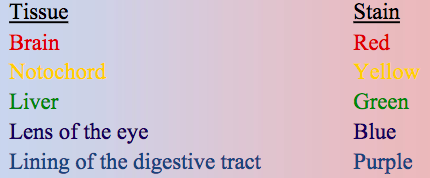
In a study of the development of frog embryos, researchers stained several early gastrulas with vital dyes and noted the locations of the dyes after gastrulation. The results are shown in the following table.

81) The ectoderm should give rise to tissues containing
A) yellow and purple colors.
B) purple and green colors.
C) green and red colors.
D) red and blue colors.
E) red and yellow colors.

back 81

Answer: D

front 82

In a study of the development of frog embryos, researchers stained several early gastrulas with vital dyes and noted the locations of the dyes after gastrulation. The results are shown in the following table.

82) The mesoderm was probably stained with a
A) blue color.
B) yellow color.
C) red color.
D) purple color.
E) green color.

back 82

Answer: B

front 83

In a study of the development of frog embryos, researchers stained several early gastrulas with vital dyes and noted the locations of the dyes after gastrulation. The results are shown in the following table.

83) The endoderm was probably stained with
A) red and yellow colors.
B) yellow and green colors.
C) green and purple colors.
D) blue and yellow colors.
E) purple and red colors.

back 83

Answer: C

front 84

84) When you slice up a pie that contains a swirled mixture of chocolate and vanilla filling, you notice that some slices have more chocolate than vanilla and that other slices have more vanilla than chocolate. This uneven distribution of chocolate and vanilla is most like the uneven distribution of
A) nuclei in a zygote.
B) nuclei in an early embryo.
C) nuclei in an egg prior to fertilization.
D) cytoplasmic determinants in a newly formed zygote.
E) cytoplasmic determinants in a baby just prior to birth.

back 84

Answer: D

front 85

85) Assume that successful reproduction in a rare salamander species, wherein all individuals are females, relies on those females having access to sperm from males of another species but that the resulting embryos show no signs of a genetic contribution from the sperm. In this case, the sperm appear to be used only for
A) morphogenesis.
B) epigenesis.
C) egg activation.
D) cell differentiation.
E) the creation of a diploid cell.

back 85

Answer: C

front 86

86) The cortical reaction of sea urchin eggs functions directly in
A) the formation of a fertilization envelope.
B) the production of a fast block to polyspermy.
C) the release of hydrolytic enzymes from the sperm.
D) the generation of an electrical impulse by the egg.
E) the fusion of egg and sperm nuclei.

back 86

Answer: A

front 87

87) Which of the following is common to the development of both birds and mammals?
A) holoblastic cleavage
B) epiblast and hypoblast
C) trophoblast
D) yolk plug
E) gray crescent

back 87

Answer: B

front 88

88) The archenteron develops into
A) the mesoderm.
B) the blastocoel.
C) the endoderm.
D) the placenta.
E) the lumen of the digestive tract.

back 88

Answer: E

front 89

89) What structural adaptation in chickens allows them to lay their eggs in arid environments rather than in water?
A) extraembryonic membranes
B) yolk
C) cleavage
D) gastrulation
E) development of the brain from ectoderm

back 89

Answer: A

front 90

90) In an egg cell treated with EDTA, a chemical that binds calcium and magnesium ions,
A) the acrosomal reaction would be blocked.
B) the fusion of sperm and egg nuclei would be blocked.
C) the fast block to polyspermy would not occur.
D) the fertilization envelope would not form.
E) the zygote would not contain maternal and paternal chromosomes.

back 90

Answer: D

front 91

91) In humans, identical twins are possible because
A) cytoplasmic determinants are distributed unevenly in unfertilized eggs.
B) extraembryonic cells interact with the zygote nucleus.
C) convergent extension occurs.
D) early blastomeres can form a complete embryo if isolated.
E) the gray crescent divides the dorsal-ventral axis into new cells.

back 91

Answer: D

front 92

92) Cells transplanted from the neural tube of a frog embryo to the ventral part of another embryo develop into nervous system tissues. This result indicates that the transplanted cells were
A) totipotent.
B) determined.
C) differentiated.
D) mesenchymal.
E) apoptotic.

back 92

Answer: B