Print Options

Card layout: ?

← Back to notecard set|Easy Notecards home page

Instructions for Side by Side Printing
  1. Print the notecards
  2. Fold each page in half along the solid vertical line
  3. Cut out the notecards by cutting along each horizontal dotted line
  4. Optional: Glue, tape or staple the ends of each notecard together
  1. Verify Front of pages is selected for Viewing and print the front of the notecards
  2. Select Back of pages for Viewing and print the back of the notecards
    NOTE: Since the back of the pages are printed in reverse order (last page is printed first), keep the pages in the same order as they were after Step 1. Also, be sure to feed the pages in the same direction as you did in Step 1.
  3. Cut out the notecards by cutting along each horizontal and vertical dotted line
To print: Ctrl+PPrint as a list

63 notecards = 16 pages (4 cards per page)

Viewing:

Campbell Biology Chapter 27

front 1

Mycoplasmas are bacteria that lack cell walls. On the basis of this structural feature, which statement concerning mycoplasmas should be true?
A) They are gram-negative.
B) They are subject to lysis in hypotonic conditions.
C) They lack a cell membrane as well.
D) They should contain less cellulose than do bacteria that possess cell walls.
E) They possess typical prokaryotic flagella.

back 1

B) They are subject to lysis in hypotonic conditions.

front 2

Though plants, fungi, and prokaryotes all have cell walls, we place them in different taxa. Which of these observations comes closest to explaining the basis for placing these organisms in different taxa, well before relevant data from molecular systematics became available?
A) Some closely resemble animals, which lack cell walls.
B) Their cell walls are composed of very different biochemicals.
C) Some have cell walls only for support.
D) Some have cell walls only for protection from herbivores.
E) Some have cell walls only to control osmotic balance.

back 2

B) Their cell walls are composed of very different biochemicals.

front 3

Which statement about bacterial cell walls is false?
A) Bacterial cell walls differ in molecular composition from plant cell walls.
B) Cell walls prevent cells from bursting in hypotonic environments.
C) Cell walls prevent cells from dying in hypertonic conditions.
D) Bacterial cell walls are similar in function to the cell walls of many protists, fungi, and plants.
E) Cell walls provide the cell with a degree of physical protection from the environment.

back 3

C) Cell walls prevent cells from dying in hypertonic conditions.

front 4

The predatory bacterium, Bdellovibrio bacteriophorus, drills into a prey bacterium and, once inside, digests it. In an attack upon a gram-negative bacterium that has a slimy cell covering, what is the correct sequence of structures penetrated by B. bacteriophorus on its way to the prey's cytoplasm?

1. membrane composed mostly of lipopolysaccharide
2. membrane composed mostly of phospholipids
3. peptidoglycan
4. capsule

A) 2, 4, 3, 1
B) 1, 3, 4, 2
C) 1, 4, 3, 2
D) 4, 1, 3, 2
E) 4, 3, 1, 2

back 4

D) 4, 1, 3, 2

front 5

Jams, jellies, preserves, honey, and other foodstuffs with high sugar content hardly ever become contaminated by bacteria, even when the food containers are left open at room temperature. This is because bacteria that encounter such an environment

A) undergo death by plasmolysis.
B) are unable to metabolize the glucose or fructose, and thus starve to death.
C) experience lysis.
D) are obligate anaerobes.
E) are unable to swim through these thick and viscous materials.

back 5

A) undergo death by plasmolysis.

front 6

In a bacterium that possesses antibiotic resistance and the potential to persist through very adverse conditions, such as freezing, drying, or high temperatures, DNA should be located within, or be part of, which structures?
1. nucleoid region
2. endospore
3. fimbriae
4. plasmids

A) 1 only
B) 1 and 2 only

C) 1 and 4 only
D) 2 and 4 only

E)

back 6

E)

front 7

Which two structures play direct roles in permitting bacteria to adhere to each other, or to other surfaces?
1. capsules
2. endospores
3. fimbriae
4. plasmids
5. flagella

A) 1 and 2
B) 1 and 3
C) 2 and 3

back 7

C) 2 and 3

front 8

The typical prokaryotic flagellum features
A) an internal 9 + 2 pattern of microtubules.
B) an external covering provided by the plasma membrane.
C) a complex "motor" embedded in the cell wall and plasma membrane.
D) a basal body that is similar in structure to the cell's centrioles.
E) a membrane-enclosed organelle with motor proteins

back 8

C) a complex "motor" embedded in the cell wall and plasma membrane.

front 9

Prokaryotic ribosomes differ from those present in eukaryotic cytosol. Because of this, which of the following is correct?
A) Some antibiotics can block protein synthesis in bacteria without effects in the eukaryotic host.
B) Eukaryotes did not evolve from prokaryotes.
C) Translation can occur at the same time as transcription in eukaryotes but not in prokaryotes.
D) Some antibiotics can block the synthesis of peptidoglycan in the walls of bacteria.
E) Prokaryotes are able to use a much greater variety of molecules as food sources than can eukaryotes.

back 9

A) Some antibiotics can block protein synthesis in bacteria without effects in the eukaryotic host.

front 10

Which statement about the genomes of prokaryotes is correct?
A) Prokaryotic genomes are diploid throughout most of the cell cycle.
B) Prokaryotic chromosomes are sometimes called plasmids.
C) Prokaryotic cells have multiple chromosomes, "packed" with a relatively large amount of protein.
D) The prokaryotic chromosome is not contained within a nucleus but, rather, is found at the nucleolus.
E) Prokaryotic genomes are composed of circular DNA.

back 10

E) Prokaryotic genomes are composed of circular DNA.

front 11

If a bacterium regenerates from an endospore that did not possess any of the plasmids that were contained in its original parent cell, the regenerated bacterium will probably also
A) lack antibiotic-resistant genes.
B) lack a cell wall.
C) lack a chromosome.
D) lack water in its cytoplasm.
E) be unable to survive in its normal environment.

back 11

A) lack antibiotic-resistant genes.

front 12

Although not present in all bacteria, this cell covering often enables cells that possess it to resist the defenses of host organisms, especially their phagocytic cells.
A) endospore
B) sex pilus
C) cell wall
D) capsule

back 12

D) capsule

front 13

Prokaryotes' essential genetic information is located in the
A) nucleolus.
B) nucleoid.
C) nucleosome.
D) plasmids.
E) exospore.

back 13

B) nucleoid.

front 14

Which of the following is an important source of endotoxin in gram-negative species?
A) endospore
B) sex pilus
C) flagellum
D) cell wall
E) capsule

back 14

D) cell wall

front 15

Chloramphenicol is an antibiotic that targets prokaryotic (70S) ribosomes, but not eukaryotic (80S) ribosomes. Which of these questions stems from this observation, plus an understanding of eukaryotic origins?

A) Can chloramphenicol also be used to control human diseases that are caused by archaeans?
B) Can chloramphenicol pass through the capsules possessed by many cyanobacteria?
C) If chloramphenicol inhibits prokaryotic ribosomes, should it not also inhibit mitochondrial ribosomes?
D) Why aren't prokaryotic ribosomes identical to eukaryotic ribosomes?
E) How is translation affected in ribosomes that are targeted by chloramphenicol?

back 15

C) If chloramphenicol inhibits prokaryotic ribosomes, should it not also inhibit mitochondrial ribosomes?

front 16

In a hypothetical situation, the genes for sex pilus construction and for tetracycline resistance are located together on the same plasmid within a particular bacterium. If this bacterium readily performs conjugation involving a copy of this plasmid, then the result should be
A) a bacterium that has undergone transduction.
B) the rapid spread of tetracycline resistance to other bacteria in that habitat.
C) the subsequent loss of tetracycline resistance from this bacterium.
D) the production of endospores among the bacterium's progeny.
E) the temporary possession by this bacterium of a completely diploid genome.

back 16

B) the rapid spread of tetracycline resistance to other bacteria in that habitat.

front 17

Regarding prokaryotic genetics, which statement is correct?
A) Crossing over during prophase I introduces some genetic variation.
B) Prokaryotes feature the union of haploid gametes, as do eukaryotes.
C) Prokaryotes exchange some of their genes by conjugation, the union of haploid gametes, and transduction.
D) Mutation is a primary source of variation in prokaryote populations.
E) Prokaryotes skip sexual life cycles because their life cycle is too short.

back 17

D) Mutation is a primary source of variation in prokaryote populations.

front 18

Which of these statements about prokaryotes is correct?
A) Bacterial cells conjugate to mutually exchange genetic material.
B) Their genetic material is confined within vesicles known as plasmids.
C) They divide by binary fission, without mitosis or meiosis.
D) The persistence of bacteria throughout evolutionary time is due to their genetic homogeneity (in other words, sameness).
E) Genetic variation in bacteria is not known to occur, because of their asexual mode of reproduction.

back 18

C) They divide by binary fission, without mitosis or meiosis.

front 19

Which of the following is least associated with the others?
A) horizontal gene transfer
B) genetic recombination
C) conjugation
D) transformation
E) binary fission

back 19

E) binary fission

front 20

In Fred Griffith's experiments, harmless R strain pneumococcus
became lethal S strain pneumococcus as the result of which of the
following?
1. horizontal gene transfer
2. transduction
3. conjugation
4. transformation
5. genetic recombination
A) 2 only
B) 4 only
C) 2 and 5
D) 1, 3 and 5

E)

back 20

E)

front 21

Hershey and Chase performed an elegant experiment that convinced most biologists that DNA, rather than protein, was the genetic material. This experiment subjected bacteria to the same gene transfer mechanism as occurs in
A) transduction.
B) transformation.
C) conjugation.
D) binary fission.
E) endosymbiosis.

back 21

A) transduction.

front 22

Match the numbered terms to the description that follows.
Choose all appropriate terms.
1. autotroph
2. heterotroph
3. phototroph
4. chemotroph
a prokaryote that obtains both energy and carbon as it decomposes
dead organisms
A) 1 only
B) 4 only
C) 1 and 3
D) 2 and 4

back 22

D) 2 and 4

front 23

Match the numbered terms to the description that follows.
Choose all appropriate terms.
1. autotroph
2. heterotroph
3. phototroph
4. chemotroph
an organism that obtains both carbon and energy by ingesting
prey
A) 1 only
B) 4 only
C) 1 and 3
D) 2 and 4
E) 1, 3 and 4

back 23

D) 2 and 4

front 24

Match the numbered terms to the description that follows.
Choose all appropriate terms.
1. autotroph
2. heterotroph
3. phototroph
4. chemotroph
an organism that relies on photons to excite electrons within its
membranes
A) 1 only
B) 3 only
C) 1 and 3
D) 2 and 4
E) 1 3 and 4

back 24

B) 3 only

front 25

Which of the following obtain energy by oxidizing inorganic
substancesⷄenergy that is used, in part, to fix CO₂?
A) photoautotrophs
B) photoheterotrophs
C) chemoautotrophs
D) chemoheterotrophs that perform decomposition
E) parasitic chemoheterotrophs

back 25

C) chemoautotrophs

front 26

Mitochondria are thought to be the descendants of certain
alpha proteobacteria. They are, however, no longer able to lead
independent lives because most genes originally present on their
chromosome have moved to the nuclear genome. Which
phenomenon accounts for the movement of these genes?
A) plasmolysis
B) conjugation
C) translation
D) endocytosis
E) horizontal gene transfer

back 26

E) horizontal gene transfer

front 27

Carl Woese and collaborators identified two major branches of
prokaryotic evolution. What was the basis for dividing prokaryotes into two
domains?
A) microscopic examination of staining characteristics of the cell wall
B) metabolic characteristics such as the production of methane gas
C) metabolic characteristics such as chemoautotrophy and photosynthesis
D) genetic characteristics such as ribosomal RNA sequences
E) ecological characteristics such as the ability to survive in extreme
environments

back 27

D) genetic characteristics such as ribosomal RNA sequences

front 28

Which statement about the domain Archaea is true?
A) Genetic prospecting has recently revealed the existence of
many previously unknown archaean species.
B) No archaeans can reduce CO₂ to methane.
C) The genomes of archaeans are unique, containing no genes that
originated within bacteria.
D) No archaeans can inhabit solutions that are nearly 30% salt.
E) No archaeans are adapted to waters with temperatures above the
boiling point.

back 28

A) Genetic prospecting has recently revealed the existence of
many previously unknown archaean species.

front 29

If archaeans are more closely related to eukaryotes than to
bacteria, then which of the following is a reasonable prediction?
A) Archaean DNA should have no introns.
B) Archaean chromosomes should have no protein bonded to
them.
C) Archaean DNA should be single-stranded.
D) Archaean ribosomes should be larger than typical prokaryotic
ribosomes.
E) Archaeans should lack cell walls.

back 29

D) Archaean ribosomes should be larger than typical prokaryotic
ribosomes.

front 30

Which of the following traits do archaeans and bacteria share?
1. composition of the cell wall
2. presence of plasma membrane
3. lack of a nuclear envelope
4. identical rRNA sequences
A) 1 only
B) 3 only
C) 1 and 3
D) 2 and 3
E) 2 and 4

back 30

D) 2 and 3

front 31

Assuming that each of these possesses a cell wall, which
prokaryotes should be expected to be most strongly resistant to
plasmolysis in hypertonic environments?
A) extreme halophiles
B) extreme thermophiles
C) methanogens
D) cyanobacteria
E) nitrogen-fixing bacteria that live in root nodules

back 31

A) extreme halophiles

front 32

The thermoacidophile, Sulfolobus acidocaldarius, lacks peptidoglycan,
but still possesses a cell wall. What is likely to be true of this species?
1. It is a bacterium.
2. It is an archaean.
3. The optimal pH of its enzymes will lie above pH 7.
4. The optimal pH of its enzymes will lie below pH 7.
5. It could inhabit certain hydrothermal springs.
6. It could inhabit alkaline hot springs.
A) 1, 3, and 6
B) 2, 4, and 6
C) 2, 4, and 5
D) 1, 3, and 5
E) 1, 4, and 5

back 32

C) 2, 4, and 5

front 33

33) A fish that has been salt-cured subsequently develops a reddish color. You suspect that the fish has been contaminated by the extreme halophile, Halobacterium. Which of these features of cells removed from the surface of the fish, if confirmed, would support your suspicion?
1. the presence of the same photosynthetic pigments found in cyanobacteria
2. cell walls that lack peptidoglycan
3. cells that are isotonic to conditions on the surface of the fish
4. cells containing bacteriorhodopsin
5. the presence of very large numbers of ion pumps in its plasma membrane
A) 2 and 5
B) 3 and 4
C) 1, 4, and 5
D) 3, 4, and 5

E)

back 33

E)

front 34

34) The termite gut protist, Mixotricha paradoxa, has at least two kinds of bacteria attached to its outer surface. One kind is a spirochete that propels its host through the termite gut. A second type of bacteria synthesizes ATP, some of which is used by the spirochetes. The locomotion provided by the spirochetes introduces the ATP-producing bacteria to new food sources. Which term(s) is (are) applicable to the relationship between the two kinds of bacteria?
1. mutualism
2. parasitism
3. symbiosis
4. metabolic cooperation
A) 1 only
B) 1 and 2

C)

D)

back 34

D)

front 35

35) In general, what is the primary ecological role of prokaryotes?
A) parasitizing eukaryotes, thus causing diseases
B) breaking down organic matter
C) metabolizing materials in extreme environments
D) adding methane to the atmosphere
E)serving as primary producers in terrestrial environments

back 35

B) breaking down organic matter

front 36

36) If all prokaryotes on Earth suddenly vanished, which of the
following would be the most likely and most direct result?
A) The number of organisms on Earth would decrease by 10ⷄ20%.
B) Human populations would thrive in the absence of disease.
C) Bacteriophage numbers would dramatically increase.
D) The recycling of nutrients would be greatly reduced, at least
initially.
E) There would be no more pathogens on Earth.

back 36

D) The recycling of nutrients would be greatly reduced, at least
initially.

front 37

37) In a hypothetical situation, a bacterium lives on the surface of a leaf, where it obtains nutrition from the leaf's nonliving, waxy covering while inhibiting the growth of other microbes that are plant pathogens. If this bacterium gains access to the inside of a leaf, however, it causes a fatal disease in the plant. Once the plant dies, the bacterium and its offspring decompose the plant. What is the correct sequence of ecological roles played by the bacterium in the situation described here? Use only those that apply.
1. nutrient recycler
2. mutualist
3. commensal
4.parasite
5. primary producer
A) 1, 3, 4

B)

C)

D)

E)

back 37

C)

front 38

38) Foods can be preserved in many ways by slowing or preventing bacterial
growth. Which of these methods should be least effective at inhibiting
bacterial growth?
A) Refrigeration: slows bacterial metabolism and growth.
B) Closing previously opened containers: prevents more bacteria from
entering, and excludes O₂.
C) Pickling: creates a pH at which most bacterial enzymes cannot function.
D) Canning in heavy sugar syrup: creates osmotic conditions that remove
water from most bacterial cells.
E) Irradiation: kills bacteria by mutating their DNA to such an extent that
their DNA-repair enzymes are overwhelmed.

back 38

B) Closing previously opened containers: prevents more bacteria from
entering, and excludes O₂.

front 39

39) Broad-spectrum antibiotics inhibit the growth of most
intestinal bacteria. Consequently, assuming that nothing is done
to counter the reduction of intestinal bacteria, a hospital patient
who is receiving broad-spectrum antibiotics is most likely to
become
A) unable to fix carbon dioxide.
B) antibiotic resistant.
C) unable to fix nitrogen.
D) unable to synthesize peptidoglycan.
E) deficient in certain vitamins and nutrients.

back 39

E) deficient in certain vitamins and nutrients.

front 40

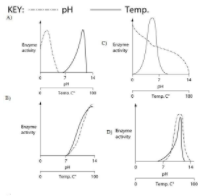
52) Consider the thermoacidophile, Sulfolobus acidocaldarius. Which of the following graphs most accurately depicts the expected temperature and pH profiles of its enzymes? (Note: The horizontal axes of these graphs are double, with pH above and temperature below.)

A. SEE IMAGE
B. SEE IMAGE
C. SEE IMAGE
D. SEE IMAGE

back 40

A. SEE IMAGE

front 41

A hypothetical bacterium swims among human intestinal contents until it finds a suitable location on the intestinal lining. It adheres to the intestinal lining using a feature that also protects it from phagocytes, bacteriophages, and dehydration. Fecal matter from a human in whose intestine this bacterium lives can spread the bacterium, even after being mixed with water and boiled. The bacterium is not susceptible to the penicillin family of antibiotics. It contains no plasmids and relatively little peptidoglycan.

53) This bacterium's ability to survive in a human who is taking penicillin pills may be due to the presence of
1. penicillin-resistance genes
2. a secretory system that removes penicillin from the cell
3. a gram-positive cell wall
4. a gram-negative cell wall
5. an endospore

back 41

D)

front 42

A hypothetical bacterium swims among human intestinal contents until it finds a suitable location on the intestinal lining. It adheres to the intestinal lining using a feature that also protects it from phagocytes, bacteriophages, and dehydration. Fecal matter from a human in whose intestine this bacterium lives can spread the bacterium, even after being mixed with water and boiled. The bacterium is not susceptible to the penicillin family of antibiotics. It contains no plasmids and relatively little peptidoglycan.

54) Adherence to the intestinal lining by this bacterium is due to its possession of
A) fimbriae.
B) pili.
C) a capsule.
D) a flagellum.
E) a cell wall with an outer lipopolysaccharide membrane.

back 42

C) a capsule.

front 43

A hypothetical bacterium swims among human intestinal contents until it finds a suitable location on the intestinal lining. It adheres to the intestinal lining using a feature that also protects it from phagocytes, bacteriophages, and dehydration. Fecal matter from a human in whose intestine this bacterium lives can spread the bacterium, even after being mixed with water and boiled. The bacterium is not susceptible to the penicillin family of antibiotics. It contains no plasmids and relatively little peptidoglycan.

55) What should be true of the cell wall of this bacterium?
A) Its innermost layer is composed of a phospholipid bilayer.
B) After it has been subjected to Gram staining, the cell should remain purple.
C) It has an outer membrane of lipopolysaccharide.
D) It is mostly composed of a complex, cross-linked polysaccharide.
E) Two of the responses above are correct.

back 43

C) It has an outer membrane of lipopolysaccharide.

front 44

A hypothetical bacterium swims among human intestinal contents until it finds a suitable location on the intestinal lining. It adheres to the intestinal lining using a feature that also protects it from phagocytes, bacteriophages, and dehydration. Fecal matter from a human in whose intestine this bacterium lives can spread the bacterium, even after being mixed with water and boiled. The bacterium is not susceptible to the penicillin family of antibiotics. It contains no plasmids and relatively little peptidoglycan.

56) Some of the proteins that allow this bacterium to swim are related (in an evolutionary sense) to proteins that
A) attach to the single chromosome.
B) act as restriction enzymes.
C) synthesize peptidoglycan for the cell wall.
D) move penicillin out of the cell.
E) comprise its ribosomes.

back 44

D) move penicillin out of the cell.

front 45

A hypothetical bacterium swims among human intestinal contents until it finds a suitable location on the intestinal lining. It adheres to the intestinal lining using a feature that also protects it from phagocytes, bacteriophages, and dehydration. Fecal matter from a human in whose intestine this bacterium lives can spread the bacterium, even after being mixed with water and boiled. The bacterium is not susceptible to the penicillin family of antibiotics. It contains no plasmids and relatively little peptidoglycan.
57) In which feature(s) should one be able to locate a complete chromosome
of this bacterium?
1. nucleolus
2. prophage
3. endospore
4. nucleoid

back 45

D)

front 46

A hypothetical bacterium swims among human intestinal contents until it finds a suitable location on the intestinal lining. It adheres to the intestinal lining using a feature that also protects it from phagocytes, bacteriophages, and dehydration. Fecal matter from a human in whose intestine this bacterium lives can spread the bacterium, even after being mixed with water and boiled. The bacterium is not susceptible to the penicillin family of antibiotics. It contains no plasmids and relatively little peptidoglycan.

58) The cell also lacks F factors and F plasmids. Upon its death, this bacterium should be able to participate in
A) conjugation.
B) transduction.
C) transformation.
D) Three of the responses above are correct.
E) Two of the responses above are correct.

back 46

C) transformation.

front 47

A hypothetical bacterium swims among human intestinal contents until it finds a suitable location on the intestinal lining. It adheres to the intestinal lining using a feature that also protects it from phagocytes, bacteriophages, and dehydration. Fecal matter from a human in whose intestine this bacterium lives can spread the bacterium, even after being mixed with water and boiled. The bacterium is not susceptible to the penicillin family of antibiotics. It contains no plasmids and relatively little peptidoglycan.

59) This bacterium derives nutrition by digesting human intestinal contents (in other words, food). Thus, this bacterium should be an
A) aerobic chemoheterotroph.
B) aerobic chemoautotroph.
C) anaerobic chemoheterotroph.
D) anaerobic chemoautotroph.

back 47

C) anaerobic chemoheterotroph.

front 48

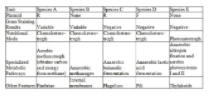
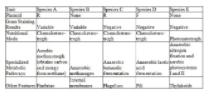
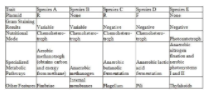
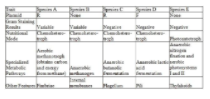
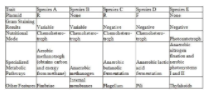
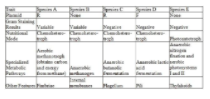
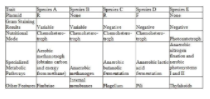
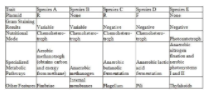
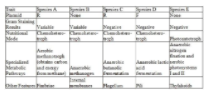
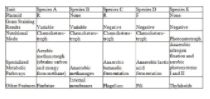
The following table depicts characteristics of five prokaryotic species (A—E). Use the information in the table to answer the following question.

63) Which two species should have much more phospholipid, in the form of bilayers, in their cytoplasms than most other bacteria?
A) species A and B
B) species A and C
C) species B and E
D) species C and D
E) species C and E

back 48

C) species B and E

front 49

The following table depicts characteristics of five prokaryotic species (A—E). Use the information in the table to answer the following question.

64) Which species should be able to respond most readily to taxes (plural of taxis)?
A) species A
B) species B
C) species C
D) species D
E) species E

back 49

C) species C

front 50

The following table depicts characteristics of five prokaryotic species (A—E). Use the information in the table to answer the following question.

65) How many of these species probably have a cell wall that partly consists of an outer membrane of lipopolysaccharide?
A) only one species
B) two species
C) three species
D) four species
E) all five species

back 50

C) three species

front 51

The following table depicts characteristics of five prokaryotic species (A—E). Use the information in the table to answer the following question.

66) Gram-variable prokaryotes are, sometimes, those without any peptidoglycan. Which two species are most likely to be archaeans?
A) species A and B
B) species A and C
C) species B and E
D) species C and D
E) species C and E

back 51

A) species A and B

front 52

The following table depicts characteristics of five prokaryotic species (A—E). Use the information in the table to answer the following question.

67) Species D is pathogenic if it gains access to the human intestine. Which other species, if it coinhabited a human intestine along with species D, is most likely to result in a recombinant species that is both pathogenic and resistant to some antibiotics?
A) species A
B) species B
C) species C
D) species D
E) species E

back 52

C) species C

front 53

The following table depicts characteristics of five prokaryotic species (A—E). Use the information in the table to answer the following question.

68) Which species might be able to include Hfr cells?
A) species A
B) species B
C) species C
D) species D
E) species E

back 53

D) species D

front 54

The following table depicts characteristics of five prokaryotic species (A—E). Use the information in the table to answer the following question.

69) Which species is most self-sustaining in terms of obtaining nutrition in environments containing little fixed nitrogen or carbon?
A) species A
B) species B
C) species C
D) species D
E) species E

back 54

E) species E

front 55

The following table depicts characteristics of five prokaryotic species (A—E). Use the information in the table to answer the following question.

70) Which two species might be expected to cooperate metabolically, perhaps forming a biofilm wherein one species surrounds cells of the other species?
A) species A and B
B) species A and C
C) species B and E
D) species C and D
E) species C and E

back 55

A) species A and B

front 56

The following table depicts characteristics of five prokaryotic species (A—E). Use the information in the table to answer the following question.

71) Which species is most likely to be found both in sewage treatment plants and in the guts of cattle?
A) species A
B) species B
C) species C
D) species D
E) species E

back 56

B) species B

front 57

The following table depicts characteristics of five prokaryotic species (A—E). Use the information in the table to answer the following question.

72) Which species is probably an important contributor to the base of aquatic food chains as a primary producer?
A) species A
B) species B
C) species C
D) species D
E) species E

back 57

E) species E

front 58

73) Genetic variation in bacterial populations cannot result from
A) transduction.
B) transformation
C) conjugation
D) mutation.
E) meiosis.

back 58

E) meiosis.

front 59

74) Photoautotrophs use
A) light as an energy source and CO₂ as a carbon source.
B) light as an energy source and methane as a carbon source.
C) N₂ as an energy source and CO₂ as a carbon source.
D) CO₂ as both an energy source and a carbon source.
E) H₂S as an energy source and CO₂ as a carbon source.

back 74

back 59

A) light as an energy source and CO₂ as a carbon source.

front 60

75) Which of the following statements is not true?
A) Archaea and bacteria have different membrane lipids.
B) Both archaea and bacteria generally lack membrane-enclosed organelles.
C) The cell walls of archaea lack peptidoglycan.
D) Only bacteria have histones associated with DNA.
E) Only some archaea use CO₂ to oxidize H₂, releasing methane.

back 60

D) Only bacteria have histones associated with DNA.

front 61

76) Which of the following involves metabolic cooperation among prokaryotic cells?
A) binary fission
B) endospore formation
C) endotoxin release
D) biofilms
E) photoautotrophy

back 61

D) biofilms

front 62

77) Bacteria perform each of the following ecological roles. Which role typically does not involve a symbiosis?
A) skin commensalist
B) decomposer
C) aggregates with methane-consuming archaea
D) gut mutualist
E) pathogen

back 62

B) decomposer

front 63

78) Plantlike photosynthesis that releases O₂ occurs in
A) cyanobacteria.
B) chlamydias.
C) archaea.
D) actinomycetes.
E) chemoautotrophic bacteria.

back 63

A) cyanobacteria.