Print Options

Card layout: ?

← Back to notecard set|Easy Notecards home page

Instructions for Side by Side Printing
  1. Print the notecards
  2. Fold each page in half along the solid vertical line
  3. Cut out the notecards by cutting along each horizontal dotted line
  4. Optional: Glue, tape or staple the ends of each notecard together
  1. Verify Front of pages is selected for Viewing and print the front of the notecards
  2. Select Back of pages for Viewing and print the back of the notecards
    NOTE: Since the back of the pages are printed in reverse order (last page is printed first), keep the pages in the same order as they were after Step 1. Also, be sure to feed the pages in the same direction as you did in Step 1.
  3. Cut out the notecards by cutting along each horizontal and vertical dotted line
To print: Ctrl+PPrint as a list

72 notecards = 18 pages (4 cards per page)

Viewing:

Chapter 21

front 1

1) Which of the following blood vessels carries blood away from the heart to other organs?

  1. a) arteries
  2. b) capillaries
  3. c) venules
  4. d) arterioles
  5. e) veins

back 1

a

front 2

2) Which of the following blood vessels carries blood from the tissues back to the heart?

  1. a) arteries
  2. b) arterioles
  3. c) aorta
  4. d) veins
  5. e) capillaries

back 2

d

front 3

3) Which layer of the arterial wall is responsible for vasoconstriction?

  1. a) tunica interna
  2. b) tunica media
  3. c) tunica externa
  4. d) tunica albuginea
  5. e) tunica fascia

back 3

b

front 4

4) A blockage in the proximal portion of the right subclavian artery will not only affect circulation to the right arm, but also to the

  1. a) left arm
  2. b) left ventricle
  3. c) right ventricle
  4. d) left vertebral artery
  5. e) left common carotid artery

back 4

d

front 5

5) The bronchial arteries arise from the

  1. a) left subclavian artery
  2. b) brachiocephalic trunk
  3. c) right subclavian artery
  4. d) left common carotid artery
  5. e) thoracic aorta

back 5

e

front 6

6) A blockage in the external iliac artery will reduce blood flow to the

  1. a) external iliac artery
  2. b) common iliac artery
  3. c) femoral artery
  4. d) abdominal aorta
  5. e) ileal artery

back 6

c

front 7

7) In resting individuals, which vessels serve as a large blood reservoir from which blood can be quickly diverted to other vessels as needed?

  1. a) Arteries and arterioles
  2. b) Arterioles and capillaries
  3. c) Venules and capillaries
  4. d) Veins and venules
  5. e) Aorta and veins

back 7

d

front 8

8) In order to supply nourishment to liver tissue, which vessel must deliver blood to the organ?

  1. a) hepatic artery
  2. b) hepatic vein
  3. c) hepatic portal vein
  4. d) superior mesenteric artery
  5. e) splenic artery

back 8

a

front 9

9) If a patient is confined to bed and is unable to walk at all, which of the following will be seriously affected?

  1. a) blood flow to the lungs
  2. b) blood flow to the kidneys
  3. c) the circulation returning from the lower body
  4. d) circulation in the jugular veins
  5. d) blood flow to the intestines

back 9

c

front 10

10) Capillaries are also referred to as

  1. a) exchange vessels.
  2. b) vasoconstrictors.
  3. c) vasodilators.
  4. d) pressure reservoirs.
  5. e) distributing vessels.

back 10

a

front 11

12) The layer of a blood vessel that is in direct contact with the blood is the

  1. tunica albuginea
  2. tunica externa
  3. tunica interna
  4. tunica media
  5. tunica vasculosa

back 11

c

front 12

the layer of the vessel that is made up of smooth muscle and elastic fibers is the

  1. tunica albuginea
  2. tunica externa
  3. tunica interna
  4. tunica media
  5. tunica vasculosa

back 12

d

front 13

13) Which of the following is the most important method of capillary exchange?

  1. a) diffusion
  2. b) facilitated diffusion
  3. c) bulk flow
  4. d) primary active transport
  5. e) secondary active transport

back 13

a

front 14

14) Which of the following structures is used to control the flow of blood through a capillary bed?

  1. a) thoroughfare channels
  2. b) precapillary sphincters
  3. c) postcapillary sphincters
  4. d) venules

back 14

b

front 15

15) Which of the following types of tissues contains continuous capillaries?

  1. a) skeletal muscle
  2. b) smooth muscle
  3. c) connective tissue
  4. d) lungs
  5. e) all of these choices

back 15

e

front 16

16) The alternate route of blood flow to a body part through an anastomosis is called

  1. a) a thoroughfare channel.
  2. b) a blood reservoir.
  3. c) a detour route.
  4. d) collateral circulation.
  5. e) microcirculation.

back 16

d

front 17

17) The largest driving force for pulling fluid from the interstitial spaces back into the capillaries is

  1. a) interstitial fluid hydrostatic pressure.
  2. b) interstitial fluid osmotic pressure.
  3. c) blood colloid osmotic pressure.
  4. d) blood hydrostatic pressure.
  5. e) glomerular hydrostatic pressure.

back 17

c

front 18

18) The pressure-driven movement of fluids and solutes from blood into interstitial fluid is called

  1. a) reabsorption.
  2. b) filtration.
  3. c) bulk flow.
  4. d) osmosis.
  5. e) transcytosis.

back 18

b

front 19

19) The volume of blood that circulates through the systemic (or pulmonary) blood vessels per minute is called

  1. a) stroke volume.
  2. b) tidal volume.
  3. c) cardiac output.
  4. d) cardiac reserve.
  5. e) total peripheral resistance.

back 19

c

front 20

20) Cardiac output is dependent on both

  1. a) heart rate and stroke volume.
  2. b) stroke volume and systemic vascular resistance.
  3. c) heart rate and systemic vascular resistance.
  4. d) blood type and stroke volume.
  5. e) blood pressure and heart rate

back 20

a

front 21

21) Vascular resistance depends on which of these factors? Select all that apply.

  1. a) size of the blood vessel lumen
  2. b) blood viscosity
  3. c) total blood vessel length
  4. d) glucose content of the blood

back 21

a,b,c

front 22

22) Which of the following would NOT result in an increase in arterial blood pressure?

  1. a) Increased blood volume
  2. b) Increased sympathetic stimulation
  3. c) Increased heart rate
  4. d) Increased stroke volume
  5. e) Increased arteriolar vasodilation

back 22

e

front 23

23) Which of the following would NOT result in an increase in systemic vascular resistance?

  1. a) Decreased diameter of systemic arterioles
  2. b) Increased blood viscosity
  3. c) Decreased length of the systemic circulatory route
  4. d) Increased vasoconstriction of systemic arterioles
  5. e) Increased red blood cell count

back 23

c

front 24

24) The right common carotid artery branches directly off the

  1. a) left common carotid artery
  2. b) left subclavian artery
  3. c) brachiocephalic trunk
  4. d) right subclavian artery
  5. e) right coronary artery

back 24

c

front 25

25) Which of the following is NOT a contribution of the cardiovascular system to other body systems?

  1. a) Blood delivers clotting factors and WBCs that aid in hemostasis when skin is damaged.
  2. b) Blood delivers calcium and phosphate ions that are needed for building bone extracellular matrix.
  3. c) Blood carries carbon dioxide to body tissues and removes oxygen for use by other organs.
  4. d) Blood carries newly absorbed nutrients and water to the liver.
  5. e) Blood circulates cells and chemicals that carry out immune functions.

back 25

c

front 26

26) The cardiovascular center is located

  1. a) in the thoracic cavity.
  2. b) in the cerebral cortex.
  3. c) in the cerebellum.
  4. d) in the medulla oblongata.
  5. e) in the hypothalamus.

back 26

d

front 27

27) The most common disorder affecting the heart and blood vessels is

  1. a) hypotension
  2. b) aneurysm
  3. c) infarction
  4. d) arrhythmia
  5. e) hypertension

back 27

e

front 28

28) Pericardial arteries supply blood to the

  1. a) outer heart muscle
  2. b) tissue of the aorta
  3. c) tissue of the pulmonary trunk
  4. d) tissues of the pericardial sac
  5. e) all of these

back 28

d

front 29

29) Which of the following hormones would NOT stimulate changes that lead to an increase in arterial blood pressure?

  1. a) Atrial natriuretic peptide (ANP)
  2. b) Antidiuretic hormone (ADH)
  3. c) Aldosterone
  4. d) Angiotensin II
  5. e) Norepinephrine

back 29

a

front 30

30) Blood flow passing through the posterior aspect of the knee is achieved through the

  1. a) tibial arteries
  2. b) popliteal arteries
  3. c) common iliac arteries
  4. d) internal iliac arteries
  5. e) external iliac arteries

back 30

b

front 31

32) The circulatory system aids in the homeostasis of the skeletal system by

  1. a) delivering calcium
  2. b) delivering phosphate
  3. c) transporting hormones for bone metabolism
  4. d) transporting hormones for production of red blood cells
  5. e) all of the above

back 31

e

front 32

33) Nutrients from digested food enter the liver via the

  1. a) hepatic portal circulation
  2. b) hepatic vein
  3. c) abdominal aorta
  4. d) inferior vena cava
  5. e) renal veins

back 32

a

front 33

34) Abnormal conditions such as atherosclerosis and patent (open) ductus arteriosus cause a large increase in the

  1. a) blood colloid osmotic pressure.
  2. b) net filtration pressure
  3. c) pulse pressure.
  4. d) blood hydrostatic pressure.
  5. e) interstitial fluid hydrostatic pressure.

back 33

c

front 34

35) The branches from the ascending aorta that supply blood to the cardiac muscle are the

  1. a) circumflex arteries
  2. b) coronary arteries
  3. c) anterior descending arteries
  4. d) interventricular arteries
  5. e) pulmonary arteries

back 34

b

front 35

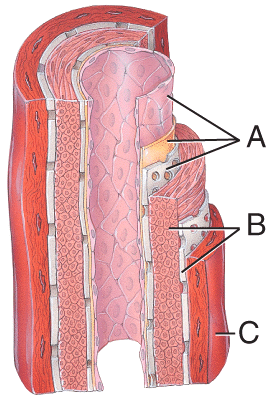
38) Which of the labeled layers in the diagram of the arterial wall consists mainly of elastic fibers and smooth muscle fibers?

back 35

b

front 36

39) Which of the labeled layers in the diagram of the arterial wall is composed of a simple squamous epithelium, a basement membrane and a layer of elastic tissue?

back 36

a

front 37

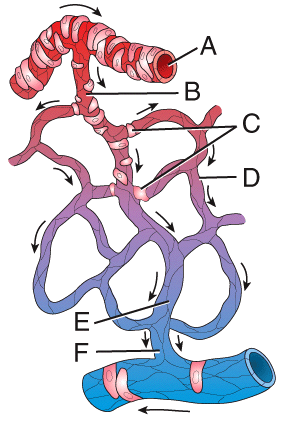
40) Which labeled structure in the figure is a metarteriole?

back 37

b

front 38

41) A blockage to one or both of the inferior phrenic veins will cause a backup of blood into which structure?

  1. a) the liver
  2. b) the kidney
  3. c) the heart
  4. d) the diaphragm
  5. e) the spleen

back 38

d

front 39

42) Which labeled structure in the figure is precapillary sphincter?

back 39

c

front 40

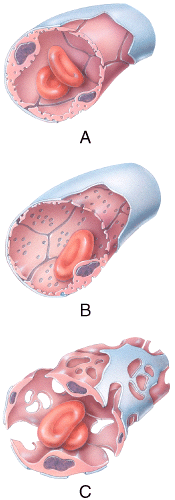
43) Which of the capillaries shown in the figure has an incomplete or absent basement membrane?

back 40

c

front 41

44) Which of the types of capillaries shown in the figure is commonly found in the kidneys, villi of the small intestine, choroid plexuses, and some endocrine glands?

back 41

b

front 42

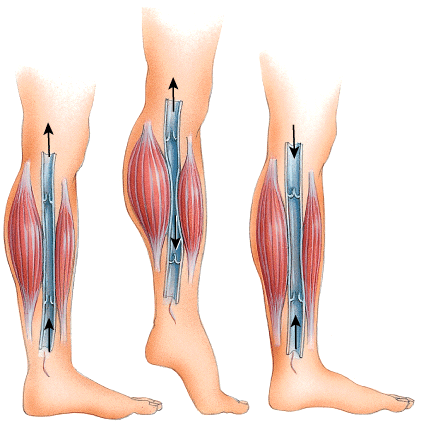
45) What physiological process is depicted in this figure?

  1. a) Venous blood blockage
  2. b) Skeletal muscle pump
  3. c) Respiratory pump
  4. d) Thoroughfare channels
  5. e) Anastomosis

back 42

b

front 43

47) Which of the following would NOT occur in response to hypovolemic shock?

  1. a) Activation of the renin-angiotensin-aldosterone (RAA) system.
  2. b) Secretion of antidiuretic hormone (ADH)
  3. c) Activation of the sympathetic division of the ANS.
  4. d) Release of atrial natriuretic peptide (ANP).
  5. e) Release of local vasodilators.

back 43

d

front 44

48) All the veins of the systemic circulation eventually drain into the

  1. a) superior vena cava.
  2. b) inferior vena cava.
  3. c) coronary sinus.
  4. d) superior and inferior vena cava.

e) superior and inferior vena cava and coronary sinus

back 44

e

front 45

49) The pulmonary trunk divides into

  1. a) brachiocephalic trunk and left subclavian artery
  2. b) right and left subclavian arteries.
  3. c) right and left pulmonary veins.
  4. d) right and left pulmonary arteries.
  5. e) right and left common carotid arteries.

back 45

d

front 46

50) If the foramen ovale doesn’t close at birth, the result will be

  1. a) overloading the lungs with blood
  2. b) excessive volume in the pulmonary trunk
  3. c) a reduction of volume in the aorta
  4. d) introducing deoxygenated blood into the systemic circulation
  5. e) no change in the content of the systemic or pulmonary circulations

back 46

d

front 47

52) Which of the following vessels supplies blood to the intestines?

  1. a) Radial artery
  2. b) Subclavian artery
  3. c) Mesenteric artery
  4. d) Coronary artery
  5. e) Popliteal artery

back 47

c

front 48

54) Which of the following vessels drains blood from the lower leg?

  1. a) Jugular vein
  2. b) Superior vena cava
  3. c) Tibial vein
  4. d) Coronary vein
  5. e) Inferior mesenteric vein

back 48

c

front 49

55) Which of the following vessels drains blood from the head and neck?

  1. a) Median cubital vein
  2. b) Inferior vena cava
  3. c) Axillary vein
  4. d) Femoral vein
  5. e) Jugular vein

back 49

e

front 50

56) Which of the following vessels carries the venous blood from the lower body into the right atrium?

  1. a) Inferior vena cava
  2. b) Superior vena cava
  3. c) Tibial vein
  4. d) Coronary vein
  5. e) Iliac vein

back 50

a

front 51

57) When the umbilical cord is tied after birth, the umbilical arteries close by filling in with

  1. a) placental fluid.
  2. b) platelet plugs.
  3. c) connective tissue.
  4. d) smooth muscle.
  5. e) epithelial tissue.

back 51

c

front 52

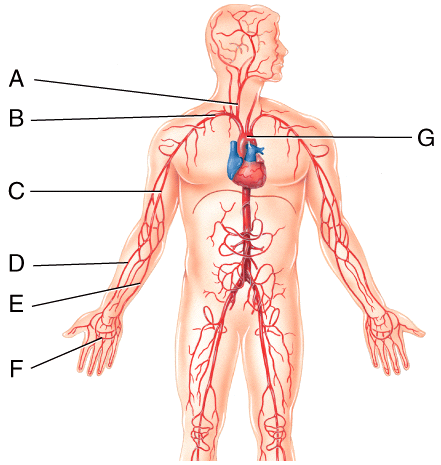
63) Which vessel in the figure is labeled “B”?

  1. a) right ulnar artery
  2. b) right subclavian artery
  3. c) right radial artery
  4. d) right brachial artery
  5. e) right axillary artery

back 52

b

front 53

64) Which vessel in the figure is labeled “A”?

  1. a) right subclavian artery
  2. b) right radial artery
  3. c) right common carotid artery
  4. d) right brachial artery
  5. e) right axillary artery

back 53

c

front 54

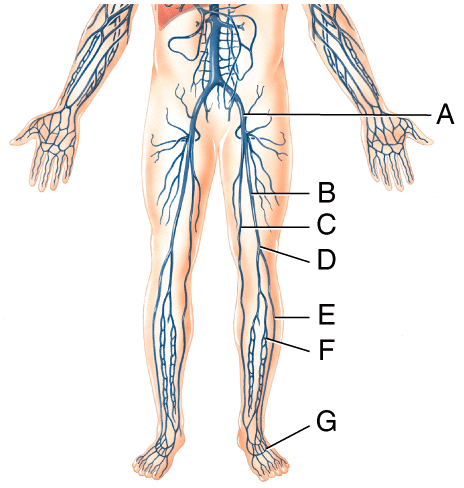
65) Which vessel in the figure is labeled “B”?

  1. a) left femoral vein
  2. b) left great saphenous vein
  3. c) left popliteal vein
  4. d) left anterior tibial vein

e) left fibular vein

back 54

a

front 55

66) Which vessel in the figure is labeled “C”?

  1. a) left femoral vein
  2. b) left great saphenous vein
  3. c) left popliteal vein
  4. d) left anterior tibial vein
  5. e) left fibular vein

back 55

b

front 56

67) Which vessel in the figure is labeled “F”?

  1. a) left femoral vein
  2. b) left great saphenous vein
  3. c) left popliteal vein
  4. d) left anterior tibial vein
  5. e) left small saphenous vein

back 56

d

front 57

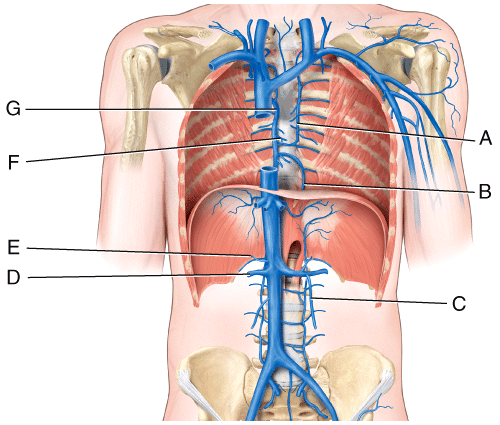
68) Which vessel in the figure is labeled “C”?

  1. a) accessory hemiazygos vein
  2. b) hemiazygos vein
  3. c) left gonadal vein
  4. d) right renal vein
  5. e) right suprarenal vein

back 57

c

front 58

69) Which vessel in the figure is labeled “D”?

  1. a) accessory hemiazygos vein
  2. b) hemiazygos vein
  3. c) right renal vein
  4. d) right suprarenal vein
  5. e) pericardial vein

back 58

c

front 59

70) Which vessel in the figure is labeled “G”?

  1. a) accessory hemiazygos vein
  2. b) hemiazygos vein
  3. c) right suprarenal vein
  4. d) pericardial vein
  5. e) azygos vein

back 59

e

front 60

71) In the fetal heart, several structures allow blood from the left and right sides to mix. When the newborn takes its first breath, these structures must close to ensure that oxygenated blood from the left side does not mix with deoxygenated blood from the right side. Which of the following closed structures prevent this mixing between the systemic and pulmonary circulation after the umbilical cord is cut? Select all that apply.

  1. a) fossa ovalis
  2. b) ligamentum arteriosum
  3. c) ligamentum venosum
  4. d) ligamentum teres

back 60

a,b

front 61

73) During embryonic development, blood vessels are formed by

  1. a) endodermal cells.
  2. b) pluripotent stem cells.
  3. c) angioblasts.
  4. d) fibroblasts.
  5. e) osteoblasts.

back 61

c

front 62

74) During embryonic development, blood cells are formed from

  1. a) endodermal cells.
  2. b) pluripotent stem cells.
  3. c) angioblasts.
  4. d) fibroblasts.
  5. e) osteoblasts.

back 62

b

front 63

76) Normal blood pressure for a young adult male is less than

  1. a) 120/80.
  2. b) 130/90.
  3. c) 80/120.
  4. d) 100/80.
  5. e) 150/85.

back 63

a

front 64

77) Which of the following types of blood vessels have high, pulsing blood pressure?

  1. a) arterioles
  2. b) capillaries
  3. c) venules
  4. d) veins
  5. e) vena cavae

back 64

a

front 65

78) What would the mean arterial pressure be for an individual with a blood pressure of 120/80?

  1. a) 40
  2. b) 93.3
  3. c) 13.3
  4. d) 120
  5. e) 200

back 65

b

front 66

79) Which of the following effectors would NOT be activated as described below in response to hypovolemic shock?

  1. a) Adrenal cortex releases aldosterone.
  2. b) Kidneys conserve salt and water.
  3. c) Heart rate increases.
  4. d) Decreased blood flow to the kidneys.
  5. e) Heart contractility increases.

back 66

d

front 67

80) The pulmonary circulatory route carries blood from the

  1. a) right atrium to the right ventricle.
  2. b) right ventricle to the left atrium.
  3. c) left atrium to the left ventricle.
  4. d) left ventricle to the right atrium.
  5. e) left ventricle to the coronary sinus.

back 67

b

front 68

81) Emphysema is a chronic obstructive pulmonary disease (COPD) that causes progressive destruction of alveoli (air sacs) in the lungs leading to a decreased ability to exhale. How does this disease affect carbon dioxide levels in the blood?

  1. a) they are unaffected
  2. b) they increase
  3. c) they decrease
  4. d) the result varies with each individual
  5. e) first, they increase, then they decrease

back 68

b

front 69

82) Into which of the following categories would an individual with a blood pressure of 145/95 be placed?

  1. a) Normal
  2. b) High normal
  3. c) Prehypertension
  4. d) Stage 1 hypertension
  5. e) Stage 2 hypertension

back 69

d

front 70

83) Which of the following categories of hypertension drugs lower blood pressure by blocking formation of angiotensin II, which results in vasodilation and decreased aldosterone secretion?

  1. a) Diuretics
  2. b) ACE inhibitors
  3. c) Beta blockers
  4. d) Calcium channel blockers
  5. e) Anabolic steroids

back 70

b

front 71

84) Which of the following veins drains the muscles, bones and skin of the hand of the forearm? Select all that apply.

  1. a) axillary veins
  2. b) ulnar veins
  3. c) radial veins
  4. d) brachial veins

back 71

b,c

front 72

85) The chemical histamine causes capillary walls to become more permeable. Excess histamine

secretion, as might be seen in allergic responses, might lead to

  1. a) decreased blood flow
  2. b) edema
  3. c) increased pain sensation
  4. d) blood clotting
  5. e) hypertension

back 72

b