Instructions for Side by Side Printing
- Print the notecards
- Fold each page in half along the solid vertical line
- Cut out the notecards by cutting along each horizontal dotted line
- Optional: Glue, tape or staple the ends of each notecard together
Chapter 3: Sodium and Chloride Imbalances
front 1 A nursing instructor is educating students about sodium imbalances. Which statement by the nurse instructor is correct? | back 1 "Sodium is the most abundant cation in the extracellular fluid (ECF)." |
front 2 A nurse assesses the laboratory values of an adult client. Which imbalance should a nurse associate with a serum sodium level of 150 mEq/L? | back 2 Hypernatremia |
front 3 A nurse assessing a client who experienced a seizure during a water-drinking contest should associate the client's seizure with which electrolyte imbalance? | back 3 Hyponatremia related to relative decrease in sodium |
front 4 A nurse assesses a newly admitted client with a serum sodium level of 120 mEq/L. The nurse should observe the client for which clinical manifestations? Select all that apply. | back 4
|
front 5 A nurse is providing discharge instructions for a client diagnosed with end-stage renal disease. The nurse explains that the client is at risk for developing hypernatremia. Which manifestation should the nurse instruct the client to report immediately to a health-care provider? | back 5 Weight gain of 3 pounds in 1 day |
front 6 A nurse instructing a client on a low-sodium diet should advise the client that it is appropriate to consume which condiment? | back 6 Mayonnaise |
front 7 A nurse instructing a client on a low-sodium diet should advise the client to avoid which beverage? | back 7 Root beer |
front 8 A nurse is evaluating the laboratory data of clients on a medical-surgical unit. Which laboratory result should a nurse report to a health-care provider? | back 8 Result A
|
front 9 Which factor in a client's history should a nurse associate with the development of hypochloremia? | back 9 Bulimia nervosa |
front 10 A nurse is teaching an older adult client diagnosed with hyponatremia. Which substance should the nurse instruct the client to avoid? | back 10 Water |
front 11 A home health nurse is educating a client diagnosed with syndrome of inappropriate antidiuretic hormone (SIADH). What should the nurse advise the client to do regarding the intake of fluids? Select all that apply. | back 11
|
front 12 A nurse is instructing a client on a high-sodium diet. Which foods should the nurse recommend as part of a high-sodium diet? | back 12 Ham and cheese sandwich |
front 13 A nurse is caring for a client diagnosed with hypovolemic hyponatremia. Which IV solution order should the nurse anticipate? | back 13 0.9% saline solution |
front 14 A nurse is planning care for a client diagnosed with severe hyponatremia. Which action should the nurse take when implementing seizure precautions for this client? | back 14 Pad the side rails and headboard. |
front 15 Which serum chloride level should a nurse anticipate when evaluating the laboratory data of a client diagnosed with hypernatremia? | back 15 Serum chloride 118 mEq/L |
front 16 Which manifestations should a nurse identify as the most serious complications associated with hyponatremia? | back 16 Lethargy, acute confusion, and decreased level of consciousness |
front 17 A nurse instructs a client on how to reduce sodium in the diet. Which meal choices, if made by the client, should indicate to the nurse that the client understands the dietary instructions? | back 17 Grilled chicken with a broccoli and carrot medley |
front 18 A nurse admitting a client who has a serum sodium level of 128 mEq/L and a serum chloride level of 88 mEq/L obtains a list of the client's current medications. Which medication should the nurse identify as having the potential to decrease serum sodium and chloride levels? | back 18 Metoprolol and hydrochlorothiazide (Lopressor HCT) |
front 19 Which measure, if included in the care plan for a client diagnosed with diabetes insipidus, should a nurse identify as most effective in restoring sodium balance? | back 19 Administer thiazide diuretics as ordered. |
front 20 Which statement, if made by a client on a sodium-restricted diet, should indicate to a nurse that the client needs further instruction? | back 20 "I will limit the amount of table salt I put on my food." |
front 21 Which foods should a nurse instruct a client to avoid to reduce dietary sodium intake? Select all that apply. | back 21
|
front 22 Which manifestations, if identified during assessment, should a nurse associate with this result? Select all that apply. | back 22
|
front 23 Which factors, if noted in a client's history, should a nurse associate with the development of hyponatremia? Select all that apply. | back 23
|
front 24 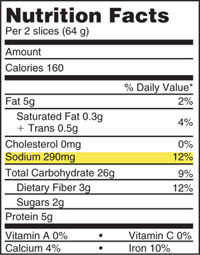 A nurse is teaching a client who is diagnosed with hypertension how to read food labels to assist the client in choosing foods that are lower in sodium. When discussing the following exhibit with the client, which statement by the nurse is correct? | back 24 "You can eat this food as long as you do not exceed 1,500 mg of sodium per day." |
front 25 Which client should a nurse identify as being at highest risk for hypernatremia? | back 25 An older adult client admitted with vomiting and diarrhea |
front 26 Which gastrointestinal manifestation, if identified in a client admitted with heart failure, should a nurse associate with the development of hyponatremia? | back 26 Diarrhea |
front 27 When hypernatremia in a client is caused by rapid fluid loss, which IV solution should a nurse anticipate being ordered to restore the client's fluid and electrolyte balance? | back 27 0.45% NaCl (half-normal saline) |
front 28 Which factor in a client admission assessment should a nurse identify as a cause of hypernatremia? | back 28 Watery diarrhea present |
front 29 Which statement by a student nurse best demonstrates an understanding of the body's attempt to restore sodium balance in a client who is hyponatremic? | back 29 "ADH is inhibited and aldosterone is released." |
front 30 A nurse identifies Risk for Falls Related to Skeletal Muscle Weakness as a diagnosis for a client admitted with hypernatremia secondary to chronic renal failure. Which nursing interventions would assist in maintaining this client's safety? Select all that apply. | back 30
|
front 31 Which laboratory result should a nurse anticipate when assessing an infant who has persistent projectile vomiting secondary to hypertrophic pyloric stenosis? | back 31 Serum chloride 90 mEq/L |
front 32 A 6-year-old client is brought to the emergency department after a near-drowning experience in the Pacific Ocean. For which electrolyte imbalance should the nurse assess? | back 32 Hypernatremia related to actual increase in sodium |
front 33 A nurse is preparing to administer IV 3% NaCl saline solution to a child weighing 60 pounds who is diagnosed with acute hyponatremia. A health-care provider orders 0.5 mEq/kg/hr of 3% saline; 3% NaCl solution contains 50 mEq of sodium per 100 milliliters. How many milliliters of this IV solution should the nurse administer hourly? Record your answer using a whole number. _____ | back 33 27 mL/hr |
front 34 An older adult client in an extended-care facility has been vomiting for 2 days. A nurse understands that this client is at increased risk for developing fluid volume deficit and hyponatremia and prepares to infuse IV 0.9% saline solution 750 mL at 125 mL/hr, as ordered by a health-care provider. The nurse selects IV tubing that has a drop factor of 15 gtts/mL. How many drops per minute should the nurse infuse to administer the prescribed 125 mL/hr? Record your answer using a whole number. _____ | back 34 31 gtt/hr |
front 35 A nurse determines that a client has a laboratory test that reveals severe hypochloremia. Which nursing diagnosis should be the nurse's priority for this client? | back 35 Ineffective Breathing Pattern |
front 36 Which manifestations, if identified during the assessment of a client, should a nurse associate with the development of hypernatremia? Select all that apply. | back 36
|
front 37 A nurse assesses a client diagnosed with hyperchloremia. Which findings would require immediate investigation by the nurse? Select all that apply. | back 37
|
front 38 A nurse is assessing a client with a possible fluid and electrolyte imbalance. Which manifestation, if identified in this client, should a nurse associate with the development of either hyponatremia or hypernatremia? | back 38 Confusion |
front 39 A nurse is planning care for a client with severe hypernatremia. Which safety intervention should be the nurse's priority? | back 39 Seizure precautions |
front 40 A nurse is caring for a client who has been diagnosed with H1N1 virus. After 3 days of severe vomiting and diarrhea, the client is now lethargic and hypotensive. A health-care provider writes orders for the client. Which orders should the nurse question? Select all that apply. | back 40
|
front 41 A nurse assists a client who is experiencing a seizure secondary to hyponatremia. When prioritizing care for this client, which actions should the nurse take? Place each intervention in the correct order (1–6). | back 41
|
front 42 A nurse identifies that a client with hyponatremia is confused and restless with a bounding pulse, blood pressure of 145/96 mm Hg, and decreased serum osmolarity. Based on these findings, which cause of sodium imbalance should the nurse suspect? | back 42 Heart failure |
front 43 For a client admitted with severe hyponatremia, which should be the priority intervention for a nurse who plans to achieve the goal "Client will remain free from injury"? | back 43 Monitor neurological status and initiate seizure precautions |
front 44 Which laboratory result should a nurse anticipate in a client diagnosed with syndrome of inappropriate antidiuretic hormone (SIADH)? Select all that apply. | back 44
|
front 45 A nurse is planning care for a client diagnosed with hyperchloremia. On which intervention should the nurse place the highest priority? | back 45 Place the client on seizure precautions |