Instructions for Side by Side Printing
- Print the notecards
- Fold each page in half along the solid vertical line
- Cut out the notecards by cutting along each horizontal dotted line
- Optional: Glue, tape or staple the ends of each notecard together
Ch 25 - 29
front 1 Which of the following is the correct sequence of events in the origin of life?
A) I, II, III, IV B) I, III, II, IV C) II, III, I, IV D) II, III, IV, I | back 1 C) II, III, I, IV |
front 2 Which of the following is a defining characteristic that all protocells had in common? A) the ability to synthesize enzymes B) a surrounding membrane or membrane-like structure C) RNA genes D) the ability to replicate RNA | back 2 B) a surrounding membrane or membrane-like structure |
front 3 The first genetic material on Earth was probably ________. A) DNA produced by reverse transcriptase from abiotically produced RNA B) DNA molecules whose information was transcribed to RNA and later translated in polypeptides C) self-replicating RNA molecules D) oligopeptides located within protocells | back 3 C) self-replicating RNA molecules |
front 4 In 2013, researchers constructed a vesicle with replicated RNA. Why was this significant evidence for abiotic origin of life? A) RNA molecules could pass on information to their "daughters." B) RNA molecules were not able to replicate. C) RNA would be used up by protocells. D) RNA is a stable repository. | back 4 A) RNA molecules could pass on information to their "daughters." |
front 5 Which of the following statements suggests natural selection as a mechanism in the evolution of ribozymes? A) Single-stranded RNA has many shapes. B) Replication of RNA is flawless. C) Some strands of RNA replicate less often. D) Some strands of RNA replicate more often and with more mutations. | back 5 C) Some strands of RNA replicate less often. |
front 6 How was early Earth from more than three billion years ago different from today's Earth? Unlike Earth today, early Earth ________. A) had an atmosphere rich in gases released from volcanic eruptions B) had an oxidizing atmosphere C) experienced little high-energy radiation from the sun D) had an atmosphere with significant quantities of ozone | back 6 A) had an atmosphere rich in gases released from volcanic eruptions |
front 7 Which hypothesis for the abiotic formation of organic molecules suggests that early Earth's atmosphere was a neutral atmosphere? A) The energy for this synthesis could have come from lightning and UV radiation. B) Some evidence suggests that the early atmosphere was made up primarily of nitrogen and carbon dioxide. C) Amino acids were found near volcanic eruption sites. D) Organic compounds were first produced in deep-sea hydrothermal vents. | back 7 B) Some evidence suggests that the early atmosphere was made up primarily of nitrogen and carbon dioxide. |
front 8 One hypothesis that has been proposed regarding the origin of life suggests that life evolved from an "RNA world" to today's "DNA world." Considering the properties of RNA and DNA molecules, which questions would direct an investigation of the most insightful test of this hypothesis? A) Is it likely that RNA molecules functioned as ribozymes to synthesize DNA from amino acids, and that this role was reversed when DNA became the information source? B) Is it likely that simple, yet stable RNA molecules served as a primitive precursor to a less stable DNA molecule that was more capable of storing more information? C) Could RNA have provided a template for DNA assembly, thereby enabling a more stable molecule that is replicated more accurately? D) Since ribozymes could freely enter and leave the vesicles, could these molecules have brought external DNA into the cell as a less stable, but more reliable storage molecule of double-stranded DNA? | back 8 C) Could RNA have provided a template for DNA assembly, thereby enabling a more stable molecule that is replicated more accurately? |
front 9 Fossils of Lystrosaurus, a dicynodont therapsid, are most common in parts of modern-day South America, South Africa, Madagascar, India, South Australia, and Antarctica. The animal apparently lived in arid regions and was mostly herbivorous. It originated during the mid-Permian period, survived the Permian extinction, and dwindled by the late Triassic, though there is evidence of a relict population in Australia during the Cretaceous period. Some dicynodonts had two large tusks, extending down from their upper jaws. The tusks were not used for food gathering, and in some species were limited to males. Food was gathered using an otherwise toothless beak. Judging from the fossil record in sedimentary rocks, these pig-sized organisms were the most common mammal-like reptiles of the Permian. What is thought to be the correct sequence of these events, from earliest to most recent, in the evolution of life on Earth?
A) 4, 3, 2, 1, 5 B) 4, 1, 2, 3, 5 C) 4, 1, 3, 2, 5 D) 4, 3, 1, 5, 2 | back 9 C) 4, 1, 3, 2, 5 |
front 10 Which of the following showed their greatest diversity during the Mesozoic era but were a small, less diverse group during the Paleozoic era? A) gymnosperms B) fungi C) flowering plants D) mammals | back 10 A) gymnosperms |
front 11 Which listing of geological periods is in the correct order, from oldest to most recent? A) Cambrian, Devonian, Permian, Cretaceous B) Devonian, Cambrian, Permian, Cretaceous C) Cambrian, Permian, Devonian, Cretaceous D) Permian, Cambrian, Cretaceous, Devonian | back 11 A) Cambrian, Devonian, Permian, Cretaceous |
front 12 You are the lucky student of a wacky professor who develops a time machine. He asks if you will test it with him. You get in, and there is an immediate glitch—the date readout fails so that when you land, you are not sure what era you are in. Your professor begins to panic, but you see something that tells you are in the Cenozoic era. Which of the following could it be? A) a rabbit eating a daisy B) a water lily floating in a pond C) masses of green ferns with dragonflies hovering above them D) a bee pollinating a flower | back 12 A) a rabbit eating a daisy |
front 13 You are the lucky student of a wacky professor who develops a time machine. He asks if you will test it with him. You get in, and there is an immediate glitch—the date readout fails so that when you land, you are not sure what era you are in. As your time machine lands, you see an unusual landscape before you. As you open the door, you realize you cannot breathe. You quickly shut the door, realizing you are in the ________. A) Archaean eon B) Cambrian period C) Cenozoic era D) Mesozoic era | back 13 A) Archaean eon |
front 14 An early consequence of the release of oxygen gas by plant and bacterial photosynthesis was to ________. A) change the atmosphere from oxidizing to reducing B) make it easier to maintain reduced molecules C) cause iron in ocean water and terrestrial rocks to rust (oxidize) D) prevent the formation of an ozone layer | back 14 C) cause iron in ocean water and terrestrial rocks to rust (oxidize) |
front 15 What is true of the Cambrian explosion? A) There are fossils of animals in geological strata that are older than the Cambrian explosion. B) Only the fossils of microorganisms are found in geological strata older than the Cambrian explosion. C) The Cambrian explosion is evidence for the instantaneous creation of life on Earth. D) The Cambrian explosion marks the appearance of filter-feeding animals in the fossil record. | back 15 A) There are fossils of animals in geological strata that are older than the Cambrian explosion. |
front 16 Which of the following characteristics are expected in the first animals to have colonized land? I) They were probably herbivores (ate photosynthesizers). II) Animals had four appendages. III) Animals had the ability to resist dehydration. IV) Animals had lobe-finned fishes as ancestors. V) Invertebrates A) III only B) III and V C) I, III and V D) I, II, III and IV | back 16 C) I, III and V |
front 17 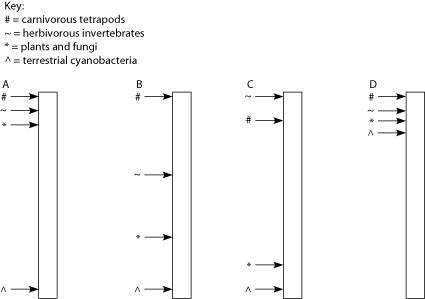 A sediment core is removed from the floor of an inland sea. The sea has been in existence, off and on, throughout the entire time that terrestrial life has existed. Researchers wish to locate and study the terrestrial organisms fossilized in this core. The core is illustrated as a vertical column, with the top of the column representing the most recent strata and the bottom representing the time when land was first colonized by life. If arrows indicate locations in the column where fossils of a particular type (see key) first appear, then which core in the figure above has the most accurate arrangement of fossils? A) core A B) core B C) core C D) core D | back 17 A) core A |
front 18 Endosymbiosis is an evolutionary theory that explains the origin of eukaryotes and suggests a specific order in which this might have occurred. Ancestral cells engulfed and then began to use the metabolic processes of the smaller cells. Based on shared-core processes and features, which statement most accurately describes the order, the theory, and the evolutionary implications for all organisms within domain Eukarya? A) Ancestral heterotrophic eukaryotes most likely engulfed both a heterotrophic and an autotrophic prokaryote, whereas ancestral photosynthetic eukaryotes probably provided the host cell for the first mitochondria. Over time, natural selection favored these relationships, and these cells became ancestors of all eukaryotes. B) All ancestral eukaryotes would have most likely consumed a nucleus-like prokaryote that eventually became the eukaryotic nucleus. These new eukaryotic cells would have had an advantage over prokaryotic cells by acquiring a nuclear command center for regulating cellular activities. C) As carbon dioxide levels were increasing over time, natural selection would have favored organisms that acquired a photosynthetic prokaryote to convert carbon dioxide into sugars. These would have likely been the first eukaryotic cells. These ancestral cells engulfed mitochondria-like prokaryotes, which would have provided an even greater advantage for cells in this environment. D) As Earth was becoming more aerobic, mitochondria would have provided an advantage to host cells by converting "toxic" oxygen into energy for heterotrophic cells. Since mitochondria are found in all eukaryotes, these combinations likely evolved first. Photosynthetic eukaryotes probably acquired an autotrophic prokaryote, which developed an advantageous symbiotic relationship with the host cell. | back 18 D) As Earth was becoming more aerobic, mitochondria would have provided an advantage to host cells by converting "toxic" oxygen into energy for heterotrophic cells. Since mitochondria are found in all eukaryotes, these combinations likely evolved first. Photosynthetic eukaryotes probably acquired an autotrophic prokaryote, which developed an advantageous symbiotic relationship with the host cell. |
front 19 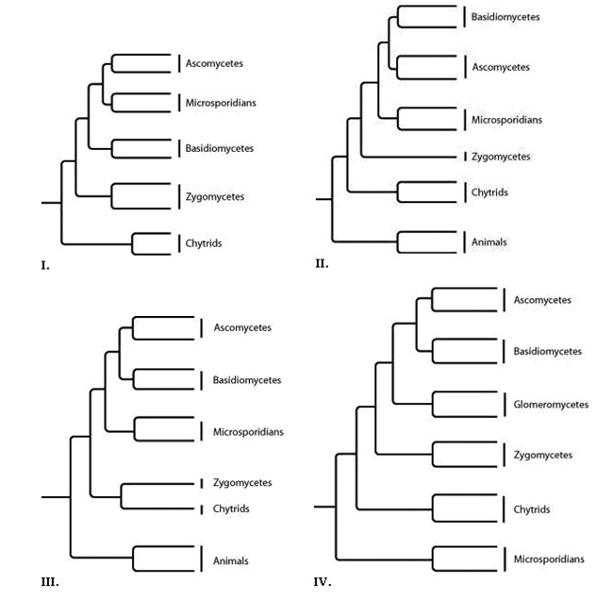 The following question refers to the following phylogenetic trees. Which tree depicts the microsporidians as a sister group of the ascomycetes? A) I B) II C) III D) IV | back 19 A) I |
front 20 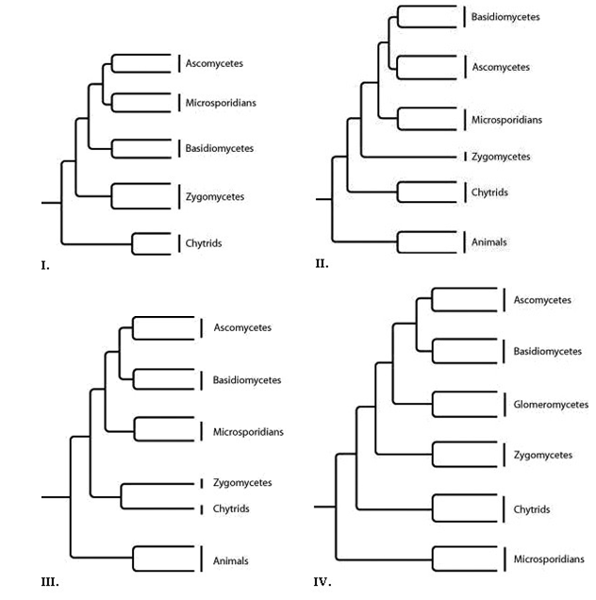 Which tree depicts the closest relationship between zygomycetes and chytrids? A) I B) II C) III D) IV | back 20 C) III |
front 21 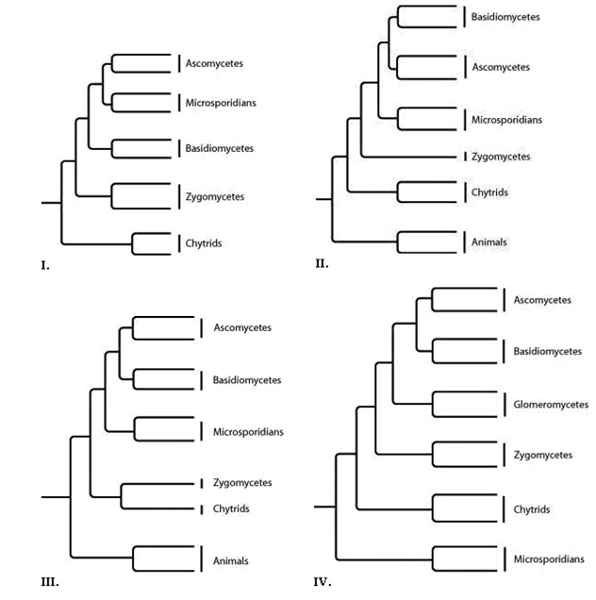 Which tree shows the greatest evolutionary distance between chytrids and ascomycetes? A) I B) II C) III D) IV | back 21 A) I |
front 22 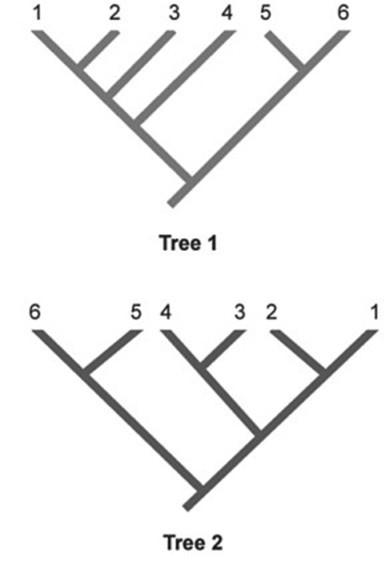 In the phylogenetic trees, numbers represent species, and the same species are shown in both trees. Which two species are represented as sister species in Tree 2 but are not shown as sister species in Tree 1? A) 1 and 2 B) 2 and 3 C) 3 and 4 D) 4 and 5 | back 22 C) 3 and 4 |
front 23 The legless condition that is observed in several groups of extant reptiles is the result of ________. A) their common ancestor having been legless B) a shared adaptation to an arboreal (living in trees) lifestyle C) several instances of the legless condition arising independently of each other D) individual lizards adapting to a fossorial (living in burrows) lifestyle during their lifetimes | back 23 C) several instances of the legless condition arising independently of each other |
front 24 The various taxonomic levels (for example, phyla, genera, classes) of the hierarchical classification system differ from each other on the basis of ________. A) how widely the organisms assigned to each are distributed throughout the environment B) their inclusiveness C) the relative genome sizes of the organisms assigned to each D) morphological characters that are applicable to all organisms | back 24 B) their inclusiveness |
front 25 If organisms A, B, and C belong to the same class but to different orders and if organisms C, D, and E belong to the same order but to different families, which of the following pairs of organisms would be expected to show the greatest degree of structural homology? A) A and D B) B and D C) B and C D) D and E | back 25 D) D and E |
front 26 Carolus Linnaeus believed that species remained fixed in the form in which they had been created. Linnaeus would have been uncomfortable with ________. A) a hierarchical classification scheme B) taxonomy C) phylogenies D) nested, increasingly inclusive categories of organisms | back 26 C) phylogenies |
front 27 The best classification system is that which most closely ________. A) unites organisms that possess similar morphologies B) conforms to traditional, Linnaean taxonomic practices C) reflects evolutionary history D) reflects the basic separation of prokaryotes from eukaryotes | back 27 C) reflects evolutionary history |
front 28 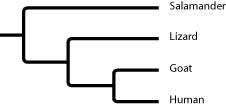 Based on this tree, which statement is correct? A) The human lineage is a basal taxon. B) Salamanders are a sister group to the group containing lizards, goats, and humans. C) Salamanders are as closely related to lizards as to humans. D) Goats are more closely related to salamanders than to humans. | back 28 B) Salamanders are a sister group to the group containing lizards, goats, and humans. |
front 29 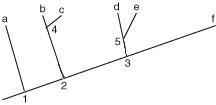 The following phylogeny shows six living species (a-f) and five ancestral (now extinct) species (#1-5). If the phylogeny had been developed on the basis of similarities in bone structure, which of the following predictions would you make in terms of the structure of a particular enzyme? A) The enzymes of species b and f are very similar. B) The enzymes of species b and c are more similar to ancestor #4 than to ancestor 2 C) The enzymes of species a and b are the same as that of ancestor #2. D) The enzyme of species c is very similar to that of species d. | back 29 B) The enzymes of species b and c are more similar to ancestor #4 than to ancestor 2 |
front 30 Some beetles and flies have antler-like structures on their heads, much like male deer. The existence of antlers in beetle, fly, and deer species with strong male-male competition is an example of ________. A) convergent evolution B) similarity due to shared ancestry C) homology D) parsimony | back 30 A) convergent evolution |
front 31 The term convergent evolution is most applicable to which of the following features? A) the legless condition found in various lineages of extant lizards B) the five-digit condition of human hands and bat wings C) the fur that covers Australian moles and North American moles D) the bones of bat forelimbs and the bones of bird forelimbs | back 31 A) the legless condition found in various lineages of extant lizards |
front 32 If, someday, an archaean cell is discovered whose rRNA sequence is more similar to that of humans than the sequence of mouse rRNA is to that of humans, the best explanation for this apparent discrepancy would be ________. A) homology B) convergent evolution C) common ancestry D) retro-evolution by humans | back 32 B) convergent evolution |
front 33 Which of the following pairs are the best examples of homologous structures? A) eyelessness in the Australian mole and eyelessness in the North American mole B) owl wing and hornet wing C) bat wing and bird wing D) bones in the bat wing and bones in the human forelimb | back 33 D) bones in the bat wing and bones in the human forelimb |
front 34 Some molecular data place the giant panda in the bear family (Ursidae) but place the lesser panda in the raccoon family (Procyonidae). If the molecular data best reflect the evolutionary history of these two groups, then the morphological similarities of these two species is most likely due to ________. A) the inheritance of acquired characteristics B) sexual selection C) possession of analogous (convergent) traits D) possession of shared primitive characters | back 34 C) possession of analogous (convergent) traits |
front 35 The importance of computers and of computer software to modern systematics s is most closely linked to advances in ________. A) light microscopy B) radiometric dating C) fossil discovery techniques D) molecular genetics | back 35 D) molecular genetics |
front 36 The common ancestors of birds and mammals were very early (stem) reptiles, which almost certainly possessed three-chambered hearts (two atria, one ventricle). Birds and mammals, however, are alike in having four-chambered hearts (two atria, two ventricles). The four-chambered hearts of birds and mammals are best described as ________. A) structural homologies B) vestiges C) structural analogies D) the result of shared ancestry | back 36 C) structural analogies |
front 37 Imagine that a phylogeny was developed for a group of mammals based on bone structure. Which of the following statements would be a reasonable prediction about a phylogeny for the same group of species based on similarities and differences in the structure of a particular enzyme? A) The same phylogeny would be unlikely. B) The same phylogeny would be predicted. C) No prediction could be made. D) The amino acid sequence would be identical in all species. | back 37 A) The same phylogeny would be unlikely. |
front 38 Phylogenetic trees constructed from evidence from molecular systematics are based on similarities in ________. A) morphology B) the pattern of embryological development C) biochemical pathways D) mutations to homologous genes | back 38 D) mutations to homologous genes |
front 39 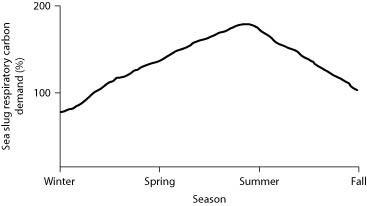 The sea slug Pteraeolidia ianthina (P. ianthina) can harbor living dinoflagellates (photosynthetic protists) in its skin. These endosymbiotic dinoflagellates reproduce quickly enough to maintain their populations. Low populations of the dinoflagellates do not affect the sea slugs very much, but high populations (> 5 x 10⁵ cells/mg of sea slug protein) can promote sea slug survival. Percent of sea slug respiratory carbon demand provided by indwelling dinoflagellates. If we assume that carbon is the sole nutrient needed by sea slugs to drive their cellular respiration, then based on the graph, during which season(s) is it least necessary for P. ianthina to act as a chemoheterotroph? A) winter B) spring C) summer D) fall | back 39 C) summer |
front 40 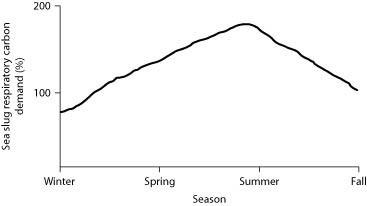 The sea slug Pteraeolidia ianthina (P. ianthina) can harbor living dinoflagellates (photosynthetic protists) in its skin. These endosymbiotic dinoflagellates reproduce quickly enough to maintain their populations. Low populations of the dinoflagellates do not affect the sea slugs very much, but high populations (> 5 x 10⁵ cells/mg of sea slug protein) can promote sea slug survival. Percent of sea slug respiratory carbon demand provided by indwelling dinoflagellates. Which of the following would be a potential disadvantage to the sea slugs of housing the dinoflagellates? A) The CO2produced by the dinoflagellates would poison the sea slug. B) The dinoflagellates would be an energy drain on the sea slug. C) The sea slugs are exposed to predators when they spend time in the sunlit areas needed by the dinoflagellates. D) The dinoflagellates will reduce the ability of the sea slugs to move. | back 40 C) The sea slugs are exposed to predators when they spend time in the sunlit areas needed by the dinoflagellates. |
front 41 Use of synthetic fertilizers often leads to the contamination of groundwater with nitrates. Nitrate pollution is also a suspected cause of anoxic "dead zones" in the ocean. Which of the following might help reduce nitrate pollution? A) growing improved crop plants that have nitrogen-fixing enzymes B) adding nitrifying bacteria to the soil C) adding denitrifying bacteria to the soil D) using ammonia instead of nitrate as a fertilizer | back 41 A) growing improved crop plants that have nitrogen-fixing enzymes |
front 42 Biologists sometimes divide living organisms into two groups: autotrophs and heterotrophs. These two groups differ in ________. A) their sources of carbon B) their electron acceptors C) their mode of inheritance D) the way that they generate ATP | back 42 A) their sources of carbon |
front 43 Data were collected from the heterocysts of a nitrogen-fixing cyanobacterium inhabiting equatorial ponds. Study the graph and choose the most likely explanation for the shape of the curve. A) Enough oxygen (O2) enters heterocysts during hours of peak photosynthesis to have a somewhat inhibitory effect on nitrogen fixation. B) Atmospheric nitrogen (N2) levels increase at night because plants are no longer metabolizing this gas, so they are not absorbing this gas through their stomata. C) Heterocyst walls become less permeable to nitrogen (N2) influx during darkness. D) The amount of fixed nitrogen that is dissolved in the pond water in which the cyanobacteria are growing peaks at the close of the photosynthetic day (1800 hours). | back 43 A) Enough oxygen (O2) enters heterocysts during hours of peak photosynthesis to have a somewhat inhibitory effect on nitrogen fixation. |
front 44 A hypothetical bacterium swims among human intestinal contents until it finds a suitable location on the intestinal lining. It adheres to the intestinal lining using a feature that also protects it from phagocytes, bacteriophages, and dehydration. Fecal matter from a human in whose intestine this bacterium lives can spread the bacterium, even after being mixed with water and boiled. The bacterium is not susceptible to the penicillin family of antibiotics. It contains no plasmids and relatively little peptidoglycan. This bacterium derives nutrition by digesting human intestinal contents. Thus, this bacterium is an ________. A) aerobic chemoheterotroph B) aerobic chemoautotroph C) anaerobic chemoheterotroph D) anaerobic chemoautotroph | back 44 C) anaerobic chemoheterotroph |
front 45 Nitrogenase, the enzyme that catalyzes nitrogen fixation, is inhibited whenever free oxygen (O2) reaches a critical concentration. Consequently, nitrogen fixation cannot occur in cells wherein photosynthesis produces free O2. Consider the colonial aquatic cyanobacterium, Anabaena, whose heterocysts are described as having "...a thickened cell wall that restricts entry of O2 produced by neighboring cells. Intercellular connections allow heterocysts to transport fixed nitrogen to neighboring cells in exchange for carbohydrates." Given that the enzymes that catalyze nitrogen fixation are inhibited by oxygen, what mechanism might nitrogen-fixing prokaryotes use to protect these enzymes from oxygen? A) couple the nitrogen fixation enzymes with photosystem II (the photosystem that splits water) B) package the nitrogen fixation enzymes in membranes that are impermeable to all gases C) live only in anaerobic environments D) package the nitrogen fixation enzymes in membranes that are impermeable to nitrogen gas (N2). | back 45 C) live only in anaerobic environments |
front 46 Nitrogenase, the enzyme that catalyzes nitrogen fixation, is inhibited whenever free oxygen (O2) reaches a critical concentration. Consequently, nitrogen fixation cannot occur in cells wherein photosynthesis produces free O2. Consider the colonial aquatic cyanobacterium, Anabaena, whose heterocysts are described as having "...a thickened cell wall that restricts entry of O2 produced by neighboring cells. Intercellular connections allow heterocysts to transport fixed nitrogen to neighboring cells in exchange for carbohydrates." Think about this description of the colonial aquatic cyanobacterium, Anabaena. Which of the following questions below is important for understanding how nitrogen (N2) enters heterocysts, and how oxygen (O2) is kept out of heterocysts? A) If carbohydrates can enter the heterocysts from neighboring cells via the "intercellular connections," how is it that O2doesn't also enter via this route? B) If the cell walls of Anabaena photosynthetic cells are permeable to O2and carbon dioxide (CO2), are they also permeable to N2? C) If the nuclei of the photosynthetic cells contain the genes that code for nitrogen fixation, how can these cells fail to perform nitrogen fixation? D) If the nuclei of the heterocysts contain the genes that code for photosynthesis, how can these cells fail to perform photosynthesis? | back 46 A) If carbohydrates can enter the heterocysts from neighboring cells via the "intercellular connections," how is it that O2 doesn't also enter via this route? |
front 47 Which two species might be expected to cooperate metabolically, perhaps forming a biofilm wherein one species surrounds cells of the other species? A) species A and B B) species A and C C) species B and E D) species C and D | back 47 A) species A and B |
front 48 If plaque on teeth is actually a biofilm, which of the following characteristics would you expect to find in plaque? A) multiple species of bacteria, production of chemicals that attract other bacteria, and production of chemicals that allow the bacteria to adhere to enamel B) single species of bacteria, production of antibiotics, and mechanisms in the biofilm that allow inner cells to expel wastes C) multiple species of bacteria, production of antibiotics, and mechanisms in the biofilm that allow inner cells to expel wastes D) single species of bacteria, production of chemicals that attract other bacteria, and production of chemicals that allow the bacteria to adhere to enamel | back 48 A) multiple species of bacteria, production of chemicals that attract other bacteria, and production of chemicals that allow the bacteria to adhere to enamel |
front 49 For several decades now, amphibian species worldwide have been in decline. A significant proportion of the decline seems to be due to the spread of the chytrid fungus, Batrachochytrium dendrobatidis (Bd). Chytrid sporangia reside within the epidermal cells of infected animals, animals that consequently show areas of sloughed skin. They can also be lethargic, which is expressed through failure to hide and failure to flee. The infection cycle typically takes four to five days, at the end of which zoospores are released from sporangia into the environment. In some amphibian species, mortality rates approach 100%; other species seem able to survive the infection. If infection primarily involves the outermost layers of adult amphibian skin, and if the chytrids use the skin as their sole source of nutrition, then which term best applies to the chytrids? A) anaerobic chemoautotroph B) aerobic chemoautotroph C) anaerobic chemoheterotroph D) aerobic chemoheterotroph | back 49 D) aerobic chemoheterotroph |
front 50 According to the endosymbiotic theory, why was it adaptive for the larger (host) cell to keep the engulfed cell alive, rather than digesting it as food? A) The engulfed cell provided the host cell with adenosine triphosphate (ATP). B) The engulfed cell provided the host cell with carbon dioxide. C) The engulfed cell allowed the host cell to metabolize glucose. D) The host cell was able to survive anaerobic conditions with the engulfed cell alive. | back 50 A) The engulfed cell provided the host cell with adenosine triphosphate (ATP). |
front 51 The chloroplasts of land plants are thought to have been derived according to which evolutionary sequence? A) cyanobacteria → green algae → land plants B) cyanobacteria → green algae → fungi → land plants C) red algae → brown algae → green algae → land plants D) cyanobacteria → red algae → green algae → land plants | back 51 A) cyanobacteria → green algae → land plants |
front 52 A particular species of protist has obtained a chloroplast via secondary endosymbiosis. You know this because the chloroplasts ________. A) have nuclear and cyanobacterial genes B) are exceptionally small C) have three or four membranes D) have only a single pigment | back 52 C) have three or four membranes |
front 53 All protists are ________. A) unicellular B) eukaryotic C) symbionts D) mixotrophic | back 53 B) eukaryotic |
front 54 An individual mixotroph loses its plastids, yet continues to survive. Which of the following most likely accounts for its continued survival? A) It relies on photosystems that float freely in its cytosol. B) It must have gained extra mitochondria when it lost its plastids. C) It engulfs organic material by phagocytosis or by absorption. D) It has an endospore. | back 54 C) It engulfs organic material by phagocytosis or by absorption. |
front 55 Which of the following have chloroplasts (or structures since evolved from chloroplasts) thought to be derived from ancestral green algae? A) stramenopiles B) apicomplexans C) dinoflagellates D) chlorarachniophytes | back 55 D) chlorarachniophytes |
front 56 Paulinella chromatophora is one of the few cercozoans that is autotrophic, carrying out aerobic photosynthesis with its two elongated "chromatophores." The chromatophores are contained within vesicles of the host cell, and each is derived from a cyanobacterium, though not the same type of cyanobacterium that gave rise to the chloroplasts of algae and plants. The closest living relative of P. chromatophora is the heterotroph P. ovalis. P. ovalis uses threadlike pseudopods to capture its prey, which it digests internally. Which of the following, if observed, would be the best reason for relabeling P. chromatophora as a mixotroph instead of an autotroph? A) a pigmented central vacuole, surrounded by a nucleomorph B) a vacuole with food inside C) a secretory vesicle D) a contractile vacuole | back 56 B) a vacuole with food inside |
front 57 Paulinella chromatophora is one of the few cercozoans that is autotrophic, carrying out aerobic photosynthesis with its two elongated "chromatophores." The chromatophores are contained within vesicles of the host cell, and each is derived from a cyanobacterium, though not the same type of cyanobacterium that gave rise to the chloroplasts of algae and plants. Which process could have allowed the nucleomorphs of chlorarachniophytes to be reduced, without the net loss of any genetic information? A) conjugation B) horizontal gene transfer C) phagocytosis D) meiosis | back 57 B) horizontal gene transfer |
front 58 According to the fossil record, plants colonized terrestrial habitats ________. A) in conjunction with insects that pollinated them B) in conjunction with fungi that helped provide them with nutrients from the soil C) to escape abundant herbivores in the oceans D) only about 150 million years ago | back 58 B) in conjunction with fungi that helped provide them with nutrients from the soil |
front 59 The most direct ancestors of land plants were probably ________. A) kelp (brown alga) that formed large beds near the shorelines B) green algae C) photosynthesizing prokaryotes (cyanobacteria) D) liverworts and mosses | back 59 B) green algae |
front 60 About 450 million years ago, the terrestrial landscape on Earth would have ________. A) looked very similar to that of today, with flowers, grasses, shrubs, and trees B) been completely bare rock, with little pools that contained cyanobacteria and protists C) been covered with tall forests in swamps that would become today's coal D) had non-vascular, green plants similar to liverworts forming green mats on rock | back 60 D) had non-vascular, green plants similar to liverworts forming green mats on rock |
front 61 What evidence do paleobotanists look for that indicates the movement of plants from water to land? A) waxy cuticle to decrease evaporation from leaves B) loss of structures that produce spores C) sporopollenin to inhibit evaporation from leaves D) remnants of chloroplasts from photosynthesizing cells | back 61 A) waxy cuticle to decrease evaporation from leaves |
front 62 Which of these events, based on plant fossils, came last (most recently)? A) extensive growth of gymnosperm forests B) colonization of land by early liverworts and mosses C) rise and diversification of angiosperms D) carboniferous swamps with giant horsetails and lycophytes | back 62 C) rise and diversification of angiosperms |
front 63 Why have biologists hypothesized that the first land plants had a low, sprawling growth habit? A) They were tied to the water for reproduction, thus needing to remain in close contact with the moist soil. B) The ancestors of land plants, green algae, lacked the structural support to stand erect in air. C) Land animals of that period were small and could not pollinate tall plants. D) There was less competition for space, so they simply spread out flat. | back 63 B) The ancestors of land plants, green algae, lacked the structural support to stand erect in air. |
front 64 Spores and seeds have basically the same function—dispersal—but are vastly different because spores ________. A) have a protective outer covering; seeds do not B) have an embryo; seeds do not C) have stored nutrition; seeds do not D) are unicellular; seeds are not | back 64 D) are unicellular; seeds are not |
front 65 You find a green organism in a pond near your house and believe it is a plant, not an alga. The mystery organism is most likely a plant and not an alga if it ________. A) contains chloroplasts B) is surrounded by a cuticle C) does not contain vascular tissue D) has cell walls that are comprised largely of cellulose | back 65 B) is surrounded by a cuticle |
front 66 Retaining the zygote on the living gametophyte of land plants ________. A) protects the zygote from herbivores B) evolved concurrently with pollen C) helps in dispersal of the zygote D) allows it to be nourished by the parent plant | back 66 D) allows it to be nourished by the parent plant |
front 67 The structural integrity of bacteria is to peptidoglycan as the structural integrity of plant spores is to ________. A) lignin B) cellulose C) secondary compounds D) sporopollenin | back 67 D) sporopollenin |
front 68 According to our current knowledge of plant evolution, which group of organisms should feature cell division most similar to that of land plants? A) some unicellular green algae B) some cyanobacteria C) some charophytes D) some red algae | back 68 C) some charophytes |
front 69 Which taxon is essentially equivalent to the "embryophytes"? A) Plantae B) Pterophyta C) Bryophyta D) Charophycea | back 69 A) Plantae |
front 70 If the kingdom Plantae is someday expanded to include the charophytes (stoneworts), then the shared derived characteristics of the kingdom will include ________. A) rings of cellulose-synthesizing complexes and ability to synthesize sporopollenin B) rings of cellulose-synthesizing complexes, chlorophylls a and b, and alternation of generations C) rings of cellulose-synthesizing complexes, alternation of generations, and ability to synthesize sporopollenin D) rings of cellulose-synthesizing complexes, chlorophylls a and b, cell walls of cellulose, and ability to synthesize sporopollenin | back 70 A) rings of cellulose-synthesizing complexes and ability to synthesize sporopollenin |
front 71 Which of the following environmental factors probably helped early plants to successfully colonize land? A) a decreased availability of CO2 B) relatively few competitors for light C) an increased availability of symbiotic partners D) air's relative lack of support, compared to water's support | back 71 C) an increased availability of symbiotic partners |
front 72 A student encounters a pondweed that appears to be a charophyte. Which of the following features would help the student determine whether the sample comes from a charophyte or from some other type of green alga? A) molecular structure of enzymes inside the chloroplasts and presence of phragmoplasts B) molecular structure of enzymes inside the chloroplasts and rings of cellulose-synthesizing complexes C) structure of sperm cells and presence of phragmoplasts D) structure of sperm cells, presence of phragmoplasts, and rings of cellulose-synthesizing complexes | back 72 D) structure of sperm cells, presence of phragmoplasts, and rings of cellulose-synthesizing complexes |
front 73 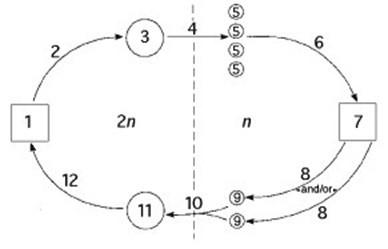 The following question refers to the generalized life cycle for land plants shown in the figure. Each number within a circle or square represents a specific plant or plant part, and each number over an arrow represents meiosis, mitosis, or fertilization. In the figure, which number represents the mature gametophyte? A) 1 B) 3 C) 7 D) 11 | back 73 C) 7 |
front 74 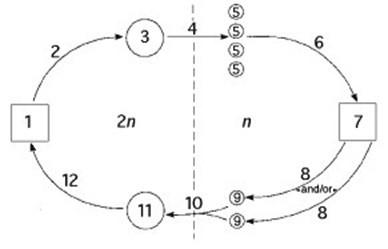 The following question refers to the generalized life cycle for land plants shown in the figure. Each number within a circle or square represents a specific plant or plant part, and each number over an arrow represents meiosis, mitosis, or fertilization. In the figure, which number represents an embryo? A) 1 B) 3 C) 7 D) 11 | back 74 D) 11 |
front 75 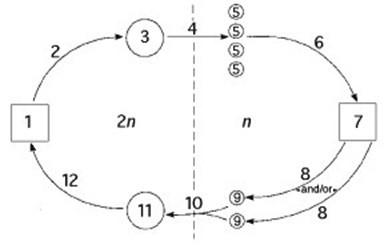 The following question refers to the generalized life cycle for land plants shown in the figure. Each number within a circle or square represents a specific plant or plant part, and each number over an arrow represents meiosis, mitosis, or fertilization. In the figure, meiosis is most likely to be represented by which number(s)? A) 2 B) 4 C) 2 and 8 D) 10 and 12 | back 75 B) 4 |
front 76 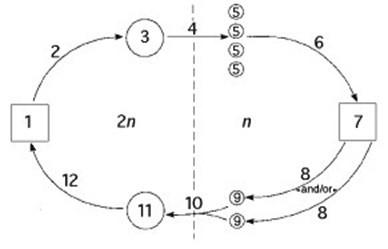 The following question refers to the generalized life cycle for land plants shown in the figure. Each number within a circle or square represents a specific plant or plant part, and each number over an arrow represents meiosis, mitosis, or fertilization. Which number represents a megaspore mother cell in the figure? A) 1 B) 3 C) 5 D) 7 | back 76 B) 3 |
front 77 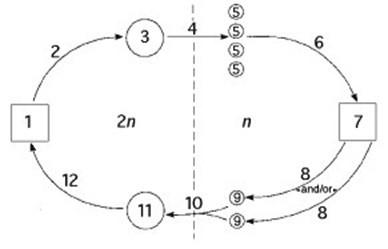 The following question refers to the generalized life cycle for land plants shown in the figure. Each number within a circle or square represents a specific plant or plant part, and each number over an arrow represents meiosis, mitosis, or fertilization. In the figure, the process labeled "6" involves ________. A) mitosis B) meiosis C) fertilization D) binary fission | back 77 A) mitosis |
front 78 The fact that both charophytes and green plants contain chlorophylls a and b demonstrates which of the following? A) These derived traits show that green plants evolved from ancient charophytes. B) These shared traits show that green plants evolved from present-day charophytes. C) The common ancestor of these two groups contained chlorophylls a and b. D) These two groups are not closely related. | back 78 C) The common ancestor of these two groups contained chlorophylls a and b. |
front 79 Which of the following statements about the transition from ocean to land by plants is most likely to be accurate? A) The transition to land occurred within a few generations. B) The transition to land was likely gradual, with plants evolving traits that let them survive ever-drier conditions. C) Rising sea levels favored individuals that were able to survive ever-drier conditions. D) The high light levels of terrestrial systems favored individuals that contained flexible photosynthetic enzyme systems. | back 79 B) The transition to land was likely gradual, with plants evolving traits that let them survive ever-drier conditions. |
front 80 Which of the following statements about the zygotes of plants is most likely to be accurate? A) Protection of the zygote from the drying effects of air was important. B) Protection of the zygote from competitors for light was more important in air than in water. C) Zygotes in plants are more independent of parental tissue than are algal zygotes. D) Zygotes in plants are more likely to germinate quickly after release from the parent plant than are zygotes released from algal organisms. | back 80 A) Protection of the zygote from the drying effects of air was important. |
front 81 If animals had alternation of generations like plants, ________. A) they would have twice as rapid a population growth rate as compared to their current rates B) the products of mitosis would undergo meiosis C) the products of meiosis would immediately fuse to form a zygote and then undergo mitosis D) the products of meiosis would undergo mitosis and become multicellular | back 81 D) the products of meiosis would undergo mitosis and become multicellular |
front 82 Apical meristems ________. A) occur only in shoots of plants B) occur only in roots of plants C) occur in both roots and shoots of plants D) allow plants to move from one place to another | back 82 C) occur in both roots and shoots of plants |
front 83 Which of the following statements about stomata is accurate? A) Stomata are not important in algae because they do not need CO2. B) Stomata, when closed, allow CO2to diffuse into plants. C) Stomata are important in terrestrial plants because they allow the roots to absorb water and nutrients from the soil. D) Stomata are important in terrestrial plants because they allow CO2to diffuse into the plant. | back 83 D) Stomata are important in terrestrial plants because they allow CO2to diffuse into the plant. |
front 84 The presence of vascular tissue allowed plants to ________. A) absorb nutrients from the soil and form a symbiosis with fungi B) transport nutrients and water from below-ground tissues to above-ground tissues and grow taller C) transport nutrients and water from below-ground tissues and use them to protect developing embryos D) release toxins into the soil that reduced competition with other plants by poisoning nearby plants | back 84 B) transport nutrients and water from below-ground tissues to above-ground tissues and grow taller |
front 85 Bryophytes (non-vascular plants) ________. A) are more similar to ancestral green algae than are vascular plants B) are more similar to ancestral red algae than are vascular plants C) can be included in the grade monilophyte because they do not have a complex vascular system D) are evolutionarily more advanced than seed plants | back 85 A) are more similar to ancestral green algae than are vascular plants |
front 86 Grades, as opposed to clades, ________. A) indicate degrees of evolutionary relatedness B) show relatedness among living organisms C) are almost always monophyletic D) represent groups with similar traits | back 86 D) represent groups with similar traits |
front 87 Stomata ________. A) occur in all land plants and define them as a monophyletic group B) open to allow gas exchange and close to decrease water loss C) occur in all land plants and are the same as pores D) open to increase both water absorption and gas exchange | back 87 B) open to allow gas exchange and close to decrease water loss |