Instructions for Side by Side Printing
- Print the notecards
- Fold each page in half along the solid vertical line
- Cut out the notecards by cutting along each horizontal dotted line
- Optional: Glue, tape or staple the ends of each notecard together
Ch 2-5 test 1
front 1 What makes each element unique and different from other elements | back 1 Unique number of protons |
front 2 What is the significance of atomic number atomic mass? | back 2 Atomic number tells us the amount of protons in an atom atomic mass tells us how many neutrons by subtracting the amount of protons electrons can be found in the electron cloud. 1-2 On periodic table: electrons. 13-18 find by subtracting 10 |
front 3 What are isotopes | back 3 Variants of a particular element different # of neutrons same # of protons |
front 4 Atoms octet | back 4 If there are a certain number of electrons in an electron cloud you can either add or give away electrons to complete a perfect octet through sharing of electrons between elements |
front 5 What are the max number of bonds specific elements can make? | back 5 Single H-H. Double bond= 2 pairs of electrons double O= O. Triple bond= 3 pairs of electrons triple N=_N |
front 6 Define electro negativity | back 6 Level of charge given from one atom to attract another. Book Def: the attraction of a particular atom for the electrons of a covalent bond |
front 7 How can electronegativity effect covalently bonded molecules | back 7 It takes partially greater charges from either positive and negatively bonded atoms and while shared equally, electrons will stay closer to the more electronegative charge |
front 8 What happens if the electronegativity is equal | back 8 There is a standoff of tug of war and a non polar covalent bid is formed |
front 9 What is the difference between ionic and covalent bonds? | back 9 Ionic bonds= electrons are not shared equally covalent bonds= electrons are shared equally |
front 10 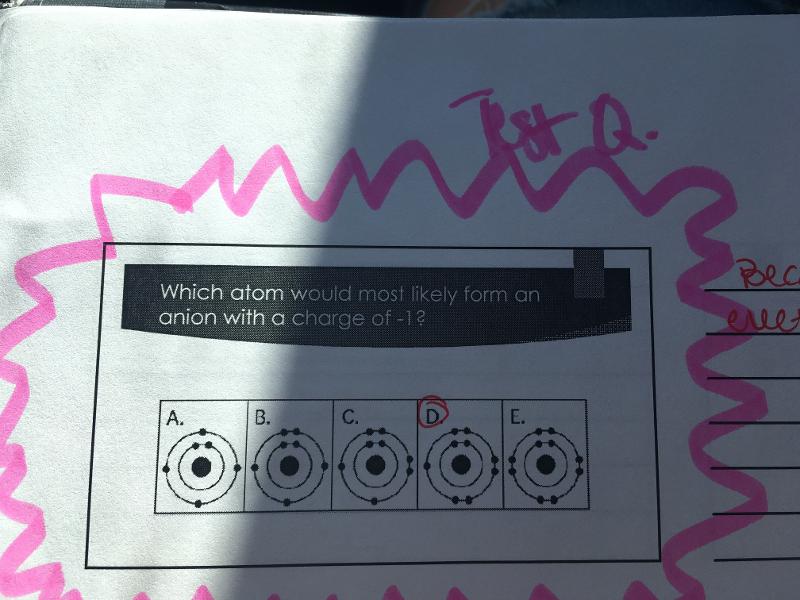 | back 10 Because it will gain one electron |
front 11 Structure of water - hydrogen bond, polar covalent bond, explain in detail partial negative charge of water molecule and why it occurs in terms of electronegativity and electrons | back 11 Positive H in one H2O molecule attracts to negative O in another. Polar covalent bond = partially negative/positive binding in a covalent bond and the electrons stay closer to the more electronegative side |
front 12 Importance of hydrogen bonding to the properties of water | back 12 Hydrogen bonds form the basic structure of water for other bondings such as polar covalent to occur |
front 13 Why do carbon atoms form diverse molecules | back 13 Carbon has 4 valence electrons do it can share electrons with other diverse molecules |
front 14 Hydrophobic molecules and how they interact with water | back 14 Hydrophobic doesn’t dissolve in water. It is no polar and does not have an attraction to water |
front 15 Interpret a PH scale | back 15 1-6 Acid 7 neutral 8-14 basic |
front 16 The importance of buffers in biological systems, how do they balance PH? | back 16 They maintain a relative constant PH when either acids or bases are added to them |
front 17 The role of dehydration reaction in organic compounds and hydrolysis in digestion of organic compounds | back 17 Dehydratiom reaction: assembles polymers releasing H2O Hydrolysis: breaks down polymers consuming H2O |
front 18 The four macromolecules and bonds that are formed durning the dehydration reaction | back 18 Carbohydrates: glycoscidic linkage Lipid: ester linkage nucleic acid: phosphodiester linkage protein: peptide bond |
front 19 Classify monosaccharides, disaccharides, and polysaccharides | back 19 Monosaccharid: monomer of carbohydrate ex: lactose glucose Disaccharide: two monosaccharides ex: sucrose polysaccharid: polymers ex: plants -store glucose as starch, animals -glycogen, cell structure in plants -cellulose |
front 20 The difference between starch and cellulose and how it impacts digestion | back 20 Starch: stores energy in plants. Plants and animals can digest cellulose: structural component in plants. CANNOT be digested by animals on account of beta glucose linkage |
front 21 What’s the difference between saturated and unsaturated fats | back 21 Unsaturated: liquid, at least on double bond saturated: solidify, contains more hydrogen,only single bonds, contributes to atherosclerosis (heart disease) |
front 22 What is the first structural level of protein? How can it change the activity of the protein | back 22 Primary: A mess up will ruin all other structures. It dictates secondary and tertiary structure. Linear chain of amino acids |
front 23 Second structural level of protein | back 23 Secondary: hydrogen bonds between an amino group of one peptide bond and the carbonyl group of another peptide bond |
front 24 Third structural level of proteins | back 24 Tertiary: interaction between r groups. Disulfide bridge, ionic bond, hydrogen bond between at least one r group |
front 25 Fourth structural level of proteins | back 25 Quaternary: two or more polypeptide chains into one large protein |
front 26 What makes each amino group different from one another? | back 26 Each has a different R group |
front 27 Name the bonds that are formed in primary and secondary structures of proteins | back 27 Primary: peptide secondary: hydrogen |
front 28 Identify the peptide bond if given a polypeptide: | back 28 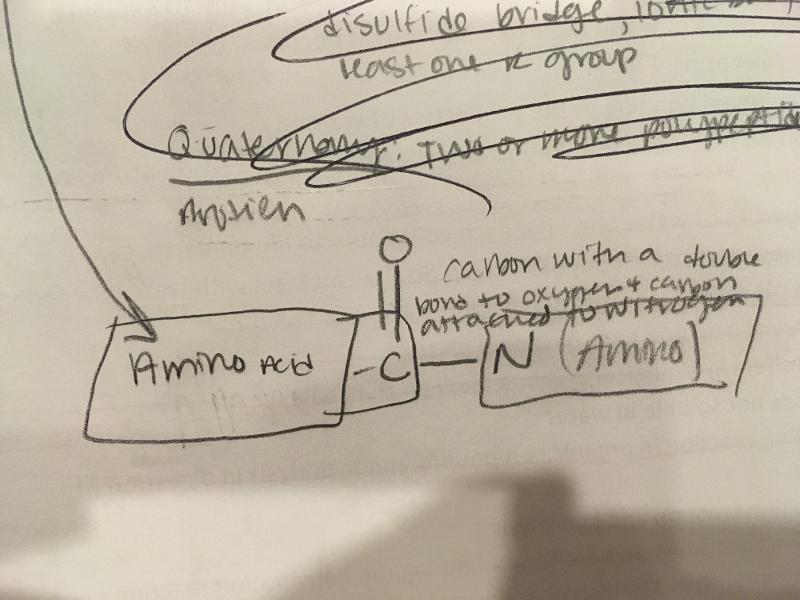 Carbon with a double bond to an oxygen single bonded to carbon attached to Nitrogen |
front 29 What maintains structure of a protein | back 29 Hydrogen bonds |
front 30 What is chaperonin | back 30 They help fold proteins within cells in the last structural level of proteins |
front 31 Base pairing rules of DNA | back 31 A=T C=G |
front 32 Steroid structure | back 32 4 carbonn fused rings |
front 33 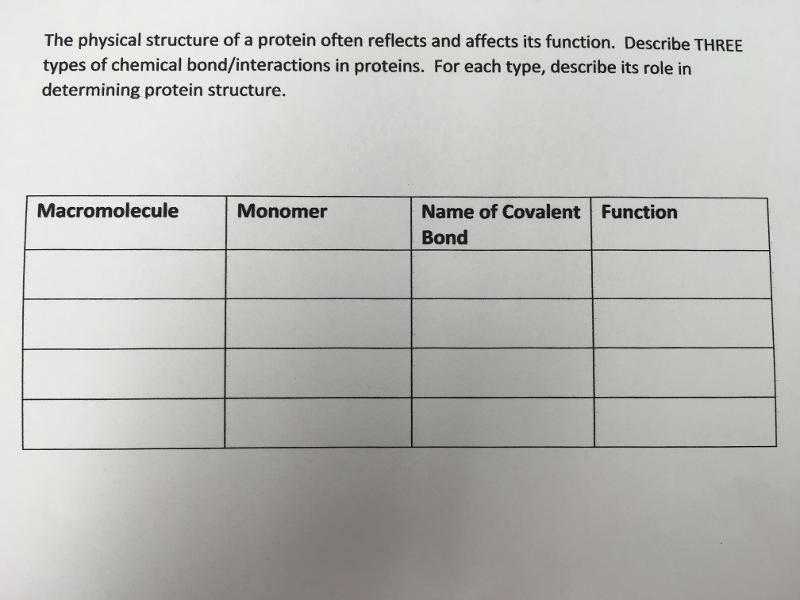 | back 33 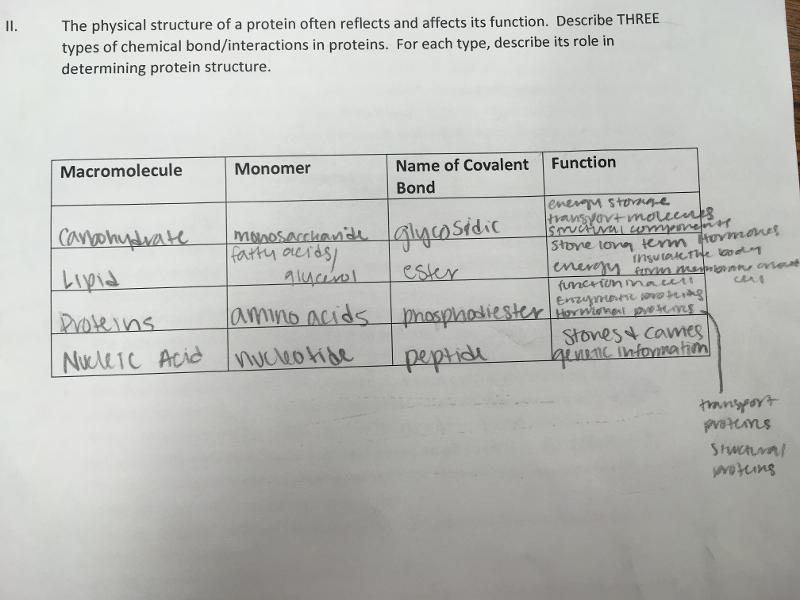 |
front 34 Hydrocarbons are not soluble in water because | back 34 The C—H bond is nonpolar |
front 35 What molecul a form a triacylglycerol/fat know and recognize the structure | back 35 G l. Fatty acid 1 y c e. Fatty acid 2 r o L. Fatty acid 3 |
front 36 Bond between nucleotide to make nuclei acids - reaction forms it, type of bond | back 36 Phosphodiester covalent bond to form backbone from 5’ carbon and 3’ carbon |
front 37 Recognize the the four biologically important organic compounds | back 37 Carbon Hydrogen Oxygen Nitrogen |
front 38 How do proteins reach their final shape | back 38 They go through all four phases and complete by using chaperonins |