front 1 1) Which of the following statements is consistent with the principle
of competitive exclusion?
- A) Bird species generally do not compete for nesting
sites.
- B) The random distribution of one competing species
will have a positive impact on the population growth of the other
competing species.
- C) Two species with the same fundamental
niche will exclude all other competing species.
- D) Even a
slight reproductive advantage will eventually lead to the
elimination of the less well adapted of two competing species.
- E) Natural selection tends to increase competition between
related species.
| back 1 - D) Even a slight reproductive advantage will eventually lead to
the elimination of the less well adapted of two competing
species.
|
front 2 2) According to the competitive exclusion principle, two species
cannot continue to occupy the same
- A) habitat.
- B) niche.
- C) territory.
- D) range.
- E) biome.
| |
front 3 3) Which of the following best describes resource partitioning?
- A) competitive exclusion that results in the success of the
superior species
- B) slight variations in a species' niche
that allow similar species to coexist
- C) two species that
can coevolve to share identical niches
- D) differential
resource utilization that results in a decrease in community species
diversity
- E) a climax community that is reached when no new
niches are available
| back 3 - B) slight variations in a species' niche that allow similar
species to coexist
|
front 4 4) As you study two closely related predatory insect species, the
two-spot and the three-spot
avenger beetles, you notice that each species seeks prey at dawn
in areas without the other species. However, where their ranges
overlap, the two-spot avenger beetle hunts at night and the
three-spot hunts in the morning. When you bring them into the
laboratory and isolate the two different species, you discover that
the offspring of both species are nocturnal. You have discovered an
example of
- A) mutualism.
- B) Batesian mimicry.
- C)
commensalism.
- D) resource partitioning.
| back 4 - D) resource partitioning.
|
front 5 5) Resource partitioning would be most likely to occur between
- A) sympatric populations of a predator and its prey.
- B) sympatric populations of species with similar ecological
niches.
- C) sympatric populations of a flowering plant and its
specialized insect pollinator.
- D) allopatric populations of
the same animal species.
- E) allopatric populations of
species with similar ecological niches.
| back 5 - B) sympatric populations of species with similar ecological
niches.
|
front 6 6) Which of the following is an example of cryptic coloration?
- A) highly contrasting bands on a coral snake
- B)
brown or gray color of tree bark
- C) bright markings of a
viceroy butterfly's wings
- D) orange or yellow colors of an
insect-pollinated flower's petals
- E) a walking stick, which
is an insect that resembles a twig
| back 6 - E) a walking stick, which is an insect that resembles a
twig
|
front 7 7) Which of the following is an example of Batesian mimicry?
- A) an insect that resembles a twig
- B) a butterfly
that resembles a leaf
- C) a nonvenomous snake that looks
like a venomous snake
- D) a fawn with fur coloring that
camouflages it in the forest environment
- E) a snapping
turtle that uses its tongue to mimic a worm, thus attracting
fish
| back 7 - C) a nonvenomous snake that looks like a venomous snake
|
front 8 8) Which of the following is an example of aposematic coloration?
- A) the brightly colored patterns of poison dart frogs
- B) eye color in humans
- C) green color of a plant
- D) colors of an insect-pollinated flower
- E) a katydid
whose wings look like a dead leaf
| back 8 - A) the brightly colored patterns of poison dart frogs
|
front 9 9) Dwarf mistletoes are flowering plants that grow on certain forest
trees. They obtain nutrients and water from the vascular tissues of
the trees. The trees derive no known benefits from the dwarf
mistletoes and can be harmed if nutrients and water are scarce in the
environment. Which of the following best describes the interactions
between dwarf mistletoes and trees?
- A) mutualism
- B) parasitism
- C)
commensalism
- D) facilitation
E) competition | |
front 10 10) Evidence shows that some grasses benefit from being grazed. Which
of the following terms would best describe this plant-herbivore interaction?
- A) mutualism
- B) commensalism
- C)
parasitism
- D) competition
- E) predation
| |
front 11 11) White-breasted nuthatches and Downy woodpeckers both eat insects
that hide in the furrows of bark in hardwood trees. The Downy
woodpecker searches for insects by hunting from the bottom of the tree
trunk toward the top, whereas the white-breasted nuthatch searches
from the top of the trunk down. These hunting behaviors best
illustrate which of the following ecological concepts?
- A) competitive exclusion
- B) resource
partitioning
- C) character displacement
- D) keystone
species
- E) bottom-up and top-down hypotheses
| |
front 12 12) Which statement best describes the evolutionary significance of mutualism?
- A) Mutualism offers more biodiversity to a community.
- B) Individuals partaking in a mutualistic relationship are more
resistant to parasites.
- C) Interaction increases the
survival and reproductive rates of mutualistic species.
- D)
Mutualistic interaction lessens competition in communities where it
is present.
- E) Mutualistic relationships allow organisms to
synthesize and use energy more efficiently.
| back 12 - C) Interaction increases the survival and reproductive rates of
mutualistic species.
|
front 13 13) How might an ecologist test whether a species is occupying its
complete fundamental niche or only a portion of it?
- A) Study the temperature range and humidity requirements of
the species.
- B) Observe whether the niche size changes
after the addition of nutritional resources to the habitat.
- C) Observe whether the niche size changes after the introduction
of a similar non-native species.
- D) Measure the change in
reproductive success when the species is subjected to environmental
stress.
- E) Observe whether the species expands its range
after the removal of a competitor.
| back 13 - E) Observe whether the species expands its range after the
removal of a competitor.
|
front 14 14) Which of the following terms is used by ecologists to describe
the community interaction in which one organism makes the environment
more suitable for another organism?
- A) parasitism
- B) herbivory
- C)
inhibition
- D) facilitation
E) commensalism | |
front 15 15) How did Eugene Odum describe an ecological niche?
- A) the "address" of an organism
- B) an
entity that is synonymous with an organism's specific trophic
level
- C) an organism's "profession" in the
community
- D) the organism's role in recycling nutrients in
its habitat
- E) the interactions of the organism with other
members of the community
| back 15 - C) an organism's "profession" in the community
|
front 16 16) In a tide pool, 15 species of invertebrates were reduced to 8
after one species was removed. The species removed was likely a(n)
- A) pathogen.
- B) keystone species.
- C)
herbivore.
- D) resource partitioner.
- E) mutualistic
organism.
| |
front 17 17) Elephants are not the most dominant species in African
grasslands, yet they influence community structure. The grasslands
contain scattered woody plants, but they are kept in check by the
uprooting activities of the elephants. If the elephants are taken
away, the grasslands convert to forests or to shrublands. The newly
growing forests support fewer species than the previous grasslands.
Which of the following describes why elephants are the keystone
species in this scenario?
- A) Elephants exhibit a disproportionate influence on the
structure of the community relative to their abundance.
- B)
Grazing animals depend upon the elephants to convert forests to
grassland.
- C) Elephants prevent drought in African
grasslands.
- D) Elephants are the biggest herbivore in this
community.
- E) Elephants help other populations survive by
keeping out many of the large African predators.
| back 17 - A) Elephants exhibit a disproportionate influence on the
structure of the community relative to their abundance.
|
front 18 18) According to bottom-up and top-down control models of community
organization, which of the following expressions would imply that an
increase in the size of a carnivore (C) population would negatively
impact on its prey (P) population, but not vice versa?
- A) P ← C
- B) P → C
- C) C ↔ P
- D) P ←
C → P
- E) C ← P →
| |
front 19 19) Which of the following is a likely explanation for why invasive
species take over communities into which they have been introduced?
- A) Invasive species are less efficient than native species
in competing for the limited resources of the environment.
- B) Invasive species are not held in check by the predators and
agents of disease that have always been in place for native
species.
- C) Invasive species have a higher reproductive
potential than native species.
- D) Invasive species come
from geographically isolated regions, so when they are introduced
to regions where there is more competition, they thrive.
| back 19 - B) Invasive species are not held in check by the predators and
agents of disease that have always been in place for native
species.
|
front 20 20) Biomanipulation can best be described as
- A) removing many of the organisms at the next higher trophic
level so that the struggling trophic level below can recover.
- B) an example of how one would use the bottom-up model for
community restoration.
- C) adjusting the numbers of each of
the trophic levels back to the numbers that they were before human
disturbance.
- D) monitoring and adjusting the nutrient and
energy flow through a community with new technologies.
| back 20 - A) removing many of the organisms at the next higher trophic
level so that the struggling trophic level below can recover.
|
front 21 21) Imagine five forest communities, each with 100 individuals
distributed among four different tree species (W, X, Y, and Z). Which
forest community would be most diverse?
- A) 25W, 25X, 25Y, 25Z
- B) 40W, 30X, 20Y, 10Z
- C) 50W, 25X, 15Y, 10Z
- D) 70W, 10X, 10Y, 10Z
E) 100W, 0X, 0Y, 0Z | |
front 22 22) In a lake with three trophic levels (fish, zooplankton, algae),
how might an algal bloom be prevented?
- A) Remove the fish.
- B) Remove the zooplankton.
- C) Add nutrient fertilizers.
D) Add fish | |
front 23 23) The feeding relationships between species in a community is called
- A) biomass.
- B) trophic structure.
- C)
top-down control.
D) bottom-up control | |
front 24 24) According to the nonequilibrium model,
- A) community structure remains stable in the absence of
interspecific competition.
- B) communities are assemblages
of closely linked species that are irreparably changed by
disturbance.
- C) interspecific interactions induce changes in
community composition over time.
- D) communities are
constantly changing after being influenced by disturbances.
| back 24 - D) communities are constantly changing after being influenced
by disturbances.
|
front 25 25) In a particular case of secondary succession, three species of
wild grass invaded a field. A fourth species' seeds were also
dispersed to this field, but despite being adapted to the abiotic
conditions, this fourth species did not establish. A possible factor
in this secondary succession was
- A) equilibrium.
- B) facilitation.
- C)
immigration.
- D) inhibition.
- E) parasitism.
| |
front 26 26) What contributed to the 1988 Yellowstone National Park lodgepole
pine forest fires?
- A) overgrazing by elk
- B) drought
- C)
unextinguished campfires
- D) geysers
| |
front 27 27) Why do moderate levels of disturbance result in an increase in
community diversity?
- A) Habitats are opened up for less competitive species.
- B) Competitively dominant species infrequently exclude less
competitive species after a moderate disturbance.
- C) The
environmental conditions become optimal.
- D) The resulting
uniform habitat supports stability, which in turn supports
diversity.
- E) Less-competitive species evolve strategies to
compete with dominant species.
| back 27 - A) Habitats are opened up for less competitive species.
|
front 28 28) What are usually the first photosynthetic organisms to colonize
during primary succession?
- A) shrubs
- B) lichens
- C) trees
- D)
grasses
| |
front 29 29) During primary succession at Glacier Bay, what is the composition
of the oldest communities on well-drained slopes?
- A) primarily Dryas
- B) liverworts, mosses,
fireweed, scattered Dryas, and willows
- C) sphagnum
moss
- D) spruce and hemlock
- E) primarily alder
| |
front 30 30) Species richness increases
- A) as evapotranspiration decreases.
- B) as we travel
southward from the North Pole to the equator.
- C) on islands
as distance from the mainland increases.
- D) in communities
experiencing frequent disturbance events.
| back 30 - B) as we travel southward from the North Pole to the
equator.
|
front 31 31) There are more species in tropical areas than in places more
distant from the equator. This is probably a result of
- A) fewer predators.
- B) more intense annual solar
radiation.
- C) more frequent ecological disturbances.
- D) fewer agents of disease.
| back 31 - B) more intense annual solar radiation.
|
front 32 32) Why do tropical communities tend to have greater species
diversity than temperate or polar communities?
- A) They are less likely to be affected by human
disturbance.
- B) There are fewer parasites to negatively
affect the health of tropical communities.
- C) Tropical
communities are low in altitude, whereas temperate and polar
communities are high in altitude.
- D) Tropical communities
are generally older than temperate and polar communities.
- E) More competitive dominant species have evolved in temperate
and polar communities.
| back 32 - D) Tropical communities are generally older than temperate and
polar communities.
|
front 33 33) Which of the following is a correct statement about the
MacArthur/Wilson Island Equilibrium Model?
- A) The more species that inhabit an island, the lower the
extinction rate.
- B) As the number of species on an island
increases, the emigration rate decreases.
- C) Competitive
exclusion is less likely on an island that has large numbers of
species.
- D) Small islands receive few new immigrant
species.
- E) Islands closer to the mainland have higher
extinction rates.
| back 33 - D) Small islands receive few new immigrant species.
|
front 34 34) What is an evolutionary factor that influences the species
richness of a community?
- A) amount of sunlight
- B) amount of
precipitation
- C) speciation rate
- D) geographic
size
- E) distance to other communities
| |
front 35 35) Tuberculosis is an infectious disease of humans that is caused by
the bacteria Mycobacterium tuberculosis. Symptoms of a
tuberculosis infection can include fever and damage to the lungs. How
should the interaction between pathogens and their hosts be classified?
- A) mutualism
- B) commensalism
- C)
competition
- D) exploitation
| |
front 36 36) Which of the following best describes the consequences of
white-band disease in Caribbean coral reefs?
- A) Staghorn coral has been decimated by the pathogen, and
elkhorn coral has taken its place.
- B) Key habitat for
lobsters, snappers, and other reef fishes has improved.
- C)
Algal species take the place of the dead coral, and the fish
community is dominated by herbivores.
- D) Algal species take
over, and the overall reef diversity increases due to increases in
primary productivity.
- E) Other coral species take the place
of the affected staghorn and elkhorn species.
| back 36 - C) Algal species take the place of the dead coral, and the fish
community is dominated by herbivores.
|
front 37 37) Zoonotic disease
- A) is caused by suborganismal pathogens such as viruses,
viroids, and prions only.
- B) is caused by pathogens that
are transferred from other animals to humans by direct contact or by
means of a vector.
- C) can only be spread from animals to
humans through direct contact.
- D) can only be transferred
from animals to humans by means of an intermediate host.
- E)
is too specific to study at the community level, and studies of
zoonotic pathogens are relegated to organismal biology.
| back 37 - B) is caused by pathogens that are transferred from other
animals to humans by direct contact or by means of a vector.
|
front 38 38) Which of the following studies would shed light on the mechanism
of spread of H5N1 from Asia to North America?
- A) Perform cloacal or saliva smears of migrating waterfowl to
monitor whether any infected birds show up in Alaska.
- B)
Test fecal samples for H5N1 in Asian pet birds that live near
domestic poultry farms in Asia.
- C) Locate and destroy birds
infected with H5N1 in Asian open-air poultry markets.
- D)
Record the incidence of H5N1 in domestic poultry farms in Asia.
| back 38 - A) Perform cloacal or saliva smears of migrating waterfowl to
monitor whether any infected birds show up in Alaska.
|
front 39 39) Why is a pathogen generally more virulent in a new habitat?
- A) More pathogens tend to immigrate into newer habitats.
- B) Intermediate host species are more motile and transport
pathogens to new areas.
- C) Pathogens evolve more efficient
forms of reproduction in new environments.
- D) Hosts in new
environments have not had a chance to become resistant to the
pathogen through natural selection.
- E) New environments are
almost always smaller in area, so that transmission of pathogens is
easily accomplished between hosts.
| back 39 - D) Hosts in new environments have not had a chance to become
resistant to the pathogen through natural selection.
|
front 40 40) In terms of community ecology, why are pathogens often more
virulent now than before?
- A) More new pathogens have recently evolved.
- B) Host
organisms have become more susceptible because of weakened immune
systems.
- C) Human activities are transporting pathogens into
new habitats (or communities) at an unprecedented rate.
- D)
Medicines for treating pathogenic disease are in short supply.
- E) Sequencing of genes in pathogenic organisms is particularly
difficult.
| back 40 - C) Human activities are transporting pathogens into new
habitats (or communities) at an unprecedented rate.
|
front 41 41) The oak tree pathogen Phytophthora ramorum has migrated
800 km in 15 years. West Nile virus spread from New York State to 46
other states in 5 years. The difference in the rate of spread is
probably related to
- A) the lethality of each pathogen.
- B) the mobility
of their hosts.
- C) the fact that viruses are very
small.
- D) innate resistance.
- E) dormancy
viability.
| back 41 - B) the mobility of their hosts.
|
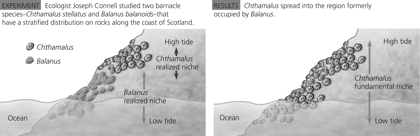
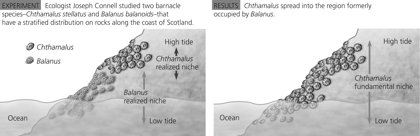
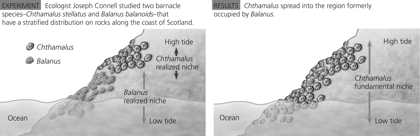
front 42 1) Which of the following statements is a valid conclusion of this experiment?
- A) Balanus can survive only in the lower intertidal
zone because it is unable to resist desiccation.
- B)
Balanus is inferior to Chthamalus in competing for
space on rocks lower in the intertidal zone.
- C) The two
species of barnacles do not compete with each other because they
feed at different times of day.
- D) The removal of
Balanus shows that the realized niche of Chthamalus
is smaller than its fundamental niche.
- E) These two
species of barnacle do not show competitive exclusion.
- F)
If Chthamalus were removed, Balanus's fundamental
niche would become larger.
| back 42 - D) The removal of Balanus shows that the realized
niche of Chthamalus is smaller than its fundamental
niche.
|
front 43 2) Connell conducted this experiment to learn more about
- A) character displacement in the color of barnacles.
- B) habitat preference in two different species of
barnacles.
- C) desiccation resistance and barnacle
species.
- D) how sea-level changes affect barnacle
distribution.
- E) competitive exclusion and distribution of
barnacle species.
| back 43 - E) competitive exclusion and distribution of barnacle
species.
|
front 44 3) Chthamalus and Balanus belong to the same
trophic level. Based on this information and their distributions in
the low tide zone in Connell's experiment, what is the best way to
represent the interaction between the two species?
- A) +/+
- B) -/+
- C) -/-
- D) +/0
| |
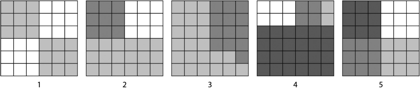
front 45 Examine Figure 41.2. According to the Shannon diversity index, which
block shows the greatest diversity?
- A) 1
- B) 2
- C) 3
- D) 4
- E)
5
| |
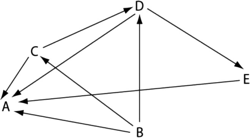
front 46 Examine the diagram of a hypothetical food web in Figure 41.3. The
arrows represent the transfer of energy between the various trophic
levels. Which letter represents an organism that could be a primary producer?
- A) A
- B) B
- C) C
- D) D
- E)
E
| |
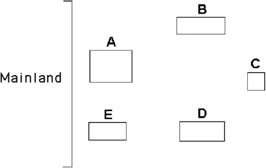
front 47 6) Which island would likely have the greatest species diversity?
- A) A
- B) B
- C) C
- D) D
- E)
E
| |
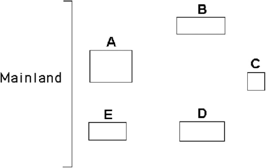
front 48 7) Which island would likely exhibit the most impoverished species diversity?
- A) A
- B) B
- C) C
- D) D
- E)
E
| |
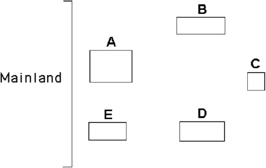
front 49 8) Which island would likely have the lowest extinction rate?
- A) A
- B) B
- C) C
- D) D
- E)
E
| |
front 50 The symbols +, -, and 0 are to be used to show the results of
interactions between individuals and groups of individuals in the
examples that follow. The symbol + denotes a positive interaction, -
denotes a negative interaction, and 0 denotes an interaction that has
no effect on the individuals involved. The first symbol refers to the
first organism mentioned.
1) What interactions exist between the cattle egret and grazing cattle?
- A) 0/-
- B) +/0
- C) +/-
- D) 0/0
- E) -/-
| |
front 51 2) What interactions exist between a lion pride and a hyena pack if
they utilize the same food sources?
- A) +/+
- B) +/0
- C) +/-
- D) 0/0
- E) -/-
| |
front 52 3) What interactions exist between a bee and a flower?
- A) +/+
- B) +/0
- C) +/-
- D) 0/0
- E) -/-
| |
front 53 4) What interactions exist between a tick on a dog and the dog?
- A) +/+
- B) +/0
- C) +/-
- D) 0/0
- E) -/-
| |
front 54 5) What interactions exist between cellulose-digesting organisms in
the gut of a termite and the termite?
- A) +/+
- B) +/0
- C) +/-
- D) 0/0
- E) -/-
| |
front 55 6) What interactions exist between mycorrhizae and evergreen tree roots?
- A) +/+
- B) +/0
- C) +/-
- D) 0/0
- E) -/-
| |
front 56 The effect of invasive species on the diversity of communities can be
large, and protecting native communities from the invasion of
non-native species is often a priority for conservation. You conduct
an experiment to study how the impact that invasive plant species have
on the diversity of plant communities varies as a function of distance
from the source of the invasive species. In this experiment, you
create five communities with equal numbers of three native plant
species at the beginning. Each of these communities is located at
increasing distances from a large patch of an invasive species. You
and your research assistant return 1 year later to measure the
relative abundance of each species. The results are shown in the table.
7) The biological hypothesis for your experiment is
based on the model of island biogeography. What is the independent
variable of your experiment?
7) The biological hypothesis for your experiment is based on the
model of island biogeography. What is the independent variable of your experiment?
- A) the plant communities
- B) the source patch of the
invasive species
- C) the distance from the source patch of
invasive species
- D) the relative abundance of the plant
species
- E) the length of time from the start to the end of
the experiment
| back 56 - C) the distance from the source patch of invasive species
|
front 57 1) The feeding relationships among the species in a community
determine the community's
- A) secondary succession.
- B) ecological niche.
- C) species richness.
- D) trophic structure.
| |
front 58 2) Based on the intermediate disturbance hypothesis, a community's
species diversity is increased by
- A) frequent massive disturbance.
- B) stable
conditions with no disturbance.
- C) moderate levels of
disturbance.
- D) human intervention to eliminate
disturbance.
| back 58 - C) moderate levels of disturbance.
|
front 59 3) Which of the following could qualify as a top-down control on a
grassland community?
- A) limitation of plant biomass by rainfall amount
- B)
influence of temperature on competition among plants
- C)
influence of soil nutrients on the abundance of grasses versus
wildflowers
- D) effect of grazing intensity by bison on plant
species diversity
| back 59 - D) effect of grazing intensity by bison on plant species
diversity
|