Instructions for Side by Side Printing
- Print the notecards
- Fold each page in half along the solid vertical line
- Cut out the notecards by cutting along each horizontal dotted line
- Optional: Glue, tape or staple the ends of each notecard together
Evolution
front 1 Which of the following is(are) homologous to the bones in this image? | back 1  |
front 2 The wing of a bat is homologous to the _____ of a whale. | back 2 flipper |
front 3 Which of the following statements about natural selection is true? | back 3 Natural selection favors individuals that reproduce more than others. |
front 4 Which term describes a trait that increases an individual's ability to survive in a particular environment? | back 4 Adaptation |
front 5 Which term describes the ability of a trait to be passed on to offspring? | back 5 Heritability |
front 6 Which of the following organisms could be produced by artificial selection? | back 6 A cow that produces a large quantity of milk. |
front 7 Which pair of chickens should a farmer breed to produce larger chickens? | back 7 Large hen, large rooster |
front 8 A farmer wishes to develop a strain of high-yield corn that is also
resistant to drought. He has the following individuals from the
current year's crop: | back 8 A and E |
front 9 Which of the following statements is an accurate combination of postulates 1 and 2 of natural selection? | back 9 Heritable variation exists for traits among individuals in a population. |
front 10 Which of the following statements is an accurate combination of postulates 3 and 4 of natural selection? | back 10 Individuals experience differential success in their ability to survive or reproduce due to differences in certain traits. |
front 11 Does the ability of a Mycobacterium tuberculosis cell to infect a new host depend on its drug-resistant phenotype? | back 11 No, drug-susceptible cells and drug-resistant cells are equally likely to infect a new host. |
front 12 Which of the following statements describes the evolution by natural selection of Mycobacterium tuberculosis bacteria in their new environment? | back 12 The drug-resistance trait is an adaptation to the environment in which human hosts are medicated with the antibiotic rifampin |
front 13 In the United States today, about half of the corn crop is genetically engineered with a protein that is toxic to corn borers, an insect pest of corn. Which of the following conditions would be necessary for evolution of resistance to the toxic protein to occur in the corn borer? | back 13 The corn borer must have or generate (by mutation) heritable variation in resistance to the toxic protein. The resistant corn borers must survive better or reproduce more than nonresistant corn borers. |
front 14 True or false? It would be difficult to assess whether the drug-susceptible or drug-resistant phenotype in a population of Mycobacterium tuberculosis was more fit in an environment without antibiotics. | back 14 True |
front 15 Different finch species have beaks of different shapes and sizes. What do these beak differences tell us? | back 15 Different finch beak shapes are evidence that finch species adapted to different environments over many generations. |
front 16 Genetic evidence supports which of the following explanations for the presence of 13 different finch species on the Galápagos islands? | back 16 Many years ago, a small population of a single finch species migrated to the islands and evolved into the current 13 species. |
front 17 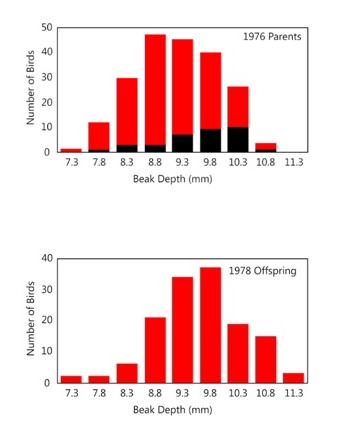 The top figure shows beak sizes of the 1976 finch population before the drought of 1977 (red bars) and after the drought (black bars). The lower figure shows the beak sizes of the offspring of the drought survivors in 1978. What do these figures tell us? | back 17 The overall beak depths of the 1978 offspring population are larger the original 1976 population. |
front 18 How did the Grants test their hypothesis that differences in birds’ songs can keep different species of finches from breeding with one another? | back 18 They played the songs of medium ground finches and cactus finches through a loudspeaker to see which species responded to each song. |
front 19 In which situation can just a few genes dramatically change an organism's entire appearance? | back 19 when the genes each control the expression of many other genes |