Print Options

Card layout: ?

← Back to notecard set|Easy Notecards home page

Instructions for Side by Side Printing
  1. Print the notecards
  2. Fold each page in half along the solid vertical line
  3. Cut out the notecards by cutting along each horizontal dotted line
  4. Optional: Glue, tape or staple the ends of each notecard together
  1. Verify Front of pages is selected for Viewing and print the front of the notecards
  2. Select Back of pages for Viewing and print the back of the notecards
    NOTE: Since the back of the pages are printed in reverse order (last page is printed first), keep the pages in the same order as they were after Step 1. Also, be sure to feed the pages in the same direction as you did in Step 1.
  3. Cut out the notecards by cutting along each horizontal and vertical dotted line
To print: Ctrl+PPrint as a list

110 notecards = 28 pages (4 cards per page)

Viewing:

bio 2

front 1

Which one of the following is an adaptation by plants to life on land?

  1. A) lack of waxy cuticle
  2. B) Calvin cycle of photosynthesis
  3. C) xylem tracheids and vessels
  4. D) Krebs cycle of respiration

back 1

C

front 2

Which of the following was an essential adaptive feature for the evolution of plants from water to the land?

  1. A) minimizing the evaporative loss of water
  2. B) using light more effectively
  3. C) acquiring CO2from the air
  4. D) acquiring water from the ground

back 2

A

front 3

Given that early land plants most likely share a common ancestor with green algae, the earliest land plants were most likely

  1. A) nonvascular plants that grew leafless photosynthetic shoots above the shallow fresh water in which they lived.
  2. B) species that did not exhibit alternation of generations.
  3. C) vascular plants with well-defined root systems.
  4. D) plants with well-developed leaves.

back 3

A

front 4

The architecture and distribution of the root system and production of proteins in plants are directly relevant to the availability ________ in soil.

  1. A) of carbon dioxide
  2. B) and richness of nitrates
  3. C) of fungal association
  4. D) of water

back 4

B

front 5

The symplast is the continuum of cytosol connected by

  1. A) extracellular spaces.
  2. B) apoplastic route.
  3. C) plasmodesmata.
  4. D) symplastic route.

back 5

C

front 6

Which of the following determines the direction of water movement across the membrane?

  1. A) cell health
  2. B) a difference in water potential
  3. C) size of the cell
  4. D) shape of the cell

back 6

B

front 7

Plants do not have a circulatory system like that of some animals. If a water molecule did "circulate" (that is, go from one point in a plant to another and back in the same day), it would require the activity of

  1. A) only the xylem.
  2. B) only the phloem.
  3. C) only the endodermis.
  4. D) both the xylem and the phloem.

back 7

D

front 8

Plasmodesmata can change in number, and when dilated can provide a passageway for

  1. A) macromolecules such as RNA and proteins.
  2. B) ribosomes.
  3. C) chloroplasts.
  4. D) mitochondria.

back 8

A

front 9

Typically, on average, what percentage of a plant's fresh biomass is water?

  1. A) 70-75
  2. B) 65-75
  3. C) 80-90
  4. D) 75-80

back 9

C

front 10

Which of the following would be least likely to affect osmosis in plants?

  1. A) proton pumps in the membrane
  2. B) a difference in solute concentrations
  3. C) receptor proteins in the membrane
  4. D) aquaporins

back 10

C

front 11

The movement of water across biological membranes can best be predicted by

  1. A) negative charges in the cell wall.
  2. B) prevailing weather conditions.
  3. C) aquaporins.
  4. D) water potentials.

back 11

D

front 12

An open beaker of pure water has a water potential (Ψ) of

  1. A) -0.23 MPa.
  2. B) +0.23 MPa.
  3. C) +0.07 MPa.
  4. D) 0.0 (zero).

back 12

D

front 13

) If ΨP = 0.3 MPa and ΨS = -0.45 MPa, the resulting Ψ is

  1. A) +0.75 MPa.
  2. B) -0.75 MPa.
  3. C) -0.15 MPa.
  4. D) +0.15 MPa.

back 13

C

front 14

The value for Ψ in root tissue was found to be -0.15 MPa. If you take the root tissue and place it in a 0.1 M solution of sucrose (Ψ = -0.23 MPa), the net water flow would

  1. A) be from the tissue into the sucrose solution.
  2. B) be from the sucrose solution into the tissue.
  3. C) be in both directions and the concentrations would remain equal.
  4. D) occur only as ATP was hydrolyzed in the tissue.

back 14

A

front 15

Compared to a cell with few aquaporins in its membrane, a cell containing many aquaporins will

  1. A) have a faster rate of osmosis.
  2. B) have a lower water potential.
  3. C) have a higher water potential.
  4. D) have a faster rate of active transport.

back 15

A

front 16

Water flows into the source end of a sieve tube because

  1. A) sucrose has diffused into the sieve tube, making it hypotonic.
  2. B) sucrose has been actively transported into the sieve tube, making it hypertonic.
  3. C) water pressure outside the sieve tube forces in water.
  4. D) the companion cell of a sieve tube actively pumps in water.

back 16

B

front 17

What is the role of proton pumps in root hair cells?

  1. A) establish ATP gradients
  2. B) maintain the H+gradient
  3. C) pressurize xylem transport
  4. D) eliminate excess electrons

back 17

B

front 18

One would expect to find the highest density of aquaporins in which of the following?

  1. A) the plasma membrane of guard cells
  2. B) the pits of a tracheid
  3. C) the plasma membrane of parenchyma cells in a ripe fruit
  4. D) the plasma membrane of a mature mesophyll cell in a leaf

back 18

A

front 19

If isolated plant cells with a water potential averaging -0.5 MPa are placed into a solution with a water potential of -0.3 MPa, which of the following would be the most likely outcome?

  1. A) The pressure potential of the cells would increase.
  2. B) Water would move out of the cells.
  3. C) The cell walls would rupture, killing the cells.
  4. D) Solutes would move out of the cells.

back 19

A

front 20

Guard cells do which of the following?

  1. A) protect the endodermis
  2. B) accumulate K+in order to close the stomata
  3. C) contain chloroplasts that import K+directly into the cells
  4. D) help balance the photosynthesis–transpiration compromise

back 20

D

front 21

Photosynthesis begins to decline when leaves wilt because

  1. A) chloroplasts within wilted leaves are incapable of photosynthesis.
  2. B) CO2accumulates in the leaves and inhibits the enzymes needed for photosynthesis.
  3. C) there is insufficient water for photolysis during the light reactions.
  4. D) stomata close, restricting CO2entry into the leaf.

back 21

D

front 22

The opening of stomata is thought to involve

  1. A) an increase in the solute concentration of the guard cells.
  2. B) a decrease in the solute concentration of the stoma.
  3. C) active transport of water out of the guard cells.
  4. D) decreased turgor pressure in the guard cells.

back 22

A

front 23

The following factors may sometimes play a role in the movement of sap through xylem. Which one depends on the direct expenditure of ATP by the plant?

  1. A) capillarity of water within the xylem
  2. B) evaporation of water from leaves
  3. C) cohesion among water molecules
  4. D) concentration of ions in the symplast

back 23

D

front 24

In which plant cell or tissue would the pressure component of water potential most often be negative?

  1. A) leaf mesophyll cell
  2. B) stem xylem
  3. C) stem phloem
  4. D) root cortex cell

back 24

B

front 25

Water potential is generally most negative in which of the following parts of a plant?

  1. A) mesophyll cells of the leaf
  2. B) xylem vessels in leaves
  3. C) xylem vessels in roots
  4. D) cells of the root cortex

back 25

A

front 26

Which of the following has the lowest (most negative) water potential?

  1. A) root cortical cells
  2. B) root xylem
  3. C) trunk xylem
  4. D) leaf air spaces

back 26

D

front 27

Active transport would be least important in the normal functioning of which of the following plant tissue types?

  1. A) leaf transfer cells
  2. B) stem tracheid element
  3. C) root endodermal cells
  4. D) leaf mesophyll cells

back 27

B

front 28

Which of the following essential nutrients plays an essential role in the opening and closing of the stomatal aperture?

  1. A) Fe
  2. B) Bo
  3. C) Mg
  4. D) K

back 28

D

front 29

What is the driving force for the movement of solutes in the phloem of plants?

  1. A) gravity
  2. B) a difference in water potential (Ψ) between the source and the sink
  3. C) root pressure
  4. D) transpiration of water through the stomata

back 29

B

front 30

Which of the following is a correct statement about sugar movement in phloem?

  1. A) Diffusion can account for the observed rates of transport.
  2. B) Movement can occur both upward and downward in the plant.
  3. C) Sugar is translocated from sinks to sources.
  4. D) Only phloem cells with nuclei can perform sugar movement.

back 30

B

front 31

Phloem transport is described as being from source to sink. Which of the following would most accurately complete this statement about phloem transport as applied to most plants in the late spring?

Phloem transports ________ from the ________ source to the ________ sink.

  1. A) amino acids; root; mycorrhizae
  2. B) sugars; leaf; apical meristem
  3. C) nucleic acids; flower; root
  4. D) proteins; root; leaf

back 31

B

front 32

Arrange the following five events in an order that explains the mass flow of materials in the phloem.

  1. Water diffuses into the sieve tubes.
  2. Leaf cells produce sugar by photosynthesis.
  3. Solutes are actively transported into sieve tubes.
  4. Sugar is transported from cell to cell in the leaf.
  5. Sugar moves down the stem.
  1. A) 2, 1, 4, 3, 5
  2. B) 1, 2, 3, 4, 5
  3. C) 2, 4, 3, 1, 5
  4. D) 4, 2, 1, 3, 5

back 32

C

front 33

For this pair of items, choose the option that best describes their relationship.

(a) The average size of particles that constitute silt

(b) The average size of particles that constitute clay

  1. A) Item (a) is larger than item (b).
  2. B) Item (a) is smaller than item (b).
  3. C) Item (a) is exactly or very approximately equal to item (b).
  4. D) Item (a) bears no relationship to item (b).

back 33

A

front 34

For this pair of items, choose the option that best describes their relationship.

(a) The amount of molybdenum in a gram of dried plant material

(b) The amount of sulfur in a gram of dried plant material

  1. A) Item (a) is greater than item (b).
  2. B) Item (a) is less than item (b).
  3. C) Item (a) is exactly or very approximately equal to item (b).
  4. D) There is not enough information to make a meaningful comparison.

back 34

B

front 35

Which of the following would be in the lowest concentration in an actively growing shoot tip?

  1. A) zinc
  2. B) nitrogen
  3. C) phosphorus
  4. D) potassium

back 35

A

front 36

Atmospheric nitrogen can be fixed by nitrogen-fixing bacteria. Arrange the following forms of nitrogen from the atmospheric N stage to the final form that enters the roots.

  1. Ammonia
  2. Nitrogen gas
  3. Ammonium ion
  4. Nitrite
  5. Nitrate
  1. A) 1, 2, 3, 4, 5
  2. B) 2, 1, 3, 5, 4
  3. C) 2, 1, 5, 4, 3
  4. D) 2, 1, 3, 4, 5

back 36

D

front 37

If you wanted to increase the cation exchange and water retention capacity of loamy soil, what should you do?

  1. A) Adjust the soil pH to 7.9.
  2. B) Add clay to the soil.
  3. C) Practice no-till agriculture.
  4. D) Add fertilizer containing potassium, calcium, and magnesium to the soil.

back 37

B

front 38

Several properties are characteristic of a soil in which typical plants would grow well. Of the following, which would be the least conducive to plant growth?

  1. A) abundant humus
  2. B) numerous soil organisms
  3. C) compacted soil
  4. D) high porosity

back 38

C

front 39

Why does overwatering a plant kill it?

  1. A) Water does not have all the necessary minerals a plant needs to grow.
  2. B) Water neutralizes the pH of the soil.
  3. C) The roots are deprived of oxygen.
  4. D) Water supports the growth of root parasites.

back 39

C

front 40

Which of the following soil minerals is most likely leached away during a hard rain?

  1. A) Na+
  2. B) K+
  3. C) Ca2+
  4. D) NO3-

back 40

D

front 41

The NPK percentages on a package of fertilizer refer to the

  1. A) total protein content of the three major ingredients of the fertilizer.
  2. B) percentages of manure collected from different types of animals.
  3. C) relative percentages of organic and inorganic nutrients in the fertilizer.
  4. D) percentages of three important mineral nutrients.

back 41

D

front 42

Most of the dry weight of a plant is derived from

  1. A) NO3-and CO2.
  2. B) K+and CO2.
  3. C) PO43-and K+.
  4. D) H2O and CO2.

back 42

D

front 43

In hydroponic culture, what is the purpose of bubbling air into the solute?

  1. A) to keep dissolved nutrients evenly distributed
  2. B) to provide oxygen to the root cells
  3. C) to inhibit the growth of aerobic algae
  4. D) to inhibit the growth of anaerobic bacteria

back 43

B

front 44

which two elements make up more than 90% of the dry weight of plants?

  1. A) carbon and nitrogen
  2. B) oxygen and hydrogen
  3. C) nitrogen and oxygen
  4. D) oxygen and carbon

back 44

D

front 45

The bulk of a plant's dry weight is derived from

  1. A) soil minerals.
  2. B) CO2.
  3. C) the hydrogen from H2
  4. D) the oxygen from H2

back 45

B

front 46

Which of the following elements is required for the stability of cell walls?

  1. A) zinc
  2. B) chlorine
  3. C) calcium
  4. D) molybdenum

back 46

C

front 47

Synthesis of which of the following compounds in a mature leaf would be least impacted by a temporary soil nitrogen deficiency?

  1. A) chlorophyll
  2. B) DNA
  3. C) RNA
  4. D) cellulose

back 47

D

front 48

What is a major function of magnesium in plants?

  1. A) to be a component of lignin-biosynthetic enzymes
  2. B) to be a component of DNA and RNA
  3. C) to be a component of chlorophyll
  4. D) to be active in amino acid formation

back 48

C

front 49

Copper plays a critical role in ________ of plant cells.

  1. A) water splitting in photosynthesis
  2. B) redox reactions and lignin-biosynthetic enzymes
  3. C) cytochromes
  4. D) cofactor for enzymes needed for nitrogen fixation

back 49

B

front 50

Reddish-purple coloring of leaves, especially along the margins of young leaves, is a typical symptom of deficiency of which element?

  1. A) C
  2. B) Mg2+
  3. C) N
  4. D) P

back 50

D

front 51

A corn (Zea mays) mutant is developed that is impaired in magnesium uptake. The most likely phenotypic expression would be

  1. A) chlorosis, especially in the older leaves.
  2. B) a purple tinge to actively growing shoots.
  3. C) severely stunted root growth and branching.
  4. D) a reduction in leaf surface area.

back 51

A

front 52

If an African violet has chlorosis, which of the following elements might be a useful addition to the soil?

  1. A) chlorine
  2. B) molybdenum
  3. C) iodine
  4. D) magnesium

back 52

D

front 53

Iron deficiency is often indicated by yellowing in newly formed leaves. This suggests that iron

  1. A) is a relatively immobile nutrient in plants.
  2. B) is tied up in formed chlorophyll molecules.
  3. C) is concentrated in the xylem of older leaves.
  4. D) is concentrated in the phloem of older leaves.

back 53

A

front 54

Which of the following, if used as a fertilizer, would be most immediately available for plant uptake?

  1. A) NH3
  2. B) N2
  3. C) CN2H2
  4. D) NO3-

back 54

D

front 55

The enzyme complex nitrogenase catalyzes the reaction that reduces atmospheric nitrogen to

  1. A) N2.
  2. B) NH3.
  3. C) NO2-.
  4. D) NO+.

back 55

B

front 56

In a root nodule, the gene coding for nitrogenase

  1. A) is inactivated by leghemoglobin.
  2. B) is absent in active bacteroids.
  3. C) is found in the cells of the pericycle.
  4. D) is part of the Rhizobium

back 56

D

front 57

The most efficient way to increase essential amino acids in crop plants for human consumption would be to

  1. A) breed for higher yield of deficient amino acids.
  2. B) increase the amount of fertilizer used on fields.
  3. C) use 20-20-20 fertilizer instead of 20-5-5 fertilizer.
  4. D) engineer nitrogen-fixing nodules into crop plants lacking them.

back 57

A

front 58

If a plant is infected with nitrogen-fixing bacteria, what is the most probable effect on the plant?

  1. A) It gets chlorosis.
  2. B) It dies.
  3. C) It will have a higher concentration of N2in its roots and shoots.
  4. D) It will likely grow faster than an uninfected plant.

back 58

D

front 59

You are weeding your garden when you accidentally expose some roots of your pea plants. You notice swellings (root nodules) on the roots and there is a reddish tinge to the ones you accidentally damaged. Most likely your pea plants

  1. A) suffer from a mineral deficiency.
  2. B) are benefiting from a mutualistic bacterium.
  3. C) are developing offshoots from the root.

D) contain developing insect pupa

back 59

B

front 60

Which of the following statements about nitrogen fixation in root nodules is true?

  1. A) The plant contributes the nitrogenase enzyme.
  2. B) The process is relatively inexpensive in terms of ATP costs.
  3. C) Leghemoglobin helps maintain a low O2concentration within the nodule.
  4. D) The process tends to deplete nitrogen compounds in the soil.

back 60

C

front 61

Upregulation of leghemoglobin biosynthesis in a leguminous species would most likely indicate

  1. A) the plant is suffering from a mineral deficiency.
  2. B) the successful inoculation of nitrogen-fixing bacteria.
  3. C) the plant is suffering from water stress.
  4. D) an increase in the biosynthesis of amino acids.

back 61

B

front 62

An example of a mutualistic association between a plant and a fungus would be

  1. A) nitrogen fixation.
  2. B) Rhizobium
  3. C) mycorrhizae.
  4. D) parasitic infection.

back 62

C

front 63

Hyphae form a covering over roots. These hyphae create a large surface area that helps to do which of the following?

  1. A) aid in absorbing minerals and ions
  2. B) maintain cell shape
  3. C) increase cellular respiration
  4. D) protect the roots from ultraviolet light

back 63

A

front 64

Which of the following is a primary difference between ectomycorrhizae and endomycorrhizae?

  1. A) Endomycorrhizae have thicker, shorter hyphae than ectomycorrhizae.
  2. B) Endomycorrhizae, but not ectomycorrhizae, form a dense sheath over the surface of the root.
  3. C) Ectomycorrhizae do not penetrate root cells, whereas endomycorrhizae grow into invaginations of the root cell membranes.
  4. D) Ectomycorrhizae are found in woody plant species; about 85% of plant families form ectomycorrhizae.

back 64

C

front 65

The earliest vascular plants on land had underground stems (rhizomes) but no roots. Water and mineral nutrients were most likely obtained by

  1. A) absorption by hairs and trichomes.
  2. B) absorption by mycorrhizae.
  3. C) osmosis through the root hairs.

D) diffusion across the cuticle of the rhizome

back 65

B

front 66

A rootless, green plant is found growing on the branches and trunks of rain forest trees, but lacks any apparent adaptation for collecting rainwater. This plant is most likely

  1. A) an epiphyte.
  2. B) a nitrogen-fixing plant.
  3. C) a carnivorous plant.
  4. D) a parasite.

back 66

D

front 67

What are epiphytes?

  1. A) aerial vines common in tropical regions
  2. B) haustoria used for anchoring to host plants and obtaining xylem sap
  3. C) plants that live in poor soil and digest insects to obtain nitrogen
  4. D) plants that grow on other plants but do not obtain nutrients from their hosts

back 67

D

front 68

Carnivorous plants have evolved mechanisms that trap and digest small animals. The products of this digestion are used to supplement the plant's supply of

  1. A) energy.
  2. B) carbohydrates.
  3. C) minerals.
  4. D) water.

back 68

C

front 69

Rhizobia, actinomycetes, and cyanobacteria all share the common feature that they can

  1. A) increase water uptake in plants.
  2. B) increase nutrient availability in the soil for plants.
  3. C) kill parasites in the soil.
  4. D) fix atmospheric nitrogen.

back 69

D

front 70

Why is nitrogen fixation an essential process?

  1. A) Nitrogen fixation can only be done by certain prokaryotes.
  2. B) Fixed nitrogen is often the limiting factor in plant growth.
  3. C) Nitrogen fixation is very expensive in terms of metabolic energy.
  4. D) Nitrogen fixers are sometimes symbiotic with legumes.

back 70

B

front 71

In what way do nitrogen compounds differ from other minerals needed by plants?

  1. A) Only nitrogen can be lost from the soil.
  2. B) Only nitrogen requires the action of bacteria to be made available to plants.
  3. C) Only nitrogen is held by cation exchange capacity in the soil.
  4. D) Only nitrogen can be absorbed by root hairs.

back 71

B

front 72

Nitrogen fixation is a process that

  1. A) recycles nitrogen compounds from dead and decaying materials.
  2. B) converts ammonia to ammonium.
  3. C) releases nitrate from the rock substrate.
  4. D) converts nitrogen gas into ammonia.

back 72

D

front 73

Which of the following would be the most effective strategy to remove toxic heavy metals from a soil?

  1. A) heavy irrigation to leach out the heavy metals
  2. B) application of fertilizers to compete with heavy metal uptake
  3. C) adding plant species that have the ability to take up and accumulate heavy metals
  4. D) inoculating soil with mycorrhizae to avoid heavy metal uptake

back 73

C

front 74

Which of the following plant structures shares the most common features and functions with a fungal hyphae?

  1. A) stomata
  2. B) vascular cambium
  3. C) lenticels
  4. D) root hairs

back 74

D

front 75

A plant developed a mineral deficiency after being treated with a fungicide. What is the most probable cause of the deficiency?

  1. A) Mineral receptor proteins in the plant membrane were not functioning.
  2. B) Mycorrhizal fungi were killed.
  3. C) Active transport of minerals was inhibited.
  4. D) Proton pumps reversed the membrane potential.

back 75

B

front 76

Pine seedlings grown in sterile potting soil grow much slower than seedlings grown in soil from the area where the seeds were collected. This is most likely because

  1. A) the sterilization process kills the root hairs as they emerge from the seedling.
  2. B) the normal symbiotic fungi are not present in the sterilized soil.
  3. C) water and mineral uptake is faster when mycorrhizae are present.
  4. D) B and C.

back 76

D

front 77

Some botanists argue that the entire plant should be considered as a single unit rather than a composite of many individual cells. Which of the following cellular structures best supports this view?

  1. A) cell wall
  2. B) cell membrane
  3. C) vacuole
  4. D) plasmodesmata

back 77

D

front 78

Root hairs are most important to a plant because they

  1. A) anchor a plant in the soil.
  2. B) store starches.
  3. C) increase the surface area for absorption.
  4. D) provide a habitat for nitrogen-fixing bacteria.

back 78

C

front 79

A water molecule could move all the way through a plant from soil to root to leaf to air and pass through a living cell only once. This living cell would be a part of which structure?

  1. A) the Casparian strip
  2. B) a guard cell
  3. C) the root epidermis
  4. D) the endodermis

back 79

D

front 80

The Casparian strip in plant roots is correctly described by which of the following?

  1. A) It aids in the uptake of nutrients.
  2. B) It provides energy for the active transport of minerals into the stele from the cortex.
  3. C) It ensures that all minerals are absorbed from the soil in equal amounts.
  4. D) It ensures that all water and dissolved substances must pass through a cell membrane before entering the stele.

back 80

D

front 81

What drives the flow of water through the xylem?

  1. A) passive transport by the endodermis
  2. B) the number of companion cells in the phloem
  3. C) the evaporation of water from the leaves
  4. D) active transport by tracheid and vessel elements

back 81

C

front 82

What is the main force by which most of the water within xylem vessels moves toward the top of a tree?

  1. A) active transport of ions into the stele
  2. B) atmospheric pressure on roots
  3. C) evaporation of water through stoma
  4. D) the force of root pressure

back 82

C

front 83

Most of the water taken up by a plant is

  1. A) used as a solvent.
  2. B) used as a hydrogen source in photosynthesis.
  3. C) lost during transpiration.
  4. D) used to keep cells turgid.

back 83

C

front 84

Which cells in a root form a protective barrier to the vascular system where all materials must move through the symplast?

  1. A) pericycle
  2. B) cortex
  3. C) epidermis
  4. D) endodermis

back 84

D

front 85

The water lost during transpiration is a side effect of the plant's exchange of gases. However, the plant derives some benefit from this water loss in the form of

  1. A) evaporative cooling.
  2. B) mineral transport.
  3. C) increased turgor.
  4. D) evaporative cooling and mineral transport.

back 85

D

front 86

Ignoring all other factors, what kind of day would result in the fastest delivery of water and minerals to the leaves of a tree?

  1. A) cool, dry day
  2. B) warm, dry day
  3. C) warm, humid day
  4. D) very hot, dry, windy day

back 86

B

front 87

Which of the following experimental procedures would most likely reduce transpiration while allowing the normal growth of a plant?

  1. A) subjecting the leaves of the plant to a partial vacuum
  2. B) increasing the level of carbon dioxide around the plant
  3. C) putting the plant in drier soil
  4. D) decreasing the relative humidity around the plant

back 87

B

front 88

As a biologist, it is your job to look for plants that have evolved structures with a selective advantage in dry, hot conditions. Which of the following adaptations would be least likely to meet your objective?

  1. A) CAM plants that grow rapidly
  2. B) small, thick leaves with stomata on the lower surface
  3. C) a thick cuticle on fleshy leaves
  4. D) plants that do not produce abscisic acid and have a short, thick taproot

back 88

D

front 89

Most of the dry weight of a plant is the result of uptake of

  1. A) water and minerals through root hairs.
  2. B) water and minerals through mycorrhizae.
  3. C) CO2through stoma.
  4. D) CO2and O2through stomata in leaves.

back 89

C

front 90

Which of the following elemental ions plays a critical role in opening and closing of stomata?

  1. A) nitrogen
  2. B) potassium
  3. C) magnesium
  4. D) calcium

back 90

B

front 91

According to the pressure flow hypothesis of phloem transport,

  1. A) solute moves from a high concentration in the source to a lower concentration in the sink.
  2. B) water is actively transported into the source region of the phloem to create the turgor pressure needed.
  3. C) the combination of a high turgor pressure in the source and transpiration water loss from the sink moves solutes through phloem conduits.

D) the formation of starch from sugar in the sink increases the osmotic concentration

back 91

A

front 92

If you were to prune the shoot tips of a plant, what would be the effect on the plant and the leaf area index?

  1. A) bushier plants; lower leaf area index
  2. B) tall plants; lower leaf area index
  3. C) short plants; lower leaf area index
  4. D) bushier plants; higher leaf area indexes

back 92

D

front 93

One is most likely to see guttation in small plants when the

  1. A) transpiration rates are high.
  2. B) root pressure exceeds transpiration pull.
  3. C) preceding evening was hot, windy, and dry.
  4. D) water potential in the stele of the root is high.

back 93

B

front 94

A young farmer purchases some land in a relatively arid area and is interested in earning a reasonable profit for many years. Which of the following strategies would best allow the farmer to achieve such a goal?

  1. A) establishing an extensive irrigation system
  2. B) using plenty of the best fertilizers
  3. C) finding a way to sell all parts of crop plants
  4. D) selecting crops adapted to arid areas

back 94

D

front 95

Which of the following is of least concern to a researcher in a mineral nutrition experiment?

  1. A) purity of the chemicals used to make the nutrient solutions
  2. B) purity of the water used to make the nutrient solutions
  3. C) ability of a laboratory balance to weigh very small quantities of chemicals
  4. D) medium in which the test seedlings were grown

back 95

C

front 96

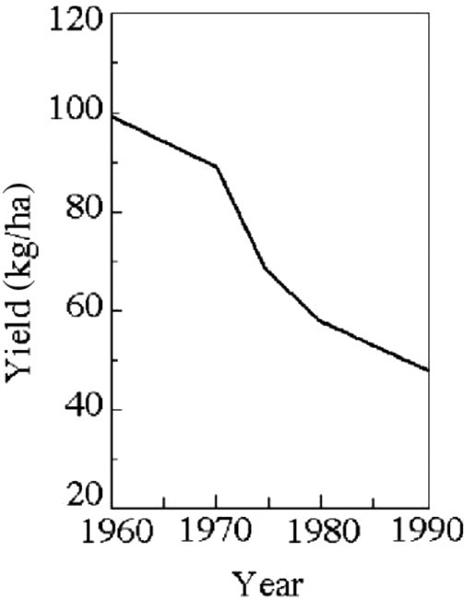
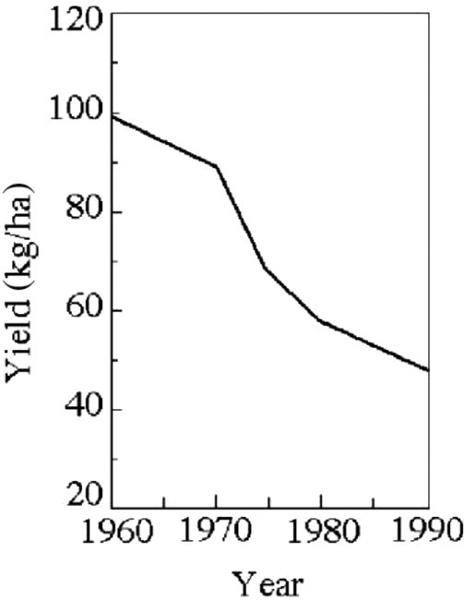
Based on the information provided in Figure 29.1, what is the most likely cause of the decline in productivity?

  1. A) The farmer used the wrong kind of fertilizer.
  2. B) The cotton is developing a resistance to the fertilizer and to irrigation water.
  3. C) Water has accumulated in the soil due to irrigation.
  4. D) The soil water potential has become more negative due to salination.

back 96

D

front 97

If you were the county agriculture agent, what would be the best advice you could give the farmer who owns the field under study in Figure 29.1?

  1. A) Plant a variety of cotton that requires less water and can tolerate salinity.
  2. B) Continue to fertilize, but stop irrigating the field and rely on rainfall.
  3. C) Continue to irrigate, but stop fertilizing the field and rely on organic nutrients in the soil.
  4. D) Continue to fertilize and irrigate, but add the nitrogen-fixing bacteria Rhizobium to the irrigation water until the productivity increases.

back 97

A

front 98

You are conducting an experiment on plant growth. You take a plant fresh from the soil that weighs 5 kg. Then you dry the plant overnight and determine the dry weight to be 1 kg. Of this dry weight, how much would you expect to be made up of organic molecules?

  1. A) 1 g
  2. B) 4 g
  3. C) 40 g
  4. D) 960 g

back 98

D

front 99

Ten tomato plants are germinated and maintained in a large tray with no drainage. After several weeks they all begin to wilt and die despite repeated watering and fertilization. The most likely cause of this die-off is

  1. A) competition for resources.
  2. B) anoxia.
  3. C) organic nutrient depletion.
  4. D) no room left for root growth.

back 99

B

front 100

A greenhouse experiment to test growth rates in tomato cultivars was conducted using sterile soil mix and watering with sterile solutions of water and fertilizer. Following germination, half of the plants in each group were transplanted into soil that was obtained from a nearby agricultural field (nonsterile) and the other half into sterile soil. After several weeks the plants that were transplanted into nonsterile soil exhibited a much higher growth rate compared to the plants transplanted into sterile soil. The most likely explanation for this result is

  1. A) the plants transplanted into the nonsterile soil were inoculated with mycorrhizae.
  2. B) the plants transplanted into the nonsterile soil received more fertilizer.
  3. C) the plants transplanted into the sterile soil were stunted due to overfertilization.
  4. D) the plants transplanted into sterile soil suffered anoxia from improper water drainage.

back 100

A

front 101

Several tomato plants are growing in a small garden plot. If soil water potential were to drop significantly on a hot summer afternoon, which of the following would most likely occur?

  1. A) Stomatal apertures would decrease.
  2. B) Transpiration would increase.
  3. C) The leaves would become more turgid.
  4. D) The uptake of CO2would be enhanced.

back 101

A

front 102

A fellow student brought in a leaf to be examined. The leaf was dark green and thin, had stoma on the lower surface only, and had a total surface area of 10 square meters. What is the most likely environment where this leaf was growing?

  1. A) a dry, sandy region
  2. B) a large, still pond
  3. C) a tropical rain forest
  4. D) an oasis within a grassland

back 102

C

front 103

Plants produce storage products in the form of carbohydrates, proteins, and lipids. Which one of the following is the backbone element in all these stored products?

  1. A) nitrogen
  2. B) phosphorus
  3. C) hydrogen
  4. D) carbon

back 103

D

front 104

Which structure or compartment is part of the symplast?

  1. A) the interior of a vessel element
  2. B) the interior of a sieve tube
  3. C) the cell wall of a mesophyll cell
  4. D) an extracellular air space

back 104

B

front 105

Which of the following is an adaptation that enhances the uptake of water and minerals by roots?

  1. A) mycorrhizae
  2. B) cavitation
  3. C) active uptake by vessel elements
  4. D) rhythmic contractions by cortical cells

back 105

A

front 106

Movement of xylem sap from roots to leaves

  1. A) occurs through the apoplast of sieve-tube elements.
  2. B) usually depends on tension, or negative pressure potential.
  3. C) depends on active transport.
  4. D) depends on the pumping of water through aquaporins.

back 106

B

front 107

What would enhance water uptake by a plant cell?

  1. A) decreasing the Ψ of the surrounding solution
  2. B) positive pressure on the surrounding solution
  3. C) the loss of solutes from the cell
  4. D) increasing the Ψ of the cytoplasm

back 107

B

front 108

A plant cell with a ΨS of -0.65 MPa maintains a constant volume when bathed in a solution that has a ΨS of -0.30 MPa and is in an open container. The cell has a

  1. A) ΨPof +0.65 MPa.
  2. B) Ψ of -0.65 MPa.
  3. C) ΨPof +0.35 MPa.
  4. D) Ψ of 0 MPa.

back 108

C

front 109

Compared with a cell with few aquaporin proteins in its membrane, a cell containing many aquaporin proteins will have a

  1. A) faster rate of osmosis.
  2. B) lower water potential.
  3. C) higher water potential.
  4. D) faster rate of active transport.

back 109

A

front 110

Two groups of tomatoes were grown in the laboratory, one with humus added to the soil and the other a control without humus. The leaves of the plants grown without humus were yellowish (less green) compared with those of the plants grown in humus-enriched soil. The best explanation for this difference is that

  1. A) the healthy plants used carbohydrates in the decomposing leaves of the humus for energy to make chlorophyll.
  2. B) the humus made the soil more loosely packed, so water penetrated more easily to the roots.
  3. C) the humus contained minerals such as magnesium and iron, needed for the synthesis of chlorophyll.
  4. D) the heat released by the decomposing leaves of the humus caused more rapid growth and chlorophyll synthesis.

back 110

C