Print Options

Card layout: ?

← Back to notecard set|Easy Notecards home page

Instructions for Side by Side Printing
  1. Print the notecards
  2. Fold each page in half along the solid vertical line
  3. Cut out the notecards by cutting along each horizontal dotted line
  4. Optional: Glue, tape or staple the ends of each notecard together
  1. Verify Front of pages is selected for Viewing and print the front of the notecards
  2. Select Back of pages for Viewing and print the back of the notecards
    NOTE: Since the back of the pages are printed in reverse order (last page is printed first), keep the pages in the same order as they were after Step 1. Also, be sure to feed the pages in the same direction as you did in Step 1.
  3. Cut out the notecards by cutting along each horizontal and vertical dotted line
To print: Ctrl+PPrint as a list

62 notecards = 16 pages (4 cards per page)

Viewing:

AP Biology Chapter 26

front 1

The legless condition that is observed in several groups of extant reptiles is the result of
A) their common ancestor having been legless.
B) a shared adaptation to an arboreal (living in trees) lifestyle.
C) several instances of the legless condition arising independently of each other.
D) individual lizards adapting to a fossorial (living in burrows) lifestyle during their
lifetimes

back 1

C

front 2

The scientific discipline concerned with naming organisms is called
A) taxonomy.
B) cladistics.
C) binomial nomenclature.
D) systematics.
E) phylocode

back 2

A

front 3

) The various taxonomic levels (viz, genera, classes, etc.) of the hierarchical classification
system differ from each other on the basis of
A) how widely the organisms assigned to each are distributed throughout the
environment.
B) the body sizes of the organisms assigned to each.
C) their inclusiveness.
D) the relative genome sizes of the organisms assigned to each.
E) morphological characters that are applicable to all organisms.

back 3

C

front 4

Which of these illustrates the correct representation of the binomial scientific name for the
African lion?
A) Panthera leo
B) panthera leo
C) Panthera leo
D) Panthera Leo
E) Panthera leo

back 4

E

front 5

A phylogenetic tree that is ʺrootedʺ is one
A) that extends back to the origin of life on Earth.
B) at whose base is located the common ancestor of all taxa depicted on that tree.
C) that illustrates the rampant gene swapping that occurred early in lifeʹs history.
D) that indicates our uncertainty about the evolutionary relationships of the taxa
depicted on the tree.
E) with very few branch points.

back 5

B

front 6

The correct sequence, from the most to the least comprehensive, of the taxonomic levels
listed here is
A) family, phylum, class, kingdom, order, species, and genus.
B) kingdom, phylum, class, order, family, genus, and species.
C) kingdom, phylum, order, class, family, genus, and species.
D) phylum, kingdom, order, class, species, family, and genus.
E) phylum, family, class, order, kingdom, genus, and species.

back 6

B

front 7

The common housefly belongs to all of the following taxa. Assuming you had access to
textbooks or other scientific literature, knowing which of the following should provide you
with the most specific information about the common housefly?
A) order Diptera
B) family Muscidae
C) genus Musca
D) class Hexapoda
E) phylum Arthropoda

back 7

C

front 8

If organisms A, B, and C belong to the same class but to different orders and if organisms
D, E, and F belong to the same order but to different families, which of the following pairs
of organisms would be expected to show the greatest degree of structural homology?
A) A and B
B) A and C
C) B and D
D) C and F
E) D and F

back 8

E

front 9

Darwin analogized the effects of evolution as the above-ground portion of a
many-branched tree, with extant species being the tips of the twigs. The common ancestor
of two species is most analogous to which anatomical tree part?
A) a single twig that gets longer with time
B) a node where two twigs diverge
C) a twig that branches with time
D) the trunk
E) neighboring twigs attached to the same stem

back 9

B

front 10

Dozens of potato varieties exist, differing from each other in potato-tuber size, skin color,
flesh color, and shape. One might construct a classification of potatoes based on these
morphological traits. Which of these criticisms of such a classification scheme is most likely
to come from an adherent of the phylocode method of classification?
A) Flesh color, rather than skin color, is a valid trait to use for classification because it is
less susceptible to change with the age of the tuber.
B) Flower color is a better classification criterion, because below-ground tubers can be
influenced by minerals in the soil as much as by their genes.
C) A more useful classification would codify potatoes based on the texture and flavor of
their flesh, because this is what humans are concerned with.
D) The most accurate phylogenetic code is that of Linnaeus. Classify potatoes based on
Linnaean principles; not according to their color.
E) The only biologically valid classification of potato varieties is one that accurately
reflects their genetic and evolutionary relatedness.

back 10

E

front 11

The term ʺhomoplasyʺ is most applicable to which of these features?
A) the legless condition found in various types of extant lizards
B) the 5-digit condition of human hands and bat wings
C) the beta-hemoglobin genes of mice and of humans
D) the fur that covers Australian moles and North American moles
E) the basic skeletal features of dog forelimbs and cat forelimbs

back 11

A

front 12

If, someday, an archaean cell is discovered whose SSU-rRNA sequence is more similar to
that of humans than the sequence of mouse SSU-rRNA is to that of humans, the best
explanation for this apparent discrepancy would be
A) homology.
B) homoplasy.
C) common ancestry.
D) retro-evolution by humans.
E) co-evolution of humans and that archaean.

back 12

B

front 13

) The best classification system is that which most closely
A) unites organisms that possess similar morphologies.
B) conforms to traditional, Linnaean taxonomic practices.
C) reflects evolutionary history.
D) corroborates the classification scheme in use at the time of Charles Darwin.
E) reflects the basic separation of prokaryotes from eukaryotes.

back 13

C

front 14

Which of the following pairs are the best examples of homologous structures?
A) bat wing and human hand
B) owl wing and hornet wing
C) porcupine quill and cactus spine
D) bat forelimb and bird wing
E) Australian mole and North American mole

back 14

A

front 15

) Some molecular data place the giant panda in the bear family (Ursidae) but place the lesser
panda in the raccoon family (Procyonidae). Consequently, the morphological similarities of
these two species are probably due to
A) inheritance of acquired characteristics.
B) sexual selection.
C) inheritance of shared derived characters.
D) possession of analogous structures.
E) possession of shared primitive characters.

back 15

D

front 16

In angiosperm plants, flower morphology can be very intricate. If a tree, such as a New
Mexico locust, has flowers that share many morphological intricacies with flowers of the
sweet pea vine, then the most likely explanation for these floral similarities is the same
general explanation for the similarities between the
A) dorsal fins of sharks and of dolphins.
B) reduced eyes of Australian moles and North American moles.
C) scales on moth wings and the scales of fish skin.
D) cranial bones of humans and those of chimpanzees.
E) adaptations for flight in birds and adaptations for flight in bats.

back 16

D

front 17

The importance of computers and of computer software to modern cladistics is most closely
linked to advances in
A) light microscopy.
B) radiometric dating.
C) fossil discovery techniques.
D) Linnaean classification.
E) molecular genetics.

back 17

E

front 18

) Which mutation should least require realignment of homologous regions of a gene that is
common to several related species?
A) 3-base insertion
B) 1-base substitution
C) 4-base insertion
D) 1-base deletion
E) 3-base deletion

back 18

B

front 19

The common ancestors of birds and mammals were very early (stem) reptiles, which almost
certainly possessed 3-chambered hearts (2 atria, 1 ventricle). Birds and mammals, however,
are alike in having 4-chambered hearts (2 atria, 2 ventricles). The 4-chambered hearts of
birds and mammals are best described as
A) structural homologies.
B) vestiges.
C) homoplasies.
D) the result of shared ancestry.
E) molecular homologies.

back 19

C

front 20

Generally, within a lineage, the largest number of shared derived characters should be
found among two organisms that are members of the same
A) kingdom.
B) class.
C) domain.
D) family.
E) order.

back 20

D

front 21

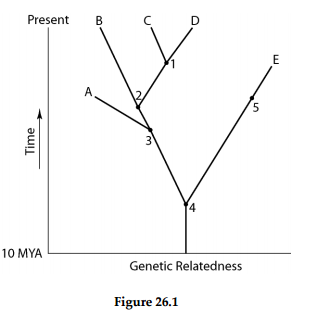
A common ancestor for both species C and E could be at position number
A) 1.
B) 2.
C) 3.
D) 4.
E) 5.

back 21

D

front 22

The two extant species that are most closely related to each other are
A) A and B.
B) B and C.
C) C and D.
D) D and E.
E) E and A.

back 22

C

front 23

) Which species are extinct?
A) A and E
B) A and B
C) C and D
D) D and E
E) cannot be determined from the information provided

back 23

A

front 24

Which extinct species should be the best candidate to serve as the outgroup for the clade
whose common ancestor occurs at position 2?
A) A
B) B
C) C
D) D
E) E

back 24

A

front 25

If this evolutionary tree is an accurate depiction of relatedness, then which of the following
should be correct?
1. The entire tree is based on maximum parsimony.
2. If all species depicted here make up a taxon, this taxon is monophyletic.
3. The last common ancestor of species B and C occurred more recently than the last
common ancestor of species D and E.
4. Species A is the direct ancestor of both species B and species C.
5. The species present at position 3 is ancestral to C, D, and E.
A) 2 and 5
B) 1 and 3
C) 3 and 4
D) 2, 3, and 4
E) 1, 2, and 3

back 25

E

front 26

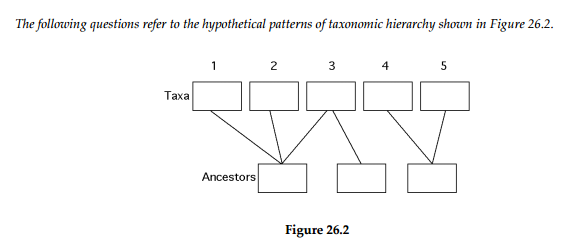
Which of the following numbers represents a polyphyletic taxon?
A) 2
B) 3
C) 4
D) 5
E) more than one of these

back 26

B

front 27

) If this figure is an accurate depiction of relatedness, then which taxon is unacceptable,
based on cladistics?
A) 1
B) 2
C) 3
D) 4
E) 5

back 27

C

front 28

) Which of the following is not true of all horizontally oriented phylogenetic trees, where
time advances to the right?
A) Each branch point represents a point in absolute time.
B) Organisms represented at the base of such trees are ancestral to those represented at
higher levels.
C) The more branch points that occur between two taxa, the more divergent their DNA
sequences should be.
D) The common ancestor represented by the rightmost branch point existed more
recently in time than the common ancestors represented at branch points located to
the left.
E) The more branch points there are, the more taxa are likely to be represented.

back 28

A

front 29

Ultimately, which of these serves as the basis for both the principle of maximum parsimony
and the principle that shared complexity indicates homology rather than analogy?
A) the laws of thermodynamics
B) Boyleʹs law
C) the laws of probability
D) chaos theory
E) Hutchinsonʹs law

back 29

C

front 30

) Shared derived characters are most likely to be found in taxa that are
A) paraphyletic.
B) polyphyletic.
C) monophyletic.

back 30

C

front 31

A taxon, all of whose members have the same common ancestor, is
A) paraphyletic.
B) polyphyletic.
C) monophyletic.

back 31

C

front 32

The term that is most appropriately associated with clade is
A) paraphyletic.
B) polyphyletic.
C) monophyletic.

back 32

C

front 33

If birds are excluded from the class Reptilia, the term that consequently describes the class
Reptilia is
A) paraphyletic.
B) polyphyletic.
C) monophyletic.

back 33

A

front 34

If the eukaryotic condition arose, independently, several different times during
evolutionary history, and if ancestors of these different lineages are extant and are classified
in the domain Eukarya, then the domain Eukarya would be
A) paraphyletic.
B) polyphyletic.
C) monophyletic.

back 34

B

front 35

When using a cladistic approach to systematics, which of the following is considered most
important for classification?
A) shared primitive characters
B) analogous primitive characters
C) shared derived characters
D) the number of homoplasies
E) overall phenotypic similarity

back 35

C

front 36

The four-chambered hearts of birds and the four-chambered hearts of mammals evolved
independently of each other. If one were unaware of this independence, then one might
logically conclude that
A) the birds were the first to evolve a 4-chambered heart.
B) birds and mammals are more distantly related than is actually the case.
C) early mammals possessed feathers.
D) the common ancestor of birds and mammals had a four-chambered heart.
E) birds and mammals should be placed in the same family.

back 36

D

front 37

Phylogenetic hypotheses (such as those represented by phylogenetic trees) are strongest
when
A) they are based on amino acid sequences from homologous proteins, as long as the
genes that code for such proteins contain no introns.
B) each clade is defined by a single derived character.
C) they are supported by more than one kind of evidence, such as when fossil evidence
corroborates molecular evidence.
D) they are accepted by the foremost authorities in the field, especially if they have won
Nobel Prizes.
E) they are based on a single DNA sequence that seems to be a shared derived sequence.

back 37

C

front 38

Cladograms (a type of phylogenetic tree) constructed from evidence from molecular
systematics are based on similarities in
A) morphology.
B) the pattern of embryological development.
C) biochemical pathways.
D) habitat and lifestyle choices.
E) mutations to homologous genes

back 38

E

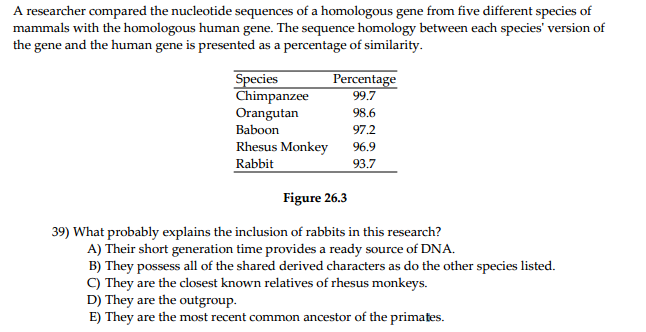
front 39

back 39

D

front 40

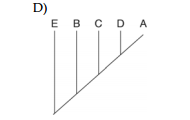
Based on the tabular data, and assuming that time advances vertically, which cladogram (a
type of phylogenetic tree) is the most likely depiction of the evolutionary relationships
among these five species?

back 40

front 41

Regarding these sequence homology data, the principle of maximum parsimony would be
applicable in
A) distinguishing introns from exons.
B) determining degree of sequence homology.
C) selecting appropriate genes for comparison among species.
D) inferring evolutionary relatedness from the number of sequence differences.

back 41

D

front 42

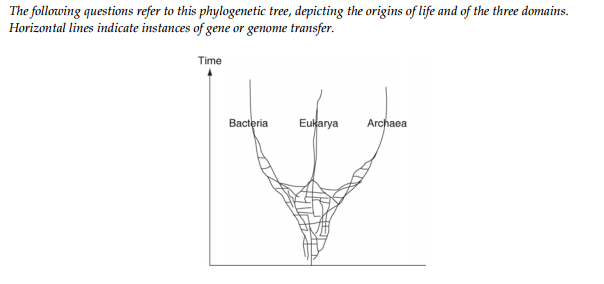
Which process hinders clarification of the deepest branchings in a phylogenetic tree that
depicts the origins of the three domains?
A) binary fission
B) mitosis
C) meiosis
D) horizontal gene transfer
E) gene duplication

back 42

D

front 43

What kind of evidence has recently made it necessary to assign the prokaryotes to either of
two different domains, rather than assigning all prokaryotes to the same kingdom?
A) molecular
B) behavioral
C) nutritional
D) anatomical
E) ecological

back 43

A

front 44

What important criterion was used in the late 1960s to distinguish between the three
multicellular eukaryotic kingdoms of the five-kingdom classification system?
A) the number of cells present in individual organisms
B) the geological stratum in which fossils first appear
C) the nutritional modes they employ
D) the biogeographic province where each first appears
E) the features of their embryos

back 44

C

front 45

Which is an obsolete kingdom that includes prokaryotic organisms?
A) Plantae
B) Fungi
C) Animalia
D) Protista
E) Monera

back 45

E

front 46

Members of which kingdom have cell walls and are all heterotrophic?
A) Plantae
B) Fungi
C) Animalia
D) Protista
E) Monera

back 46

B

front 47

) Which kingdom has been replaced with two domains?
A) Plantae
B) Fungi
C) Animalia
D) Protista
E) Monera

back 47

E

front 48

Which eukaryotic kingdom is polyphyletic and therefore not acceptable, based on
cladistics?
A) Plantae
B) Fungi
C) Animalia
D) Protista
E) Monera

back 48

D

front 49

Which eukaryotic kingdom includes members that are the result of endosymbioses that
included an ancient proteobacterium and an ancient cyanobacterium?
A) Plantae
B) Fungi
C) Animalia
D) Protista
E) Monera

back 49

A

front 50

The human nuclear genome includes hundreds of genes that are orthologs of bacterial
genes, and hundreds of other genes that are orthologs of archaean genes. This finding can
be explained by proposing that
A) neither archaea nor bacteria contain paralogous genes.
B) the eukaryotic lineage leading to humans involved at least one fusion of an ancient
bacterium with an ancient archaean.
C) the infection of humans by bacteriophage introduced prokaryotic genes into the
human genome.
D) horizontal gene transfer did not occur to any significant extent among the prokaryotic
ancestors of humans.

back 50

B

front 51

) If the early history of life on Earth is accurately depicted by this phylogenetic tree, then
which statement is least in agreement with the hypothesis proposed by this tree?
A) The last universal common ancestor of all extant species is better described as a
community of organisms, rather than an individual species.
B) The origin of the three domains appears as a polytomy.
C) Archaean genomes should contain genes that originated in bacteria, and vice versa.
D) Eukaryotes are more closely related to archaeans than to bacteria.

back 51

D

front 52

Which process is observed in prokaryotes and is responsible for the vertical components of
the various bacterial and archaean lineages?
A) mitosis
B) meiosis
C) sexual reproduction
D) binary fission

back 52

D

front 53

Which of these processes can be included among those responsible for the horizontal
components of this phylogeny?
A) endosymbiosis
B) mitosis
C) binary fission
D) point mutations
E) S phase of the cell cycle

back 53

A

front 54

Which portion of this tree may ultimately be better depicted as a ʺringʺ?
A) the bacterial lineage
B) the archaean lineage
C) the eukaryotic lineage
D) the weblike part near the base of the tree
E) the part corresponding to the first living cell on Earth

back 54

D

front 55

A large proportion of archaeans are ʺextremophiles,ʺ so called because they inhabit extreme
environments with high acidity and/or high temperature. Such environments are thought
to have been much more common on the primitive Earth. Thus, modern extremophiles
survive only in places that their ancestors became adapted to long ago. Which of these is,
consequently, a valid statement about modern extremophiles, assuming that their habitats
have remained relatively unchanged?
A) Among themselves, they should share relatively few ancestral traits, especially those
that enabled ancestral forms to adapt to extreme conditions.
B) On a phylogenetic tree whose branch lengths are proportional to amount of genetic
change, the branches of the extremophiles should be shorter, relative to branches of
the non-extremophilic archaeans.
C) They should contain genes that originated in eukaryotes that are the hosts for
numerous species of bacteria.
D) They should currently be undergoing a high level of horizontal gene transfer with
non-extremophilic archaeans.

back 55

B

front 56

In Figure 26.4 from your textbook, which similarly inclusive taxon descended from the
same common ancestor as Canidae?
A) Felidae
B) Mustelidae
C) Carnivora
D) Canis
E) Lutra

back 56

B

front 57

Three living species X, Y, and Z share a common ancestor T, as do extinct species U and V.
A grouping that includes species T, X, Y, and Z makes up
A) a valid taxon.
B) a monophyletic clade.
C) an ingroup, with species U as the outgroup.
D) a paraphyletic grouping.
E) a polyphyletic grouping.

back 57

D

front 58

In a comparison of birds with mammals, having four appendages is
A) a shared ancestral character.
B) a shared derived character.
C) a character useful for distinguishing birds from mammals.
D) an example of analogy rather than homology.
E) a character useful for sorting bird species.

back 58

A

front 59

If you were using cladistics to build a phylogenetic tree of cats, which of the following
would be the best outgroup?
A) lion
B) domestic cat
C) wolf
D) leopard
E) tiger

back 59

C

front 60

The relative lengths of the amphibian and mouse branches in the phylogeny in Figure 26.12
in your textbook indicate that
A) amphibians evolved before mice.
B) mice evolved before amphibians.
C) the genes of amphibians and mice have only coincidental homoplasies.
D) the homologous gene has evolved more slowly in mice.
E) the homologous gene has evolved more rapidly in mice.

back 60

D

front 61

back 61

D

front 62

To apply parsimony to constructing a phylogenetic tree,
A) choose the tree that assumes all evolutionary changes are equally probable.
B) choose the tree in which the branch points are based on as many shared derived
characters as possible.
C) base phylogenetic trees only on the fossil record, as this provides the simplest
explanation for evolution.
D) choose the tree that represents the fewest evolutionary changes, either in DNA
sequences or morphology.
E) choose the tree with the fewest branch points.

back 62

D