Instructions for Side by Side Printing
- Print the notecards
- Fold each page in half along the solid vertical line
- Cut out the notecards by cutting along each horizontal dotted line
- Optional: Glue, tape or staple the ends of each notecard together
chapter 6
front 1 Sixty-five percent of the mass of bone is a compound called hydroxyapatite. | back 1 True |
front 2 During infancy and childhood, the most important stimulus of epiphyseal plate activity is ________. | back 2 growth hormone |
front 3 Which of the following is not a function of the skeletal system? | back 3 communication |
front 4 Bones do NOT have a role in ________. | back 4 glycogen production |
front 5 The periosteum is secured to the underlying bone by dense connective tissue called ________. | back 5 perforating (Sharpey's) fibers |
front 6 The cell responsible for secreting the matrix of bone is the ________. | back 6 osteoblast |
front 7 In adults, yellow marrow is located ________. | back 7 in the medullary cavity of long bones |
front 8 Ossification of the ends of long bones ________. | back 8 is produced by secondary ossification centers |
front 9 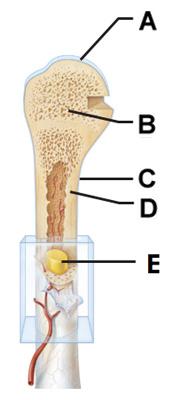 Which of the following is the major component of the part of the bone labeled E? | back 9 adipose tissue |
front 10 What kind of tissue is the forerunner of long bones in the embryo? | back 10 hyaline cartilage |
front 11 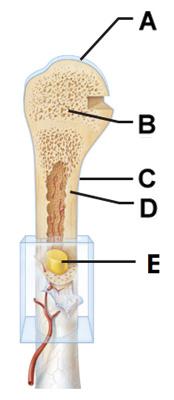 Which of the labeled parts of the bone is composed primarily of compact bone? | back 11 D |
front 12 The epiphyseal plate is ________. | back 12 where long bone lengthening occurs |
front 13 An osteon contains osteocytes, lamellae, and a central canal, and is found in compact bone only. | back 13 True |
front 14 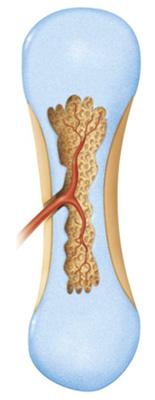 A step in which bone-forming process is shown in the figure? | back 14 endochondral ossification |
front 15 Choose the TRUE statement. | back 15 Endochondral ossification converts hyaline cartilage "bone" models into true bones (i.e., hyaline cartilage serves as a template for bone formation). |
front 16 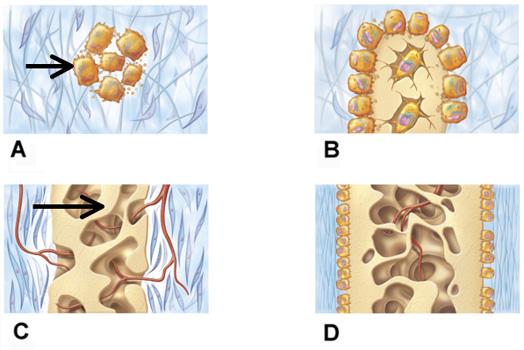 The above figure depicts which of the following bone-forming processes? | back 16 intramembranous ossification during embryonic development |
front 17 The canal that runs through the core of each osteon (the Haversian canal) is the site of ________. | back 17 blood vessels and nerve fibers |
front 18 Osteoclasts ________. | back 18 break down bone |
front 19 The term diploë refers to the ________. | back 19 internal layer of spongy bone in flat bones |
front 20 A fracture in the shaft of a bone would be a break in the ________. | back 20 diaphysis |
front 21 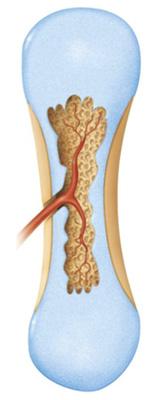 Which of the following bones are formed by the illustrated process? | back 21 All of the listed responses are correct. |
front 22 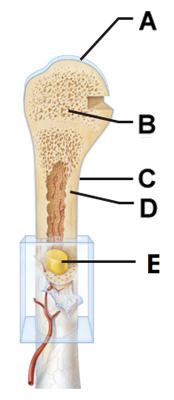 Which of the labeled parts of the bone is composed primarily of hyaline cartilage? | back 22 A |
front 23 In adults, hematopoietic tissue is NOT found in ________. | back 23 the medullary cavity of long bones |
front 24 The structural unit of compact bone (osteon) resembles the growth rings of a tree trunk. | back 24 True |