Instructions for Side by Side Printing
- Print the notecards
- Fold each page in half along the solid vertical line
- Cut out the notecards by cutting along each horizontal dotted line
- Optional: Glue, tape or staple the ends of each notecard together
chapter 3 part 2
front 1 Some types of cells move freely through the body, while others are bound into tightly knit communities. | back 1 True |
front 2 ________ is a molecular "ferry" that brings amino acids to the ribosome to build a protein. | back 2 t-RNA |
front 3 There is only one cell type in the human body that has a flagellum. | back 3 True |
front 4 DNA transcription is another word for DNA replication. | back 4 False |
front 5 In which stage of mitosis do the identical sets of chromosomes uncoil and resume their chromatin form? | back 5 telophase |
front 6 Which of the following names the three main parts of a human cell? | back 6 cytoplasm, plasma membrane, and nucleus |
front 7 The RNA responsible for bringing the amino acids to the ribosome for protein formation is ________. | back 7 tRNA |
front 8 Each daughter cell resulting from mitotic cell division has exactly as many chromosomes as the parent cell. | back 8 True |
front 9 Which of the following is NOT a concept of the cell theory? | back 9 Cells are given life through a process known as spontaneous generation. |
front 10 The plasma membrane is made primarily of ________. | back 10 phospholipids |
front 11 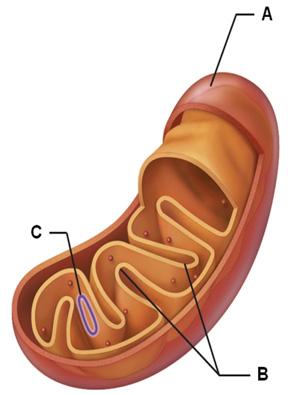 The figure is of which cellular organelle? | back 11 a mitochondrion |
front 12 Which of the following would not be a constituent of a plasma membrane? | back 12 messenger RNA |
front 13 What is the primary function of the mitochondria? | back 13 They are the main sites of ATP production. |
front 14 Which of the following is characteristic of cilia? | back 14 They are whiplike, motile cellular extensions that occur in large numbers on the exposed surfaces of certain cells. |
front 15 Why is the selective permeability of the plasma membrane essential for normal cell function? | back 15 Selective permeability allows cells to exclude some substances and allow others to pass into or out of the cell. |
front 16 The functions of centrioles include ________. | back 16 organizing the mitotic spindle in cell division |
front 17 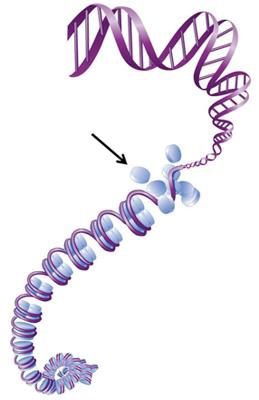 What type of protein is indicated by the arrow? | back 17 histone |
front 18 Passive membrane transport processes include ________. | back 18 movement of a substance down its concentration gradient |
front 19 ________ is the diffusion of a solvent, such as water, across a selectively permeable membrane. | back 19 Osmosis |
front 20 Which vesicular transport process occurs primarily in some white blood cells and macrophages? | back 20 phagocytosis |
front 21 If cells are placed in a hypertonic solution containing a solute to which the membrane is impermeable, what could happen? | back 21 The cells will lose water and shrink. |
front 22 The main component of the cytosol is ________. | back 22 Water |
front 23 Once solid material is phagocytized and taken into a vacuole, which of the following statements best describes what happens? | back 23 A lysosome combines with the vacuole and digests the enclosed solid material. |
front 24 The electron microscope has revealed that one of the components within the cell consists of pinwheel array of 9 triplets of microtubules arranged to form a hollow tube. This structure is a ________. | back 24 centriole |
front 25 Lipid rafts, found in the cell outer membrane surface, are concentrating platforms for certain receptor molecules or for protein molecules needed for cell signaling.. | back 25 True |
front 26 Which of the following statements correctly describes the plasma membrane? | back 26 It is a dynamic fluid structure that is in constant flux. |
front 27 Lysosomes perform digestive functions within a cell. | back 27 True |
front 28 Which of the following is FALSE regarding the membrane potential? | back 28 The resting membrane potential is maintained solely by passive transport processes. |
front 29 Some hormones enter cells via ________. | back 29 receptor-mediated endocytosis |
front 30 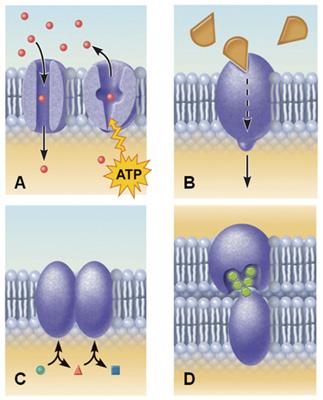 Which set of membrane proteins in the figure depicts the transport of solute molecules? | back 30 A |
front 31 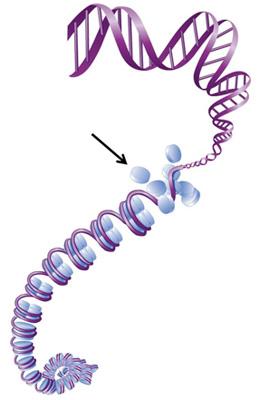 What is the function of the indicated protein? | back 31 to allow DNA to form a compact structure |
front 32 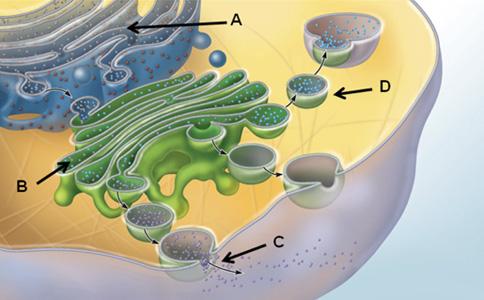 The structure indicated by B is ______. | back 32 the Golgi apparatus |
front 33 Which of the following is a principle of the fluid mosaic model of cell membrane structure? | back 33 Phospholipids form a bilayer that is largely impermeable to water-soluble molecules. |
front 34 The orderly sequence of the phases of mitosis is prophase, metaphase, anaphase, and telophase. | back 34 True |
front 35 What must happen before a body cell can begin mitotic cell division? | back 35 Its DNA must be replicated exactly so that identical copies of the cell's genes can be passed on to each of its offspring. |
front 36 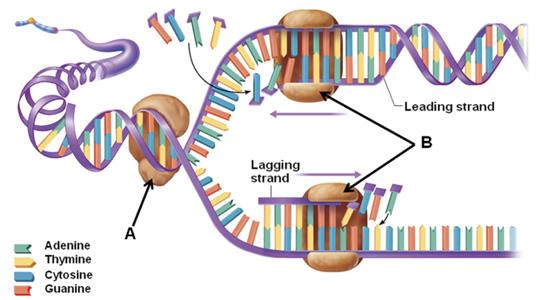 What is the specific role of the enzyme indicated by B during the formation of the new DNA strands? | back 36 joining the nucleotides that form the new DNA strand |
front 37 During DNA replication, the covalent bonding of nucleotides into a new strand of DNA is performed by ________. | back 37 DNA polymerase |
front 38 Diffusion is a form of active transport. | back 38 False |
front 39 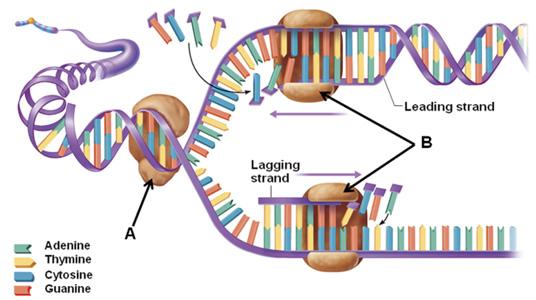 What is a function of the enzyme indicated by structure A? | back 39 breaking the bonds between complementary base pairs |
front 40 Which of the following describes the plasma membrane? | back 40 the phospholipid bilayer surrounding the cell |