Instructions for Side by Side Printing
- Print the notecards
- Fold each page in half along the solid vertical line
- Cut out the notecards by cutting along each horizontal dotted line
- Optional: Glue, tape or staple the ends of each notecard together
Ch 18
front 1 1) All of the following are generally used in vaccines EXCEPT A) toxoids. B) parts of bacterial cells. C) live, attenuated viruses. D) inactivated viruses. E) antibodies. | back 1 Answer: E |
front 2 2) Patient's serum, influenza virus, and red blood cells are mixed in a tube. What happens if the patient has antibodies against influenza virus? A) agglutination B) hemagglutination C) complement fixation D) hemolysis E) hemagglutination-inhibition | back 2 Answer: E |
front 3 3) A patient shows the presence of antibodies against diphtheria toxin. Which of the following statements is FALSE? A) The patient may have the disease. B) The patient may have had the disease and has recovered. C) The patient may have been vaccinated. D) A recent transfusion may have passively introduced the antibodies. E) The patient was near someone who had the disease. | back 3 Answer: E |
front 4 4) In an agglutination test, eight serial dilutions to determine antibody titer were set up. Tube #1 contained a 1:2 dilution; tube #2, a 1:4, etc. If tube #6 is the last tube showing agglutination, what is the antibody titer? A) 6 B) 1:6 C) 64 D) 1:32 E) 32 | back 4 Answer: C |
front 5 5) An ELISA for Hepatitis C has 95 percent sensitivity and 90 percent specificity. This means that the test A) detects 95 percent of the true positive samples and has 10 percent false positive results. B) detects 5 percent of the true positive samples and has 90 percent false positive results. C) detects 90 percent of the true positive samples and has 5 percent false positive results. D) detects 95 percent of the true positive samples and has 90 percent false positive results. E) detects 5 percent of the true positive samples and has 10 percent false positive results. | back 5 Answer: A |
front 6 6) Which of the following are sources of antibodies for serological testing? A) vaccinated animals B) cells producing monoclonal antibodies C) viral cultures D) vaccinated animals and cells producing monoclonal antibodies E) vaccinated animals, cells producing monoclonal antibodies, and viral cultures | back 6 Answer: D |
front 7 7) A reaction between an antibody and soluble antigen-forming lattices is called a(n) A) agglutination reaction. B) complement fixation. C) immunofluorescence. D) neutralization reaction. E) precipitation reaction. | back 7 Answer: E |
front 8 8) A reaction between antibody and particulate antigen is called a(n) A) agglutination reaction. B) complement fixation. C) immunofluorescence. D) neutralization reaction. E) precipitation reaction. | back 8 Answer: A |
front 9 9) A reaction that uses the absence of hemolysis of red blood cells to indicate an antigen—antibody reaction is called a(n) A) agglutination reaction. B) complement fixation. C) immunofluorescence. D) neutralization reaction. E) precipitation reaction. | back 9 Answer: B |
front 10 10) A DNA plasmid encoding a protein antigen from West Nile virus is injected into muscle cells of a horse. This is an example of a(n) A) subunit vaccine. B) conjugated vaccine. C) nucleic acid vaccine. D) attenuated whole-agent vaccine. E) live whole-agent vaccine. | back 10 Answer: C |
front 11 11) Toxoid vaccines, such as the vaccines against diphtheria and tetanus, elicit a(n) A) TCcell response. B) immune complex. C) dendritic cell proliferation. D) antibody response against these bacterial toxins. E) antibody response against gram-positive bacteria. | back 11 Answer: D |
front 12 12) The clumping of test red blood cells indicates a negative test result (no antibodies against the virus in the patient's serum) in the A) direct agglutination test. B) indirect agglutination test. C) complement-fixation test. D) precipitation test. E) viral hemagglutination inhibition test. | back 12 Answer: E |
front 13 13) What type of vaccine involves host synthesis of viral antigens? A) conjugated vaccine B) subunit vaccine C) nucleic acid vaccine D) attenuated whole-agent vaccine E) toxoid vaccine | back 13 Answer: C |
front 14 14) Purified protein from Bordetella pertussis is used in a(n) A) conjugated vaccine. B) subunit vaccine. C) nucleic acid vaccine. D) attenuated whole-agent vaccine. E) toxoid vaccine. | back 14 Answer: B |
front 15 15) What type of vaccine is the live, weakened measles virus? A) conjugated vaccine B) subunit vaccine C) nucleic acid vaccine D) attenuated whole-agent vaccine E) toxoid vaccine | back 15 Answer: D |
front 16 16) A test used to identify antibodies against Treponema pallidum in a patient's serum is the A) direct fluorescent-antibody test. B) indirect fluorescent-antibody test. C) direct agglutination test. D) direct ELISA test. E) hemagglutination-inhibition test. | back 16 Answer: B |
front 17 17) A test used to identify Streptococcus pyogenes in a patient's throat swab is the A) direct fluorescent-antibody test. B) indirect fluorescent-antibody test. C) hemagglutination test. D) hemagglutination-inhibition test. E) indirect ELISA test. | back 17 Answer: A |
front 18 18) A test used to detect anti-Rickettsia antibodies in a patient's serum is the A) direct fluorescent-antibody test. B) indirect fluorescent-antibody test. | back 18 Answer: B |
front 19 19) Which of the following is a pregnancy test used to find the fetal hormone HCG in a woman's urine using anti-HCG and latex spheres? A) direct agglutination reaction B) indirect agglutination reaction C) immunofluorescence D) neutralization reaction E) precipitation reaction | back 19 Answer: B |
front 20 20) Which of the following is a test to determine a patient's blood type by mixing the patient's red blood cells with antisera? A) direct agglutination reaction B) passive agglutination reaction C) immunofluorescence D) neutralization reaction E) precipitation reaction | back 20 Answer: A |
front 21 21) Which of the following is a test to determine the presence of soluble antigens in a patient's saliva? A) direct agglutination reaction B) passive agglutination reaction C) immunofluorescence D) neutralization reaction E) precipitation reaction | back 21 Answer: E |
front 22 22) A patient's serum, Mycobacterium, guinea pig complement, sheep red blood cells, and anti-sheep red blood cell antibodies are mixed in a test tube. What happens if the patient has antibodies to Mycobacterium? A) Bacteria fluoresce. B) Hemagglutination occurs. C) Hemagglutination-inhibition occurs. D) Hemolysis occurs. E) No hemolysis occurs. | back 22 Answer: E |
front 23 23) A vaccine against HIV proteins made by a genetically-engineered vaccinia virus that has infected a eukaryotic cell line is a(n) A) conjugated vaccine. B) subunit vaccine. C) nucleic acid vaccine. D) inactivated whole-agent vaccine. E) toxoid vaccine. | back 23 Answer: B |
front 24 24) Inactivated tetanus toxin is a(n) A) conjugated vaccine. B) subunit vaccine. C) nucleic acid vaccine. D) inactivated whole-agent vaccine. E) toxoid vaccine. | back 24 Answer: E |
front 25 25) A hybridoma results from the fusion of a(an) A) B cell with a T cell. B) B cell with a myeloma cell. C) antigen with an antibody. D) antigen with a B cell. E) myeloma cell with a virus. | back 25 Answer: B |
front 26 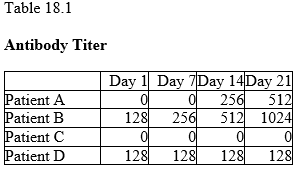 26) In Table 18.1, who probably has the disease? A) Patients A and B B) Patients B and C C) Patients A and C D) Patients C and D E) Patients A and D | back 26 Answer: A |
front 27 27) In Table 18.1, who is most likely protected from the disease, as observed by the test results over time? A) Patient A B) Patient B C) Patient C D) Patient D | back 27 Answer: D |
front 28 28) In Table 18.1, who showed seroconversion during these observations? A) Patient A B) Patient B C) Patient C D) Patient D | back 28 Answer: A |
front 29 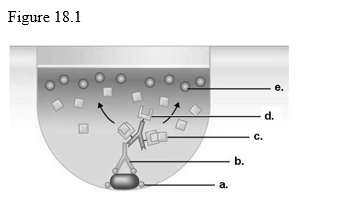 29) Which component in Figure 18.1 came from the patient in this indirect ELISA test? A) a B) b C) c D) d E) e | back 29 Answer: B |
front 30 30) Figure 18.1 is an illustration of a(an) A) negative indirect ELISA test. B) positive indirect ELISA test. C) complement fixation test. D) hemagglutination test. E) precipitation test. | back 30 Answer: B |
front 31 31) Monoclonal antibodies are used in diagnostic tests and disease treatments because they A) are highly specific. B) can be produced in large quantities. C) contain a mixture of antibodies. D) are highly specific and they can be produced in large quantities. E) are highly specific, they can be produced in large quantities, and they contain a mixture of antibodies. | back 31 Answer: D |
front 32 32) The following steps are used to produce monoclonal antibodies. What is the fourth step? A) A B cell is activated to produce antibodies. B) Culture the hybridoma in a selective medium. C) Fuse a B cell to a myeloma cell. D) Isolate antibody-producing B cells. E) Vaccinate a mouse. | back 32 Answer: C |
front 33 33) Palivizumab is used to treat respiratory syncytial virus disease. This antiviral drug is a(n) A) toxoid. B) monoclonal antibody. C) vaccine. D) immunosuppressive. E) nucleoside analog. | back 33 Answer: B |
front 34 34) Live weakened polio virus can be used directly in a(n) A) inactivated whole-agent vaccine. B) attenuated whole-agent vaccine. C) conjugated vaccine. D) subunit vaccine. E) toxoid vaccine. | back 34 Answer: B |
front 35 35) Haemophilus capsule polysaccharide plus diphtheria toxoid is a(n) A) inactivated whole-agent vaccine. B) attenuated whole-agent vaccine. C) conjugated vaccine. D) subunit vaccine. E) toxoid vaccine. | back 35 Answer: C |
front 36 36) Dead Bordetella pertussis can be used in a(n) A) inactivated whole-agent vaccine. B) attenuated whole-agent vaccine. C) conjugated vaccine. D) subunit vaccine. E) toxoid vaccine. | back 36 Answer: A |
front 37 37) Isolated and purified hepatitis B virus surface antigen can be used in a(n) A) inactivated whole-agent vaccine. B) attenuated whole-agent vaccine. C) conjugated vaccine. D) subunit vaccine. E) toxoid vaccine. | back 37 Answer: D |
front 38 38) In a direct ELISA test to screen for drugs in a patient's urine, what is the third step in the test process? A) substrate for the enzyme is added B) enzyme-labeled antibodies against the drug being tested is added C) the patient's urine sample is diluted D) antibody against the drug being tested is added | back 38 Answer: B |
front 39 39) Which item is from the patient in a direct ELISA test? A) substrate for the enzyme B) antigen C) antihuman immune serum D) antibodies against the antigen | back 39 Answer: B |
front 40 40) Which of the following tests is MOST useful in determining the presence of AIDS antibodies? A) agglutination B) complement fixation C) neutralization D) indirect ELISA E) direct fluorescent-antibody | back 40 Answer: D |
front 41 41) Which of the following uses fluorescent-labeled antibodies? A) agglutination B) complement fixation C) precipitation D) flow cytometry E) neutralization | back 41 Answer: D |
front 42 42) Which of the following is NOT an advantage of live attenuated vaccine agents? A) They elicit lifelong immunity. B) They stimulate by cell-mediated and humoral immune responses. C) They occasionally revert to virulent forms. D) They require few or no booster immunizations. E) The immune response generated by the vaccine closely mimics a real infection. | back 42 Answer: C |
front 43 43) In an immunodiffusion test to diagnose the fungal disease histoplasmosis, a patient's serum is placed in a well in an agar plate. In a positive test, a precipitate forms as the serum diffuses from the well and meets material diffusing from a second well. In this test process, what is the most likely identity of the material in the second well? A) antibodies B) a purified fungal antigen C) entire fungal cells D) a purified protozoan antigen E) red blood cells | back 43 Answer: B |
front 44 44) In an immunodiffusion test to diagnose histoplasmosis, a patient's serum is placed in a well in an agar plate. In a positive test, a line forms as the serum diffuses from the well and meets material diffusing from a second well. What type of test is this? A) an agglutination reaction B) a precipitation reaction C) a complement-fixation test D) an indirect ELISA test E) a direct ELISA test | back 44 Answer: B |
front 45 45) Which of the following statements about measles is FALSE? A) It is a serious disease. B) It is preventable by vaccination. C) Annually, it kills thousands of children worldwide. D) The disease has been eradicated in the United States. E) Complications include pneumonia, encephalitis, and death. | back 45 Answer: D |
front 46 1) Vaccines are preparations of organisms or fractions of organisms that are used to induce protective immune responses. | back 46 Answer: TRUE |
front 47 2) In a vaccine preparation, the term "attenuated" means that the agent does NOT replicate. | back 47 Answer: FALSE |
front 48 3) An injection of "naked" DNA into muscle cells to induce an immune response against the proteins encoded by the DNA is an example of a subunit vaccine. | back 48 Answer: FALSE |
front 49 4) Adjuvants such as aluminum salts are used as additives in vaccines to enhance immune responses. | back 49 Answer: TRUE |
front 50 5) Blood typing tests are examples of hemagglutination reactions. | back 50 Answer: TRUE |
front 51 6) A positive complement-fixation test is indicated by the lysis of the sheep red blood cells added in the indicator phase of the test. | back 51 Answer: FALSE |
front 52 7) The home pregnancy test kit is an example of a direct ELISA. | back 52 Answer: TRUE |
front 53 8) Western blotting uses antibodies to detect specific proteins in a mixture of proteins. | back 53 Answer: TRUE |
front 54 9) A highly specific diagnostic test will be unlikely to indicate a positive result if a specimen being tested is a true negative. | back 54 Answer: TRUE |
front 55 10) Agglutination tests use particulate antigens while precipitation tests use soluble antigens. | back 55 Answer: TRUE |