Instructions for Side by Side Printing
- Print the notecards
- Fold each page in half along the solid vertical line
- Cut out the notecards by cutting along each horizontal dotted line
- Optional: Glue, tape or staple the ends of each notecard together
ch 14
front 1 1) A commensal bacterium A) does not receive any benefit from its host. B) is beneficial to its host. C) may also be an opportunistic pathogen. D) isn't capable of causing disease in its host. E) always causes disease in its host. | back 1 Answer: C |
front 2 2) Which of the following statements is TRUE? A) Both members are harmed in a symbiotic relationship. B) Members of a symbiotic relationship cannot live without each other. C) A parasite is not in symbiosis with its host. D) Symbiosis always refers to different organisms living together and benefiting from each other. E) At least one member must benefit in a symbiotic relationship. | back 2 Answer: E |
front 3 3) A nosocomial infection is A) always present, but is inapparent at the time of hospitalization. B) acquired during the course of hospitalization. C) always caused by medical personnel. D) only a result of surgery. E) always caused by pathogenic bacteria. | back 3 Answer: B |
front 4 4) The major significance of Robert Koch's work is that A) microorganisms are present in a diseased animal. B) diseases can be transmitted from one animal to another. C) microorganisms can be cultured. D) microorganisms cause disease. E) microorganisms are the result of disease. | back 4 Answer: D |
front 5 5) Which of the following is NOT a verified exception in the use of Koch's postulates? A) Some diseases have poorly defined etiologies. B) Some pathogens can cause several disease conditions. C) Some human diseases have no other known animal host. D) Some diseases are not caused by microbes. E) Some diseases are noncommunicable. | back 5 Answer: E |
front 6 6) Which of the following diseases is NOT spread by droplet infection? A) botulism B) tuberculosis C) measles D) the common cold E) diphtheria | back 6 Answer: A |
front 7 7) Biological transmission differs from mechanical transmission in that biological transmission A) occurs when a pathogen is carried on the feet of an insect. B) involves fomites. C) involves reproduction of a pathogen in an arthropod vector prior to transmission. D) requires direct contact. E) works only with noncommunicable diseases. | back 7 Answer: C |
front 8 8) Which of the following definitions is INCORRECT? A) endemic: a disease that is constantly present in a population B) epidemic: a disease that is endemic across the world C) pandemic: a disease that affects a large number of people in the world in a short time D) sporadic: a disease that affects a population occasionally E) incidence: number of new cases of a disease | back 8 Answer: B |
front 9 9) Focal infections initially start out as A) sepsis. B) bacteremia. C) local infections. D) septicemia. E) systemic infections. | back 9 Answer: C |
front 10 10) The rise in herd immunity amongst a population can be directly attributed to A) increased use of antibiotics. B) improved handwashing. C) vaccinations. D) antibiotic-resistant microorganisms. E) None of the answers is correct. | back 10 Answer: C |
front 11 11) Koch observed Bacillus anthracis multiplying in the blood of cattle. What is this condition called? A) bacteremia B) focal infection C) local infection D) septicemia E) systemic infection | back 11 Answer: D |
front 12 12) Which one of the following does NOT contribute to the incidence of nosocomial infections? A) antibiotic resistance B) lapse in aseptic techniques C) gram-negative cell walls D) lack of handwashing E) lack of insect control | back 12 Answer: C |
front 13 13) Transient microbiota differ from normal microbiota in that transient microbiota A) cause diseases. B) are found in a certain location on the host. C) are always acquired by direct contact. D) are present for a relatively short time. E) never cause disease. | back 13 Answer: D |
front 14 14) Which of the following statements about nosocomial infections is FALSE? A) They occur in compromised patients. B) They may be caused by opportunists. C) They may be caused by drug-resistant bacteria. D) They may be caused by normal microbiota. E) The patient was infected before hospitalization. | back 14 Answer: E |
front 15 15) One effect of washing regularly with antibacterial agents is the removal of normal microbiota. This can result in A) body odor. B) fewer diseases. C) increased susceptibility to disease. D) normal microbiota returning immediately. E) no bacterial growth because washing removes their food source. | back 15 Answer: C |
front 16 16) Which of the following is NOT a reservoir of infection? A) a sick person B) a healthy person C) a sick animal D) a hospital E) None of the answers is correct; all of these can be reservoirs of infection. | back 16 Answer: E |
front 17 17) Which of the following is NOT a communicable disease? A) malaria B) AIDS C) tuberculosis D) tetanus E) typhoid fever | back 17 Answer: D |
front 18 18) Which of the following is a fomite? A) water B) droplets from a sneeze C) pus D) insects E) a hypodermic needle | back 18 Answer: E |
front 19 19) Which of the following statements about biological transmission is FALSE? A) The pathogen reproduces in the vector. B) The pathogen may enter the host in the vector's feces. C) Houseflies are an important vector. D) The pathogen may be injected by the bite of the vector. E) The pathogen may require the vector as a host. | back 19 Answer: C |
front 20 20) Which of the following definitions is INCORRECT? A) acute: a short-lasting primary infection B) inapparent: infection characteristic of a carrier state C) chronic: a disease that develops slowly and lasts for months D) primary infection: an initial illness E) secondary infection: a long-lasting illness | back 20 Answer: E |
front 21 21) Symptoms of disease differ from signs of disease in that symptoms A) are changes felt by the patient. B) are changes observed by the physician. C) are specific for a particular disease. D) always occur as part of a syndrome. E) None of the answers is correct. | back 21 Answer: A |
front 22 22) The science that deals with when diseases occur and how they are transmitted is called A) ecology. B) epidemiology. C) communicable disease. D) morbidity and mortality. E) public health. | back 22 Answer: B |
front 23 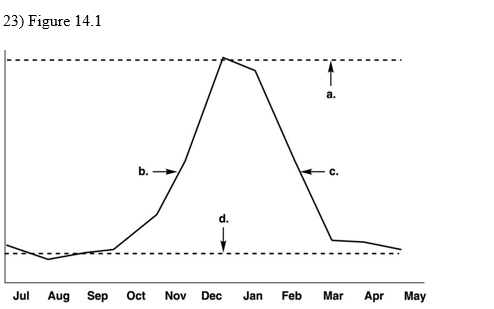 Figure 14.1 shows the incidence of influenza during a typical year. Which letter on the graph indicates the endemic level? A) a B) b C) c D) d E) The answer cannot be determined based on the information provided. | back 23 Answer: D |
front 24 24) Emergence of infectious diseases can be attributed to all of the following EXCEPT A) antibiotic resistance. B) climatic changes. C) new strains of previously known agents. D) ease of travel. E) The emergence of infectious diseases can be attributed to all of these. | back 24 Answer: E |
front 25 25) Which of the following pairs is mismatched? A) malaria — vector B) salmonellosis — vehicle transmission C) syphilis — direct contact D) influenza — droplet infection E) None of the pairs is mismatched. | back 25 Answer: E |
front 26 26) Which of the following can contribute to postoperative infections? A) using syringes more than once B) normal microbiota on the operating room staff C) errors in aseptic technique D) antibiotic resistance E) All of the answers are correct. | back 26 Answer: E |
front 27 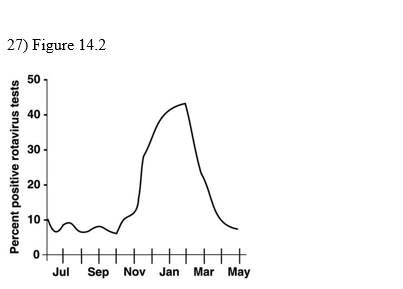 In Figure 14.2, when is the prevalence the highest? A) July B) January C) February D) March E) The answer cannot be determined based on the information provided. | back 27 Answer: C |
front 28 28) A cold transmitted by a facial tissue is an example of A) direct contact. B) droplet transmission. C) fomite. D) vector. E) vehicle transmission. | back 28 Answer: E |
front 29 29) A researcher has performed a prospective study on a disease. To which specific kind of epidemiological study is this referring? A) analytical B) case control C) descriptive D) experimental E) prodromal | back 29 Answer: C |
front 30 30) The CDC is located in A) Atlanta, GA. B) Washington, DC. C) New York City, NY. D) Los Angeles, CA. E) Chicago, IL. | back 30 Answer: A |
front 31 31) A disease in which the causative agent remains inactive for a time before producing symptoms is referred to as A) subacute. B) subclinical. C) latent. D) zoonotic. E) acute. | back 31 Answer: C |
front 32 32) A needlestick is an example of A) direct contact. B) droplet transmission. C) indirect contact transmission by fomite. D) direct biological transmission by vector. E) vehicle transmission. | back 32 Answer: C |
front 33 33) Which of the following is NOT a predisposing factor of disease? A) lifestyle B) genetic background C) climate D) occupation E) All of these are predisposing factors of disease. | back 33 Answer: E |
front 34 34) In which of the following diseases can gender be considered a viable predisposing factor? A) urinary tract infections B) pneumonia C) salmonellosis D) tetanus E) anthrax | back 34 Answer: A |
front 35 35) In which of the following patterns of disease does the patient experience no signs or symptoms? A) prodromal B) decline C) convalescence D) incubation E) both incubation and convalescence | back 35 Answer: E |
front 36 Situation 14.1 During a six-month period, 239 cases of pneumonia occurred in a town of 300 people. A clinical case was defined as fever ≥ 39°C lasting >2 days with three or more symptoms (i.e., chills, sweats, severe headache, cough, aching muscles/joints, fatigue, or feeling ill). A laboratory-confirmed case was defined as a positive result for antibodies against Coxiella burnetii. Before the outbreak, 2000 sheep were kept northwest of the town. Of the 20 sheep tested from the flock, 15 were positive for C. burnetii antibodies. Wind blew from the northwest, and rainfall was 0.5 cm compared with 7 to 10 cm during each of the previous three years. 36) Situation 14.1 is an example of
| back 36 Answer: B |
front 37 37) The etiologic agent of the disease in Situation 14.1 is A) sheep. B) soil. C) Coxiella burnetii. D) pneumonia. E) wind. | back 37 Answer: C |
front 38 38) The method of transmission of the disease in Situation 14.1 was A) direct contact. B) droplet. C) indirect contact. D) vector-borne. E) vehicle. | back 38 Answer: E |
front 39 39) Which of the following is NOT an example of microbial antagonism? A) acid production by bacteria B) bacteriocin production C) bacteria occupying host receptors D) bacteria causing disease E) bacteria producing vitamin K | back 39 Answer: D |
front 40 40) The yeast Candida albicans does not normally cause disease because of A) symbiotic bacteria. B) antagonistic bacteria. C) parasitic bacteria. D) commensal bacteria. E) other fungi. | back 40 Answer: B |
front 41 41) If a prodromal period exists for a certain disease, it should occur prior to A) incubation. B) illness. C) decline. D) convalescence. | back 41 Answer: B |
front 42 42) Which one of the following is NOT a zoonosis? A) cat-scratch disease B) Hantavirus pulmonary syndrome C) rabies D) tapeworm E) All of these are zoonoses. | back 42 Answer: E |
front 43 43) Pseudomonas bacteria colonized the bile duct of a patient following his liver transplant surgery. This is an example of a A) communicable disease. B) latent infection. C) nosocomial infection. D) sporadic disease. E) None of the answers is correct. | back 43 Answer: C |
front 44 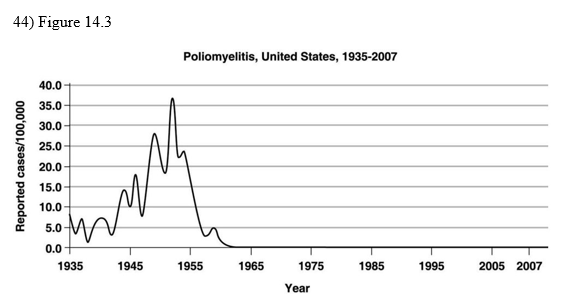 44) The graph in Figure 14.3 shows the incidence of polio in the United States. The period between 1945 and 1955 indicates a(n) A) endemic level. B) epidemic level. C) sporadic infection. D) communicable disease. E) pandemic. | back 44 Answer: B |
front 45 45) Which of the following statements is FALSE? A) Antimicrobial therapy for hemodialysis-associated infections increases antibiotic resistance. B) aureus is differentiated from other mannitol+ cocci by the coagulase test. C) The M in MRSA stands for mannitol. D) The USA100 strain accounts for most hospital-acquired MRSA. E) The USA300 strain accounts for most community-acquired MRSA. | back 45 Answer: C |
front 46 1) For a particular disease at a specific time period, morbidity rates should always be equal or greater than mortality rates. | back 46 Answer: TRUE |
front 47 2) Testing the effectiveness of a new drug for anthrax would be best performed as an experimental study. | back 47 Answer: TRUE |
front 48 3) MMWR is a publication by the CDC that reports on only emerging diseases. | back 48 Answer: FALSE |
front 49 4) A researcher only needs to select a cohort group when implementing an analytical epidemiological study. | back 49 Answer: FALSE |
front 50 5) Diseases that are referred to as emerging infectious diseases have only been discovered in the past fifty years. | back 50 Answer: FALSE |
front 51 6) Compromised hosts are always suffering from suppressed immune systems. | back 51 Answer: FALSE |
front 52 7) A host is not considered diseased until an infection changes one's state of health. | back 52 Answer: TRUE |
front 53 8) Reservoirs of infections are always animate objects. | back 53 Answer: FALSE |
front 54 9) Urinary tract infections are the most common forms of nosocomial infections. | back 54 Answer: FALSE |
front 55 10) Both normal and transient flora can become opportunistic pathogens. | back 55 Answer: TRUE |