front 5 ) There is still some controversy among biologists about whether
Neanderthals should be
placed within the same species as modern
humans, or into a separate species of their own.
Most DNA
sequence data analyzed so far indicate that there was probably little
or no gene
flow between Neanderthals and Homo sapiens. Which
species concept is most applicable in
this example?
A)
phylogenetic
B) ecological
C) morphological
D) biological | |
front 6 A biologist discovers two populations of wolf spiders whose members
appear identical.
Members of one population are found in the leaf
litter deep within the woods. Members of
the other population are
found in the grass at the edge of the woods. The biologist
decides
to designate the members of the two populations as two
separate species. Which species
concept is this biologist most
closely utilizing?
A) ecological
B) biological
C)
morphological
D) phylogenetic | |
front 7 What was the species concept most used by Linnaeus?
A)
biological
B) morphological
C) ecological
D) phylogenetic | |
front 8 You are confronted with a box of preserved grasshoppers of various
species that are new to
science and have not been described. Your
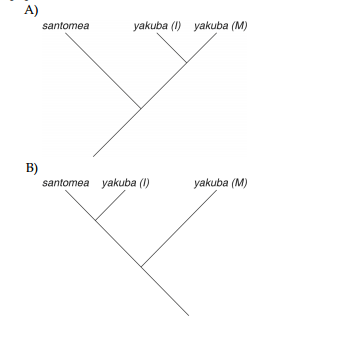
assignment is to separate them into species.
There is no
accompanying information as to where or when they were collected.
Which
species concept will you have to use?
A)
biological
B) phylogenetic
C) ecological
D) morphological | |
front 9 Several closely related frog species of the genus Rana are found in
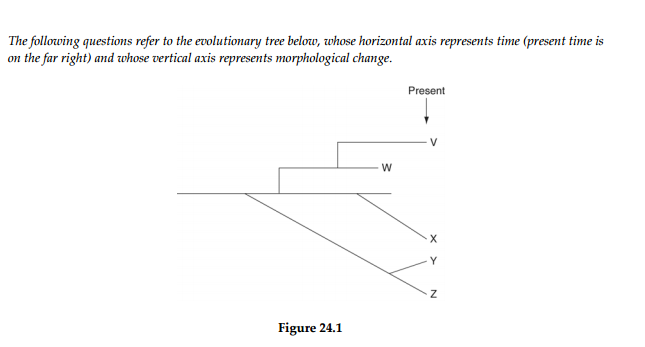
the forests of the southeastern United
States. The species
boundaries are maintained by reproductive barriers. In each case,
match the various
descriptions of frogs below with the
appropriate reproductive barrier listed.
Males of one species sing only when its predators are absent; males
of another species sing
only when its predators are
present.
A) behavioral
B) gametic
C) habitat
D)
temporal
E) mechanical | |
front 10 Several closely related frog species of the genus Rana are found in
the forests of the southeastern United
States. The species
boundaries are maintained by reproductive barriers. In each case,
match the various
descriptions of frogs below with the
appropriate reproductive barrier listed.
One species lives only in tree holes; another species lives only in
streams.
A) behavioral
B) gametic
C) habitat
D)
temporal
E) mechanical | |
front 11 Several closely related frog species of the genus Rana are found in
the forests of the southeastern United
States. The species
boundaries are maintained by reproductive barriers. In each case,
match the various
descriptions of frogs below with the
appropriate reproductive barrier listed.
Females of one species choose mates based on song quality; females
of another species
choose mates on the basis of size.
A)
behavioral
B) gametic
C) habitat
D) temporal
E) mechanical | |
front 12 Several closely related frog species of the genus Rana are found in
the forests of the southeastern United
States. The species
boundaries are maintained by reproductive barriers. In each case,
match the various
descriptions of frogs below with the
appropriate reproductive barrier listed.
One species mates at the season when daylight is increasing from 13
hours to 13 hours, 15
minutes; another species mates at the
season when daylight is increasing from 14 hours to
14 hours, 15
minutes.
A) behavioral
B) gametic
C) habitat
D)
temporal
E) mechanical | |
front 13 Several closely related frog species of the genus Rana are found in
the forests of the southeastern United
States. The species
boundaries are maintained by reproductive barriers. In each case,
match the various
descriptions of frogs below with the
appropriate reproductive barrier listed.
) Males of one species are too small to perform amplexus (an action
that stimulates
ovulation) with females of all other
species.
A) behavioral
B) gametic
C) habitat
D)
temporal
E) mechanical | |
front 14 Dog breeders maintain the purity of breeds by keeping dogs of
different breeds apart when
they are fertile. This kind of
isolation is most similar to which of the following
reproductive
isolating mechanisms?
A) reduced hybrid
fertility
B) hybrid breakdown
C) mechanical
isolation
D) habitat isolation
E) gametic isolation | |
front 15 Rank the following from most general to most specific:
1.
gametic isolation
2. reproductive isolating mechanism
3.
pollen-stigma incompatibility
4. prezygotic isolating
mechanism
A) 2, 3, 1, 4
B) 2, 4, 1, 3
C) 4, 1, 2,
3
D) 4, 2, 1, 3
E) 2, 1, 4, 3 | |
front 16 Two species of frogs belonging to the same genus occasionally mate,
but the offspring fail
to develop and hatch. What is the
mechanism for keeping the two frog species separate?
A) the
postzygotic barrier called hybrid inviability
B) the postzygotic
barrier called hybrid breakdown
C) the prezygotic barrier called
hybrid sterility
D) gametic isolation
E) adaptation | |
front 17 ) Theoretically, the production of sterile mules by interbreeding
between female horses and
male donkeys should
A) result in
the extinction of one of the two parental species.
B) cause
convergent evolution.
C) strengthen postzygotic barriers between
horses and donkeys.
D) weaken the intrinsic reproductive barriers
between horses and donkeys.
E) eventually result in the formation
of a single species from the two parental species. | |
front 18 The biological species concept is inadequate for grouping
A)
plants.
B) parasites.
C) asexual organisms.
D) animals
that migrate.
E) sympatric populations. | |
front 19 Which example below will most likely guarantee that two closely
related species will
persist only as distinct biological
species?
A) colonization of new habitats
B) convergent
evolution
C) hybridization
D) geographic isolation from one
another
E) reproductive isolation from one another | |
front 20 Races of humans are unlikely to evolve extensive differences in the
future for which of the
following reasons?
I. The
environment is unlikely to change.
II. Human evolution is
complete.
III. The human races are incompletely isolated.
A)
I only
B) III only
C) I and II only
D) II and III
only
E) I, II, and III | |
front 21 In a hypothetical situation, a certain species of flea feeds only on
pronghorn antelopes. In
rangelands of the western United States,
pronghorns and cattle often associate with one
another. If some
of these fleas develop a strong preference, instead, for cattle blood
and
mate only with fleas that, likewise, prefer cattle blood,
then over time which of these should
occur, if the host mammal
can be considered as the fleasʹ habitat?
1. reproductive
isolation
2. sympatric speciation
3. habitat
isolation
4. prezygotic barriers
A) 1 only
B) 2 and
3
C) 1, 2, and 3
D) 2, 3, and 4
E) 1 through 4 | |
front 22 ) A defining characteristic of allopatric speciation is
A) the
appearance of new species in the midst of old ones.
B) asexually
reproducing populations.
C) geographic isolation.
D)
artificial selection.
E) large populations. | |
front 23 A rapid method of speciation that has been important in the history
of flowering plants is
A) genetic drift.
B) a mutation in
the gene controlling the timing of flowering.
C) behavioral
isolation.
D) polyploidy. | |
front 24 Two closely related populations of mice have been separated for many
generations by a
river. Climatic change causes the river to dry
up, thereby bringing the mice populations
back into contact in a
zone of overlap. Which of the following is not a possible
outcome
when they meet?
A) They interbreed freely and
produce fertile hybrid offspring.
B) They no longer attempt to
interbreed.
C) They interbreed in the region of overlap,
producing an inferior hybrid. Subsequent
interbreeding between
inferior hybrids produces progressively superior hybrids
over
several generations.
D) They remain separate in the
extremes of their ranges but develop a persistent hybrid
zone in
the area of overlap.
E) They interbreed in the region of overlap,
but produce sterile offspring. | |
front 25 ) The difference between geographic isolation and habitat
differentiation is the
A) relative locations of two populations
as speciation occurs.
B) speed (tempo) at which two populations
undergo speciation.
C) amount of genetic variation that occurs
among two gene pools as speciation occurs.
D) identity of the
phylogenetic kingdom or domain in which these phenomena occur.
E)
the ploidy of the two populations as speciation occurs. | |
front 26 Among known plant species, which of these have been the two most
commonly occurring
phenomena leading to the origin of new
species?
1. allopatric speciation
2. sympatric
speciation
3. sexual selection
4. polyploidy
A) 1 and
3
B) 1 and 4
C) 2 and 3
D) 2 and 4 | |
front 27 Beetle pollinators of a particular plant are attracted to its
flowersʹ bright orange color. The
beetles not only pollinate the
flowers, but they mate while inside of the flowers. A
mutant
version of the plant with red flowers becomes more common
with the passage of time. A
particular variant of the beetle
prefers the red flowers to the orange flowers. Over time,
these
two beetle variants diverge from each other to such an extent that
interbreeding is no
longer possible. What kind of speciation has
occurred in this example, and what has driven
it?
A)
allopatric speciation, ecological isolation
B) sympatric
speciation, habitat differentiation
C) allopatric speciation,
behavioral isolation
D) sympatric speciation, sexual
selection
E) sympatric speciation, allopolyploidy | |
front 28 The origin of a new plant species by hybridization, coupled with
accidents during nuclear
division, is an example of
A)
allopatric speciation.
B) sympatric speciation.
C)
autopolyploidy.
D) habitat selection. | |
front 29 The phenomenon of fusion is likely to occur when, after a period of
geographic isolation,
two populations meet again and
A)
their chromosomes are no longer homologous enough to permit
meiosis.
B) a constant number of viable, fertile hybrids is
produced over the course of
generations.
C) the hybrid zone
is inhospitable to hybrid survival.
D) an increasing number of
viable, fertile hybrids is produced over the course
of
generations
E) a decreasing number of viable, fertile
hybrids is produced over the course of
generations. | |
front 30 The constantly changing nature of the Appalachian ground crickets
(Allonemobius fasciatus
and Allonemobius socius) hybrid zone
favors
A) no gene flow between the two gene pools.
B) little
gene flow between the two gene pools.
C) increased levels of gene
flow between the two gene pools.
D) extinction of both species as
the hybrids persist. | |
front 31 A hybrid zone is properly defined as
A) an area where two
closely related speciesʹ ranges overlap.
B) an area where mating
occurs between members of two closely related species,
producing
viable offspring.
C) a zone that features a gradual change in
species composition where two neighboring
ecosystems border each
other.
D) a zone that includes the intermediate portion of a
cline.
E) an area where members of two closely related species
intermingle, but experience no
gene flow. | |
front 32 Which of these should decline in hybrid zones where reinforcement is
occurring?
A) gene flow between distinct gene pools
B)
speciation
C) the genetic distinctness of two gene pools
D)
mutation rate
E) hybrid sterility | |
front 33 The most likely explanation for the high rate of sympatric speciation
that apparently
existed among the cichlids of Lake Victoria in
the past is
A) sexual selection.
B) habitat
differentiation.
C) polyploidy.
D) pollution.
E)
introduction of a new predator. | |
front 34 The most likely explanation for the recent decline in cichlid species
diversity in Lake
Victoria is
A) reinforcement.
B)
fusion.
C) stability.
D) geographic isolation.
E) polyploidy. | |
front 35 In the narrow hybrid zone that separates the toad species Bombina
bombina and Bombina
variegata, what is true of those alleles that
are unique to the parental species?
A) Such alleles should be
absent.
B) Their allele frequency should be nearly the same as
the allele frequencies in toad
populations distant from the
hybrid zone.
C) The allelesʹ heterozygosity should be higher
among the hybrid toads there.
D) Their allele frequency on one
edge of the hybrid zone should roughly equal their
frequency on
the opposite edge of the hybrid zone. | |
front 36 On the volcanic, equatorial West African island of Sao Tomé, two
species of fruit fly exist. Drosophila
yakuba inhabits the
islandʹs lowlands, and is also found on the African mainland, located
about 200 miles
away. At higher elevations, and found only on Sao
Tomé, is found the very closely related Drosophila
santomea. The
two species can hybridize, though male hybrids are sterile. A hybrid
zone exists at middle
elevations, though hybrids there are
greatly outnumbered by D. santomea. Studies of the two
speciesʹ
nuclear genomes reveal that D. yakuba on the island is
more closely related to mainland D. yakuba than to
D. santomea
(2n=4 in both species). Sao Tomé rose from the Atlantic Ocean about 14
million years ago.
Which of these reduces gene flow between the gene pools of the two
species on Sao Tomé,
despite the existence of hybrids?
A)
hybrid breakdown
B) hybrid inviability
C) hybrid
sterility
D) temporal isolation
E) a geographic barrier | |
front 37 On the volcanic, equatorial West African island of Sao Tomé, two
species of fruit fly exist. Drosophila
yakuba inhabits the
islandʹs lowlands, and is also found on the African mainland, located
about 200 miles
away. At higher elevations, and found only on Sao
Tomé, is found the very closely related Drosophila
santomea. The
two species can hybridize, though male hybrids are sterile. A hybrid
zone exists at middle
elevations, though hybrids there are
greatly outnumbered by D. santomea. Studies of the two
speciesʹ
nuclear genomes reveal that D. yakuba on the island is
more closely related to mainland D. yakuba than to
D. santomea
(2n=4 in both species). Sao Tomé rose from the Atlantic Ocean about 14
million years ago.
The observation that island D. yakuba are more closely related to
mainland D. yakuba than
island D. yakuba are to D. santomea is
best explained by proposing that D. santomea
A) descended from a
now-extinct, non-African fruit fly.
B) arose de novo; that is,
had no ancestors.
C) descended from a single colony of D. yakuba,
which had been introduced from
elsewhere, with no subsequent
colonization events.
D) descended from an original colony of D.
yakuba, of which there are no surviving
members. The current
island D. yakuba represent a second colonization event from
elsewhere. | |
front 38 On the volcanic, equatorial West African island of Sao Tomé, two
species of fruit fly exist. Drosophila
yakuba inhabits the
islandʹs lowlands, and is also found on the African mainland, located
about 200 miles
away. At higher elevations, and found only on Sao
Tomé, is found the very closely related Drosophila
santomea. The
two species can hybridize, though male hybrids are sterile. A hybrid
zone exists at middle
elevations, though hybrids there are
greatly outnumbered by D. santomea. Studies of the two
speciesʹ
nuclear genomes reveal that D. yakuba on the island is
more closely related to mainland D. yakuba than to
D. santomea
(2n=4 in both species). Sao Tomé rose from the Atlantic Ocean about 14
million years ago.
If a speciation event occurred on Sao Tomé, producing D. santomea
from a parent colony of
D. yakuba, then which terms
apply?
I. macroevolution
II. allopatric speciation
III.
sympatric speciation
A) I only
B) II only
C) I &
II
D) I & III | |
front 39 On the volcanic, equatorial West African island of Sao Tomé, two
species of fruit fly exist. Drosophila
yakuba inhabits the
islandʹs lowlands, and is also found on the African mainland, located
about 200 miles
away. At higher elevations, and found only on Sao
Tomé, is found the very closely related Drosophila
santomea. The
two species can hybridize, though male hybrids are sterile. A hybrid
zone exists at middle
elevations, though hybrids there are
greatly outnumbered by D. santomea. Studies of the two
speciesʹ
nuclear genomes reveal that D. yakuba on the island is
more closely related to mainland D. yakuba than to
D. santomea
(2n=4 in both species). Sao Tomé rose from the Atlantic Ocean about 14
million years ago.
Using only the information provided in the paragraph, which of these
is the best initial
hypothesis for how D. santomea descended from
D. yakuba?
A) geographic isolation
B) autopolyploidy
C)
habitat differentiation
D) sexual selection
E) allopolyploidy | |
front 40 On the volcanic, equatorial West African island of Sao Tomé, two
species of fruit fly exist. Drosophila
yakuba inhabits the
islandʹs lowlands, and is also found on the African mainland, located
about 200 miles
away. At higher elevations, and found only on Sao
Tomé, is found the very closely related Drosophila
santomea. The
two species can hybridize, though male hybrids are sterile. A hybrid
zone exists at middle
elevations, though hybrids there are
greatly outnumbered by D. santomea. Studies of the two
speciesʹ
nuclear genomes reveal that D. yakuba on the island is
more closely related to mainland D. yakuba than to
D. santomea
(2n=4 in both species). Sao Tomé rose from the Atlantic Ocean about 14
million years ago.
Which of these evolutionary trees represents the situation described
in the paragraph above
(NOTE: yakuba (I) represents the island
population, and yakuba (M) represents the mainland
population)? | |
front 41 On the volcanic, equatorial West African island of Sao Tomé, two
species of fruit fly exist. Drosophila
yakuba inhabits the
islandʹs lowlands, and is also found on the African mainland, located
about 200 miles
away. At higher elevations, and found only on Sao
Tomé, is found the very closely related Drosophila
santomea. The
two species can hybridize, though male hybrids are sterile. A hybrid
zone exists at middle
elevations, though hybrids there are
greatly outnumbered by D. santomea. Studies of the two
speciesʹ
nuclear genomes reveal that D. yakuba on the island is
more closely related to mainland D. yakuba than to
D. santomea
(2n=4 in both species). Sao Tomé rose from the Atlantic Ocean about 14
million years ago.
) If the low number of hybrid flies in the hybrid zone, relative to
the number of D. santomea
flies there, is due to the fact that
hybrids are poorly adapted to conditions in the hybrid
zone, and
if fewer hybrid flies are produced with the passage of time, this is
most likely to
lead to
A) fusion.
B)
reinforcement.
C) stability.
D) further speciation events. | |
front 42 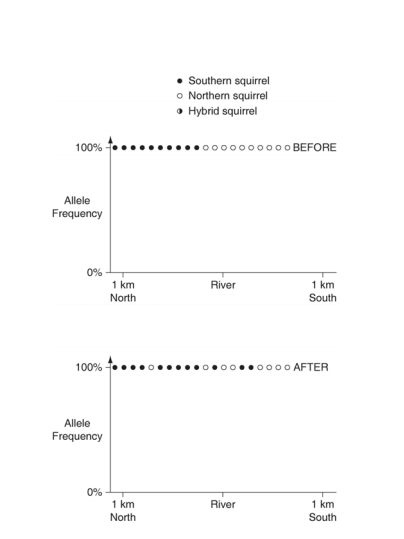 In a hypothetical situation, the National Park Service, which
administers Grand Canyon National Park in
Arizona, builds a
footbridge over the Colorado River at the bottom of the canyon. The
footbridge
permits interspersal of two closely related antelope
squirrels. Previously, one type of squirrel had been
restricted
to the terrain south of the river, and the other type had been
restricted to terrain on the north
side of the river. Immediately
before and ten years after the bridgeʹs completion, ten antelope
squirrels
from both sides of the river were collected, blood
samples were taken, and frequencies of alleles unique
to the two
types of antelope squirrels were determined (see graphs below).
The data in the graphs above indicate that
A) a hybrid zone was
established after the completion of the bridge.
B) no
interspersal of the two types of squirrel occurred after the
completion of the
bridge.
C) gene flow occurred from one
type of squirrel into the gene pool of the other type
of
squirrel.
D) 2-way migration of squirrels occurred across
the bridge, but without hybridization.
E) some northern squirrels
migrated south, but no southern squirrels migrated north
across
the bridge. | |
front 43 In a hypothetical situation, the National Park Service, which
administers Grand Canyon National Park in
Arizona, builds a
footbridge over the Colorado River at the bottom of the canyon. The
footbridge
permits interspersal of two closely related antelope
squirrels. Previously, one type of squirrel had been
restricted
to the terrain south of the river, and the other type had been
restricted to terrain on the north
side of the river. Immediately
before and ten years after the bridgeʹs completion, ten antelope
squirrels
from both sides of the river were collected, blood
samples were taken, and frequencies of alleles unique
to the two
types of antelope squirrels were determined (see graphs below).
) The results depicted in the graphs above are best accounted for by
which of the following
facts?
A) The Colorado River has been
an effective geographic barrier to these two types of
squirrels
for several million years.
B) There is more white fur on the
tails of the northern squirrels than on the tails of the
southern
squirrels.
C) Both types of squirrel subsist largely on a diet of
pine nuts and juniper seeds in this
ecosystem.
D) Both types
of squirrel share the same common ancestor.
E) Both types of
squirrel are active during the day. | |
front 44 According to the concept of punctuated equilibrium, the ʺsuddenʺ
appearance of a new
species in the fossil record means
that
A) the species is now extinct.
B) speciation occurred
instantaneously.
C) speciation occurred in one
generation.
D) speciation occurred rapidly in geologic
time.
E) the species will consequently have a relatively short
existence, compared with other
species. | |
front 45 According to the concept of punctuated equilibrium,
A) natural
selection is unimportant as a mechanism of evolution.
B) given
enough time, most existing species will branch gradually into new
species.
C) a new species accumulates most of its unique features
as it comes into existence.
D) evolution of new species features
long periods during which changes are occurring,
interspersed
with short periods of equilibrium, or stasis.
E) transitional
fossils, intermediate between newer species and their parent
species,
should be abundant. | |
front 46 ) Which of the following would be a position held by an adherent of
the punctuated
equilibrium theory?
A) A new species forms
most of its unique features as it comes into existence and
then
changes little for the duration of its existence.
B)
One should expect to find many transitional fossils left by organisms
in the process of
forming new species.
C) Given enough time,
most existing species will gradually evolve into new species.
D)
Natural selection is unimportant as a mechanism of evolution. | |
front 47 Speciation
A) occurs at such a slow pace that no one has ever
observed the emergence of new
species.
B) occurs only by the
accumulation of genetic change over vast expanses of time.
C)
must begin with the geographic isolation of a small, frontier
population.
D) proceeds at a uniform tempo across all
taxa.
E) can involve changes involving a single gene. | |
front 48 Which of the following statements about speciation is
correct?
A) The goal of natural selection is speciation.
B)
When reunited, two allopatric populations will not interbreed.
C)
Natural selection chooses the reproductive barriers for
populations.
D) Prezygotic reproductive barriers usually evolve
before postzygotic barriers.
E) Speciation is a basis for
understanding macroevolution. | |
front 49 ) Upon undergoing change, which of these genes is most likely to
result in speciation while a
geographic barrier separates two
populations of a flowering-plant species?
A) one that affects the
rate of chlorophyll a synthesis
B) one that affects the amount of
growth hormone synthesized per unit time
C) one that affects the
compatibility of male pollen and female reproductive parts
D) one
that affects the average depth to which roots grow down through the
soil
E) one that affects how flexible the stems are | |
front 50 In order for speciation to occur, what is true?
A) The number of
chromosomes in the genome must change.
B) Changes to centromere
location or chromosome size must occur within the genome.
C)
Large numbers of genes that affect a single phenotypic trait must
change.
D) Large numbers of genes that affect numerous phenotypic
traits must change.
E) At least one gene, affecting at least one
phenotypic trait, must change. | |
front 51 Which of these five species (V—Z) in the evolutionary tree would
likely have fossil records
indicating that punctuated equilibrium
was an important part of their evolutionary history?
A) V and
W
B) V and Y
C) X and Y
D) W, Y, and Z
E) X, Y,
and Z | |
front 52 Which of these five species originated earliest and appeared suddenly
in the fossil record?
A) V
B) W
C) X
D) Y
E) Z | |
front 53 Which conclusion can be drawn from this evolutionary tree?
A)
Gradualistic speciation and speciation involving punctuated
equilibrium are mutually
exclusive concepts; only one of them can
occur.
B) Eldredge and Gould would deny that the lineages labeled
X, Y, and Z could represent
true species.
C) Assuming that
the tip of each line represents a species, there are five extant
(i.e., not
extinct) species resulting from the earliest common
ancestor.
D) A single clade (i.e., a group of species that share
a common ancestor) can exhibit both
gradualism and punctuated
equilibrium.
E) V and W shared a common ancestor more recently
than any of the other species. | |
front 54 Which of these five species is the extant (i.e., not extinct) species
that is most closely related
to species X, and why is this
so?
A) V; shared a common ancestor with X most recently
B)
W; shared a common ancestor with X most recently
C) Y; arose in
the same fashion (i.e., at the same tempo) as X
D) Z; shared a
common ancestor with X most recently, and arose in the same fashion as
X
E) This tree does not provide enough information to answer this question. | |
front 55 The largest unit within which gene flow can readily occur is
a
A) population.
B) species.
C) genus.
D)
hybrid.
E) phylum. | |
front 56 Bird guides once listed the myrtle warbler and Audubonʹs warbler as
distinct species.
Recently, these birds have been classified as
eastern and western forms of a single species,
the yellow-rumped
warbler. Which of the following pieces of evidence, if true, would
be
cause for this reclassification?
A) The two forms
interbreed often in nature, and their offspring have good survival
and
reproduction.
B) The two forms live in similar
habitats.
C) The two forms have many genes in common.
D) The
two forms have similar food requirements.
E) The two forms are
very similar in coloration. | |
front 57 Males of different species of the fruit fly Drosophila that live in
the same parts of the
Hawaiian islands have different elaborate
courtship rituals that involve fighting other
males and stylized
movements that attract females. What type of reproductive
isolation
does this represent?
A) habitat isolation
B)
temporal isolation
C) behavioral isolation
D) gametic
isolation
E) postzygotic barriers | |
front 58 Which of the following factors would not contribute to allopatric
speciation?
A) A population becomes geographically isolated from
the parent population.
B) The separated population is small, and
genetic drift occurs.
C) The isolated population is exposed to
different selection pressures than the
ancestral
population.
D) Different mutations begin to
distinguish the gene pools of the separated populations.
E) Gene
flow between the two populations is extensive. | |
front 59 ) Plant species A has a diploid number of 12. Plant species B has a
diploid number of 16. A
new species, C, arises as an
allopolyploid from A and B. The diploid number for species
C
would probably be
A) 12.
B) 14.
C) 16.
D)
28.
E) 56. | |
front 60 ) According to the punctuated equilibria model,
A) natural
selection is unimportant as a mechanism of evolution.
B) given
enough time, most existing species will branch gradually into new
species.
C) most new species accumulate their unique features
relatively rapidly as they come
into existence, then change
little for the rest of their duration as a species.
D) most
evolution occurs in sympatric populations.
E) speciation is
usually due to a single mutation. | |