Instructions for Side by Side Printing
- Print the notecards
- Fold each page in half along the solid vertical line
- Cut out the notecards by cutting along each horizontal dotted line
- Optional: Glue, tape or staple the ends of each notecard together
Chapter 7
front 1 1) Which of the following is the best method to sterilize heat-labile solutions? A) dry heat B) autoclave C) membrane filtration D) pasteurization E) freezing | back 1 Answer: C |
front 2 2) Which of the following best describes the pattern of microbial death? A) The cells in a population die at a constant rate. B) All the cells in a culture die at once. C) Not all of the cells in a culture are killed. D) The pattern varies depending on the antimicrobial agent. E) The pattern varies depending on the species. | back 2 Answer: A |
front 3 3) Which of the following chemical agents is used for sterilization? A) alcohol B) phenolics C) ethylene oxide D) chlorine E) soap | back 3 Answer: C |
front 4 4) Which of the following substances is used for surgical hand scrubs? A) phenol B) chlorine bleach C) chlorhexidine D) soap E) glutaraldehyde | back 4 Answer: C |
front 5 5) Which of the following pairs of terms is mismatched? A) bacteriostatic — kills vegetative bacterial cells B) germicide — kills microbes C) virucide — inactivates viruses D) sterilant — destroys all living microorganisms E) fungicide — kills yeasts and molds | back 5 Answer: A |
front 6 6) The antimicrobial activity of chlorine is due to which of the following? A) the formation of hypochlorous acid B) the formation of hydrochloric acid C) the formation of ozone D) the formation of a hypochlorite ion E) disruption of the plasma membrane | back 6 Answer: A |
front 7 7) Which of the following regarding antimicrobial control agents is FALSE? A) Contaminating organic debris such as blood or sputum decrease effectiveness. B) Some agents kill by denaturing microbial cell proteins. C) Some agents affect microbial cell membranes by dissolving lipids. D) Silver is used for treating antibiotic-resistant bacteria. E) Alcohols effectively inactivate nonenveloped viruses by attacking lipids. | back 7 Answer: E |
front 8 8) Which of the following does NOT achieve sterilization? A) dry heat B) pasteurization C) autoclave D) supercritical fluids E) ethylene oxide | back 8 Answer: B |
front 9 9) Which of the following is a limitation of the autoclave? A) It requires an excessively long time to achieve sterilization. B) It cannot inactivate viruses. C) It cannot kill endospores. D) It cannot be used with heat-labile materials. E) It cannot be used with glassware. | back 9 Answer: D |
front 10 10) An agent used to reduce the number of bacteria on a toilet would most accurately be called a(n) A) disinfectant. B) antiseptic. C) aseptic. D) fungicide. E) virucide. | back 10 Answer: A |
front 11 11) Application of heat to living cells can result in all of the following EXCEPT A) breaking of hydrogen bonds. B) alteration of membrane permeability. C) denaturation of enzymes. D) decreased thermal death time. E) damage to nucleic acids. | back 11 Answer: D |
front 12 12) Which of the following disinfectants acts by disrupting the plasma membrane? A) soaps B) aldehydes C) bisphenols D) halogens E) heavy metals | back 12 Answer: C |
front 13 13) Oxidizing agents include all of the following EXCEPT A) chlorine. B) glutaraldehyde. C) hydrogen peroxide. D) iodine. E) ozone. | back 13 Answer: B |
front 14 14) Disinfection of water is achieved by all of the following EXCEPT A) ozone. B) UV radiation. C) chlorine. D) copper sulfate. E) peracetic acid. | back 14 Answer: E |
front 15 15) All of the following substances are effective against nonenveloped viruses EXCEPT A) alcohol. B) chlorine. C) ethylene oxide. D) ozone. E) None of the answers is correct; all of these are equally effective against nonenveloped viruses. | back 15 Answer: A |
front 16 16) Which of the following methods is used to preserve food by slowing the metabolic processes of foodborne microbes? A) lyophilization B) nonionizing radiation C) freezing D) ionizing radiation E) pasteurization | back 16 Answer: C |
front 17 17) Which concentration of ethanol is the most effective bactericide? A) 100 percent B) 70 percent C) 50 percent D) 40 percent E) 30 percent | back 17 Answer: B |
front 18 18) All of the following factors contribute to hospital-acquired infections EXCEPT A) some bacteria metabolize disinfectants. B) gram-negative bacteria are often resistant to disinfectants. C) invasive procedures can provide a portal of entry for bacteria. D) bacteria may be present in commercial products such as mouthwash. E) None of the answers is correct; all of these factors may contribute to hospital-acquired infection. | back 18 Answer: E |
front 19 19) Which of the following treatments is the most effective for controlling microbial growth? A) 63°C for 30 minutes B) 72°C for 15 seconds C) 140°C for 4 seconds D) They are equivalent treatments. E) None of the answers is correct. | back 19 Answer: D |
front 20 20) Which of the following could be used to sterilize plastic Petri plates in a plastic wrapper? A) autoclave B) gamma radiation C) microwaves D) sunlight E) ultraviolet radiation | back 20 Answer: B |
front 21 21) Which of the following regarding antimicrobial control agents is FALSE? A) Contaminating organic debris such as blood or sputum will decrease effectiveness. B) Some agents kill by denaturing microbial cell proteins. C) Some agents affect microbial cell membranes by dissolving lipids. D) Some agents are utilized as both an antiseptic and a disinfectant. E) A true antimicrobial control agent is equally effective against both bacteria and viruses. | back 21 Answer: E |
front 22 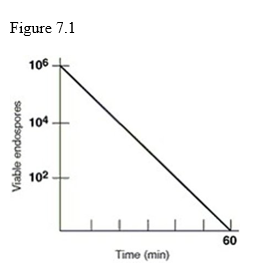 A suspension of 106 Bacillus cereus endospores was put in a hot-air oven at 170°C. Plate counts were used to determine the number of endospores surviving at the time intervals shown. 22) In Figure 7.1, what is the thermal death time? A) 150°C B) 60 minutes C) 120 minutes D) 100°C E) The answer cannot be determined based on the information provided. | back 22 Answer: B |
front 23 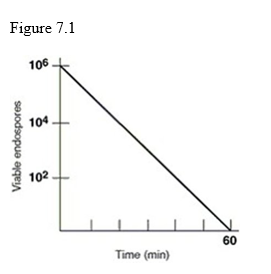 23) In Figure 7.1, the thermal death point for this culture is
| back 23 Answer: E |
front 24 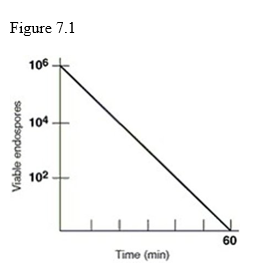 24) In Figure 7.1, the decimal reduction time (D value) for the culture, which is defined as the time to reduce a population by one log, is approximately A) 0 minutes. B) 10 minutes. C) 30 minutes. D) 40 minutes. E) 60 minutes. | back 24 Answer: B |
front 25 25) Which of the following results in lethal damage to nucleic acids? A) heat B) radiation C) certain chemicals D) heat and radiation E) heat, radiation, and some chemicals | back 25 Answer: E |
front 26 26) Which of the following pairs is mismatched? A) Ag — wound dressings B) alcohols — open wounds C) CuSO4— algicide D) H2O2— open wounds E) organic acids — food preservation | back 26 Answer: B |
front 27 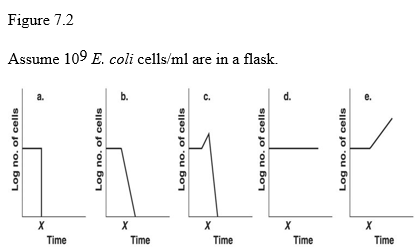 27) Which graph in Figure 7.2 best depicts the effect of placing the culture in an autoclave for 15 minutes at time x? A) a B) b C) c D) d E) e | back 27 Answer: B |
front 28 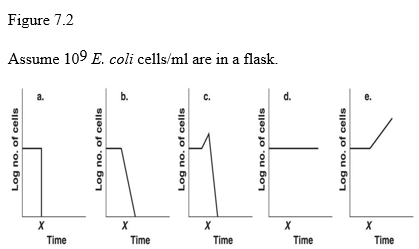 28) Which graph in Figure 7.2 best depicts the effect of placing the culture at 7°C at time x? A) a B) b C) c D) d E) e | back 28 Answer: D |
front 29 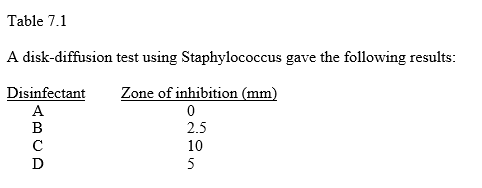 29) In Table 7.1, which compound was the most effective against Staphylococcus? A) A B) B C) C D) D E) The answer cannot be determined based on the information provided. | back 29 Answer: C |
front 30 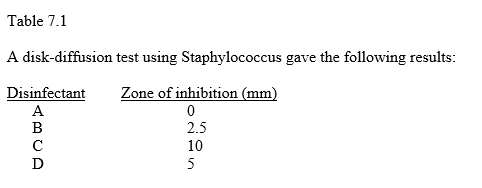 30) In Table 7.1, which compound was the most effective against E. coli? A) A B) B C) C D) D E) The answer cannot be determined based on the information provided. | back 30 Answer: E |
front 31 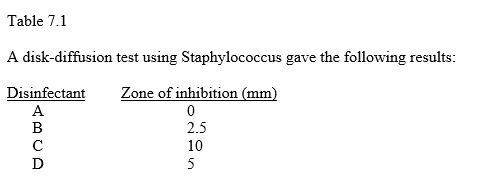 31) In Table 7.1, which compound was bactericidal? A) A B) B C) C D) D E) The answer cannot be determined based on the information provided. | back 31 Answer: E |
front 32 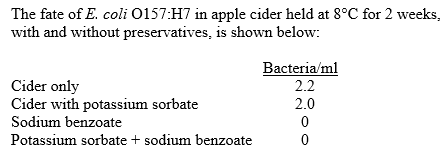 32) In Table 7.2, which preservative is most effective? A) potassium sorbate B) sodium benzoate C) potassium sorbate + sodium benzoate D) no preservative | back 32 Answer: B |
front 33 33) An iodophor is a(n) A) phenol. B) agent that reduces oxygen. C) quaternary ammonium compound. D) form of formaldehyde. E) iodine mixed with a surfactant. | back 33 Answer: E |
front 34 34) Ethylene oxide A) is a good antiseptic. B) is not sporicidal. C) requires high heat to be effective. D) is a sterilizing agent. E) is the active chemical in household bleach. | back 34 Answer: D |
front 35 35) All of the following substances are used to preserve foods EXCEPT A) biguanides. B) nisin. C) potassium sorbate. D) sodium nitrite. E) calcium propionate. | back 35 Answer: A |
front 36 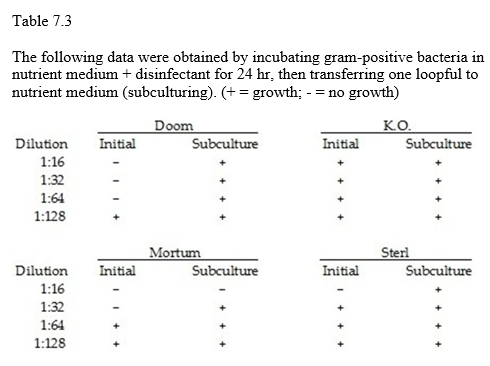 36) In Table 7.3, which disinfectant is the most effective at stopping bacterial growth? A) Doom B) K.O. C) Mortum D) Sterl E) The answer cannot be determined based on the information provided. | back 36 Answer: A |
front 37 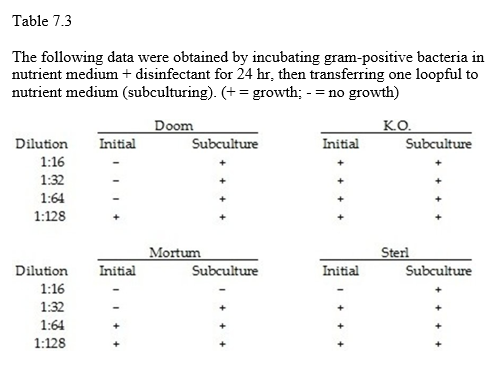 37) In Table 7.3, which disinfectant was bactericidal?
| back 37 Answer: C |
front 38 38) In Table 7.3, which disinfectant was most effective against Salmonella? A) Doom B) K.O. C) Mortum D) Sterl E) The answer cannot be determined based on the information provided. | back 38 Answer: E |
front 39 39) All of the following are effective for destroying prions EXCEPT A) boiling. B) incineration. C) NaOH + autoclaving at 134°C. D) proteases. E) None of the answers are correct; each of these will destroy prions. | back 39 Answer: A |
front 40 40) Which of the following pairs is mismatched? A) ionizing radiation — hydroxyl radicals B) ozone — takes electrons from substances C) plasma sterilization — free radicals D) supercritical fluids — CO2 E) ultraviolet radiation — desiccation | back 40 Answer: E |
front 41 41) All of the following are methods of food preservation EXCEPT A) desiccation. B) high pressure. C) ionizing radiation. D) microwaves. E) osmotic pressure. | back 41 Answer: D |
front 42 42) The preservation of beef jerky from microbial growth relies on which method of microbial control? A) filtration B) lyophilization C) desiccation D) ionizing radiation E) supercritical CO2 | back 42 Answer: C |
front 43 43) If you were preparing nutrient agar at home and did not have an autoclave, what could you use to sterilize the nutrient agar? A) bleach B) boiling for one hour C) hydrogen peroxide D) oven at 121°C for one hour E) pressure cooker at 121°C for 15 minutes | back 43 Answer: E |
front 44 44) Bone and tendons for transplant are decontaminated by A) ethylene oxide. B) glutaraldehyde. C) peroxygens. D) plasma sterilization. E) supercritical fluids. | back 44 Answer: E |
front 45 45) Which one of the following is most resistant to chemical biocides?
| back 45 Answer: A |
front 46 46) The following is true of quarternary ammonium compounds EXCEPT A) they are non-toxic at lower concentrations. B) they are tasteless. C) they are effective when combined with soaps. D) they are stable. E) they may be an ingredient in mouthwash. | back 46 Answer: C |