Instructions for Side by Side Printing
- Print the notecards
- Fold each page in half along the solid vertical line
- Cut out the notecards by cutting along each horizontal dotted line
- Optional: Glue, tape or staple the ends of each notecard together
Chapter 21: The Immune System: Innate and Adaptive Body Defenses
front 1 What type of antigen are recognized by T Cells? A) Free Antigens B) Bacterial Antigens Only C) Cancer Antigens only D) Processed fragments of protein antigens displayed on surfaces of body cells | back 1 D) Processed fragments of protein antigens displayed on surfaces of body cells |
front 2 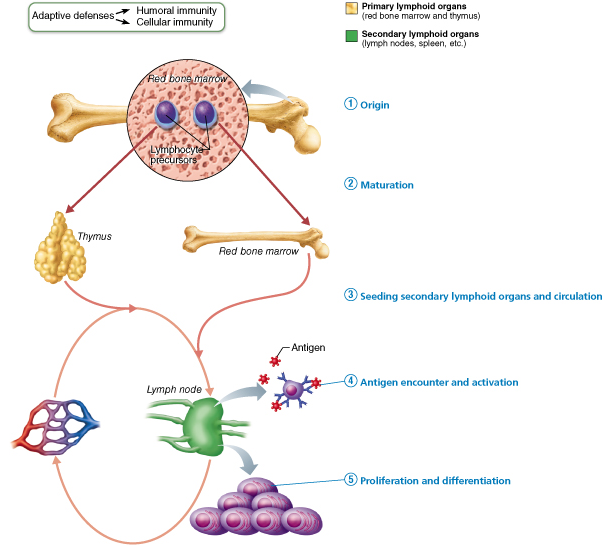 What are B and T cells called that have not yet been exposed to an antigen? A) Naive B) Immunocompetent C) Clone D) Self-Tolerant | back 2 A) Naive |
front 3 T cells achieve self-tolerance in the ___. A) Lymph Node B) Bone Marrow C) Tonsils D) Thymus | back 3 D) Thymus **T cells learn and are screened for self-tolerance in the thymus. |
front 4 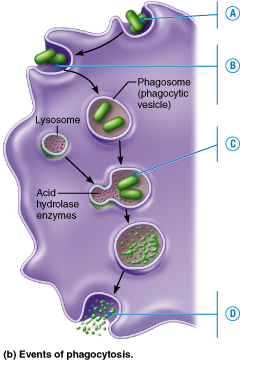 Which letter represents the adhesion of the phagocyte to the pathogen? Select from letters A-D. A B C D | back 4 A |
front 5 __________ immunity protects a baby who is fed breast milk. A) Natural active B) Artificial passive C) Artificial active D) Natural passive | back 5 D) Natural passive **Natural immunity is achieved through natural, non-manmade means. Natural passive immunity occurs when an individual gets antibodies from another source--they are not self-made. In the case of a nursing infant, the process is natural and the baby is protected by antibodies received from the mother. |
front 6 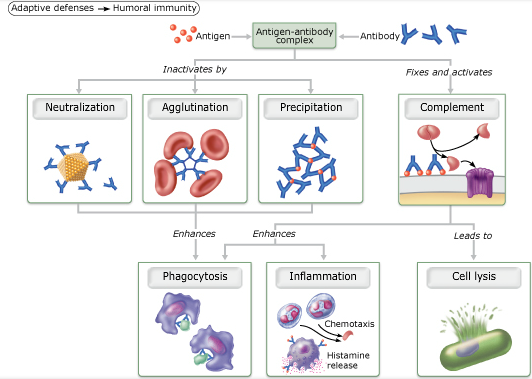 | back 6 no data |
front 7 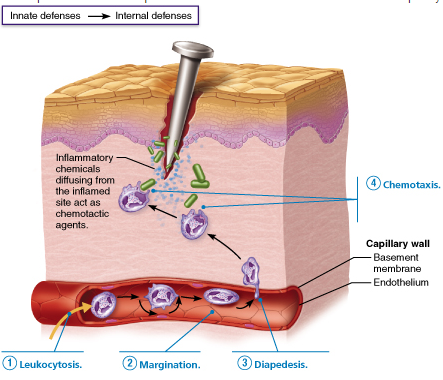 Neutrophils flatten and squeeze between the endothelial cells of the capillary walls during what process? A) leukocytosis B) margination C) diapedesis D) chemotaxis | back 7 C) diapedesis |
front 8 Which of the following cells predominate at the sites of chronic infections? A) Basophils B) Macrophages C) Eosinophils D) B cells | back 8 B) Macrophages |
front 9 B cells respond to the initial antigen challenge by ________. A) reducing its size B) forming of a large number of cells that are unlike the original B cell C) producing progeny cells that include plasma cells and memory cells D) immediately producing antigen-specific antibodies | back 9 C) producing progeny cells that include plasma cells and memory cells |
front 10 Which of the following cells is the most critical cell in immunity? A) B cell B) APC C) helper T cell D) cytotoxic T cell | back 10 C) helper T cell |
front 11 T/F: Fever is one of the cardinal signs of inflammation. | back 11 FALSE |
front 12 Which of the following statements is a false or incorrect statement? A) T cells and B cells become activated when they bind with recognized antigens. B) It is our genes, not antigens, that determine what specific foreign substances our immune system will be able to recognize and resist. C) The lymphoid organs where lymphocytes become immunocompetent are called primary lymph organs. All other lymphoid organs are referred to as secondary lymphoid organs. D) After becoming immunocompetent, the naive T cells and B cells are exported to the bone marrow where the encounters with antigens occur. | back 12 D) After becoming immunocompetent, the naive T cells and B cells are exported to the bone marrow where the encounters with antigens occur. |
front 13 Cellular immunity is attributed to the action of __________. A) T cells B) complement proteins C) interferons D) antibodies. | back 13 A) T cells |
front 14 Which of the following is not an autoimmune disease? A) multiple sclerosis B) systemic lupus erythematosus C) glomerulonephritis D) type II diabetes | back 14 D) type II diabetes |
front 15 Which of the following is characteristic of antibodies? A) three binding sites per antibody monomer B) composed of heavy and light polypeptide chains C) incapable of being transferred from one person to another D) carbohydrate structure | back 15 B) composed of heavy and light polypeptide chains |
front 16 What mobilizes the adaptive defenses and provokes an immune response? A) MHC proteins B) pyrogens C) interferons D) antigens | back 16 D) antigens **Antigens (anything the body recognizes as foreign) are substances that can mobilize the adaptive defenses and provoke an immune response. Antigens are the ultimate targets of all adaptive immune responses. |
front 17 Treatment of an abscess often requires that it be surgically drained because ______. A) the wall of the abscess prevents proper blood flow into the pus B) the wall of the abscess prevents proper elimination of wastes from the enclosed pus C) the wall of the abscess prevents neutrophils from entering the pus and attacking the pathogens D) the wall of the abscess prevents macrophages from differentiating into monocytes in the pus | back 17 C) the wall of the abscess prevents neutrophils from entering the pus and attacking the pathogens **Neutrophils are one of the first immune cells to respond to a site of pathogenic invasion. They can act as phagocytes and can kill bacteria using the respiratory burst. |
front 18 Which cell of the immune system is absolutely required for an adaptive immune response in that it helps activate both humoral and cellular immune responses? A) antigen-presenting cell B) helper T cell C) cytotoxic T cell D) plasma cell | back 18 B) helper T cell |
front 19 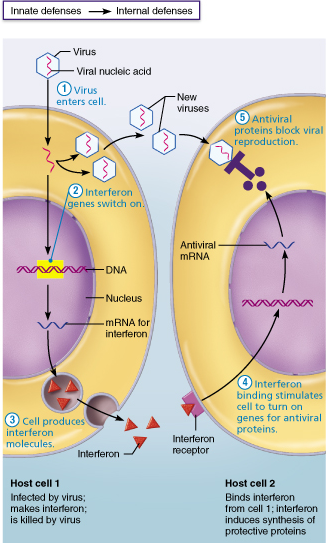 What protein can be released by infected cells to help protect cells that have not yet been infected? A) complement B) interferons (IFNs) C) opsonins D) pyrogens | back 19 B) interferons (IFNs) |
front 20 Which of the following would be classified as a delayed hypersensitivity reaction? A) anaphylaxis B) cytotoxic hypersensitivity C) allergic contact dermatitis D) immune complex hypersensitivity | back 20 C) allergic contact dermatitis |
front 21 Helper T cells ________. A) often function to decrease the immune response B) bind tightly to target cells and release a lymphotoxin called perforin C) release B7 proteins D) function in the adaptive immune system activation | back 21 D) function in the adaptive immune system activation |
front 22 Why are children given vaccinations? A) to develop a disease in a mild state rather than have it later on in a more serious state B) to see whether the immune system is capable of defense against disease C) to develop memory cells against various diseases D) to activate the cell-mediated defense against pathogens | back 22 C) to develop memory cells against various diseases |
front 23 Which of the following is not a mechanism for the development of autoimmune disorders? A) cross-reaction of antibodies formed against foreign antigens with self-antigens B) mutation followed by the appearance of membrane proteins not previously present C) exposure of previously "hidden" self-antigens to the adaptive immune system D) a second exposure to an allergen | back 23 D) a second exposure to an allergen |
front 24 Proinflammatory signals include all of the following, EXCEPT __________. A) antibodies B) histamines C) prostaglandins D) leukotrienes | back 24 A) antibodies **Antibodies are not proinflammatory signals. They are proteins that activated B cells produce to protect the body from specific foreign antigens. |
front 25 T-cell activation requires ________. A) antigen binding and co-stimulation B) antibody production and co-stimulation C) antigen binding, antibody production, and co-stimulation D) antigen binding and antibody production | back 25 A) antigen binding and co-stimulation |
front 26 Which of the following is a part of the second line of defense against microorganisms? A) phagocytes B) keratin C) gastric juice D) cilia | back 26 A) phagocytes |
front 27 Select the correct statement about the prevention of immune attack on "self." A) Neutrophils capable of binding to self-antigens are chemically inactivated. B) Tolerance to self is due to the action of foreign antigens that inactivate the immune response to one's own tissues. C) The development of tolerance is specific to B cells only. D) Tolerance is developed during fetal life. | back 27 D) Tolerance is developed during fetal life. |
front 28 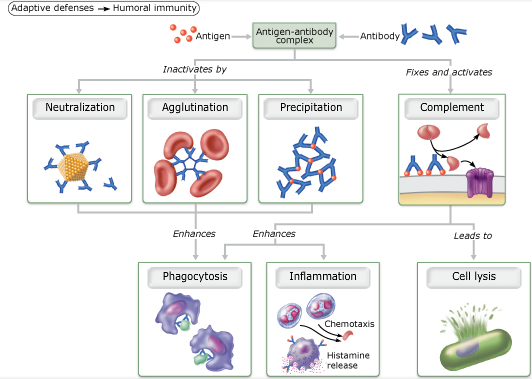 Which mechanism of antibody action results in cell lysis? A) precipitation B) agglutination C) complement fixation and activation D) neutralization | back 28 C) complement fixation and activation |
front 29  What activates CD8 cells? A) peptides containing 14-17 amino acids B) exogenous antigens C) antigens on class II MHC proteins D) antigen fragments on class I MHC proteins | back 29 D) antigen fragments on class I MHC proteins |
front 30 Pyrogens induce __________. A) cytolysis B) inflammation C) opsonization D) fever | back 30 D) fever |
front 31 Select the correct statement about the function of antibodies A) The most potent agglutinating agent is IgG. B) Antibodies may directly destroy "invaders." C) Complement fixation is the main mechanism by which antibodies provide protection. D) Neutralization is the process by which antibodies cause invading cells to clump together. | back 31 C) Complement fixation is the main mechanism by which antibodies provide protection. |
front 32 The redness and heat of an inflamed area are due to a local hyperemia caused by ________. A) complement production B) phagocyte mobilization C) vasoconstriction D) vasodilation | back 32 D) vasodilation |
front 33 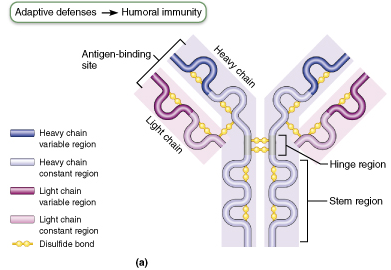 What is the first antibody released in the primary response and usually indicates infection? A) IgA B) IgG C) IgD D) IgM | back 33 D) IgM |
front 34 T/F: MHC I proteins (major histocompatibility class I proteins) are found on most cells of the body. | back 34 TRUE |
front 35 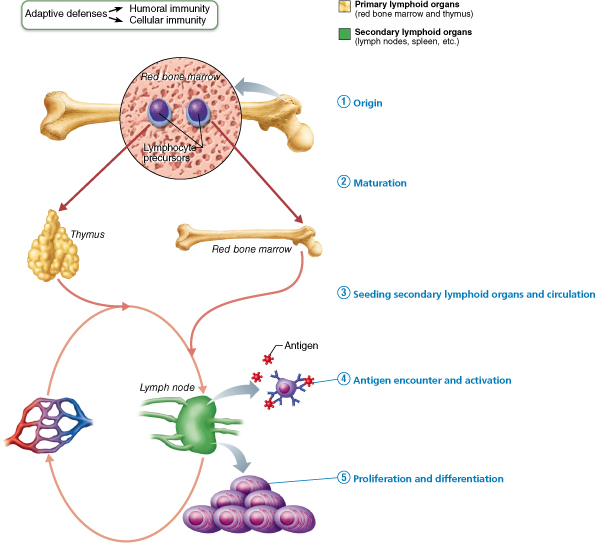 Which cells mature in the thymus? A) B cells B) Memory Cells C) Effector Cells D) T Cells | back 35 D) T cells |
front 36 Which of the following statements is incorrect or false? A) MHC proteins are the cell's identity markers. B) Class II MHC molecules appear only on the surface of antigen-presenting cells, thymic cells, and T cells that have been activated by exposure to antigens. C) Class 1 MHC molecules are built into the plasma membranes of all body cells. D) Haptens lack immunogenicity unless attached to protein carriers. | back 36 B) Class II MHC molecules appear only on the surface of antigen-presenting cells, thymic cells, and T cells that have been activated by exposure to antigens. |
front 37 Which of the following is a role of interferons (IFNs)? A) IFNs stimulate the release of histamine. B) IFNs activate helper T cells by presenting antigens. C) IFNs stimulate antibody production in response to a bacterial infection. D) IFNs help the body combat viral infections. | back 37 D) IFNs help the body combat viral infections. **Interferons (IFNs) are a group of proteins that have antiviral effects. IFNs activate macrophages and mobilize natural killer cells (NK cells) as well. They also have an anticancer role. |
front 38 Which of the following is not a role of activated complement? A) insertion of MAC and cell lysis B) prevention of immediate hypersensitivity reactions C) enhancement of inflammation D) opsonization | back 38 B) prevention of immediate hypersensitivity reactions |
front 39 Which of the following is not a complement activation pathway? A) alternative pathway B) lactate pathway C) classical pathway D) lectin pathway | back 39 B) lactate pathway |
front 40 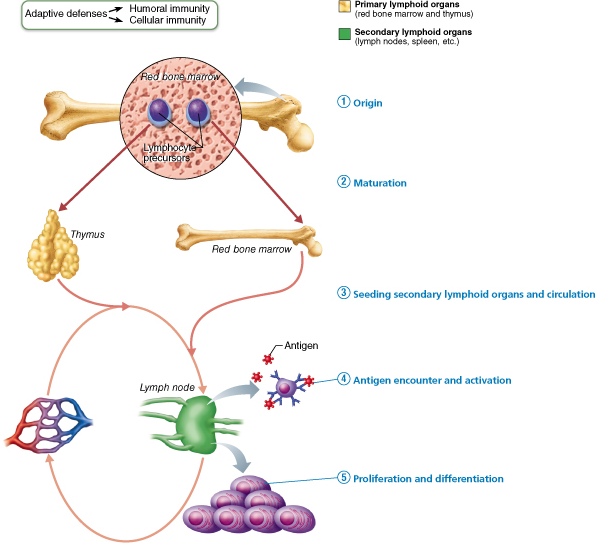 How does a lymphocyte become immunocompetent? A) Lymphocytes rapidly proliferate to form an army of cells exactly like themselves and bearing the same antigen-specific receptors. B) Lymphocytes must be able to recognize their one specific antigen by binding to it. C) An antigen binds to a particular lymphocyte that has a receptor for it. D) Lymphocytes must be relatively unresponsive to self-antigens so that they do not attack the body's own cells. | back 40 B) Lymphocytes must be able to recognize their one specific antigen by binding to it. |
front 41 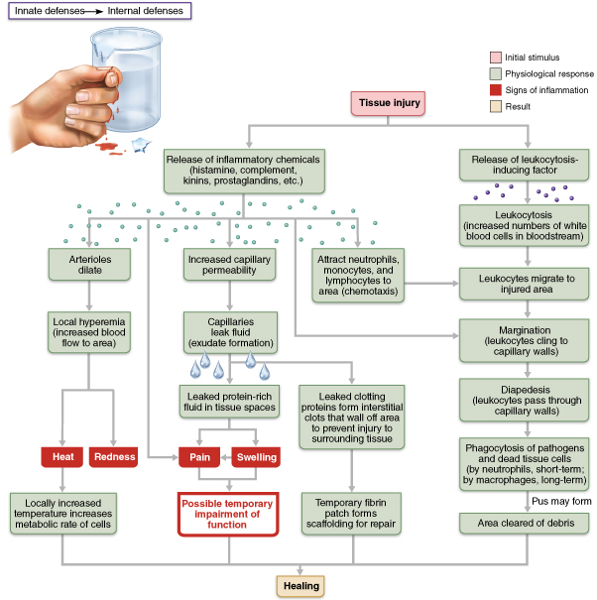 Four (or five) cardinal signs indicate inflammation. What specific sign of inflammation is the result of exudate in the tissue spaces? A) Heat B) Impaired Function C) Redness D) Edema (swelling) | back 41 D) Edema (swelling) |
front 42 Select the correct statement about immunodeficiency. A) Severe combined immunodeficiency (SCID) disease is an acquired condition. B) The causative agent in acquired immune deficiency syndrome (AIDS) is a virus that recognizes CD4 proteins. C) The most common form of immunodeficiency is graft-versus-host (GVH) disease. D) Hodgkin's disease is a hereditary immunodeficiency found in children. | back 42 B) The causative agent in acquired immune deficiency syndrome (AIDS) is a virus that recognizes CD4 proteins. |
front 43 Which of the following cells engulf antigens and present fragments of them on their own surfaces, where they can be recognized by cells that will deal with them? A) dendritic cells B) CD8 cells C) T lymphocytes D) NK cells | back 43 A) dendritic cells |
front 44 Which of the following does not respond to cell-mediated immunity? A) pathogens in the lumen of the stomach B) foreign tissue transplants C) some cancer cells D) intracellular pathogens that reside within host cells | back 44 A) pathogens in the lumen of the stomach |
front 45 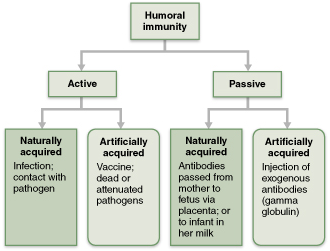 Which of the following exemplifies passive immunity? A) Antitoxin B) Infection C) Vaccine D) Vaccine Booster Shots | back 45 A) Antitoxin |
front 46 Natural killer (NK) cells ________. A) can kill cancer cells before the immune system is activated B) are also called cytotoxic T cells C) are a type of phagocyte D) are cells of the adaptive immune system | back 46 A) can kill cancer cells before the immune system is activated |
front 47 Activated T cells and macrophages release ________ to mobilize immune cells and attract other leukocytes into the area. A) Interleukin 1 proteins B) Cytokines C) Perforins D) Interleukin 2 proteins | back 47 B) Cytokines |
front 48 Regulatory T cells ________. A) may function in preventing autoimmune reactions B) aid B cells in antibody production C) release cytokines that increase the activity of cytotoxic T cells and activated B cells D) decrease their activity as antigenic stimulus decreases | back 48 A) may function in preventing autoimmune reactions |
front 49 Antibody functions include all of the following except ________. A) binding and inactivating chemical toxins released by bacteria or other microorganisms B) cross-linking cell-bound antigens on red blood cells when blood types are properly matched C) targeting foreign cells so that complement proteins can cause cellular lysis D) linking soluble antigens together so that they fall out of solution | back 49 B) cross-linking cell-bound antigens on red blood cells when blood types are properly matched |
front 50 Select the correct statement about antigens. A) The largest type of antigen is called a hapten. B) "Self-antigens" is another name for incomplete antigens. C) Only small antigens exhibit reactivity. D) One antigen may have many different antigenic determinants and may therefore cause the formation of more than one antibody. | back 50 D) One antigen may have many different antigenic determinants and may therefore cause the formation of more than one antibody. |
front 51 B lymphocytes develop immunocompetence in the ________. A) thymus B) spleen C) lymph nodes D) bone marrow | back 51 D) bone marrow |
front 52 Innate immune system defenses include ________. A) B cells B) plasma cells C) phagocytosis D) T cells | back 52 C) phagocytosis |
front 53 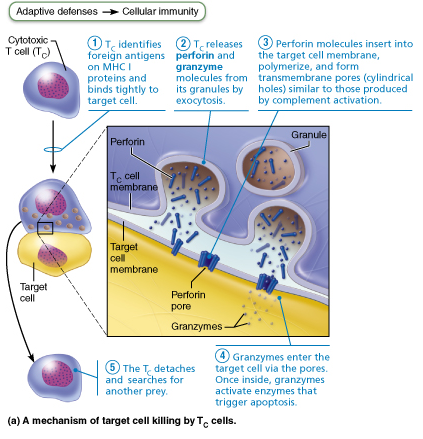 What type of T cell can directly attack and kill other cells, such as virus-infected cells? A) APC B) regulatory T (TReg) cells C) cytotoxic T (TC) cells D) helper T (TH) cells | back 53 C) cytotoxic T (TC) cells |
front 54 Involved in allergies | back 54 IgE |
front 55 Protects mucosal barriers | back 55 IgA |
front 56 First to peak during a primary immune response | back 56 IgM |
front 57 Along with IgM, this is a B cell receptor | back 57 IgD |
front 58 Main antibody of both primary and secondary immune response | back 58 IgG |
front 59 Which defense mechanism results in redness, heat, pain, and swelling? A) cell-mediated immunity B) phagocytosis C) inflammation D) antibody production | back 59 C) inflammation **The cardinal signs of an inflammatory reaction are redness and heat (due to increased blood flow to the area), pain (due to increased blood flow and chemical mediators), and swelling (due to leakage of blood plasma into the injured area). |
front 60 Fever ________. A) is a higher-than-normal body temperature that is always dangerous B) causes the liver to release large amounts of iron, which seems to inhibit bacterial replication C) production is regulated by chemicals that reset the body's thermostat to a higher setting D) decreases the metabolic rate of the body to conserve energy | back 60 C) production is regulated by chemicals that reset the body's thermostat to a higher setting |
front 61 Which of the following is not a method by which antibodies work? A) neutralizing antigen B) direct cell lysis C) enhancing phagocytosis D) agglutinating and precipitating antigen | back 61 B) direct cell lysis |
front 62 Which immunoglobulin class can cross the placenta to provide naturally acquired passive immunity to the fetus? A) IgG B) IgM C) IgA D) IgD | back 62 A) IgG |
front 63 Which of the following determine(s) what specific foreign substances our adaptive immune system will be able to recognize and resist? A) Our genes B) The type of antigen C) Enzymes present at the time of the invasion D) Memory cell production | back 63 A) Our genes |
front 64 Select the correct statement about active and passive immunity. A) Active and passive humoral immunity are both mechanisms of adaptive immunity that use antibodies. B) Immunological memory is established by passive immunization. C) A vaccination is an example of the introduction of passive immunity into the body. D) The antibodies utilized in active immunity are acquired from another organism. | back 64 A) Active and passive humoral immunity are both mechanisms of adaptive immunity that use antibodies. |
front 65 What is the specific target of interferons? A) specific viruses B) infected cells C) nearby healthy cells D) antibodies | back 65 C) nearby healthy cells |
front 66 What part of the antibody's structure determines its class? A) heavy (H) chain B) light (L) chain C) constant (C) region D) variable (V) region | back 66 C) constant (C) region |
front 67 Which of the following do NOT serve as antigen-presenting cells (APC)? A) dendritic cells B) macrophages C) natural killer cells D) B cells | back 67 C) natural killer cells |
front 68 How do interferons protect against infection in healthy cells? A) Interferons block viral reproduction in healthy cells through the production of antiviral proteins. B) Interferons promote fever, or an abnormally high body temperature. C) Interferons perform opsonization to coat microorganisms. D) Interferons perform complement activation. | back 68 A) Interferons block viral reproduction in healthy cells through the production of antiviral proteins. |
front 69 Which of the following is NOT a nonspecific internal defense against disease? A) NK cells B) inflammation C) phagocytes D) T cells | back 69 D) T cells |
front 70 Cancer cells and virus-infected body cells can be killed before activation of adaptive immunity by ________. A) natural killer cells B) T lymphocytes C) pinocytosis D) B lymphocytes | back 70 A) natural killer cells |
front 71 Which of the statements below does not describe antigens? A) The parts of antigen molecules that initiate immune responses are called epitopes or antigenic determinants. B) Antigens exhibit immunogenicity and reactivity. C) Antigens can include proteins, nucleic acids, lipoproteins, glycoproteins, and certain large polysaccharides. D) Antigens only come from microbes. | back 71 D) Antigens only come from microbes. |
front 72 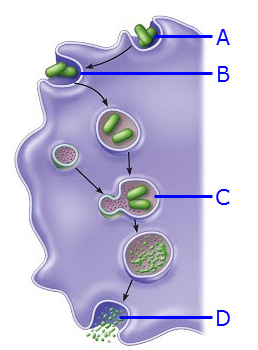 Which letter represents the formation of a phagolysosome resulting from the fusion of a lysosome with the phagocytic vesicle? Select from letters A-D | back 72 Answer: C |
front 73 Which of the following is not characteristic of the adaptive immune system? A) It is antigen-specific. B) It is systemic. C) It is specific for a given organ. D) It has memory. | back 73 C) It is specific for a given organ. |
front 74 Which of the following is an effect of complement activation? A) T cell activation B) opsonization C) tissue repair D) fever | back 74 B) opsonization |
front 75 __________ are lymphocytes that directly kill virus- infected cells. A) Macrophages B) B cells C) Helper T cells D) Cytotoxic T cells | back 75 D) Cytotoxic T cells |
front 76 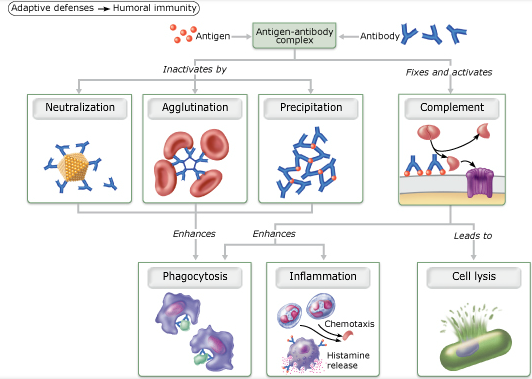 Which of the following mechanisms of antibody action occur when red blood cells clump due to a transfusion of mismatched blood? A) agglutination B) precipitation C) complement fixation and activation D) neutralization | back 76 A) agglutination |
front 77 Small molecules that bind with self-proteins to produce antigenic substances are called ________. A) haptens B) reagins C) antibodies D) ions | back 77 A) haptens |
front 78 Which of the following is not a function of the inflammatory response? A) disposes of cellular debris and pathogens B) prevents the spread of the injurious agent to nearby tissue C) replaces injured tissues with connective tissue D) sets the stage for repair processes | back 78 C) replaces injured tissues with connective tissue |
front 79 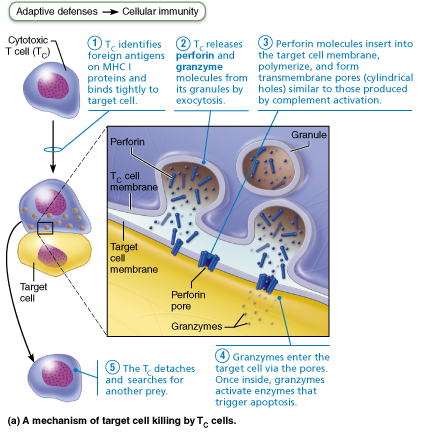 Cytotoxic T (TC) cells check cells of the body for identity flags to see if they look they way they are supposed to. What is this process called? A) opsonization B) anergy C) immune surveillance D) complement fixation | back 79 C) immune surveillance |
front 80 Which of the following is NOT a property of interferons (IFNs)? A) IFNs activate macrophages. B) IFNs have an anticancer role. C) IFNs stimulate B cells to produce antibodies. D) IFNs have antiviral activity. | back 80 C) IFNs stimulate B cells to produce antibodies. |
front 81 All of the following are functions of interferons, EXCEPT that __________. A) they are not virus-specific B) they mobilize natural killer cells C) they interfere with viral replication in affected cells D) they only occur naturally | back 81 D) they only occur naturally |
front 82 Interferons can be used to treat all of the following, EXCEPT __________. A) muscular dystrophy B) cancer C) hepatitis C D) viral infections | back 82 A) muscular dystrophy |
front 83 Tears and mucus membranes would be a part of which defense system? | back 83 Innate external defenses |
front 84 Phagocytotic cells such as macrophages identify a variety of enemies by recognizing markers unique to pathogens. They would be classified as which type of defense system? | back 84 Innate internal defenses |
front 85 What cells make antibodies? | back 85 plasma B cells |
front 86 What is the name of the unique area (specific region) that a lymphocyte recognizes and binds to? | back 86 An antigenic determinant |
front 87 What type of immunity can be transferred by bodily fluids from one person to another, thus conferring immunity to the recipient? | back 87 Humoral Immunity |
front 88 If a virus attacks a cell, which type of immunity would be activated? | back 88 cell-mediated immunity (cellular immunity) |
front 89 Cancer cells would be attacked by which type of cells? | back 89 Cytotoxic T Cells |
front 90 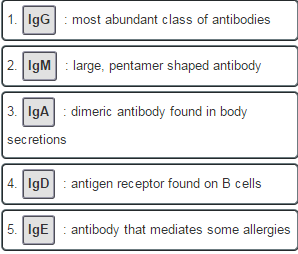 | back 90 no data |
front 91 When do neutrophils enter the blood from the red bone marrow, in response to leukocytosis-inducing factors? | back 91 Leukocytosis |
front 92 Which of the following is NOT a sign of inflammation? A) Pain B) Fever C) Swelling D) Redness | back 92 B) Fever |
front 93 Which of the following is NOT a characteristic of Natural Killer (NK) cells? A) NK cells recognize abnormal or cancer cells by a specific antigen on their cell membrane. B) NK cells induce the target cell to undergo “apoptosis” (cell suicide). C) NK cells attack infected or cancerous cells. D) NK cells attack transplanted organs. | back 93 A) NK cells recognize abnormal or cancer cells by a specific antigen on their cell membrane. |
front 94 Which of the following innate internal defenses work by interfering with viral replication? A) interferons B) complement proteins C) phagocytes D) T lymphocytes | back 94 A) interferons |
front 95 How do phagocytes recognize foreign cells or bacteria? A) The phagocytes recognize molecules on pathogens not normally found on body cells. B) The phagocytes look for the absence of “self” proteins. C) All the foreign cells or bacteria are marked with opsonins that the phagocytes recognize. D) Phagocytes recognize a specific antigen on the cell surface. | back 95 A) The phagocytes recognize molecules on pathogens not normally found on body cells. |
front 96 Which of the innate defense mechanisms can lyse bacteria and mark cells for phagocytosis? | back 96 Complement Proteins |
front 97 Which of the following can act as opsonins on bacteria, thus enhancing phagocytosis? A) interferons B) natural killer (NK) cells C) antibodies and complement proteins D) T cells | back 97 C) antibodies and complement proteins |
front 98 T/F: A moderate fever is a protective adaptive response. | back 98 TRUE |
front 99 Which of the following does NOT protect the skin from bacteria? A) the temperature of the skin B) defensins C) cathelicidins D) the low pH of the skin E) dermcidin | back 99 A) the temperature of the skin |
front 100 Choose the FALSE statement. A) Skin acts as a biological barrier. B) Skin does not have a role in regulating body temperature. C) Low pH protects the skin. D) There are substances in sweat that can kill bacteria. | back 100 B) Skin does not have a role in regulating body temperature. |
front 101 The skin is permeable to organic solvents, such as acetone or turpentine, because they ________. | back 101 can dissolve the lipid bilayers of epidermal and dermal cell plasma membranes |
front 102 MHC II proteins are found on __________. A) red blood cells B) cytotoxic T cells C) helper T cells D) antigen-presenting cells | back 102 D) antigen-presenting cells |
front 103 Which of the following is a nonspecific barrier defense? A) natural killer cells B) complements C) antibodies D) mucous membranes E) macrophages | back 103 D) mucous membranes |
front 104 Toll-like receptors are found on __________. A) lymphocytes B) macrophages C) neutrophils D) mast cells | back 104 B) macrophages |
front 105 Which of the following is a metabolic function of skin? A) elimination of nitrogenous wastes B) synthesis of a vitamin D precursor C) cutaneous sensation D) body temperature regulation | back 105 B) synthesis of a vitamin D precursor |
front 106 Which class of tissue graft is the least likely to be accepted by a patient's body? A) autograft B) isograft C) allograft D) xenograft | back 106 D) xenograft |
front 107 __________ are substances that can trigger the adaptive defenses and provoke an immune response. | back 107 Antigens |
front 108 Saliva and lacrimal fluids contain this enzyme that destroys bacteria. | back 108 Lysozyme |
front 109 When a localized area exhibits increased capillary filtration, hyperemia, and swelling, it is an indication that __________. | back 109 inflammation is occuring |
front 110 The process that begins when a helper T cell binds to a class II MHC protein on a displaying cell is known as __________. | back 110 Costimulation |
front 111 Which of the following is NOT one of the cardinal signs of inflammation? A) opsonization B) swelling C) pain D) redness E) heat | back 111 A) opsonization |
front 112 Cytotoxic T cells kill target cells __________. A) through injection of tumor necrosis factor B) through insertion of perforins into the target's membrane C) by releasing oxidizing agents D) by phagocytosis by secreting antibodies | back 112 B) through insertion of perforins into the target's membrane |
front 113 Which of the following are mismatched? A) immediate hypersensitivity: allergic contact dermatitis B) severe combined immunodeficiency syndrome (SCID): genetic defect resulting in a shortage of B and/or T cells C) multiple sclerosis: autoimmune disorder D) AIDS (acquired immune deficiency syndrome): helper T cells are destroyed by a virus | back 113 A) immediate hypersensitivity: allergic contact dermatitis |
front 114 What is the second step of T cell activation? A) chemotaxis B) anergy C) antigen binding D) co-stimulation | back 114 D) co-stimulation |
front 115 A "nonself" substance that can provoke an immune response is called a(n) __________. A) interferon B) colony-stimulating factor C) antigen D) immunoglobulin E) antibody | back 115 C) antigen |
front 116 Which of the following minerals needed for bacterial reproduction do both the liver and spleen sequester during a fever? A) Copper B) Magnesium C) Phosphorous D) Zinc | back 116 D) Zinc |
front 117 Without __________ there is no adaptive immune response. | back 117 T Lymphocytes |
front 118 Self-reactive B cells are eliminated in the __________. | back 118 Bone Marrow |
front 119 These molecules are secreted by leukocytes and macrophages and result in a fever. | back 119 Pyrogens **Pyrogens target the hypothalamus and raise the body's temperature above normal. |
front 120 Which is correctly matched? A) helper T cells: recognize virus-infected cells B) cytotoxic T cells: activated by antigens bound to MHC I C) B cells: suppress the immune response once the foreign antigen has been cleared from the body D) regulatory T cells: make antibodies | back 120 B) cytotoxic T cells: activated by antigens bound to MHC I |
front 121 The first step in inflammation is __________. | back 121 the release of inflammatory chemicals |
front 122 All of the following are examples of autoimmune disorders, EXCEPT __________. A) systemic lupus erythematosus (SLE) B) myasthenia gravis C) sickle-cell anemia D) Graves disease E) rheumatoid arthritis | back 122 C) sickle-cell anemia |
front 123 Leukotrienes cause __________. | back 123 dilation of the small blood vessels in an injured area |
front 124 Which of the following steps is the first step in an inflammatory response? A) release of leukocytosis-inducing factor B) adhesion of the neutrophil's cell-adhesion molecules to antigen C) positive chemotaxis D) diapedesis | back 124 A) release of leukocytosis-inducing factor |
front 125 Which of the following is mismatched? A) B cells: can be activated to produce antibodies B) cytotoxic T cells: carry out cellular immune responses regulatory C) T cells: release inhibitory cytokines to dampen the immune response D) helper T cells: directly target and kill cancer cells | back 125 D) helper T cells: directly target and kill cancer cells |
front 126 Lymphocytes that develop immunocompetence in the thymus are __________. | back 126 T Lymphocytes |
front 127 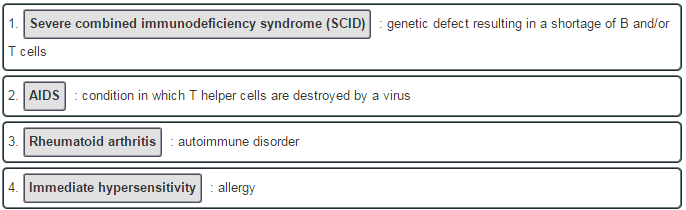 | back 127 no data |
front 128 Active artificially acquired immunity is a result of __________. A) antibodies passed on from mother to baby through breast milk B) contact with a pathogen C) injection of an immune serum D) antibodies passed on from mother to fetus through the placenta E) vaccination | back 128 E) vaccination |