Instructions for Side by Side Printing
- Print the notecards
- Fold each page in half along the solid vertical line
- Cut out the notecards by cutting along each horizontal dotted line
- Optional: Glue, tape or staple the ends of each notecard together
A&P Chapter 4 Tissue: The Living Fabric
front 1 The wall of the alveolus (air sac) in the lung is composed of which type of epithelium? | back 1 simple squamous epithelium |
front 2 The proximal tubule of the nephron (kidney tubule) in the kidney is composed of which type of epithelium? | back 2 simple cuboidal epithelium |
front 3 The epithelium of the esophagus is composed of which type of epithelial tissue? | back 3 stratified squamous epithelium |
front 4 Which part of the neuron (a specialized nerve cell) receives signals from other cells and is also the main metabolic region of the neuron? | back 4 soma |
front 5 Which of the three muscle cell types has multiple nuclei? | back 5 skeletal |
front 6 Which muscle cell type has visible striations but is not under voluntary control? | back 6 cardiac |
front 7 Drag the appropriate labels to their respective targets. | back 7 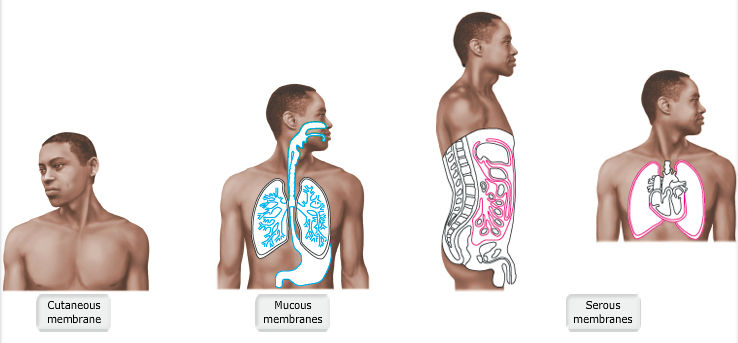 |
front 8 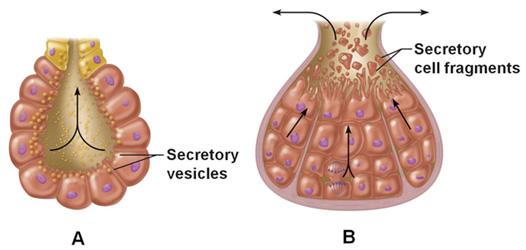 What do the glands shown in A and B both have in common? | back 8 Both are exocrine glands. |
front 9 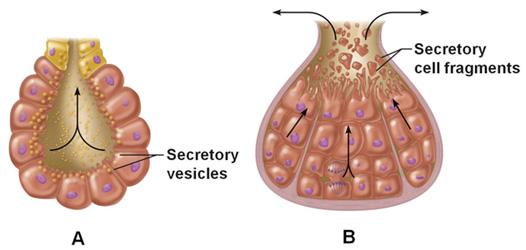 What process is depicted in the basal layer of the glandular epithelium shown in B? | back 9 cell division |
front 10 Which of the following epithelial tissue locations is NOT correctly matched to its function? | back 10 skin: absorption |
front 11 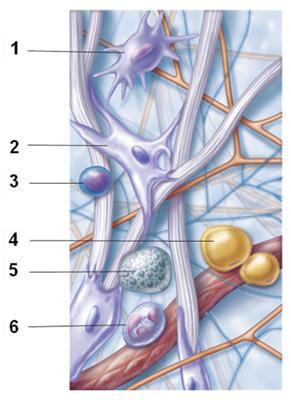 Which of the numbered cell types is primarily responsible for producing protein fibers found in connective tissue proper? | back 11 2 |
front 12 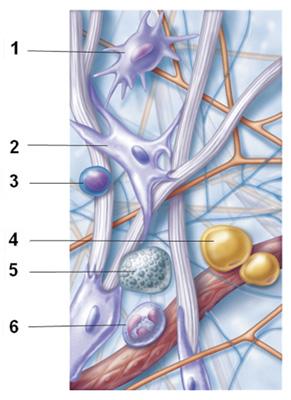 Which numbered cell type initiates inflammatory responses to infection or tissue damage? | back 12 5 |
front 13 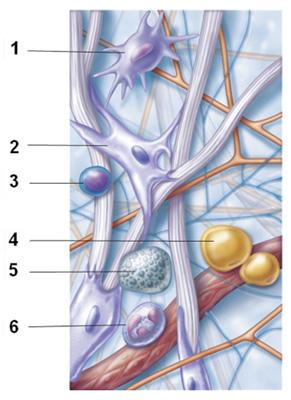 Cells 3 and 6 are both classified as ______. | back 13 white blood cells |
front 14 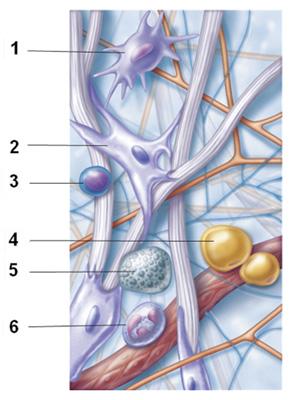 Which of the following statements is NOT characteristic of the areolar connective tissue pictured in the figure? | back 14 Areolar connective tissue is avascular. |
front 15 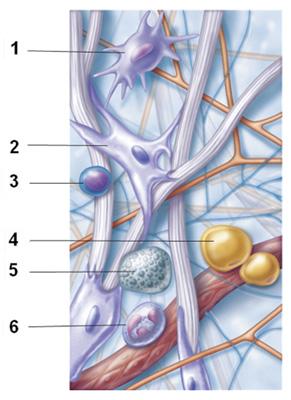 Which of the following substances would NOT be found in significant amounts in the extracellular matrix of the illustrated areolar connective tissue? | back 15 keratin |
front 16 Which of the following increases the surface area of certain epithelial tissues? | back 16 microvilli |
front 17 Which of the following statements is INCORRECT? | back 17 Simple cuboidal epithelia are found in areas that stretch. |
front 18 Where is transitional epithelium found? | back 18 in areas subjected to stretching |
front 19 ________ is a water-soluble, complex glycoprotein that is secreted by goblet cells. | back 19 Mucin |
front 20 Which type of epithelium lines the interior of the urinary bladder? | back 20 transitional epithelium |
front 21 Which of the following is a single-celled layer of epithelium that forms the lining of serous membranes? | back 21 simple squamous |
front 22 Which tissue type arises from all three embryonic germ layers? | back 22 epithelial tissue |
front 23 ________ epithelium appears to have two or three layers of cells, but all the cells are in contact with the basement membrane. | back 23 Pseudostratified columnar |
front 24 Goblet cells are found within pseudostratified ciliated columnar epithelium. | back 24 True |
front 25 Merocrine glands produce their secretions by accumulating their secretions internally until the cell ruptures. | back 25 False |
front 26 What tissue has lacunae, calcium salts, and blood vessels | back 26 osseous tissue |
front 27 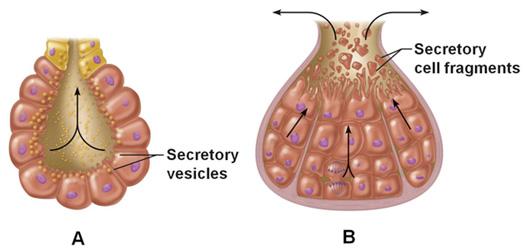 Which of the following cellular processes is portrayed in A? | back 27 exocytosis |
front 28 Connective tissue matrix is composed of ________. | back 28 fibers and ground substance |
front 29 All connective tissues arise from an embryonic tissue called mesenchyme. | back 29 True |
front 30 The shape of the external ear is maintained by ________. | back 30 elastic cartilage |
front 31 Endocrine glands are often called ducted glands. | back 31 False |
front 32 What are the three main components of connective tissue? | back 32 ground substance, fibers, and cells |
front 33 Which of the following describes a holocrine gland? | back 33 Holocrine glands secrete their products by rupturing. |
front 34 Which of the following is not a step in tissue repair? | back 34 Formation of new stem cells |
front 35 Select the correct statement regarding epithelia. | back 35 Stratified squamous epithelia are present where protection from abrasion is important. |
front 36 Which of the following increases the surface area of certain epithelial tissues? | back 36 microvilli |
front 37 Mesenchymal cells are most commonly found in ________ connective tissue. | back 37 embryonic |
front 38 ________ is the tissue that regulates and controls body functions. | back 38 Nervous tissue |
front 39 Chondroblasts ________. | back 39 within the cartilage divide and secrete new matrix |
front 40 Simple cuboidal epithelia are usually found in areas where secretion and absorption occur. | back 40 True |
front 41 Intercalated discs and striations are found in skeletal muscle. | back 41 False |
front 42 Nervous tissue consists mainly of neurons and collagen fibers. | back 42 False |
front 43 Which tissues have little to no functional regenerative capacity? | back 43 cardiac muscle and nervous tissue in the brain and spinal cord |
front 44 Select the correct statement regarding adipose tissue. | back 44 Its primary function is nutrient storage. |
front 45 The simple columnar epithelium that form absorptive cells of the digestive tract have which characteristic? | back 45 dense microvilli |
front 46 Exocrine glands ________. | back 46 secrete substances onto body surfaces |
front 47 Which is true concerning muscle tissue? | back 47 highly cellular and well vascularized |
front 48 Cartilage has good regenerative capacity, while most epithelial tissues do not. | back 48 False |
front 49 Tendons and ligaments are composed mainly of dense irregular connective tissue. | back 49 False |
front 50 Which type of membrane is a dry membrane exposed to the air? | back 50 cutaneous membrane |
front 51 Which of the following statements is true of connective tissue? | back 51 Collagen fibers provides high tensile strength. |
front 52 Which tissue repair process results in the formation of scar tissue? | back 52 fibrosis |
front 53 Which tissue type is responsible for regulating and controlling body functions? | back 53 nervous tissue |
front 54 Which of the following is NOT a role of connective tissue? | back 54 absorption |
front 55 A major characteristic of fibrocartilage is its unique amount of flexibility and elasticity. | back 55 False |
front 56 Which of the following statements is INCORRECT? | back 56 The cutaneous membrane is made of a simple columnar epithelium |
front 57 Which of the following increases the surface area of certain epithelial tissues? | back 57 microvilli |
front 58 Epithelial tissues always exhibit apica-basal polarity; meaning that cell regions near the apical surface differ from those near the basal surface. | back 58 True |
front 59 Connective tissues ________. | back 59 primarily consist of extracellular matrix |
front 60 Which of the following is not a step in tissue repair? | back 60 Formation of new stem cells |
front 61 The correct order of events in tissue repair, from first to last, is ________. | back 61 inflammation, organization, and regeneration |
front 62 Intercalated discs and striations are found in skeletal muscle. | back 62 False |
front 63 Which type of gland produces hormones? | back 63 endocrine glands |
front 64 Mesenchymal cells are most commonly found in ________ connective tissue. | back 64 embryonic |
front 65 Nervous tissue consists mainly of neurons and collagen fibers. | back 65 False |
front 66 In connective tissue, the role of collagen fibers is to ________. | back 66 provide tensile strength |
front 67 Smooth muscle ________. | back 67 is under involuntary control |
front 68 Which tissues have little to no functional regenerative capacity? | back 68 cardiac muscle and nervous tissue in the brain and spinal cord |
front 69 The shock-absorbing pads between the vertebrae are formed of fibrocartilage. | back 69 True |
front 70 Which is the most atypical connective tissue since it does not connect things or provide structural support? | back 70 blood |
front 71 What tissue has lacunae, calcium salts, and blood vessels? | back 71 osseous tissue |
front 72 Which statement best describes connective tissue? | back 72 usually contains a large amount of matrix |
front 73 Squamous cells are flattened and scalelike when mature. | back 73 True |
front 74 Injured cartilage might heal more quickly if a treatment were discovered that would __________. | back 74 stimulate blood vessels to develop within cartilage |
front 75 Groups of cells that are similar in structure and perform a common or related function form a(n) ________. | back 75 tissue |