Instructions for Side by Side Printing
- Print the notecards
- Fold each page in half along the solid vertical line
- Cut out the notecards by cutting along each horizontal dotted line
- Optional: Glue, tape or staple the ends of each notecard together
Chapter 11: Cell Communication
front 1 In yeast signal transduction, a yeast cell releases a mating factor which... | back 1 A) Acts back on the same cell that secreted the mating factor, changing its development B) Passes through the membrane neighboring cells, binds to DNA, and initiates transcription C) binds to receptors on the membranes of other types of yeast cells D) Diffuses through the membranes of distant cells, causing them to produce factors that initiate long-distance migrations |
front 2 Which of the following statements about quorum sensing is FALSE? Quorum sensing... | back 2 A) is cell-cell communication in eukaryotes B) Is species specific C) May result in biofilm formation D) Is particularly well studied because of its medical importance |
front 3 In the formation of biofilms, such as those forming on unbrushed teeth, cell signaling serves which function? | back 3 A) Formation of mating complexes B) aggregation of bacteria that can cause cavities C) Secretion of substances that inhibit foreign bacteria D) Digestion of unwanted parasite populations |
front 4 Which of the following is a type of local signaling in which a cell secretes a signal molecule that affects neighboring cells? | back 4 A) Hormonal signaling B) Autocrine signaling C) paracrine signaling D) Synaptic signaling |
front 5 Hormones are chemical substances produced in one organ that are released into the bloodstream and affect the function of a target organ. For the target organ to respond to a particular hormone it must... | back 5 A) Modify its plasma membrane to alter the hormone entering the cytoplasm B) Be from the same cell type as the organ that produced the hormone C) Experience and imbalance that disrupts its normal function D) have receptors that recognize and bind the hormone molecule |
front 6 In which of the following ways do plant hormones differ from hormones in animals? | back 6 A) plant hormones most often travel in air as a gas. B) Animal hormones are only local regulators. C) Plant hormones are typically released into the soil. D) Animal hormones are primarily for nation and embryonic development. |
front 7 When a neuron responds to a particular neurotransmitter by opening gated ion channels, the neurotransmitter is serving as which part of the signal pathway? | back 7 A) Relay molecule B) Transducer C) signal molecule D) Response molecule |
front 8 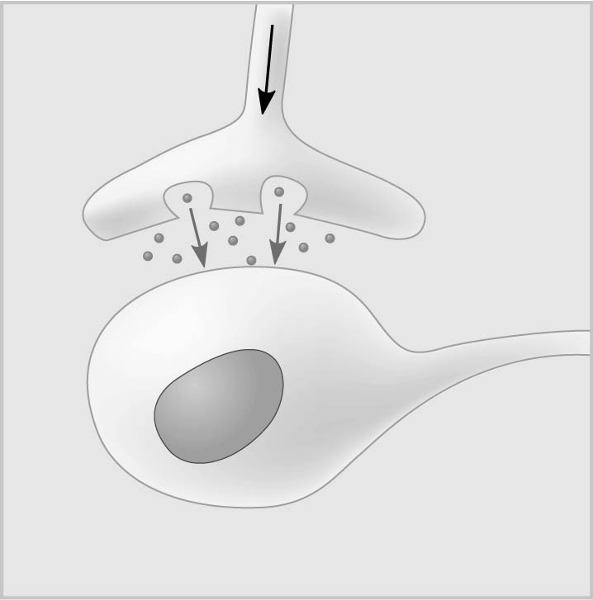 Which of the following types of signaling is represented in the figure? | back 8 A) Autocrine B) Paracrine C) Hormonal D) synaptic |
front 9 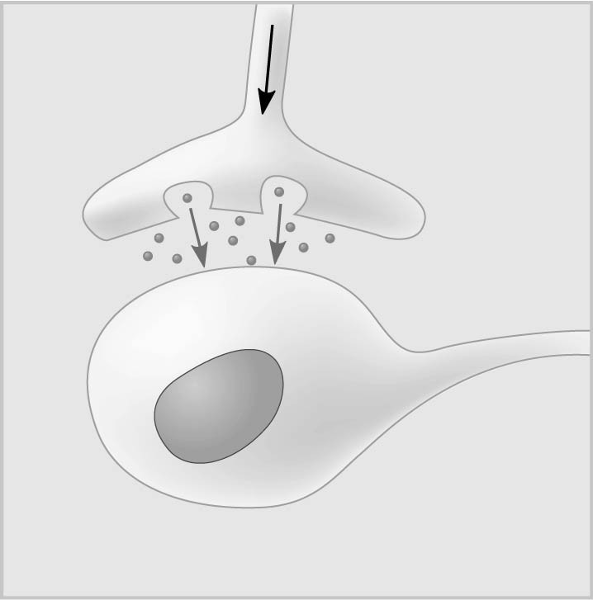 In the figure, the dots in the space between the two structures represent which of the following? | back 9 A) Receptor molecules B) Signal transducers C) neurotransmitters D) Hormones |
front 10 Which observation suggested to Sutherland the involvement of a second messenger in epinephrine's effect on liver cells? | back 10 A) Receptor studies indicated that epinephrine was a ligand. B) glycogen breakdown was observed only when epinephrine was administered to intact cells. C) Glycogen breakdown was observed when epinephrine and glycogen phosphorylase were combined. D) Epinephrine was known to have different effects on different types of cells. |
front 11 A G-protein receptor with GTP bound to it... | back 11 A) is in its active state B) Signals a protein to maintain its shape and conformation C) Will use cGMP as a second messenger D) Directly affects dene expression |
front 12 Testosterone functions inside a cell by... | back 12 A) Acting as a signal receptor that activated tyrosine kinases B) binding with a receptor protein that enter the nucleus and activates specific genes C) Acting as a steroid signal receptor that activates ion channel proteins D) Coordinating a phosphorylation cascade that increases spermatogenesis |
front 13 Scientists have found that extracellular matrix components may induce specific gene expression in embryonic tissues such as the liver and testes. For this to happen there must be direct communication between extracellular matrix and the developing cells. Which kind of transmembrane protein would most likely be involved in this kind of induction? | back 13 A) integrins B) Collagens C) Actins D) Fibronectins |
front 14 One of the major categories of receptors in the plasma membrane reacts by forming dimers, adding phosphate groups, and then activating relay proteins. Which type does this? | back 14 A) G protein-coupled receptors B) Ligan-gated ion channels C) Steroid receptors D) receptor tyrosine kinases |
front 15 A drug designed to inhibit the response of cells to testosterone would most likely result in... | back 15 A) Lower cytoplasm levels of cAMP B) a decrease in transcriptional activity of certain genes C) An increase in cytosolic calcium concentration D) A decrease in G protein activity |