Print Options

Card layout: ?

← Back to notecard set|Easy Notecards home page

Instructions for Side by Side Printing
  1. Print the notecards
  2. Fold each page in half along the solid vertical line
  3. Cut out the notecards by cutting along each horizontal dotted line
  4. Optional: Glue, tape or staple the ends of each notecard together
  1. Verify Front of pages is selected for Viewing and print the front of the notecards
  2. Select Back of pages for Viewing and print the back of the notecards
    NOTE: Since the back of the pages are printed in reverse order (last page is printed first), keep the pages in the same order as they were after Step 1. Also, be sure to feed the pages in the same direction as you did in Step 1.
  3. Cut out the notecards by cutting along each horizontal and vertical dotted line
To print: Ctrl+PPrint as a list

50 notecards = 13 pages (4 cards per page)

Viewing:

Exam 2 practice quiz

front 1

1) What is the term for metabolic pathways that release stored energy by breaking down complex molecules?
A) catabolic pathways
B) thermodynamic pathways
C) anabolic pathways
D) fermentation pathways
E) bioenergetic pathways

back 1

A

front 2

2) During cellular respiration, a glucose molecule loses an electron as the result of an oxidation-reduction reaction,
and thereby becomes _____.
A) hydrolyzed
B) hydrogenated
C) oxidized
D) transmitted
E) reduced

back 2

C

front 3

3) Which of the following statements about NAD+ is true?
A) NAD+ does not ever participate in cellular respiration
B) In the absence of NAD+, glycolysis can still function.
C) NAD+ is reduced to NADH during glycolysis, pyruvate oxidation, and the citric acid cycle.
D) NAD+ (rather than NADH) can donate electrons for use in oxidative phosphorylation.
E) NAD+ has more chemical energy than NADH, glucose, and ATP combined

back 3

C

front 4

4) How many oxygen molecules (O2) are required each time a molecule of glucose (C6H12O6) is completely
oxidized to carbon dioxide and water via aerobic respiration?
A) 6 B) 1 C) 30 D) 3 E) 12

back 4

A

front 5

5) Which process in eukaryotic cells will proceed normally whether oxygen (O2) is present or absent?
A) glycolysis
B) the citric acid cycle
C) electron transport
D) chemiosmosis
E) oxidative phosphorylation

back 5

A

front 6

6) In addition to ATP, what are the end products of glycolysis?
A) H2O, FADH2, and citrate
B) CO2 and pyruvate
C) NADH and pyruvate
D) CO2 and H2O
E) CO2 and NADH

back 6

C

front 7

7) Energy released by the electron transport chain is used to pump H+ into which location in eukaryotic cells?
A) mitochondrial intermembrane space
B) cytosol
C) nucleus
D) lysosomes
E) golgi apparatus

back 7

A

front 8

8) Which of the following are products of the light reactions of photosynthesis that are utilized as an energy source
in the Calvin cycle?
A) drugs and alcohol
B) ADP, i, and NADP+
C) nitrogen and sulfur
D) ATP and NADPH
E) high fructose corn syrup

back 8

D

front 9

9) When oxygen is released as a result of photosynthesis, a process called oxigenic photosynthesis, it is a direct
by-product of _____.
A) reducing NADP+
B) the electron transfer system of cellular respiration
C) splitting water molecules
D) the electron transfer system of photosystem I
E) chemiosmosis

back 9

C

front 10

10) What is the main purpose of light-dependent reactions of photosynthesis?
A) to produce NAD+ for use in respiration
B) to use ATP to make glucose
C) to produce NADPH and ATP for use in the calvin cycle
D) to generate heat

back 10

C

front 11

11) In a plant cell, where are the ATP synthase complexes located?
A) nuclear membrane
B) thylakoid membrane and inner mitochondrial membrane
C) lysosomes
D) nucleaus
E) plasma membrane

back 11

B

front 12

12) Where do the enzymatic reactions of the Calvin cycle take place?
A) cytosol around the nucleus
B) stroma of the chloroplast
C) in the nucleus
D) matrix of the mitochondria
E) subdural space

back 12

B

front 13

13) What is the primary function of the Calvin cycle?
A) split water and release oxygen
B) use ADP to release carbon dioxide
C) use NAD+ to release carbon dioxide
D) synthesize simple sugars from carbon dioxide
E) transport RuBP out of the chloroplast

back 13

D

front 14

14) How are the light-dependent and light-independent reactions of photosynthesis related?
A) The products of light-dependent reactions are used in light-independent reactions.
B) The products of light-independent reactions are used in light-dependent reactions.
C) The products of light-independent reactions must be present for light-dependent reactions to take place.
D) They are not related.

back 14

A

front 15

15) Mendel studied seven different traits in the garden pea. What genetic term is used to describe an observable
trait, such as those studied by Mendel?
A) appearance B) genotype C) haplotype D) phenotype E) category

back 15

D

front 16

16) Two plants are crossed, resulting in offspring with a 3:1 ratio for a particular trait. This ratio suggests that _____.
Drawing a punnett square will help you answer this question!
A) the particular trait shows incomplete dominance
B) the parents were both heterozygous for the particular trait
C) the parents were recessive for the trait
D) each offspring has the same alleles for each of two different traits
E) a blending of traits has occurred

back 16

B

front 17

17) When crossing an organism that is homozygous recessive for a single trait with a heterozygote, what is the
chance of producing an offspring with the homozygous recessive phenotype? Drawing a punnett square will
help you answer this question!
A) 50% B) 75% C) 25% D) 0% E) 100%

back 17

A

front 18

18) Albinism is an autosomal (not sex-linked) recessive trait. A man and woman are both of normal pigmentation,
but both have one parent who is albino (without melanin pigmentation). What is the probability that their child
will be an albino? Drawing a punnett square will help you answer this question!
A) 1/4 B) 0 C) 1 D) 1/8 E) 1/2

back 18

A

front 19

19) When Thomas Hunt Morgan crossed his red-eyed F1 generation flies to each other, the F2 generation included
both red- and white-eyed flies. Remarkably, all the white-eyed flies were male. What was the explanation for
this result?
A) The gene involved is on the X chromosome.
B) Other female-specific factors influence eye color in flies.
C) Other male-specific factors influence eye color in flies.
D) The gene involved is on an autosome, but only in males.
E) The gene involved is on the Y chromosome.

back 19

A

front 20

20) Which of the following is the meaning of the chromosome theory of inheritance as expressed in the early
twentieth century?
A) Mendelian genes are at specific loci on the chromosome and, in turn, segregate during meiosis.
B) Homologous chromosomes give rise to some genes and crossover chromosomes to other genes.
C) Individuals inherit all phenotypes based on blood type
D) No more than a single pair of chromosomes can be found in a healthy normal cell.
E) Natural selection acts on certain chromosome arrays rather than on genes.

back 20

A

front 21

21) Which of the following describes the ability of a single allele to have multiple phenotypic effects (as is the case
in Marfan Syndrome)?
A) epistasis B) incomplete dominance
C) multiple alleles D) pleiotropy

back 21

D

front 22

22) DNA contains the template needed to copy itself, but it has no catalytic activity in cells. What enzyme catalyzes
the formation of phosphodiester bonds between adjacent nucleotides in the DNA polymer being formed?
A) ribozymes B) DNA polymerase
C) deoxyribonucleotide triphosphates D) ATP

back 22

B

front 23

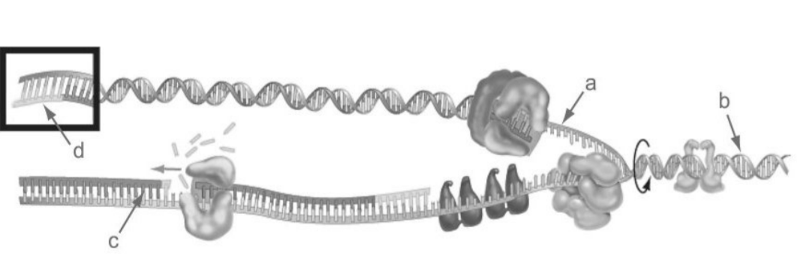
23) In the figure above, which is the template strand?
A) a B) b C) c D) d

back 23

A

front 24

24) The leading and the lagging strands differ in that _____.
A) the leading strand is synthesized at twice the rate of the lagging strand
B) the leading strand is synthesized in the same direction as the movement of the replication fork, and the
lagging strand is synthesized in the opposite direction
C) the lagging strand is synthesized continuously, whereas the leading strand is synthesized in short
fragments that are ultimately stitched together
D) the leading strand is synthesized by adding nucleotides to the 3 end of the growing strand, and the
lagging strand is synthesized by adding nucleotides to the 5 end

back 24

B

front 25

25) Which of the following help(s) to hold the DNA strands apart while they are being replicated?
A) DNA polymerase
B) primase
C) ligase
D) single-strand DNA binding proteins
E) nuclease

back 25

D

front 26

26) Eukaryotic telomeres replicate differently than the rest of the chromosome. This is a consequence of which of
the following?
A) the evolution of helicase enzyme
B) gaps left at the 3' end of the lagging strand because of the need for a primer
C) gaps left at the 5' end of the lagging strand
D) the "no ends" of a circular chromosome
E) DNA polymerase that cannot replicate the leading strand template to its 5

back 26

C

front 27

27) In a healthy cell, the rate of DNA repair is equal to the rate of DNA mutation. When the rate of repair lags
behind the rate of mutation, particularly when mutations occur in genes which regulate the cell cycle, what is a
possible fate of the cell?
A) RNA may be used instead of DNA as inheritance material.
B) The cell will always become healthier.
C) DNA synthesis will continue by a new mechanism.
D) The cell can be transformed to a cancerous cell.

back 27

D

front 28

28) Because of their linear (non-circular) choromosomes, telomere shortening is a problem in which types of cells?
A) only eukaryotic cells B) prokaryotes and eukaryotes C) only prokaryotic cells

back 28

A

front 29

29) Which of the following is NOT synthesized from a DNA template?
A) amino acids

B) messenger RNA

C) ribosomal RNA

D) tRNA

back 29

A

front 30

30) In the process of transcription, _____.
A) mRNA attaches to lysosomes B) RNA is synthesized
C) DNA is replicated D) proteins are synthesized

back 30

B

front 31

31) The statement "DNA -> RNA -> Proteins" _____.
A) describes viral infection B) descibes cell theory
C) is known as central dogma D) describes evolution

back 31

C

front 32

32) The HIV virus that causes AIDS is an RNA retrovirus, meaning it is made of RNA and not DNA. A retrovirus
_____.
A) makes proteins directly from RNA
B) a cellular virus that uses ribosomes to reproduce inside a living cell
C) uses reverse transcriptase to make DNA from RNA
D) uses DNA as a template in the process of translation

back 32

C

front 33

33) What does it mean when we say the genetic code is redundant?
A) A single codon can specify many types of amino acids.
B) The genetic code is different for different domains of organisms.
C) More than one codon can specify the addition of the same amino acid.
D) The genetic code is not meaningful

back 33

C

front 34

34) Which one of the following is true? A codon _____.
A) consists of four nucleotides
B) is the basic unit of the genetic code and contains 3 nucleotides
C) can code for up to four different amino acids
D) extends from one end of a tRNA molecule

back 34

B

front 35

35) The mutation resulting in sickle-cell disease changes one base pair of DNA so that a codon now codes for a
different amino acid so it is an example of a _____.
A) nonsense mutation B) missense mutation
C) silent mutation D) frameshift mutation

back 35

B

front 36

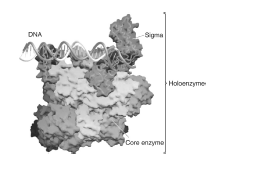
36) The core enzyme which initiates transcription and is shown in the figure above is _____.
A) RNA polymerase B) helicase C) DNA polymerase D) topoisomerase

back 36

A

front 37

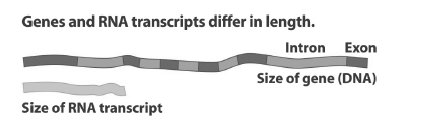
37) Refer to the figure above. The mRNA in eukaryotes is smaller than the length of the gene in the DNA that codes
for it because _____.
A) post-transcriptional modification removes the exons from the mRNA
B) bases are added to the tail of the primary transcript
C) the regulatory regions (exons) of the gene are not transcribed
D) post-transcriptional modification removes the introns from the mRNA

back 37

D

front 38

38) Ribosomes can attach to prokaryotic messenger RNA _____.
A) before transcription is complete, meaning transcription and translation can occur simultaneously on a
single mRNA
B) only after replication is complete
C) only after post-transcriptional modification of the protein is complete
D) only after the primary transcript has been released from RNA polymerase

back 38

A

front 39

39) There are sixty-one mRNA codons that specify an amino acid, but only forty-five tRNAs. This is best explained
by the fact that _____.
A) competitive exclusion forces some tRNAs to be destroyed by nucleases
B) the DNA codes for all sixty-one tRNAs, but some are then destroyed
C) some tRNAs have anticodons that don't work.
D) the wobble hypothesis, which states that the rules for base pairing between the third base of a codon and
tRNA are flexible
E) many codons are never used, so the tRNAs that recognize them are dispensable

back 39

D

front 40

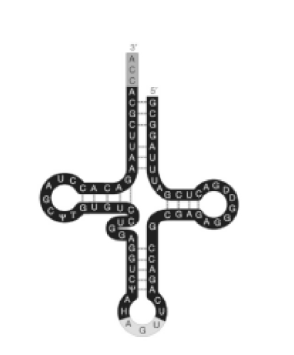
40) Refer to the figure above. What is the function of the AGU on the loop of the tRNA?
A) It stabilizes the gene.
B) It attaches to the amino acid.
C) It is the anticodon, and base pairs with a codon of mRNA.
D) It is the active site of this ribozyme.

back 40

C

front 41

41) Refer to the figure above. What is the function of the CCA sequence at the 3ƍ end?

A) It stabilizes the gene.B) It attaches to an amino acid. C) It is the active site of this ribozyme. D) It base pairs with the codon of mRNA.

back 41

B

front 42

42) Translation directly involves _____.
A) mRNA, tRNA, ribosomes, and DNA
B) mRNA, tRNA, ribosomes
C) tRNA, ribosomes, and DNA
D) mRNA, ribosomes, and DNA
E) mRNA, tRNA, and DNA

back 42

B

front 43

43) Regulating levels of gene expression serves an organism's survival by _____.
A) organizing gene expression, so that genes are always expressed in a given order
B) allowing environmental changes to alter a prokaryote's genome
C) allowing organisms to always express the same genes in the same quantities
D) allowing each gene to be expressed an equal number of times
E) allowing an organism to adjust to changes in environmental conditions

back 43

E

front 44

44) Which of the following levels of gene expression allows the most rapid response to environmental change?
A) translational control B) post-translational control C) transcriptional control

back 44

B

front 45

45) The greatest expression of the lac operon occurs when lactose levels are _____ and glucose levels are _____.
A) high , low B) high, high C) low, low D) low, high

back 45

A

front 46

46) The product of the lacI gene is _____.
A) an enzyme
B) the repressor
C) B-galactosidase
D) a transport protein embedded within the membrane

back 46

B

front 47

47) The arabinose operon (ara) provides a particularly interesting example of ___________ in that when arabinose is
present in the environment, the operon is transcribed.
A) negative control
B) reverse transcription
C) positive control
D) positive translation
E) push forward control

back 47

C

front 48

48) Under what condition is the AraC protein an activator?
A) The AraC protein is an activator when it is bound to lactose.
B) The AraC protein is an activator when it is bound to arabinose.
C) The AraC protein is an activator when it is bound to cyclic AMP.
D) The AraC protein is an activator when it is bound to any sugar molecule.
E) The AraC protein is an activator when it is bound to glucose.

back 48

B

front 49

49) Prokaryotes are classified as belonging to two different domains. What are the domains?
A) Bacteria and Archaea
B) Archaea and Monera
C) Bacteria and Protista
D) Bacteria and Eukarya
E) Eukarya and Monera

back 49

A

front 50

50) While examining a rock surface, you have discovered an interesting new organism. Which of the following
criteria will allow you to classify the organism as belonging to Prokary, not Eukarya?
A) The lipids in its plasma membrane consist of glycerol bonded to straight-chain fatty acids.
B) It is unicellular.
C) It can survive at room temprature
D) The organism does not have nucleus..
E) The organism does not have ribosomes

back 50

D