Instructions for Side by Side Printing
- Print the notecards
- Fold each page in half along the solid vertical line
- Cut out the notecards by cutting along each horizontal dotted line
- Optional: Glue, tape or staple the ends of each notecard together
Microbiology: Chapter 12
front 1 Recall from chapter 8
| back 1 An organism REQUIRING molecular oxygen (O2) for growth. |
front 2 Recall from chapter 8
| back 2 Respiration in which the final electron acceptor in the electron transport chain is molecular oxygen (O2) |
front 3 Recall from chapter 8
| back 3 An organism that does NOT use molecular oxygen, but is not affected by its presence. |
front 4 Recall from chapter 8
| back 4 An organism that does NOT require molecular oxygen for growth. |
front 5 Recall from chapter 8
| back 5 Respiration in which the final electron acceptor in the electron transport chain is an INORGANIC MOLECULE other than molecular oxygen (O2); for example, a nitrate ion or CO2. |
front 6 Recall from chapter 8
| back 6 All syntheses reactions in living organism; the building of complex organic molecules from simpler ones |
front 7 Recall from chapter 8
| back 7 All decomposition reactions in a living organism; the breakdown of complex organic compounds into simpler ones. |
front 8 Recall from chapter 8
| back 8 An enzyme that breaks down hydrogen peroxide: 2h202-->2h2O+O2 |
front 9 Recall from chapter 8
| back 9 A substance that increases the rate of chemical reaction but is not altered itself. |
front 10 Recall from chapter 8
| back 10 An organism that uses an inorganic chemical as an energy source and CO2 as a carbon source. |
front 11 Recall from chapter 8
| back 11 An orgnanism that uses organic molecules as a source of carbon & energy. |
front 12 Photoautotroph: | back 12 An organism that uses light as its energy source & carbon dioxide (CO2) as its carbon source. |
front 13 Photoheterotroph: | back 13 An organism that uses light as its energy source & an organic carbon source. |
front 14 Inorganic compound: | back 14 A small molecule that does not contain carbon & hydrogen |
front 15 Organic compound: | back 15 A molecule that contains carbon & hydrogen |
front 16 An organism that uses an inorganic chemical as an energy source and CO2 as a carbon source. | back 16 Chemoautotroph: |
front 17 An orgnanism that uses organic molecules as a source of carbon & energy. | back 17 Chemoheterotroph: |
front 18 Respiration in which the final electron acceptor in the electron transport chain is molecular oxygen (O2) | back 18 aerobic respiration: |
front 19 Respiration in which the final electron acceptor in the electron transport chain is an INORGANIC MOLECULE other than molecular oxygen (O2); for example, a nitrate ion or CO2. | back 19 anaerobic respiration: |
front 20 A small molecule that does not conatin carbon & hydrogen | back 20 Inorganic compound: |
front 21 Arthropods: | back 21 are animals twith jointed legs. The arthropods that transmit diseases are important in microbiology. These include ticks & some insects; most often members of the misquito family are responsible for transmitting disease. |
front 22 Helminth: | back 22 are multicellular animals. They are chemoheterotroph. Most obtain nutrients by ingestion through a mouth; some are absorptive. Parasitic heminths often have elaborate life cycles including egg, larva & adult. |
front 23 Fungi: | back 23 are in the Fungi kingdom. Fungi are chemoheterotrophs & acuire food by absorption. W/the exception of yeasts, fungi are multicellular. Most reproduces w/sexual & asexual spores. |
front 24 Algae: | back 24 belong to several kingdoms & can reproduce both sexually & asexually. They are photoautotrophs & produce several different photosynthetic pigments. They obtain nutrients by diffusion. Some are multicellular, forming colonies, filaments, or even tissues. A few produce toxins. |
front 25 Protozoa: | back 25 belong to several kingdoms. Most are chemoheterotrophic, but a few are photoautotrophic. They obtain nutrients by absorption or ingestion. All are unicellular, and many are motile. Parasitic protozoans often form resistant cysts. |
front 26 Fungi, protozoa, and helminths | back 26 cause diseases in humans. Most of these diseases are diagnosed by microscopic examination. Like bacteria, fungi are cultured on labroatory media. |
front 27 Infections caused by eukaryotes are | back 27 difficult to treat because humans have eukaryotic cells. |
front 28 Algal diseases of humans are | back 28 not infectious; they are intoxications because the symptoms are due to ingesting toxins produced by the algae |
front 29 Arthropods that transmit | back 29 are called vectors. Arthropod-brone diseases such as West Nile encephalitis are best controlled by limiting exposure to the arthropod. |
front 30 Mycorrhizae: | back 30 Nearly all plants depend on symbiotic fungi, known as mycorrhizae, which help their roots absorb mineral & water from the soil. |
front 31 Vegetative Structures: | back 31 Fungal colonies are described as vegetative structurs because they are composed of the cells involved in catabolism & growth |
front 32 Thallus | back 32 (body) of a mold or fleshy fungus consists of long filaments of cells joined together; these filaments are called hyphae |
front 33 Hyphae | back 33 long filaments joined together that make up the flshy fungus. |
front 34 Septa: | back 34 cross walls in the hyphae, which divide them into distinct, uninucleate cell-like units. |
front 35 Septate hypha: | back 35  multiple septa in a hypha.
|
front 36 Coenocytic hypha: | back 36 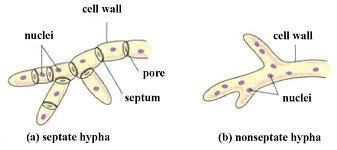 Hyphae w/no septa; also called coenocytic hypha
|
front 37 How do Hyphae grow? | back 37 By elongating at the tips; each part of a hypha is capable of growth & when a fragment breaks off, it can elongate to form a new hypha. |
front 38 When fragments of hypha break off what can happen? | back 38 It can elongate to form a new hypha |
front 39 In the laboratory, fungi are usually | back 39 grown from fragments obtained from a fungal thallus. |
front 40 The portion of a hypha that obtains nutrients is call the | back 40 vegetative hypha |
front 41 The portion of a hypha concerned w/reproduction is the | back 41 reproductive or aerial hypha, named because it projects above the surface of the medium on which the fungus is growing. |
front 42 Aerial hyphae | back 42 often bear reproductive spores |
front 43 When conditions are suitable, the hyphae grow to form a filamentous mass called a __________, which is visible to the unaided eye. | back 43 mycelium |
front 44 Yeasts: | back 44 Yeasts are nonfilamentous, unicellular fungi that are typically spherical or oval. |
front 45 Like molds, yeasts are widely... | back 45 distributed in nature; they are frequently found as a white powdery coating on fruits & leaves. |
front 46 Budding yeasts | back 46 Such as Saccharomyces, divide unevenly. |
front 47 In budding | back 47 the parent cell forms a protuberance (bud) on its outer surface. |
front 48 As the bud elongates- | back 48 the parent cell's nucleus divides & one nucleus migrates into the bud.
|
front 49 One yeast cell can in time produce up to ___ daughter cells by budding. | back 49 24 |
front 50 Some yeasts produce buds that fail to detach themselves; these buds form a short chain of cells called a | back 50 pseudohypha. |
front 51 Candida albicans | back 51 attaches to human epithelial cells as a yeast but usually requires pseudohyphae to invade deeper tissues. |
front 52 Fission yeasts | back 52 such as Schizosaccharomyces, divide evenly to produce two new cells.
|
front 53 ~Fungi~
| back 53 ~Fungi~
|
front 54 ~Bacteria~
| back 54 ~Bacteria~
|
front 55 Fungi cell type: | back 55 Eukaryotic |
front 56 Fungi cell membrane: | back 56 Sterols present |
front 57 Fungi Cell wall: | back 57 Glucans; mannan; chitin (no peptidoglycan) |
front 58 Fungi spores: | back 58 Sexual & asexual reproductive spores |
front 59 Fungi metabolism: | back 59 limited to heterotrophic; aerobic, facultatively anaerobic. |
front 60 Bacteria cell type: | back 60 Prokaryotic |
front 61 Bacteria cell membrane: | back 61 Sterols absent, except in Mycoplasma (italics) |
front 62 Bacteria cell wall: | back 62 Peptidoglycan |
front 63 Bacteria spores: | back 63 Endospores (not reproduction); some asexual reproductive spores. |
front 64 Bacteria metabolism: | back 64 Heterotrophic, autotrophic; aerobic, facultatively anaerobic, anaerobic |
front 65 _____ are capable of facultative anaerobic growth. | back 65 Yeasts |
front 66 _____ can use oxygen or an organic compound as the final electron acceptor; this is a valuable attribute because it allows these fungi to survive in various environments. | back 66 Yeasts |
front 67 What is the benefit for yeast using oxygen or an organic compound as the final electron acceptor? | back 67 It allows fungi to survive in various environments. |
front 68 If given access to oxygen yeasts will | back 68 perform aerobic respiration to metabolize carbohydrates to carbon dioxide & water. |
front 69 If denied oxygen yeasts will | back 69 ferment carbohydrates & produce ethanol & carbon dioxide.
|
front 70 Saccharomyces species | back 70 produce ethanol in brewed beverages & carbon dioxide for leavening bread dough. |
front 71 Dimorphic Fungi- | back 71 Some fungi, most notably the pathogenic species, exhibit DIMORPHISM- 2 forms of growth.
|
front 72 The moldlike forms produce- | back 72 vegetative & aerial hyphae |
front 73 The yeastlike forms | back 73 reproduce by budding |
front 74 dimorphism in pathogenic fungi is temperature-dependent: at | back 74 37°C, the fungus is yeastlike |
front 75 dimorphism in pathogenic fungi is temperature-dependent: at | back 75 25°C, it is moldlike |
front 76 However, the appearance of the dimorphic (nonpathogenic) fungus changes with | back 76 CO2 concentration. |
front 77 Life cycle~
| back 77 asexually by fragmentation of their hyphae. |
front 78 Both sexual & asexual reproduction in fungi occurs by the formation of | back 78 spores. |
front 79 Usually fungi are identified by what? | back 79 Spore type |
front 80 Are fungal spores different from bacterial endospores? | back 80 Yes, quite different. |
front 81 Bacterial endospores allow a bacterial cell to | back 81 survive adverse environmental conditions. |
front 82 A single vegetative bacterial cell forms | back 82 one endospore, which eventually germinates to produce a single vegetative bacterial cell.
|
front 83 After a mold forms a spore, the spore detaches from the parent & germinates into a new mold. | back 83 *Unlike the bacterial endospore, this is a true reproductive spore; a 2nd organism grows from the spore. |
front 84 Survival of fungal spores: | back 84 Although fungal spores can survive for extended periods in dry or hot environments, most do not exhibit the extreme tolerance & longevity of bacterial endospores |
front 85 Spores are formed from | back 85 aerial hyphae in a number of different ways, depending on the species.
|
front 86 Asexual spores: | back 86 are formed by the hyphae of one organism.
|
front 87 Sexual spores: | back 87 result from the fusion of nuclei from 2 opposite mating strains of the same species of fungus. |
front 88 Fungi produce sexual spores LESS frequently than | back 88 asexual spores. |
front 89 Organisms that grow from sexual spores will | back 89 have genetic characteristics of both parental strains. |
front 90 Asexual Spores: | back 90 Asexual spores are produced by an individual fungus through MITOSIS & SUBSEQUENT CELL DIVISION.
|
front 91 What are the 2 types of asexual spores produced by fungi? | back 91 1. Conidiospore or conidium
|
front 92 Conidiospore or Conidium: | back 92 a unicellular or multicellular spore that is not enclosed in a sac. |
front 93 How are Conidia are produced? | back 93 In a chain at the end of a conidiophore. Such spores are produced by Aspergillus (italics). |
front 94 Conidia formed by the fragmentation of a septate hypha into single, slightly thickened cells are called ____________. | back 94 arthroconidia |
front 95 Another type of conidium, ____________, consists of buds coming off the parent cell. | back 95 blastoconidia |
front 96 Blastonconida are found in some yeasts, such as | back 96 Candida albicans & Cryptococcus (both in italics). |
front 97 Chlamydoconidium | back 97 is a thick-walled spore formed by rounding & enlargement within a hyphal segment. |
front 98 A fungus that produces chlamydoconidia is the yeast | back 98 C. albicans (italics) |
front 99 Sporangiospore | back 99 formed within a sporangium, or sac, at the end of an aerial hypha called a sporangiophore. |
front 100 The sporangium can contain | back 100 hundreds of sporangiospores.
|
front 101 Sexual Spores: A fungal sexual spore results from sexual reproduction, which consists of 3 phases: | back 101 1. Plasmogamy
|
front 102 Plasmogamy: | back 102 A haploid nucleus of a donor cell (+) penetrates the cytoplasm of a recipient cell (-). |
front 103 Karyogamy: | back 103 The (+) & (-) nuclei fuse to form a diploid zygote nucleus. |
front 104 Meiosis: | back 104 The diploid nucleus gives rise to haploid nuclei (sexual spores), some of which may be genetic recombinants. |
front 105 The sexual spores produced by fungi characterize the ___. | back 105 phyla |
front 106 In laboratory settings, most fungi exhibit only ____ spores. | back 106 asexual |
front 107 Clinical identification is based on microscopic examination of _____ spores. | back 107 asexual |
front 108 Nutritional Adaptations- | back 108 Fungi are generally adapted to environments that would be hostile to bacteria. |
front 109 Fungi are __________, and, like bacteria, they absorb nutrients rather than ingesting them as animals do. | back 109 chemoheterotrophs |
front 110 Fungi differ from bacteria in certain environmental requirements & in the following nutritional characteristics: | back 110 Fungi usually grow better in an environment with a pH of about 5, which is too acidic for the growth of most common bacteria. |
front 111 Fungi differ from bacteria in certain environmental requirements & in the following nutritional characteristics: | back 111 Almost all molds are aerobic. Most yeasts are facultative anaerobes. |
front 112 Fungi differ from bacteria in certain environmental requirements & in the following nutritional characteristics: | back 112 Most fungi are more resistant to osmotic pressure than bacteria; most can therefore grow in relatively high sugar or salt concentrations. |
front 113 Fungi differ from bacteria in certain environmental requirements & in the following nutritional characteristics: | back 113 Fungi can grow on substances w/a very low moisture content, generally too low to support the growth of bacteria. |