Instructions for Side by Side Printing
- Print the notecards
- Fold each page in half along the solid vertical line
- Cut out the notecards by cutting along each horizontal dotted line
- Optional: Glue, tape or staple the ends of each notecard together
Economics of Money: Chapter 17
front 1 The exchange rate is
| back 1 Answer: D |
front 2 Exchange rates are determined in
| back 2 Answer: B |
front 3 Although foreign exchange market trades are said to involve the buying and selling of currencies, most trades involve the buying and selling of
| back 3 Answer: A |
front 4 The immediate (two-day) exchange of one currency for another is a
| back 4 Answer: B |
front 5 An agreement to exchange dollar bank deposits for euro bank deposits in one month is a
| back 5 Answer: C |
front 6 Today 1 euro can be purchased for $1.10. This is the
| back 6 Answer: A |
front 7 In an agreement to exchange dollars for euros in three months at a price of $0.90 per euro, the price is the
| back 7 Answer: C |
front 8 When the value of the British pound changes from $1.25 to $1.50, the pound has ________ and the U.S. dollar has ________.
| back 8 Answer: C |
front 9 When the value of the British pound changes from $1.50 to $1.25, then the pound has ________ and the U.S. dollar has ________.
| back 9 Answer: B |
front 10 When the value of the dollar changes from £0.5 to £0.75, then the British pound has ________ and the U.S. dollar has ________.
| back 10 Answer: B |
front 11 When the value of the dollar changes from £0.75 to £0.5, then the British pound has ________ and the U.S. dollar has ________.
| back 11 Answer: C |
front 12 When the exchange rate for the Mexican peso changes from 9 pesos to the U.S. dollar to 10 pesos to the U.S. dollar, then the Mexican peso has ________ and the U.S. dollar has ________.
| back 12 Answer: B |
front 13 When the exchange rate for the Mexican peso changes from 10 pesos to the U.S dollar to 9 pesos to the U.S. dollar, then the Mexican peso has ________ and the U.S. dollar has ________.
| back 13 Answer: C |
front 14 On January 25, 2009, one U.S. dollar traded on the foreign exchange market for about 0.75 euros. Therefore, one euro would have purchased about ________ U.S. dollars.
| back 14 Answer: C |
front 15 On January 25, 2009, one U.S. dollar traded on the foreign exchange market for about 49.0 Indian rupees. Thus, one Indian rupee would have purchased about ________ U.S. dollars.
| back 15 Answer: A |
front 16 On January 25, 2009, one U.S. dollar traded on the foreign exchange market for about 1.15 Swiss francs. Therefore, one Swiss franc would have purchased about ________ U.S. dollars.
| back 16 Answer: B |
front 17 On January 25, 2009, one U.S. dollar traded on the foreign exchange market for about 3.33 Romanian new lei. Therefore, one Romanian new lei would have purchased about ________ U.S. dollars.
| back 17 Answer: A |
front 18 If the U.S. dollar appreciates from 1.25 Swiss franc per U.S. dollar to 1.5 francs per dollar, then the franc depreciates from ________ U.S. dollars per franc to ________ U.S. dollars per franc.
| back 18 Answer: A |
front 19 If the British pound appreciates from $0.50 per pound to $0.75 per pound, the U.S. dollar depreciates from ________ per dollar to ________ per dollar.
| back 19 Answer: B |
front 20 If the Japanese yen appreciates from $0.01 per yen to $0.02 per yen, the U.S. dollar depreciates from ________ per dollar to ________ per dollar.
| back 20 Answer: A |
front 21 If the dollar appreciates from 1.5 Brazilian reals per dollar to 2.0 reals per dollar, the real depreciates from ________ per real to ________ per real.
| back 21 Answer: A |
front 22 When the exchange rate for the British pound changes from $1.80 per pound to $1.60 per pound, then, holding everything else constant, the pound has ________ and ________ expensive.
| back 22 Answer: C |
front 23 If the dollar depreciates relative to the Swiss franc
| back 23 Answer: C |
front 24 Everything else held constant, when a country's currency appreciates, the country's goods abroad become ________ expensive and foreign goods in that country become ________ expensive.
| back 24 Answer: A |
front 25 Everything else held constant, when a country's currency depreciates, its goods abroad become ________ expensive while foreign goods in that country become ________ expensive.
| back 25 Answer: D |
front 26 According to the law of one price, if the price of Colombian coffee is 100 Colombian pesos per pound and the price of Brazilian coffee is 4 Brazilian reals per pound, then the exchange rate between the Colombian peso and the Brazilian real is
| back 26 Answer: C |
front 27 The starting point for understanding how exchange rates are determined is a simple idea called ________, which states: if two countries produce an identical good, the price of the good should be the same throughout the world no matter which country produces it.
| back 27 Answer: B |
front 28 The ________ states that exchange rates between any two currencies will adjust to reflect changes in the price levels of the two countries.
| back 28 Answer: A |
front 29 The theory of PPP suggests that if one country's price level rises relative to another's, its currency should
| back 29 Answer: A |
front 30 The theory of PPP suggests that if one country's price level falls relative to another's, its currency should
| back 30 Answer: B |
front 31 The theory of PPP suggests that if one country's price level falls relative to another's, its currency should
| back 31 Answer: B |
front 32 The theory of purchasing power parity cannot fully explain exchange rate movements in the short run because
| back 32 Answer: C |
front 33 The theory of purchasing power parity states that exchange rates between any two currencies will adjust to reflect changes in
| back 33 Answer: D |
front 34 If the real exchange rate between the United States and Japan is ________, then it is cheaper to buy goods in Japan than in the United States.
| back 34 Answer: A |
front 35 According to PPP, the real exchange rate between two countries will always equal
| back 35 Answer: C |
front 36 The theory of PPP suggests that if one country's price level rises relative to another's, its currency should
| back 36 Answer: A |
front 37 In the long run, a rise in a country's price level (relative to the foreign price level) causes its currency to ________, while a fall in the country's relative price level causes its currency to ________.
| back 37 Answer: C |
front 38 If the 2005 inflation rate in Canada is 4 percent, and the inflation rate in Mexico is 2 percent, then the theory of purchasing power parity predicts that, during 2005, the value of the Canadian dollar in terms of Mexican pesos will
| back 38 Answer: D |
front 39 Assume that the following are the predicted inflation rates in these countries for the year: 2% for the United States, 3% for Canada; 4% for Mexico, and 5% for Brazil. According to the purchasing power parity and everything else held constant, which of the following would we expect to happen?
| back 39 Answer: A |
front 40 According to the purchasing power parity theory, a rise in the United States price level of 5 percent, and a rise in the Mexican price level of 6 percent cause
| back 40 Answer: A |
front 41 Higher tariffs and quotas cause a country's currency to ________ in the ________ run, everything else held constant.
| back 41 Answer: D |
front 42 Lower tariffs and quotas cause a country's currency to ________ in the ________ run, everything else held constant.
| back 42 Answer: C |
front 43 Anything that increases the demand for foreign goods relative to domestic goods tends to ________ the domestic currency because domestic goods will only continue to sell well if the value of the domestic currency is ________, everything else held constant.
| back 43 Answer: A |
front 44 Everything else held constant, increased demand for a country's ________ causes its currency to appreciate in the long run, while increased demand for ________ causes its currency to depreciate.
| back 44 Answer: C |
front 45 Everything else held constant, increased demand for a country's exports causes its currency to ________ in the long run, while increased demand for imports causes its currency to ________.
| back 45 Answer: B |
front 46 Everything else held constant, if a factor increases the demand for ________ goods relative to ________ goods, the domestic currency will appreciate.
| back 46 Answer: D |
front 47 Everything else held constant, if a factor decreases the demand for ________ goods relative to ________ goods, the domestic currency will depreciate.
| back 47 Answer: D |
front 48 An increase in productivity in a country will cause its currency to ________ because it can produce goods at a ________ price, everything else held constant.
| back 48 Answer: B |
front 49 If, in retaliation for "unfair" trade practices, Congress imposes a 30 percent tariff on Japanese DVD recorders, but at the same time, U.S. demand for Japanese goods increases, then, in the long run, ________, everything else held constant.
| back 49 Answer: D |
front 50 If the U.S. Congress imposes a quota on imports of Japanese cars due to claims of "unfair" trade practices, and Japanese demand for American exports increases at the same time, then, in the long run ________, everything else held constant.
| back 50 Answer: B |
front 51 If the inflation rate in the United States is higher than that in Mexico and productivity is growing at a slower rate in the United States than in Mexico, then, in the long run, ________, everything else held constant.
| back 51 Answer: A |
front 52 If the Brazilian demand for American exports rises at the same time that U.S. productivity rises relative to Brazilian productivity, then, in the long run, ________, everything else held constant.
| back 52 Answer: B |
front 53 Explain the law of one price and the theory of purchasing power parity. Why doesn't purchasing power parity explain all exchange rate movements in the short run? What factors determine long-run exchange rates? | back 53 Answer: With no trade barriers and low transport costs, the law of one price states that the price of traded goods should be the same in all countries. The purchasing power parity theory extends the law of one price to total economies. PPP states that exchange rates should adjust to reflect changes in the price levels between two countries. PPP may fail to fully explain exchange rates because goods are not identical, and price levels include traded and nontraded goods and services. Long-run exchange rates are determined by domestic price levels relative to foreign price levels, trade barriers, import and export demand, and productivity. |
front 54 The theory of portfolio choice suggests that the most important factor affecting the demand for domestic and foreign assets is
| back 54 Answer: B |
front 55 The ________ suggests that the most important factor affecting the demand for domestic and foreign assets is the expected return on domestic assets relative to foreign assets.
| back 55 Answer: A |
front 56 The theory of portfolio choice suggests that the most important factor affecting the demand for domestic and foreign assets is the ________ on these assets relative to one another.
| back 56 Answer: C |
front 57 As the relative expected return on dollar assets increases, foreigners will want to hold more ________ assets and less ________ assets, everything else held constant.
| back 57 Answer: C |
front 58 When Americans or foreigners expect the return on ________ assets to be high relative to the return on ________ assets, there is a higher demand for dollar assets and a correspondingly lower demand for foreign assets.
| back 58 Answer: B |
front 59 When Americans or foreigners expect the return on dollar assets to be high relative to the return on foreign assets, there is a ________ demand for dollar assets and a correspondingly ________ demand for foreign assets.
| back 59 Answer: B |
front 60 Everything else held constant, when the current value of the domestic currency increases, the ________ domestic assets ________.
| back 60 Answer: D |
front 61 Everything else held constant, when the current value of the domestic exchange rate increases, the ________ of domestic assets ________.
| back 61 Answer: A |
front 62 An increase in the domestic interest rate causes the demand for domestic assets to ________ and the domestic currency to ________, everything else held constant.
| back 62 Answer: A |
front 63 An increase in the domestic interest rate causes the demand for domestic assets to shift to the ________ and the domestic currency to ________, everything else held constant.
| back 63 Answer: A |
front 64 A decrease in the domestic interest rate causes the demand for domestic assets to ________ and the domestic currency to ________, everything else held constant.
| back 64 Answer: D |
front 65 A decrease in the domestic interest rate causes the demand for domestic assets to shift to the ________ and the domestic currency to ________, everything else held constant.
| back 65 Answer: D |
front 66 ________ in the domestic interest rate causes the demand for domestic assets to increase and the domestic currency to ________, everything else held constant.
| back 66 Answer: A |
front 67 ________ in the domestic interest rate causes the demand for domestic assets to shift to the right and the domestic currency to ________, everything else held constant.
| back 67 Answer: A |
front 68 ________ in the domestic interest rate causes the demand for domestic assets to decrease and the domestic currency to ________, everything else held constant.
| back 68 Answer: D |
front 69 ________ in the domestic interest rate causes the demand for domestic assets to shift to the left and the domestic currency to ________, everything else held constant.
| back 69 Answer: D |
front 70 ________ in the domestic interest rate causes the demand for domestic assets to ________ and the domestic currency to appreciate, everything else held constant.
| back 70 Answer: A |
front 71 ________ in the domestic interest rate causes the demand for domestic assets to shift to the ________ and the domestic currency to appreciate, everything else held constant.
| back 71 Answer: A |
front 72 ________ in the domestic interest rate causes the demand for domestic assets to ________ and the domestic currency to depreciate, everything else held constant.
| back 72 Answer: D |
front 73 ________ in the domestic interest rate causes the demand for domestic assets to shift to the ________ and the domestic currency to depreciate, everything else held constant.
| back 73 Answer: D |
front 74 Suppose that the Federal Reserve enacts expansionary policy. Everything else held constant, this will cause the demand for U.S. assets to ________ and the U.S. dollar to ________.
| back 74 Answer: D |
front 75 Suppose that the Federal Reserve conducts an open market sale. Everything else held constant, this will cause the demand for U.S. assets to ________ and the U.S. dollar will ________.
| back 75 Answer: A |
front 76 An increase in the foreign interest rate causes the demand for domestic assets to ________ and the domestic currency to ________, everything else held constant.
| back 76 Answer: D |
front 77 An increase in the foreign interest rate causes the demand for domestic assets to shift to the ________ and the domestic currency to ________, everything else held constant.
| back 77 Answer: D |
front 78 A decrease in the foreign interest rate causes the demand for domestic assets to ________ and the domestic currency to ________, everything else held constant.
| back 78 Answer: A |
front 79 A decrease in the foreign interest rate causes the demand for domestic assets to shift to the ________ and the domestic currency to ________, everything else held constant.
| back 79 Answer: A |
front 80 ________ in the foreign interest rate causes the demand for domestic assets to increase and the domestic currency to ________, everything else held constant.
| back 80 Answer: C |
front 81 ________ in the foreign interest rate causes the demand for domestic assets to shift to the right and the domestic currency to ________, everything else held constant.
| back 81 Answer: C |
front 82 ________ in the foreign interest rate causes the demand for domestic assets to decrease and the domestic currency to ________, everything else held constant.
| back 82 Answer: B |
front 83 ________ in the foreign interest rate causes the demand for domestic assets to shift to the left and the domestic currency to ________, everything else held constant.
| back 83 Answer: B |
front 84 ________ in the foreign interest rate causes the demand for domestic assets to ________ and the domestic currency to appreciate, everything else held constant.
| back 84 Answer: C |
front 85 ________ in the foreign interest rate causes the demand for domestic assets to shift to the ________ and the domestic currency to appreciate, everything else held constant.
| back 85 Answer: C |
front 86 ________ in the foreign interest rate causes the demand for domestic assets to ________ and the domestic currency to depreciate, everything else held constant.
| back 86 Answer: B |
front 87 ________ in the foreign interest rate causes the demand for domestic assets to shift to the ________ and the domestic currency to depreciate, everything else held constant.
| back 87 Answer: B |
front 88 Suppose that the European Central Bank enacts expansionary policy. Everything else held constant, this will cause the demand for U.S. assets to ________ and the U.S. dollar to ________.
| back 88 Answer: A |
front 89 Suppose that the European Central Bank conducts a main refinancing sale. Everything else held constant, this would cause the demand for U.S. assets to ________ and the U.S. dollar will ________.
| back 89 Answer: D |
front 90 An increase in the expected future domestic exchange rate causes the demand for domestic assets to ________ and the domestic currency to ________, everything else held constant.
| back 90 Answer: A |
front 91 An increase in the expected future domestic exchange rate causes the demand for domestic assets to shift to the ________ and the domestic currency to ________, everything else held constant.
| back 91 Answer: A |
front 92 A decrease in the expected future domestic exchange rate causes the demand for domestic assets to ________ and the domestic currency to ________, everything else held constant.
| back 92 Answer: D |
front 93 A decrease in the expected future domestic exchange rate causes the demand for domestic assets to shift to the ________ and the domestic currency to ________, everything else held constant.
| back 93 Answer: D |
front 94 ________ in the expected future domestic exchange rate causes the demand for domestic assets to increase and the domestic currency to ________, everything else held constant.
| back 94 Answer: A |
front 95 ________ in the expected future domestic exchange rate causes the demand for domestic assets to shift to the right and the domestic currency to ________, everything else held constant.
| back 95 Answer: A |
front 96 ________ in the expected future domestic exchange rate causes the demand for domestic assets to decrease and the domestic currency to ________, everything else held constant.
| back 96 Answer: D |
front 97 ________ in the expected future domestic exchange rate causes the demand for domestic assets to shift to the left and the domestic currency to ________, everything else held constant.
| back 97 Answer: D |
front 98 ________ in the expected future domestic exchange rate causes the demand for domestic assets to ________ and the domestic currency to appreciate, everything else held constant.
| back 98 Answer: A |
front 99 ________ in the expected future domestic exchange rate causes the demand for domestic assets to shift to the ________ and the domestic currency to appreciate, everything else held constant.
| back 99 Answer: A |
front 100 ________ in the expected future domestic exchange rate causes the demand for domestic assets to ________ and the domestic currency to depreciate, everything else held constant.
| back 100 Answer: D |
front 101 ________ in the expected future domestic exchange rate causes the demand for domestic assets to shift to the ________ and the domestic currency to depreciate, everything else held constant.
| back 101 Answer: D |
front 102 Suppose the Federal Reserve releases a policy statement today which leads people to believe that the Fed will be enacting expansionary monetary policy in the near future. Everything else held constant, the release of this statement would immediately cause the demand for U.S. assets to ________ and the U.S. dollar to ________.
| back 102 Answer: D |
front 103 Suppose a report was released today that showed the Euro-Zone inflation rate is running above the European Central Bank's inflation rate target. This leads people to expect that the European Central Bank will enact contractionary policy in the near future. Everything else held constant, the release of this report would immediately cause the demand for U.S. assets to ________ and the U.S. dollar will ________.
| back 103 Answer: A |
front 104 Suppose that the latest Consumer Price Index (CPI) release shows a higher inflation rate in the U.S. than was expected. Everything else held constant, the release of the CPI report would immediately cause the demand for U.S. assets to ________ and the U.S. dollar would ________.
| back 104 Answer: D |
front 105 Evidence from the United States during the period 1973-2002 indicates that the value of the dollar and the measure of the ________ interest rate rose and fell together.
| back 105 Answer: A |
front 106 During the beginning on the global financial crisis in the United States when the effects of the crisis were mostly confined within the United States, the U. S. dollar ________ because demand for U.S. assets ________.
| back 106 Answer: D |
front 107 When the effects of the global financial crisis started to spread more quickly throughout the rest of the world, the U.S. dollar ________ because demand for U.S. assets ________.
| back 107 Answer: A |
front 108 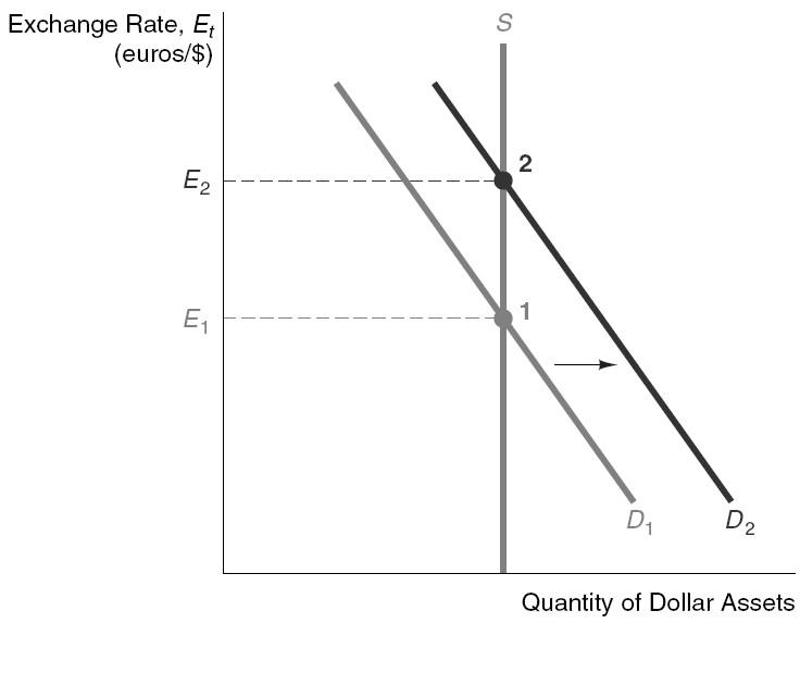 Explain and show graphically the effect of an increase in the expected future exchange rate on the equilibrium exchange rate, everything else held constant. | back 108 Answer: See figure Chapter 17 Number 108. When the expected future exchange rate increases, the relative expected return on the domestic assets increases. This will cause the demand for domestic assets to increase and the current value of the exchange rate will appreciate. |
front 109 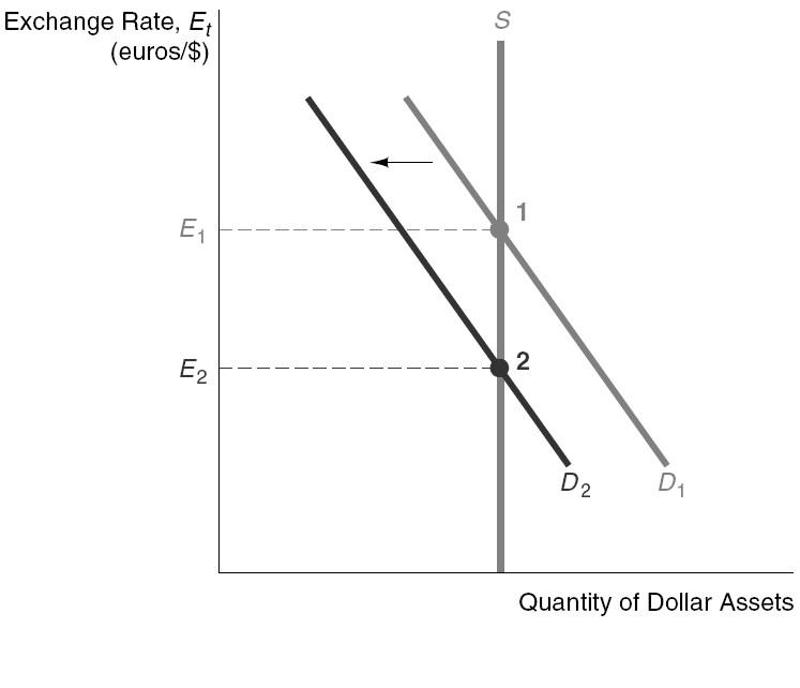 Explain and show graphically the effect of an increase in the expected inflation rate on the equilibrium exchange rate, everything else held constant. | back 109 Answer: See figure Chapter 17 Number 109 When the expected inflation rate increases, the relative expected return on domestic assets is affected two ways. First, through the Fisher effect, the domestic nominal interest rate will increase the expected return on domestic assets. Second, through purchasing power parity, the future value of the domestic exchange rate will decline which will decrease the expected return on domestic assets. Since it is generally believed that the effect of the change in the expected future value of the domestic exchange rate is larger than the Fisher effect, the net effect is a lower expected return on domestic assets. This will decrease the demand for domestic assets, which will cause the current value of the domestic exchange rate to depreciate. |
front 110 The condition that states that the domestic interest rate equals the foreign interest rate minus the expected appreciation of the domestic currency is called
| back 110 Answer: B |
front 111 If the interest rate is 7 percent on euro-denominated assets and 5 percent on dollar-denominated assets, and if the dollar is expected to appreciate at a 4 percent rate, for Francois the Frenchman the expected rate of return on dollar-denominated assets is
| back 111 Answer: B |
front 112 If the interest rate is 7 percent on euro-denominated assets and 5 percent on dollar-denominated assets, and if the dollar is expected to appreciate at a 4 percent rate, the expected return on ________-denominated assets in ________ percent.
| back 112 Answer: D |
front 113 If the interest rate is 7 percent on euro-denominated assets and 5 percent on dollar-denominated assets, and if the dollar is expected to appreciate at a 4 percent rate, the expected return on ________-denominated assets in terms of ________ percent.
| back 113 Answer: C |
front 114 If the interest rate is 7 percent on euro-denominated assets and 5 percent on dollar-denominated assets, and if the dollar is expected to appreciate at a 4 percent rate, the expected return on ________-denominated assets in terms of ________ percent.
| back 114 Answer: D |
front 115 If the interest rate on euro-denominated assets is 13 percent and it is 15 percent on peso-denominated assets, and if the euro is expected to appreciate at a 4 percent rate, for Manuel the Mexican the expected rate of return on euro-denominated assets is
| back 115 Answer: C |
front 116 If the interest rate on euro-denominated assets is 13 percent and it is 15 percent on peso-denominated assets, and if the euro is expected to appreciate at a 4 percent rate, for Francois the Frenchman the expected rate of return on peso-denominated assets is
| back 116 Answer: A |
front 117 With a 10 percent interest rate on dollar deposits, and an expected appreciation of 7 percent over the coming year, the expected return on dollar deposits in terms of the foreign currency is
| back 117 Answer: D |
front 118 With a 10 percent interest rate on dollar deposits, and an expected appreciation of 7 percent over the coming year, the expected return on dollar deposits in terms of the dollar is
| back 118 Answer: B |
front 119 The expected return on dollar deposits in terms of foreign currency can be written as the ________ of the interest rate on dollar deposits and the expected appreciation of the dollar.
| back 119 Answer: C |
front 120 In a world with few impediments to capital mobility, the domestic interest rate equals the sum of the foreign interest rate and the expected depreciation of the domestic currency, a situation known as the
| back 120 Answer: A |
front 121 According to the interest parity condition, if the domestic interest rate is 12 percent and the foreign interest rate is 10 percent, then the expected ________ of the foreign currency must be ________ percent.
| back 121 Answer: B |
front 122 According to the interest parity condition, if the domestic interest rate is 10 percent and the foreign interest rate is 12 percent, then the expected ________ of the foreign currency must be ________ percent.
| back 122 Answer: C |