Instructions for Side by Side Printing
- Print the notecards
- Fold each page in half along the solid vertical line
- Cut out the notecards by cutting along each horizontal dotted line
- Optional: Glue, tape or staple the ends of each notecard together
Economics of Money: Chapter 16
front 1 The most common definition that monetary policymakers use for price stability is
| back 1 Answer: D |
front 2 Inflation results in
| back 2 Answer: D |
front 3 Economists believe that countries recently suffering hyperinflation have experienced
| back 3 Answer: A |
front 4 A nominal variable, such as the inflation rate or the money supply, which ties down the price level to achieve price stability is called ________ anchor.
| back 4 Answer: A |
front 5 A central feature of monetary policy strategies in all countries is the use of a nominal variable that monetary policymakers use as an intermediate target to achieve an ultimate goal such as price stability. Such a variable is called a nominal
| back 5 Answer: A |
front 6 A nominal anchor promotes price stability by
| back 6 Answer: C |
front 7 Monetary policy is considered time-inconsistent because
| back 7 Answer: C |
front 8 The time-inconsistency problem with monetary policy tells us that, if policymakers use discretionary policy, there is a higher probability that the ________ will be higher, compared to policy makers following a behavior rule.
| back 8 Answer: A |
front 9 The theory that monetary policy conducted on a discretionary, day-by-day basis leads to poor long-run outcomes is referred to as the
| back 9 Answer: C |
front 10 The ________ problem of discretionary policy arises because economic behavior is influenced by what firms and people expect the monetary authorities to do in the future.
| back 10 Answer: B |
front 11 If the central bank pursues a monetary policy that is more expansionary than what firms and people expect, then the central bank must be trying to
| back 11 Answer: A |
front 12 The time-inconsistency problem in monetary policy can occur when the central bank conducts policy
| back 12 Answer: C |
front 13 Explain the time-inconsistency problem. What is the likely outcome of discretionary policy? What are the solutions to the time-inconsistency problem? | back 13 Answer: With policy discretion, policymakers have an incentive to attempt to increase output by pursuing expansionary policies once expectations are set. The problem is that this policy results not in higher output, but in higher actual and expected inflation. The solution is to adopt a rule to constrain discretion. Nominal anchors can provide the necessary constraint on discretionary behavior. |
front 14 Even if the Fed could completely control the money supply, monetary policy would have critics because
| back 14 Answer: A |
front 15 High unemployment is undesirable because it
| back 15 Answer: A |
front 16 When workers voluntarily leave work while they look for better jobs, the resulting unemployment is called
| back 16 Answer: B |
front 17 Unemployment resulting from a mismatch of workers' skills and job requirements is called
| back 17 Answer: B |
front 18 The goal for high employment should be a level of unemployment at which the demand for labor equals the supply of labor. Economists call this level of unemployment the
| back 18 Answer: C |
front 19 Supply-side economic policies seek to
| back 19 Answer: D |
front 20 The Federal Reserve System was created to
| back 20 Answer: B |
front 21 Having interest rate stability
| back 21 Answer: A |
front 22 Foreign exchange rate stability is important because a decline in the value of the domestic currency will ________ the inflation rate, and an increase in the value of the domestic currency makes domestic industries ________ competitive with competing foreign industries.
| back 22 Answer: B |
front 23 Which set of goals can, at times, conflict in the short run?
| back 23 Answer: C |
front 24 The primary goal of the European Central Bank is
| back 24 Answer: A |
front 25 The mandate for the monetary policy goals that has been given to the European Central Bank is an example of a ________ mandate.
| back 25 Answer: D |
front 26 The mandate for the monetary policy goals that has been given to the Federal Reserve System is an example of a ________ mandate.
| back 26 Answer: B |
front 27 Either a dual or hierarchial mandate is acceptable as long as ________ is the primary goal in the ________.
| back 27 Answer: B |
front 28 The type of monetary policy that is used in Canada, New Zealand, and the United Kingdom is
| back 28 Answer: B |
front 29 Which of the following is not an element of inflation targeting?
| back 29 Answer: C |
front 30 The first country to adopt inflation targeting was
| back 30 Answer: C |
front 31 In both New Zealand and Canada, what has happened to the unemployment rate since the countries adopted inflation targeting?
| back 31 Answer: C |
front 32 Which of the following is not an advantage of inflation targeting?
| back 32 Answer: C |
front 33 Which of the following is not a disadvantage to inflation targeting?
| back 33 Answer: D |
front 34 The decision by inflation targeters to choose inflation targets ________ zero reflects the concern of monetary policymakers that particularly ________ inflation can have substantial negative effects on real economic activity.
| back 34 Answer: D |
front 35 Inflation targets can increase the central bank's flexibility in responding to declines in aggregate spending. Declines in aggregate ________ that cause the inflation rate to fall below the floor of the target range will automatically stimulate the central bank to ________ monetary policy without fearing that this action will trigger a rise in inflation expectations.
| back 35 Answer: B |
front 36 Explain what inflation targeting is. What are the advantages and disadvantages of this type of monetary policy strategy? | back 36 Answer: There are five main elements to inflation targeting: 1. a public announcement of a medium-term target for the inflation rate; 2. a commitment to price stability as the primary long-term goal of policy; 3. many variables are used in making decisions about policy moves; 4. increased transparency about policy strategy with the public; 5. the central bank has increased accountability for attaining policy goals. The advantages of inflation targeting include: 1. the simplicity and clarity of a numerical target for the inflation rate; 2. there is increased accountability of the central bank; 3. reduces the effects of inflationary shocks. The disadvantages of inflation targeting include: 1. there is a delayed signal about the achievement of the target; 2. it could lead to a rigid rule where the only focus is the inflation rate (has not happened in practice); 3. if sole focus is the inflation rate, larger output fluctuations can occur (has not happened in practice). |
front 37 The type of monetary policy regime that the Federal Reserve has followed From the 1980s up until the time Ben Bernanke became chair of the Federal Reserve in 2006 can best be described as
| back 37 Answer: C |
front 38 Estimates from large macroeconometric models of the U.S. economy suggests that it takes over ________ for monetary policy to affect output and over ________ for monetary policy to affect the inflation rate.
| back 38 Answer: A |
front 39 Which of the following is not a disadvantage of of the Fed's "just do it" approach to monetary policy?
| back 39 Answer: D |
front 40 Suppose it takes roughly two years for monetary policy to have a significant impact on inflation. If inflation is currently low but policymakers believe inflation will rise over the next two years with an unchanged stance of monetary policy, when should they tighten monetary policy to prevent the inflationary surge?
| back 40 Answer: A |
front 41 Under Alan Greenspan and Ben Bernanke, the Federal Reserve was successful in pursuing a ________ policy.
| back 41 Answer: A |
front 42 After Ben Bernanke became chair of the Fed in 2006, he
| back 42 Answer: A |
front 43 The FOMC finally moved to ________ on January 25, 2012, when it issued its "Statement on Long-Run Goals and Monetary Policy Strategy."
| back 43 Answer: A |
front 44 In the FOMC's "Statement on Long-Run Goals and Monetary Policy Strategy,"the FOMC agreed to a single numerical value of the inflation objective, 2% on the ________.
| back 44 Answer: A |
front 45 The FOMC "Statement on Long-Run Goals and Monetary Policy Strategy"made it clear that the Federal Reserve would be pursuing ________, consistent with its dual mandate.
| back 45 Answer: A |
front 46 Lessons that economists and policy makers have learned from the recent global financial crisis include
| back 46 Answer: E |
front 47 The problems of raising the level of the inflation target include
| back 47 Answer: D |
front 48 The "Greenspan doctrine"—central banks should not try to prick bubbles—was based on which of the following arguments?
| back 48 Answer: E |
front 49 When asset prices increase above their fundamental values it is called an
| back 49 Answer: A |
front 50 Suppose interest rates are kept very low for a long time such that there is a spike in the amount of lending. Everything else held constant, this could cause ________ bubble.
| back 50 Answer: B |
front 51 A credit-driven bubble arises when ________ in lending causes ________ in asset prices which can cause ________ in lending.
| back 51 Answer: C |
front 52 ________ bubble is driven entirely by unrealistic optimistic expectations.
| back 52 Answer: A |
front 53 Everything else held constant, a credit-drive bubble is generally considered to have the potential to cause ________ damage to an economy compared to an irrational exuberance bubble.
| back 53 Answer: C |
front 54 A central bank has ________ chance to identify a credit-driven bubble compared to an irrational exuberance bubble.
| back 54 Answer: A |
front 55 Which of the following is NOT an argument against using monetary policy to prick asset-price bubbles?
| back 55 Answer: D |
front 56 Which of the following is NOT an operating instrument?
| back 56 Answer: D |
front 57 Which of the following is a potential operating instrument for the central bank?
| back 57 Answer: A |
front 58 Due to the lack of timely data for the price level and economic growth, the Fed's strategy
| back 58 Answer: C |
front 59 If the central bank targets a monetary aggregate, it is likely to lose control over the interest rate because
| back 59 Answer: A |
front 60 If the Fed pursues a strategy of targeting an interest rate when fluctuations in money demand are prevalent
| back 60 Answer: B |
front 61 Fluctuations in the demand for reserves cause the Fed to lose control over a monetary aggregate if the Fed targets
| back 61 Answer: C |
front 62 Real interest rates are difficult to measure because
| back 62 Answer: B |
front 63 Which of the following criteria need NOT be satisfied for choosing a policy instrument?
| back 63 Answer: D |
front 64 Which of the following is NOT a requirement in selecting a policy instrument?
| back 64 Answer: C |
front 65 When it comes to choosing an policy instrument, both the ________ rate and ________ aggregates are measured accurately and are available daily with almost no delay.
| back 65 Answer: D |
front 66 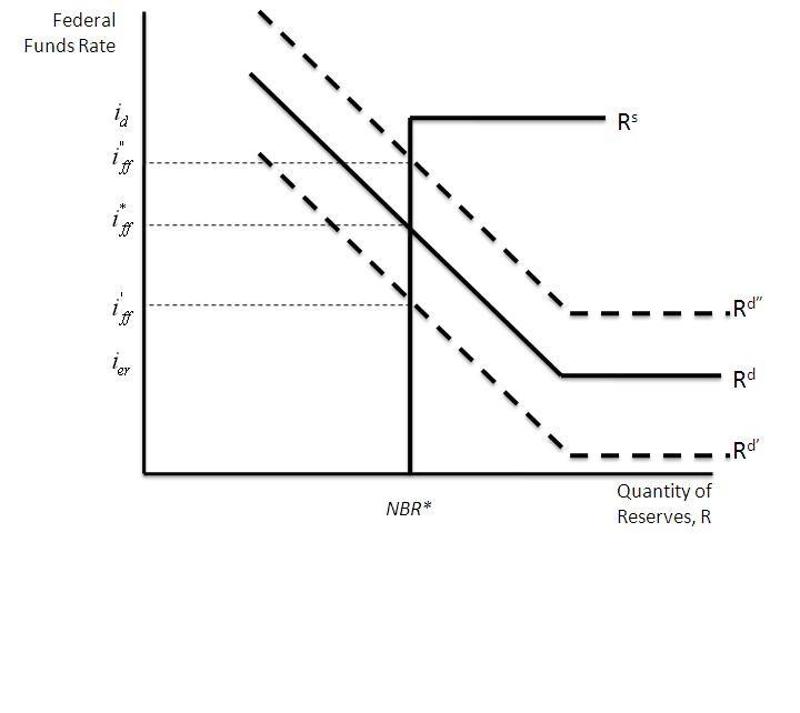 Explain and demonstrate graphically how targeting nonborrowed reserves can result in federal funds rate instability. | back 66 Answer: See figure - Chapter 16 Number 66 When nonborrowed reserves are held constant, increases in the demand for reserves result in the federal funds rate increasing and decreases in the demand for nonborrowed reserves result in the federal funds rate declining. Since fluctuations in demand do not cause monetary policy actions, the result is the federal funds rate will fluctuate (assuming the equilibrium federal funds rate is below the discount rate). |
front 67 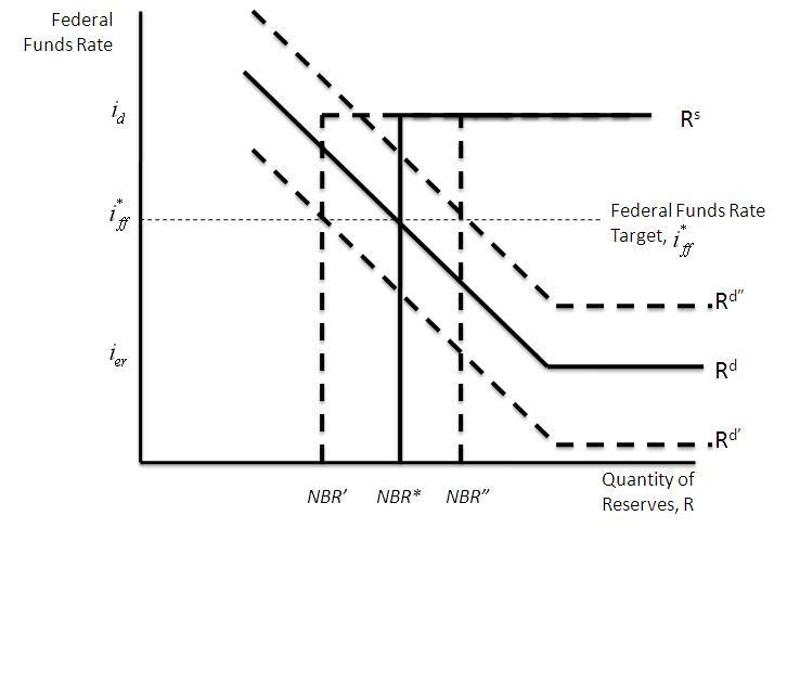 Explain and demonstrate graphically how targeting the federal funds rate can result in fluctuations in nonborrowed reserves. | back 67 Answer: See figure - Chapter 16 Number 67 With a federal funds rate target, fluctuations in demand for reserves require similar changes in the nonborrowed reserves to keep the federal funds rate constant. |
front 68 According to the Taylor rule, the Fed should raise the federal funds interest rate when inflation ________ the Fed's inflation target or when real GDP ________ the Fed's output target.
| back 68 Answer: C |
front 69 Using Taylor's rule, when the equilibrium real federal funds rate is 3 percent, the positive output gap is 2 percent, the target inflation rate is 1 percent, and the actual inflation rate is 2 percent, the nominal federal funds rate target should be
| back 69 Answer: D |
front 70 Using Taylor's rule, when the equilibrium real federal funds rate is 2 percent, there is no output gap, the actual inflation rate is zero, and the target inflation rate is 2 percent, the nominal federal funds rate should be
| back 70 Answer: B |
front 71 According to the Taylor Principle, when the inflation rate rises, the nominal interest rate should be ________ by ________ than the inflation rate increase.
| back 71 Answer: A |
front 72 If the Taylor Principle is not followed and nominal interest rates are increased by less than the increase in the inflation rate, then real interest rates will ________ and monetary policy will be too ________.
| back 72 Answer: D |
front 73 The rate of inflation tends to remain constant when
| back 73 Answer: B |
front 74 The rate of inflation increases when
| back 74 Answer: C |
front 75 Explain the Taylor rule, including the formula for setting the federal funds rate target, and the components of the formula. If the Fed were to use this rule, how many goals would it use to set monetary policy? | back 75 Answer: The Taylor rule specifies that the target federal fund rates should be set to equal the equilibrium real federal funds rate, plus the rate of inflation (for the Fisher effect), plus one-half times the output gap, plus one-half times the inflation gap. The formula is Federal funds rate target = equilibrium real federal funds rate + inflation rate + (output gap) + (inflation gap) The output gap is the percentage deviation of real GDP from potential full-employment real GDP. The inflation gap is the difference between actual inflation and the central bank's target rate of inflation. The equilibrium real federal funds rate is the real rate consistent with full employment in the long run. The inflation rate is the actual rate of inflation. The Taylor rule sets the federal funds rate recognizing the goals of low inflation and full employment (or equilibrium long-run economic growth). |
front 76 In pursuing a strategy of monetary targeting, the central bank announces that it will achieve a certain value (the target) of the annual growth rate of a ________.
| back 76 Answer: A |
front 77 During the years 1979 to 1982, the Federal Reserve's announced policy was monetary targeting. During this time period the Federal Reserve
| back 77 Answer: B |
front 78 Compared to the United States, Japan's experience with monetary targeting during the 1978––1987 period performed
| back 78 Answer: A |
front 79 One of the factors that contributed to the success German policymakers had using a monetary targeting type policy starting in the mid-1970s and continuing through the next two decades was that
| back 79 Answer: C |
front 80 The European Central Bank (ECB) pursues a hybrid monetary policy strategy that has elements in common with the -targeting strategy previously used by the Bundesbank but also includes some elements of targeting.
| back 80 Answer: A |
front 81 Which of the following is an advantage to money targeting?
| back 81 Answer: A |
front 82 Which of the following is a disadvantage to monetary targeting?
| back 82 Answer: A |
front 83 If the relationship between the monetary aggregate and the goal variable is weak, then
| back 83 Answer: D |
front 84 The monetary policy strategy that relies on a stable money-income relationship is
| back 84 Answer: B |
front 85 In its earliest years, the Federal Reserve's guiding principle for the conduct of monetary policy was known as the
| back 85 Answer: A |
front 86 The guiding principle for the conduct of monetary policy that held that as long as loans were being made for "productive" purposes, then providing reserves to the banking system to make these loans would not be inflationary became known as the
| back 86 Answer: D |
front 87 The real bills doctrine was the guiding principle for the conduct of monetary policy during the
| back 87 Answer: A |
front 88 The Fed accidentally discovered open market operations in the early
| back 88 Answer: A |
front 89 The Fed accidentally discovered open market operations when
| back 89 Answer: B |
front 90 The Fed's mistakes of the early 1930s were compounded by its decision to
| back 90 Answer: A |
front 91 During World War II, whenever interest rates would ________ and the price of bonds would begin to ________, the Fed would make open market purchases.
| back 91 Answer: B |
front 92 During World War II, whenever interest rates would rise and the price of bonds would begin to fall, the Fed would
| back 92 Answer: C |
front 93 During World War II, the Fed in effect relinquished its control of monetary policy through its policy of
| back 93 Answer: C |
front 94 The Fed was committed to keeping interest rates low to assist Treasury financing of budget deficits
| back 94 Answer: C |
front 95 The Fed-Treasury Accord of March 1951 provided the Fed greater freedom to
| back 95 Answer: A |
front 96 During the 1950s, the Fed targeted
| back 96 Answer: D |
front 97 During the 1950s, Fed monetary policy targeted
| back 97 Answer: D |
front 98 Targeting interest rates can be procyclical because
| back 98 Answer: A |
front 99 High inflation can spiral out of control when
| back 99 Answer: A |
front 100 In practice, the Fed's policy of targeting money market conditions in the 1960s proved to be
| back 100 Answer: B |
front 101 In practice, the Fed's policy of targeting ________ in the 1960s proved to be ________, destabilizing the economy.
| back 101 Answer: B |
front 102 Although the Fed professed employment of a monetary aggregate targeting strategy during the 1970s, its behavior suggests that it emphasized
| back 102 Answer: B |
front 103 Although the Fed professed employment of ________ targeting during the 1970s, its behavior suggests that it emphasized ________ targeting.
| back 103 Answer: C |
front 104 The Fed's use of the federal funds rate as an operating target in the 1970s resulted in
| back 104 Answer: C |
front 105 The Fed's use of the ________ as an operating target in the 1970s resulted in ________ monetary policy.
| back 105 Answer: B |
front 106 In the 1970s, the Fed selected an interest rate as an operating target rather than a reserve aggregate primarily because it
| back 106 Answer: B |
front 107 The Fed operating procedures employed between 1979 and 1982 resulted in ________ swings in the federal funds rate and ________ swings in the M1 growth rate.
| back 107 Answer: A |
front 108 The fluctuations in both money supply growth and the federal funds rate during 1979-1982 suggest that the Fed
| back 108 Answer: D |
front 109 Large fluctuations in money supply growth and smaller fluctuations in the federal funds rate between October 1982 and the early 1990s indicate that the Fed had shifted to ________ as an operating target.
| back 109 Answer: A |
front 110 The strengthening of the dollar between 1980 and 1985 contributed to a ________ in American competitiveness, putting pressure on the Fed to pursue a more ________ monetary policy.
| back 110 Answer: D |
front 111 A borrowed reserves target is ________ because increases in income ________ interest rates and discount loans, causing the Fed to ________ the monetary base, everything else held constant.
| back 111 Answer: A |
front 112 Fed policy since the early 1990s indicates that it is pursuing a policy of targeting the
| back 112 Answer: C |
front 113 Since the early 1990s, the Fed has conducted monetary policy by setting a target for the
| back 113 Answer: C |
front 114 The Fed can engage in preemptive strikes against a rise in inflation by ________ the federal funds interest rate; it can act preemptively against negative demand shocks by ________ the federal funds interest rate.
| back 114 Answer: A |
front 115 International policy coordination refers to
| back 115 Answer: C |
front 116 The Federal Reserve has been ________ preemptive because of the changing view that monetary policy has to be ________ looking.
| back 116 Answer: A |