Instructions for Side by Side Printing
- Print the notecards
- Fold each page in half along the solid vertical line
- Cut out the notecards by cutting along each horizontal dotted line
- Optional: Glue, tape or staple the ends of each notecard together
Bio 141 Chapter 10
front 1 What are the overall inputs (substrates and energy sources) and outputs (products and by- products) for the light-capturing reactions of photosynthesis and the Calvin cycle reactions of photosynthesis? | back 1 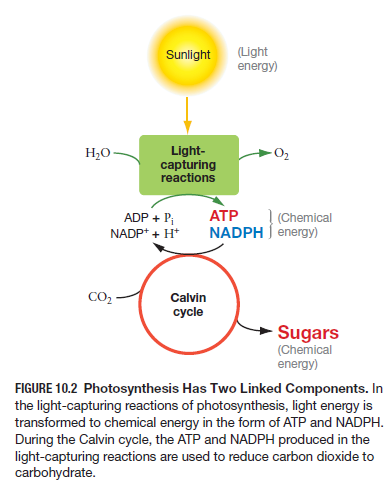
Calvin:
|
front 2 How are the light-capturing and Calvin cycle parts of photosynthesis coupled? How would poisoning the electron transport system associated with the light-capturing reactions of photosynthesis affect the Calvin cycle reactions? | back 2 The two reactions are linked by electrons that are released when water is split to form oxygen gas. ATP and NADPH made from photosystem I used to reduce 3PGA to G3P. Would not have these molecules to make reduction and regeneration possible in cycle. |
front 3 Where do the reactions of the light-capturing part of photosynthesis take place? Where do the reactions of the Calvin cycle reactions take place? | back 3 Both reactions take place in chloroplasts. Light-capturing reactions: thylakoids Calvin cycle: stroma |
front 4 In what way are the structures of mitochondria and chloroplasts similar and different? What molecules or systems function in both types of organelles? Which enzymes or processes are unique to each organelle? | back 4 Both:
Mitochondria:
Chloroplasts:
|
front 5 Give an example of two types of plant cells that lack chloroplasts. How do plant cells that lack chloroplasts produce the ATP they need? Do plant cells that contain chloroplasts also contain mitochondria? | back 5 Gamete sex cells? Roots, bulbs (underground so not exposed to light = no chloroplasts) Plants that lack chloroplasts receive sugars but still need mitochondria to break up those sugars into ATP. Plant cells that contain chloroplasts more than likely also contain mitochondria. |
front 6 Which has more chemical energy, 5 molecules of G3P or 3 molecules of RuBP? Explain. | back 6 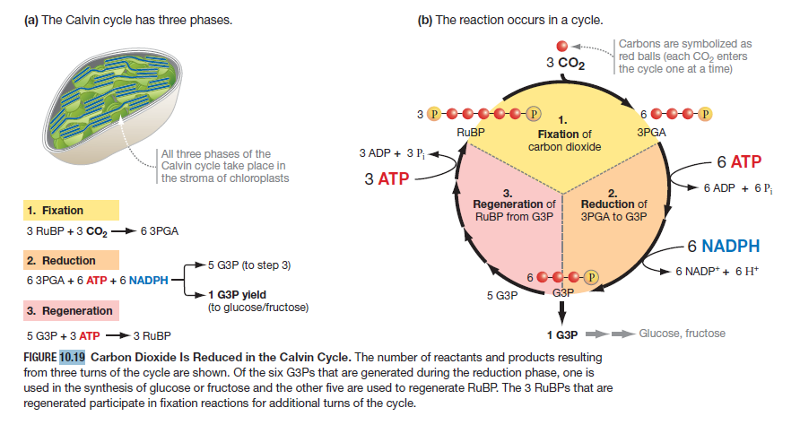 RuBP have more chemical energy than 5 molecules of G3P. These 3 RuBP’s that are regenerated then participate in fixation reactions forming a cycle. |