Print Options

Card layout: ?

← Back to notecard set|Easy Notecards home page

Instructions for Side by Side Printing
  1. Print the notecards
  2. Fold each page in half along the solid vertical line
  3. Cut out the notecards by cutting along each horizontal dotted line
  4. Optional: Glue, tape or staple the ends of each notecard together
  1. Verify Front of pages is selected for Viewing and print the front of the notecards
  2. Select Back of pages for Viewing and print the back of the notecards
    NOTE: Since the back of the pages are printed in reverse order (last page is printed first), keep the pages in the same order as they were after Step 1. Also, be sure to feed the pages in the same direction as you did in Step 1.
  3. Cut out the notecards by cutting along each horizontal and vertical dotted line
To print: Ctrl+PPrint as a list

64 notecards = 16 pages (4 cards per page)

Viewing:

Bio II Final Review; Test 1

front 1

One major advantage of using Arabidopsis thaliana as a model system for studies of plant form and function is its
A) fast generation time.
B) exceptionally large genome.
C) large seeds.
D) high tolerance to stress.
E) high mutation rate.

back 1

A

front 2

Which of the following is derived from the ground tissue system?
A) root hair
B) cuticle
C) periderm
D) pith
E) phloem

back 2

D

front 3

Which of the following have unevenly thickened primary walls that support young, growing parts of the plant?
A) parenchyma cells
B) collenchyma cells
C) sclerenchyma cells
D) tracheids and vessel elements
E) sieve-tube elements

back 3

B

front 4

Which cells are no longer capable of carrying out the process of DNA transcription?
A) tracheids
B) mature mesophyll cells
C) companion cells
D) meristematic cells
E) glandular cells

back 4

A

front 5

All of the following cell types are correctly matched with their functions except
A) mesophyll–photosynthesis.
B) guard cell–regulation of transpiration.
C) sieve-tube member–translocation.
D) vessel element–water transport.
E) companion cell–formation of secondary xylem and phloem.

back 5

E

front 6

Additional vascular tissue produced as secondary growth in a root originates from which cells?
A) vascular cambium
B) apical meristem
C) endodermis
D) phloem
E) xylem

back 6

A

front 7

As a youngster, you drive a nail in the trunk of a young tree that is 3 meters tall. The nail is about 1.5 meters from the ground. Fifteen years later, you return and discover that the tree has grown to a height of 30 meters. About how many meters above the ground is the nail?
A) 0.5
B) 1.5
C) 3.0
D) 15.0
E) 28.5

back 7

B

front 8

What tissue makes up most of the wood of a tree?
A) primary xylem
B) secondary xylem
C) secondary phloem
D) mesophyll cells
E) vascular cambium

back 8

B

front 9

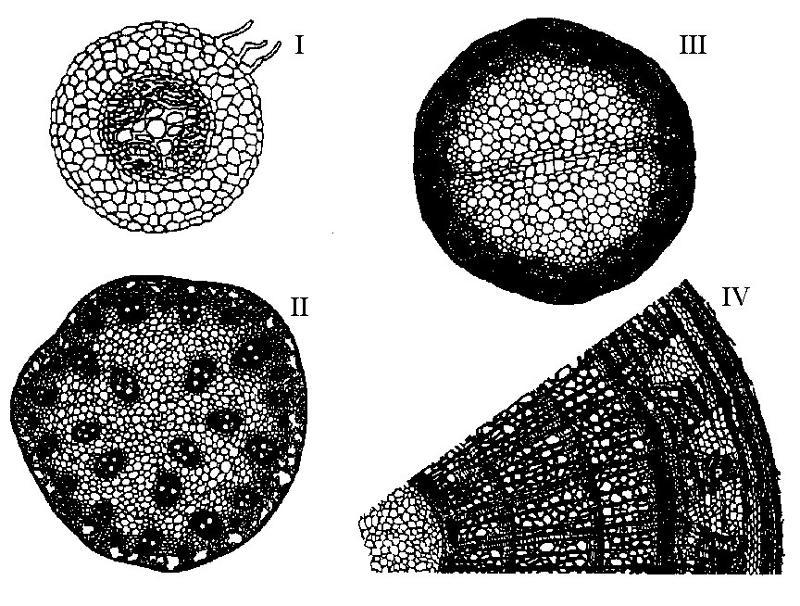
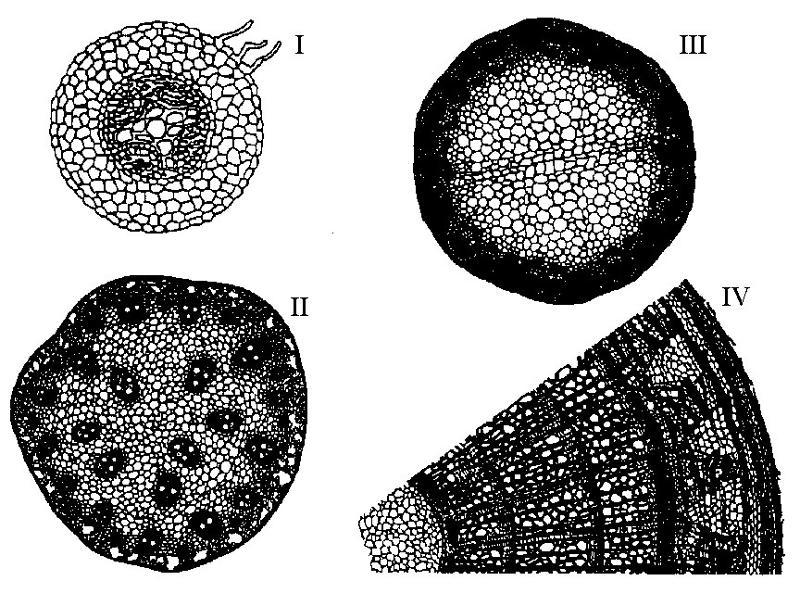
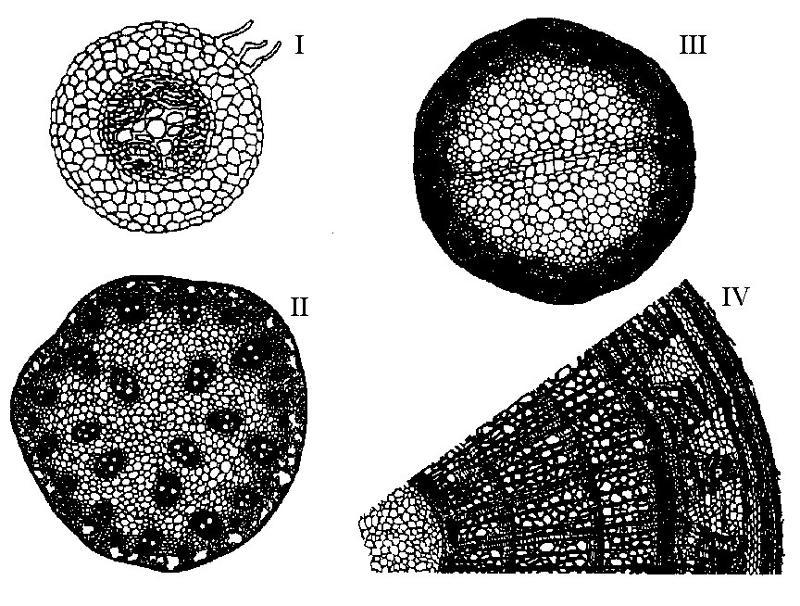
The following question are based on the drawing of root or stem cross sections shown in Figure 35.2.

Figure 35.2

58) A woody eudicot is represented by
A) I only.
B) II only.
C) III only.
D) IV only.
E) both I and III.

back 9

D

front 10

A monocot stem is represented by
A) I only.
B) II only.
C) III only.
D) IV only.
E) both I and III.

back 10

B

front 11

A plant that is at least 3 years old is represented by
A) I only.
B) II only.
C) III only.
D) IV only.
E) both I and III.

back 11

D

front 12

Which of the following would be least likely to affect osmosis in plants?
A) proton pumps in the membrane
B) a difference in solute concentrations
C) receptor proteins in the membrane
D) aquaporins
E) a difference in water potential

back 12

C

front 13

A water molecule could move all the way through a plant from soil to root to leaf to air and pass through a living cell only once. This living cell would be a part of which structure?
A) the Casparian strip
B) a guard cell
C) the root epidermis
D) the endodermis
E) the root cortex

back 13

D

front 14

What drives the flow of water through the xylem?
A) passive transport by the endodermis
B) the number of companion cells in the phloem
C) the evaporation of water from the leaves
D) active transport by sieve-tube elements
E) active transport by tracheid and vessel elements

back 14

C

front 15

Phloem transport is described as being from source to sink. Which of the following would most accurately complete this statement about phloem transport as applied to most plants in the late spring?
Phloem transports ________ from the ________ source to the ________ sink.

A) amino acids; root; mycorrhizae
B) sugars; leaf; apical meristem
C) nucleic acids; flower; root
D) proteins; root; leaf
E) sugars; stem; root

back 15

B

front 16

Which structure or compartment is part of the symplast?
A) the interior of a vessel element
B) the interior of a sieve tube
C) the cell wall of a mesophyll cell
D) an extracellular air space
E) the cell wall of a root hair

back 16

B

front 17

In plant roots, the Casparian strip is correctly described by which of the following?
A) It aids in the uptake of nutrients.
B) It provides energy for the active transport of minerals into the stele from the cortex.
C) It ensures that all minerals are absorbed from the soil in equal amounts.
D) It ensures that all water and dissolved substances must pass through a cell membrane before entering the stele.
E) It provides increased surface area for the absorption of mineral nutrients.

back 17

D

front 18

Which of the following is responsible for the cohesion of water molecules?
A) hydrogen bonds between the oxygen atoms of a water molecule and cellulose in a vessel cell
B) covalent bonds between the hydrogen atoms of two adjacent water molecules
C) hydrogen bonds between the oxygen atom of one water molecule and a hydrogen atom of another water molecule
D) covalent bonds between the oxygen atom of one water molecule and a hydrogen atom of another water molecule
E) low concentrations of charged solutes in the fluid

back 18

C

front 19

Cells produced by lateral meristems are known as

A) secondary tissues

B) pith

C) dermal and ground tissue

D) shoots and roots

back 19

A

front 20

Photosynthesis ceases when leaves wilt, mainly because
A) the chlorophyll in wilting leaves is degraded.
B) flaccid mesophyll cells are incapable of photosynthesis.
C) stomata close, preventing CO₂ from entering the leaf.
D) photolysis, the water-splitting step of photosynthesis, cannot occur when there is a water deficiency.
E) accumulation of CO₂ in the leaf inhibits enzymes.

back 20

C

front 21

All of the following normally enter the plant through the roots except
A) carbon dioxide.
B) nitrogen.
C) potassium.
D) water.
E) calcium.

back 21

A

front 22

Which of the following plant structures shares the most common features and functions with a fungal hyphae?
A) stomata
B) vascular cambium
C) lenticels
D) root hairs
E) prop roots

back 22

D

front 23

Most of the water taken up by a plant is
A) used as a solvent.
B) used as a hydrogen source in photosynthesis.
C) lost during transpiration.
D) converted to CO₂.
E) used to keep cells turgid.

back 23

C

front 24

A soil well suited for the growth of most plants would have all of the following properties except
A) abundant humus.
B) air spaces.
C) good drainage.
D) high cation exchange capacity.
E) a high pH.

back 24

E

front 25

Which of the following statements is false about bulk flow?

A) It depends on the force of gravity on a column of water

B) It is driven primarily by pressure potential

C) It is more effective than diffusion over distances greater than 100mm

D) It depends on a difference in pressure potential at the source and sink

back 25

A

front 26

A person working with plants may reduce the inhibition of apical dominance by auxin via which of the following?
A) pruning shoot tips
B) deep watering of the roots
C) fertilizing
D) treating the plants with auxins
E) feeding the plants nutrients

back 26

A

front 27

Which of the following soil minerals is most likely leached away during a hard rain?

A) Na+
B) K+
C) Ca++
D) NO₃-
E) H+

back 27

D

front 28

A farming commitment that embraces a variety of methods that are conservation-minded, environmentally safe, and profitable is called
A) hydroponics.
B) nitrogen fixation.
C) responsible irrigation.
D) genetic engineering.
E) sustainable agriculture.

back 28

E

front 29

Which of the following would be the most effective strategy to remove toxic heavy metals from a soil?
A) heavy irrigation to leach out the heavy metals
B) application of fertilizers to compete with heavy metal uptake
C) application of sulfur to lower the soil pH and precipitate the heavy metals
D) adding plant species that have the ability to take up and volatilize heavy metals
E) inoculating soil with mycorrhizae to avoid heavy metal uptake

back 29

D

front 30

The bulk of a plant's dry weight is derived from

A) soil minerals.
B) CO₂.
C) the hydrogen from H₂O.
D) the oxygen from H₂O.
E) the uptake of organic nutrients from the soil.

back 30

B

front 31

Nitrogen fixation is a process that
A) recycles nitrogen compounds from dead and decaying materials.
B) converts ammonia to ammonium.
C) releases nitrate from the rock substrate.
D) converts nitrogen gas into ammonia.
E) recycles nitrogen compounds from dead and decaying materials, and converts ammonia to ammonium.

back 31

D

front 32

If a plant is infected with nitrogen-fixing bacteria, what is the most probable effect on the plant?
A) It gets chlorosis.
B) It dies.
C) It is supplied with increased essential elements from the soil.
D) It will likely grow faster.
E) It becomes flaccid due to the loss of water and nutrients from the roots.

back 32

D

front 33

An example of a mutualistic association between a plant and a fungus would be
A) nitrogen fixation.
B) Rhizobium infection.
C) mycorrhizae.
D) parasitic infection.
E) assisted pollination.

back 33

D

front 34

Epiphytes are
A) fungi that attack plants.
B) fungi that form mutualistic associations with roots.
C) nonphotosynthetic parasitic plants.
D) plants that capture insects.
E) plants that grow on other plants.

back 34

E

front 35

Some of the problems associated with intensive irrigation include all but
A) mineral runoff.
B) overfertilization.
C) land subsidence.
D) aquifer depletion.
E) soil salinization.

back 35

B

front 36

Which of the following is the correct sequence during the alternation of generations life cycle in a flowering plant?

A) sporophyte → meiosis → gametophyte → gametes → fertilization → diploid zygote
B) sporophyte → mitosis → gametophyte → meiosis → sporophyte
C) haploid gametophyte → gametes → meiosis → fertilization → diploid sporophyte
D) sporophyte → spores → meiosis → gametophyte → gametes
E) haploid sporophyte → spores → fertilization → diploid gametophyte

back 36

A

front 37

Which of the following are true of most angiosperms?
A) They have a triploid endosperm within the seed.
B) They have an ovary that becomes a fruit.
C) They have a small (reduced) sporophyte.
D) They have a triploid endosperm within the seed and an ovary that becomes a fruit.
E) They have a triploid endosperm within the seed, an ovary that becomes a fruit, and a small (reduced) sporophyte.

back 37

D

front 38

The ovary is most often located on/in the
A) stamen.
B) carpel.
C) petals.
D) sepals.
E) receptacle.

back 38

B

front 39

Microsporangia in flowering plants are located in the
A) stamen.
B) carpel.
C) petals.
D) sepals.
E) receptacle.

back 39

A

front 40

Which of the following is the correct order of floral organs from the outside to the inside of a complete flower?
A) petals → sepals → stamens → carpels
B) sepals → stamens → petals → carpels
C) spores → gametes → zygote → embryo
D) sepals → petals → stamens → carpels
E) male gametophyte → female gametophyte → sepals → petals

back 40

D

front 41

Which of the following types of plants are incapable of self-pollination?
A) dioecious
B) monoecious
C) complete
D) wind-pollinated
E) insect-pollinated

back 41

A

front 42

All of the following are primary functions of flowers except
A) pollen production.
B) photosynthesis.
C) meiosis.
D) egg production.
E) sexual reproduction.

back 42

B

front 43

Which of the following statements regarding flowering plants is false?
A) The sporophyte is the dominant generation.
B) Female gametophytes develop from megaspores within the anthers.
C) Pollination is the placing of pollen on the stigma of a carpel.
D) The food-storing endosperm is derived from the cell that contains two polar nuclei and one sperm nucleus.
E) Flowers produce fruits within the ovules.

back 43

B

front 44

Which of the following "vegetables" is botanically a fruit?
A) potato
B) lettuce
C) radish
D) celery
E) green beans

back 44

E

front 45

Fruits develop from
A) microsporangia.
B) receptacles.
C) fertilized eggs.
D) ovaries.
E) ovules.

back 45

D

front 46

Which of the following is a successful example of the commercial use of transgenic crops?
A) inserting Bt toxin genes into cotton, maize, and potato
B) developing plants that are resistant to ultraviolet light mutations
C) producing plants that resist attack by large herbivores
D) developing plants that produce all the essential amino acids for humans
E) producing plants that contain genes for making human insulin

back 46

A

front 47

Double fertilization means that
A) flowers must be pollinated twice to yield fruits and seeds.
B) every egg must receive two sperm to produce an embryo.
C) one sperm is needed to fertilize the egg, and a second sperm is needed to fertilize the polar nuclei.
D) the egg of the embryo sac is diploid.
E) every sperm has two nuclei.

back 47

C

front 48

A small flower with green petals is most likely
A) bee-pollinated.
B) bird-pollinated.
C) bat-pollinated.
D) wind-pollinated.
E) moth-pollinated.

back 48

D

front 49

What is the first step in the germination of a seed?
A) pollination
B) fertilization
C) imbibition
D) hydrolysis of starch and other food reserves
E) emergence of the radicle

back 49

C

front 50

Which of the following could be considered an evolutionary advantage of asexual reproduction in plants?
A) increased success of progeny in a stable environment.
B) increased agricultural productivity in a rapidly changing environment.
C) maintenance and expansion of a large genome.
D) production of numerous progeny.
E) increased ability to adapt to a change in the environment.

back 50

A

front 51

Charles and Francis Darwin concluded from their experiments on phototropism by grass seedlings that the part of the seedling that detects the direction of light is the
A) tip of the coleoptile.
B) part of the coleoptile that bends during the response.
C) base of the coleoptile.
D) cotyledon.
E) phytochrome in the leaves.

back 51

A

front 52

Why do coleoptiles grow toward light?
A) Auxin is destroyed by light.
B) Gibberellins are destroyed by light.
C) Auxin synthesis is stimulated in the dark.
D) Auxin moves away from the light to the shady side.
E) Gibberellins move away from the light to the shady side.

back 52

D

front 53

The detector of light during de-etiolation (greening) of a tomato plant is (are)
A) carotenoids.
B) xanthophylls.
C) phytochrome.
D) chlorophyll.
E) auxin.

back 53

C

front 54

The ripening of fruit and the dropping of leaves and fruit are principally controlled by
A) auxins.
B) cytokinins.
C) indole acetic acid.
D) ethylene.
E) carbon dioxide concentration (in air).

back 54

D

front 55

Which of the following hormones is commonly used as an herbicide, such as 2, 4-D?

A) gibberellins

B) cytokinins

C) auxins

D) abscisic acid

back 55

C

front 56

If a farmer wanted more loosely packed clusters of grapes, he would most likely spray the immature bunches with
A) auxin.
B) gibberellins.
C) cytokinins.
D) abscisic acid.
E) ethylene.

back 56

B

front 57

The hormone that helps plants respond to drought is
A) auxin.
B) gibberellin.
C) cytokinin.
D) ethylene.
E) abscisic acid.

back 57

E

front 58

If you were shipping green bananas to a supermarket thousands of miles away, which of the following chemicals would you want to eliminate from the plants' environment?
A) CO₂
B) cytokinins
C) ethylene
D) auxin
E) gibberellic acids

back 58

C

front 59

The synthesis of which of the following hormones would be a logical first choice in an attempt to produce normal growth in mutant dwarf plants?
A) indoleacetic acid
B) cytokinin
C) gibberellin
D) abscisic acid
E) ethylene

back 59

C

front 60

A short-day plant will flower only when
A) days are shorter than nights.
B) days are shorter than a certain critical value.
C) nights are shorter than a certain critical value.
D) nights are longer than a certain critical value.
E) days and nights are of equal length.

back 60

D

front 61

The initial response of the root cells of a tomato plant watered with seawater would be to
A) rapidly produce organic solutes in the cytoplasm.
B) rapidly expand until the cells burst.
C) begin to plasmolyze as water is lost.
D) actively transport water from the cytoplasm into the vacuole.
E) actively absorb salts from the seawater.

back 61

C

front 62

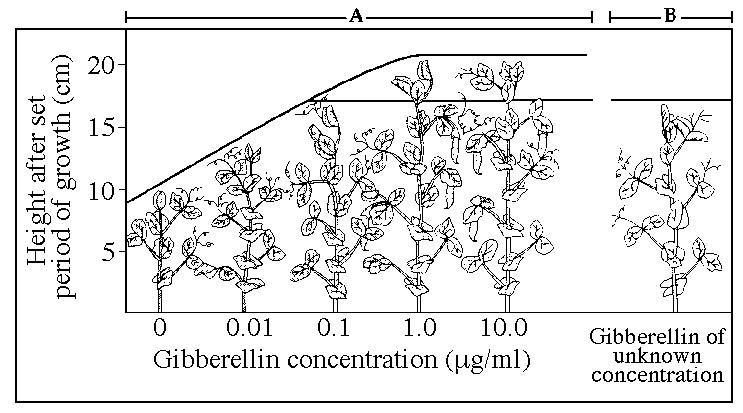
The results of this experiment, shown on the left of the graph (area A), may be used to
A) show that these plants can live without gibberellin.
B) show that gibberellin is necessary in positive gravitropism.
C) show that taller plants with more gibberellin produce fruit (pods).
D) show a correlation between plant height and gibberellin concentration.
E) study phytoalexins in plants.

back 62

D

front 63

If you wanted to genetically engineer a plant to be more resistant to drought, increasing amounts of which of the following hormones might be a good first attempt?
A) abscisic acid
B) brassinosteroids
C) gibberellins
D) cytokinins
E) auxin

back 63

A

front 64

Seed packets give a recommended planting depth for the enclosed seeds. The most likely reason some seeds are to be covered with only 1/4 inch of soil is that the
A) seedlings do not produce a hypocotyl.
B) seedlings do not have an etiolation response.
C) seeds require light to germinate.
D) seeds require a higher temperature to germinate.
E) seeds are very sensitive to waterlogging.

back 64

C