Instructions for Side by Side Printing
- Print the notecards
- Fold each page in half along the solid vertical line
- Cut out the notecards by cutting along each horizontal dotted line
- Optional: Glue, tape or staple the ends of each notecard together
APUSH Exam Review
front 1 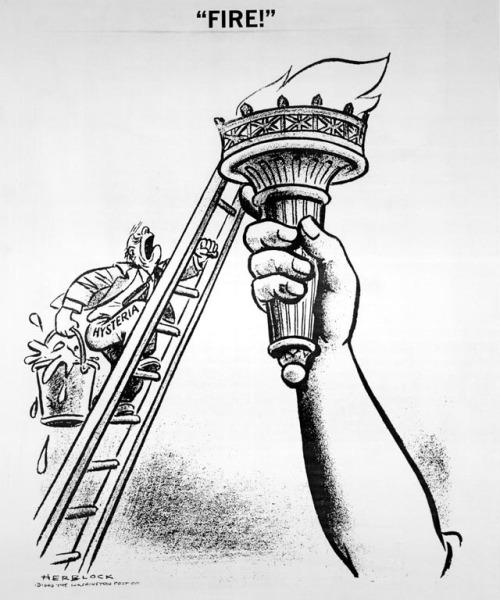 Which of the following statements most accurately describes the main point of this cartoon? A) the need to extinguish the communist threat justified swift and severe government action. B) the freedoms of Americans were at risk because of an overreaction to the perceived threat of communism after World War II C) The existence of communists in the United States was a simple problem to solve. D) There was no need to panic in the face of the communist threat. | back 1 B |
front 2 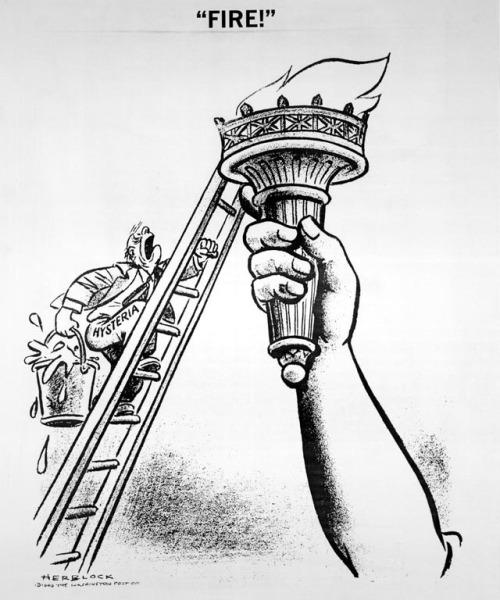 Which other historical time period could have elicited a similar political cartoon? A) The Panic of 1873 B) The era of the New Deal C) The Great Awakening D) The Quasi-War with France in 1768 | back 2 D |
front 3 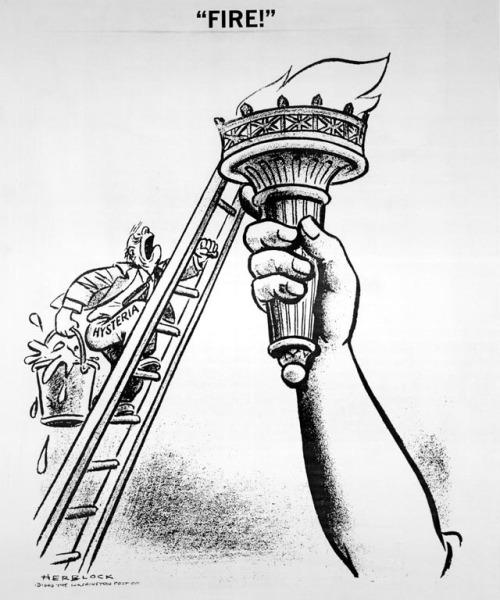 Which of the following actions would this cartoonist most likely have criticized? A) Congressional passage of the McCarran Internal Security Act B) President Eisenhower's Farewell Address C) Vice President Nixon's "Kitchen Debate" with Soviet Premier Khrushchev D) The implementation of the containment policy | back 3 A |
front 4 Prime Minister George Grenville later challenged Benjamin Franklin's statements that the American colonists should have representation in Parliament by claiming that...? A)The colonists had virtual representation in Parliament, meaning that Parliament represented all subjects of the British king. B) The Stamp Act would be only the first of many internal taxes that the Americans would be expected to pay. C) No subject of the king had the right to challenge Parliament's authority D) By refusing to pay the taxes imposed by Parliament, the Americans were committing treason. | back 4 A |
front 5 President Jackson's policy was later altered by the...? A) Homestead Act of 1862 B) Immigration Act of 1921 C) Supreme Court decision Plessy v. Ferguson D) Dawes Act of 1887 | back 5 D |
front 6 Which of the following Supreme Court decisions provided the legal basis for the system of segregation that Martin Luther King, Jr. and others were trying to end? A) Dred Scott v. Sanford (1857) B) Brown v. Board of Education of Topeka, Kansas (1954) C) Worcester v. Georgia (1831) D) Plessy v. Ferguson (1896) | back 6 D |
front 7 Martin Luther King, Jr., was in jail in Birmingham, Alabama, because of his belief in protesting injustice through the use of...? A) Targeted assassinations of segregationist public officials. B) Massive letter-writing campaigns denouncing segregated business. C) Violent self-defense D) Nonviolent direct action | back 7 D |
front 8 Which other nineteenth century reform movement made similar arguments to those by Susan B. Anthony? A) The temperance movement B) Utopian communities C) The abolition movement D) Public school advocates | back 8 C |
front 9 Susan B. Anthony and others in the women's rights movement had a major influence on the ratification of which of the following? A) The nineteenth amendment B)The Equal Rights Amendment C) The Fifteenth Amendment D) The Twenty-sixth Amendment | back 9 A |
front 10 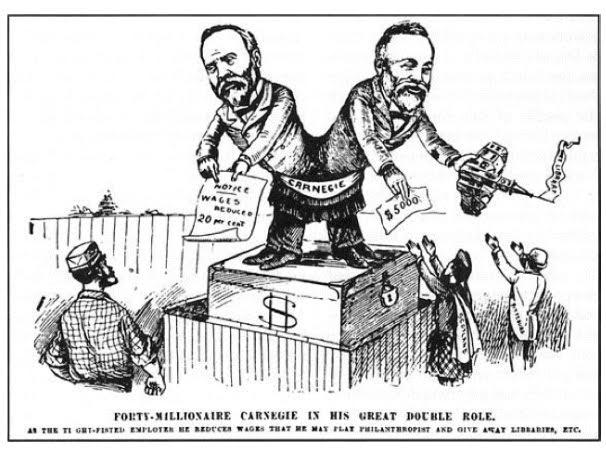 Which of the following statements best represents the criticism of Andrew Carnegie found in this cartoon? A) Carnegie was able to give away a great deal of money only because he abused his workers' right. B) Carnegie did not give enough of his considerable fortune to charity. C) Carnegie was dividing his attention and was therefore not as successful in either of his wain endeavors. D) Carnegie's ruthless business practices were causing him to lose tough with his working-class origins. | back 10 A |
front 11 Which of the following was another common criticism of Andrew Carnegie? A) As an immigrant, Carnegie has no right to own a controlling interest in major American industries. B) Carnegie did nothing to prevent the use of violence against his workers when they asked for better wages and working conditions. C) Carnegie was seen as the epitome of American success, but he was not even the richest man in America. D) Too much of Carnegie's philanthropic efforts were concentrated on his homeland of Scotland, denying Americans the benefits of his charity. | back 11 B |
front 12 Which of the following federal laws was NOT designed to empower the government to regulate the increasing wealth and power of the industrialists in the late nineteenth and early twentieth centuries? A) Sherman Anti-Trust Act (1890) B) Interstate Commerce Act (1887) C) Federal Trade Commission Act (1914) D) Newlands Reclamation Act (1902) | back 12 D |
front 13 During the Pennsylvania anthracite coal miner strike in 1902, President Theodore Roosevelt altered governmental policy toward striking workers by A) Using the United States Army to take over the administration of the coal mines B) Helping the coal miners keep their jobs put preventing them from collecting a higher salary. C) Mediating negotiations between the miners and the mine owners. D) Declaring the use of collective bargaining to be unconstitutional and using the United States Army to bar the workers from entering the mining facilities. | back 13 C |
front 14 The Fourteenth Amendment attempted to eliminate the societal conditions described in this passage by...? A) Revoking the voting rights of all known members of the Confederate government and soldiers of the Confederate Army. B) Granting citizen ship and guaranteeing equal protection under the law to former slaves. C) Creating a special appeals process that expedited civil rights claims directly to the Supreme Court D) Ensuring that former slaves received the forty acres of land promised to them by General William Sherman and the Freedman's Bureau Bill of 1866. | back 14 B |
front 15 Which of the following events of the twentieth century reflects a continuation of the attitudes of southern whites as described in this passage? A) The Great Migration B) Jim Crow legislation C) The Civil Rights Act of 1957 D) The March on Washington for Jobs and Freedom | back 15 B |
front 16 Which of these is the most likely effect of declining mortality rates of indentured servants in the Chesapeake region in the seventeenth century? A) Indentured servants outlived their contracts and gained freedom, but discovered that freedom did not equate to land ownership. B) Most indentured servants were able to purchase plots of land that guaranteed them economic security C) Cash crop planters were eager to help indentured servants acquire land so that the colony as a whole would be more economically viable D) There was an increased demand for cooperation with the Indian tribes on the frontier of the colonies | back 16 A |
front 17 Which of the following best describes a yeoman farmer in the Chesapeake region in the seventeenth century? A) A farmer who was only in the colony until he earned enough money to purchase land in England. B) A farmer who owned a small, family-farmed plot of land and possibly had a few servants to help work the land. C) A farmer who lived a subsistence life in the wilderness D) A farmer who was unwilling to cede political control to the growing population of indentured servants | back 17 B |
front 18 How did President Lincoln's issuance of the Emancipation Proclamation alter the course of the Civil War? A) The war came to a swift conclusion because the Proclamation made the Confederacy realize the futility of their cause. B) The war grew in scope because the Proclamation caused Great Britain to join the fight on the side of the Union. C) President Jefferson Davis of the Confederacy vowed massive resistance to any Union effort to free the slaves. D) The war aims of the United States were no longer exclusive to the preservation of the Union | back 18 D |
front 19 Which of these statements best describes the Emancipation Proclamation? A) It guaranteed the freedom of all slaves living within the boundaries of the United States at the conclusion of the Civil War. B) It freed only the slaves in states and portions of states in rebellion against the United States at the time it was issued. C) It declared that the freedom of the slaves was conditional upon the agreement of individual southern states to sign a peace treaty with the United States government. D) It prohibited the use of slaves in combat in both the Union and Confederate Armies | back 19 B |
front 20 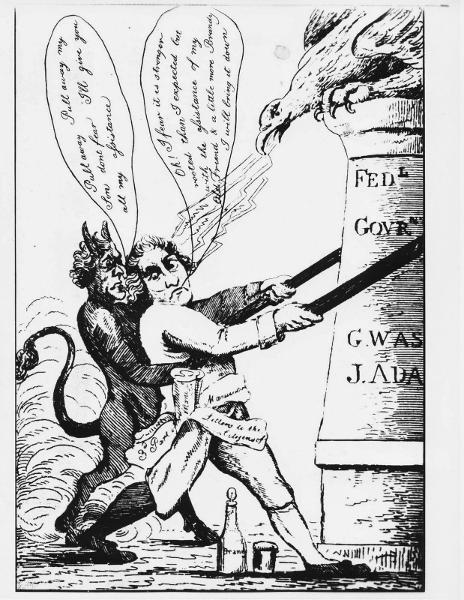 The above cartoon illustrates which of the following? A) The growing political partisanship after the election of Thomas Jefferson as president B) A governmental effort to regulate excessive drinking C) An effort on the part of the British government to subvert American democracy D) The pessimistic outlook of many Americans concerning the ability of the nation to survive its formative years. | back 20 A |
front 21 The development of political parties led to which of the following amendments to the Constitution of the United States? A) The elected president would appoint the vice president after the election to ensure that members of the same political party filled both positions. B) The majority party in Congress would have the authority to choose the vice president. C) Distinct ballots would be cast for president and vice president, avoiding a situation in which one person from each political party would serve in those posts. D) The electoral college was abolished and the winner of the popular vote would be declared president, with the vice president being chosen by the officials of the president's political party. | back 21 C |
front 22 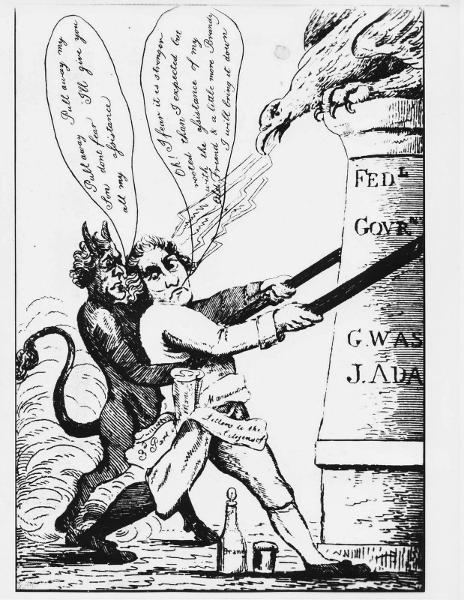 How does this cartoon demonstrate the political viewpoint of the Federalist Party? A) Thomas Jefferson is portrayed as the Devil and is helping to tear down the federal government. B) Thomas Paine is attempting to hold back the efforts of the Devil to destroy the national government. C) Alexander Hamilton is working with the Devil to dismantle the Constitutional principle of federalism. D) John Adams and George Washington were unable to successfully argue against the negative attitudes of the Republican press. | back 22 A |
front 23 The conservative political revival that led to President Ronald Reagan's election in 1980 was most directly a reaction to...? A) President Franklin Roosevelt's New Deal. B) The Supreme Court's Decision in Loving v. Virginia. C) President John F. Kennedy's close electoral victory over Richard Nixon. D) President Lyndon Johnson's Great Society | back 23 D |
front 24 Which of the following would have most likely agreed with President Reagan's statement that the federal government was created by the states and he federal government's role should be limited? A) The Anti-federalists B) The Whig Party C) The mugwumps D) The Progressives | back 24 A |
front 25 Which of the following issues found across eras in United States history is expressed in the quotation? A) Debates over the powers of the president B) Debates over participation in elections C) Debates over federal power over the economy D) Debates over federal power over international affairs | back 25 C |
front 26 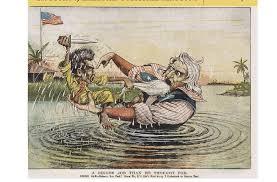 The 1899 cartoon shown above makes the point that...? A) Insurgents in Cuba were manipulated by Spain into resisting the presence of American troops. B) Native Hawaiians behaved in a childlike manner when the Hawaiian islands were annexed by the United States. C) The United States misread the reaction of the Filipino people when it acquired the Philippines following the Spanish-American War. D) The task of completing the Panama Canal was more time consuming, and more costly, than the United States had originally anticipated. | back 26 C |
front 27 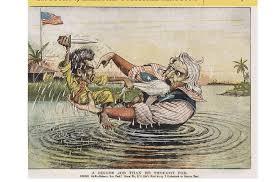 The cartoon reflects which of the following continuities in United States history? A) Debates over extending constitutional rights to people's in territories acquired by the United States. B) Debates over the wisdom of asserting American control over foreign possessions C) Debates over the morality of tactics used by the United States in wars of colonial independence. D) Debates over allowing the CIA to engage in covert operations in foreign countries | back 27 B |
front 28 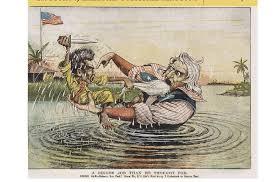 The event depicted in the cartoon represents which of the following? A) A shift in American foreign policy from"gun boat diplomacy" to "dollar diplomacy". B) The beginning of a period of isolation from world affairs C) A shift from "brinkmanship" to detente D) The beginning of a period of imperialistic activities by the United States | back 28 D |
front 29 By following the ideas of Richard Hakluyt, England was eventually able to...? A) Drive the French and Portuguese governments into bankruptcy. B) Conquer large parts of Africa in the eighteenth century. C) Establish several colonies along the Atlantic coastline of North America. D) Destroy the Dutch commercial empire. | back 29 C |
front 30 An important point that Jonathan Edwards is making in the sermon, "Sinners in the Hands of an Angry God," is that...? A) Despite the sinful nature of humanity, God has given individuals a chance to rectify their sins. B) Human beings are born inherently good, but are corrupted by the evils of society. C) God is merciless, allowing sinners and saints alike to suffer in the fires of hell. D) It is not important what you believe in life, just as long as you live your life in a moral and ethical manner | back 30 A |
front 31 The sermon, "Sinners in the Hands of an Angry God," by Jonathan Edwards was a central text of...? A) Transcendentalism B) Mormonism C) the Great Awakening D) the Social Gospel | back 31 C |
front 32 Which of the following describes the context that Jonathan Edwards was preaching in? A) There had been a marked decline in piety in Puritan New England; Edwards hoped to rekindle the fires of New England church members. B) The government of Massachusetts had disestablished the Congregational Church forcing preachers like Edwards to travel from town to town in search of adherents. C) New England had experienced a wave of immigrants from all over Europe, including many Catholics, Jews, Protestants of a variety of sects, and non-believes; Edwards hoped to convert them to teaching of the Congregational Church. D) New England was recently devastated by war with American Indians; Edwards sought to reassure the survivors that God did, indeed, exist. | back 32 A |
front 33 Jonathan Edwards was part of a broader religious movement that impacted colonial American society by...? A) Encouraging colonists to question and challenge the legitimacy of British authorities. B) Citing the immorality of slavery and stressing the importance of ending the institution. C) Asserting the importance of developing amicable relations with American Indians. D) Fostering changes in colonists' understandings of God, themselves, and the world around them. | back 33 D |
front 34 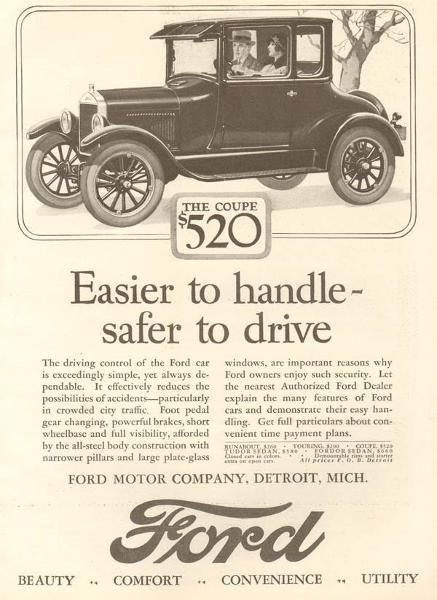 What does the above image tell you about the decade of the 1920's? A) Consumer safety was the primary concern of leading manufacturing companies. B) Automobiles were a rare commodity and therefore extremely expensive. C) New technologies such as automobiles were unproven and unsafe, requiring extensive propaganda in order to make consumers interested in them. D) Consumer products were increasingly affordable and highly desired by the public as a sign of status. | back 34 D |
front 35 Like other consumer products such as radios and home electric appliances, automobiles were often offered to consumers through...? A) Credit buying plans, which allowed consumers to defer full payment over time. B) Self-manufacturing kits, which reduced the costs for companies selling the products. C) Exclusive retail stores, which prevented consumers from buying products at the lowest possible price. D) Incentives such as rebates, which consumers could acquire by agreeing to sell products for the manufacturer. | back 35 A |
front 36 The consumer economy of the 1920's most directly shows the influence of which of the following? A) Manifest Destiny and territorial expansion. B) The Industrial Revolution and entrepreneurial spirit. C) Reconstruction and the "redemption" of the South D) World War I and international cooperation. | back 36 B |
front 37 Which of the following was a demand of the Populist Party in the 1880's and 1890's to address the situation reflected in the figures in the table? A) A national sales tax. B) Government funding for the purchase of agricultural machinery. C) "Internal improvements" in the West, including railroads and canals D) An end to the gold standard and a shift to currency backed by silver as well as gold. | back 37 D |
front 38 The Magna Carta and the English Bill of Rights were significant influences on United States constitutional development because they...? A) Provided suffrage for all men and women. B) Placed limits on the powers of the government. C) Called for the abolition of slavery D) supported the development of federalism | back 38 B |
front 39 The Declaration of Independence contains a...? A) Proposal for reuniting the colonies and England. B) Statement of grievances against the King of England. C) Request for a treaty between the colonies and Spain. D) A plan for organizing the Western territories | back 39 B |
front 40 Which set of events related to early America is in the correct chronological order? A) The inauguration of George Washington - the passage of the Stamp Act - The Battle of Saratoga - The French and Indian War B) The Battle of Saratoga - The French and Indian War - the passage of the Stamp Act - the inauguration of George Washington C) The French and Indian War - the passage of the Stamp Act - The Battle of Saratoga - the inauguration of George Washington D) Passage of the Stamp Act - The French and Indian War - the inauguration of George Washington - The Battle of Saratoga | back 40 C |
front 41 Critics of the Articles of Confederation argued that it...? A) Imposed unfair taxes on the states. B) Used a draft to raise a national army C) Provided a strong system of federal courts D) Placed too much power in the hands of the states | back 41 A |
front 42 According to the Northwest Ordinance...? A)The issue of slavery was largely ignored before the Civil War. B) Abolitionists had gained control of the Constitutional Convention. C) Slavery was legally banned in the Northwest Territory. D) Enslaved persons had constitutionally protected civil rights. | back 42 C |
front 43 The Great Compromise enabled delegates at the Constitutional Convention (1787) to...? A) Establish the principle of popular sovereignty in the territories. B) Give Congress the exclusive right to declare war if the nation is attacked. C) Protect the interests of states with small populations and states with large populations. D) Provide for the indirect election of the president through the electoral college. | back 43 C |
front 44 Which presidential action is an example of the use of the unwritten constitution? A) Signing a law passed by Congress. B) Calling a meeting of the cabinet. C) Ordering the Navy to patrol the Persian Gulf D) Nominating a federal court judge. | back 44 B |
front 45 The major benefit of having the Elastic Clause in the United States Constitution is that it...? A) Allows the government to respond to changing conditions. B) Protects the rights of racial minorities. C) Prevents one branch of government from becoming too powerful. D) Establishes a postal service. | back 45 A |
front 46 How did Alexander Hamilton's financial plan affect the economy of the United States during the 1790's? A) National tax revenues decreased. B) High tariffs increased foreign trade. C) Treasury policies contributed to widespread inflation. D) The newly created Bank of the United States helped stabilize the economy. | back 46 D |
front 47 One result of the purchase of the Louisiana territory (1803) was that the United States...? A) Acquired California from Spain. B) Gained control of the port of New Orleans. C) Ended border conflicts with British Canada. D) Annexed Florida | back 47 B |
front 48 The decision in Marbury v. Madison (1803) was significant because it established that the Supreme Court...? A) Had limited powers over state courts. B) Had the power to choose its own members. C) Could declare a federal law unconstitutional D) Could impeach the president and other government officials. | back 48 C |
front 49 The constitutional controversy that led directly to the start of the Civil War concerned the right of states to..? A) Control tariff rates. B) Sign treaties with foreign nations. C) Redraw congressional districts. D) Secede from the Union | back 49 D |
front 50 Which group benefited most directly from the Supreme Court decision in Dred Scott v. Sanford (1857)? A) Abolitionists. B) Immigrants. C) Slave owners. D) Enslaved persons. | back 50 C |
front 51 Which statement best describes how the statues of African Americans in the South changed soon after the end of Reconstruction in 1877? A) The Supreme Court consistently supported civil rights for African Americans. B) Poll taxes and literacy tests were eliminated for African Americans. C) Increasing numbers of African Americans were elected to public office. D) African Americans faced increasing discrimination and segregation. | back 51 D |
front 52 The theory of laissez-faire economics was used during the late 1800's to...? A) Justify unregulated business growth. B) Call for more consumer protection. C) Support Progressive programs. D) Achieve equal distribution of income. | back 52 A |
front 53 The term muckraker was used in the early 1900's to describe writers who...? A) Supported limits on government regulation. B) Exposed abuses in American society. C) Wanted the United States to ban all immigration. D) Promoted racial integration efforts. | back 53 B |
front 54 In the early 1900's, the United States proposed the Open Door policy to...? A) Gain new colonies in the Pacific. B) Win support for building the Panama Canal. C) Improve relations with Europe. D) Secure access to markets in China. | back 54 D |
front 55 Which one of the following statements about the Spanish conquest of the Americans is most accurate? A) African slavery was a direct result of Spanish settlements in Florida. B) Early native civilizations in Mexico introduced Spanish explorers to cattle ranching and wheat cultivation C) Christopher Columbus was not the first European to have explored North America. D) Due to racial prejudice, Spanish explorers shunned intermarriage with native people | back 55 C |
front 56 Which of the following presidents was most involved in Latin American politics in the nineteenth century? A) James K. Polk B) James Monroe C) Theodore Roosevelt D) Chester Arthur | back 56 C |
front 57 Maize cultivation among the native peoples of Mexico is most analogous to which of the following? A) Buffalo hunting among the Lakota Sioux. B) Wolf domestication by the Algonquians. C) Mixed agriculture among the Iroquois. D) Seal hunting among the Inuit. | back 57 C |
front 58 The Puritans believed that the freedom to practice religion should be extended to...? A) Puritans only. B) all Protestants only. C) all Christians only. D) all Jews and Christians only. | back 58 A |
front 59 Roger Williams was banished from Massachusetts Bay in 1636 for advocating...? A) Puritanism. B) The Enlightenment. C) Transcendentalism. D) Existentialism. | back 59 B |
front 60 Puritan emigration from England came to a near halt between the years 1649 and 1660 because, during that period...? A) Most English Puritans were imprisoned for heresy. B) Most Puritans converted to Catholicism. C) The New England settlement had become too overcrowded, and colonial legislatures strongly discouraged immigration. D) The Puritans controlled the English government. | back 60 D |
front 61 Which of the following documents encouraged church membership in the Massachusetts Bay Colony? A) The Mayflower Compact. B) The Fundamental Orders. C) The Halfway Covenant. D) The Cambridge Agreement. | back 61 C |
front 62 A major weakness of the Articles of Confederation was that they...? A) Created a too-powerful chief executive. B) Did not include a mechanism for their own amendment. C) Made it too difficult for the government to raise money through taxes and duties. D) Denied the federal government the power to mediate disputes between. | back 62 C |
front 63 The most notable achievement of the United States under the Articles of Confederation was...? A) The creation of a strong executive office to lead the national government. B) The empowerment of Congress to regulate commerce. C) The empowerment of Congress to collect taxes. D) The provision for land sales in the Northwest that would benefit the entire nation. | back 63 D |
front 64 The Sugar Act of 1764 represented a major shift in British policy toward the colonies in that, for the first time, the British...? A) Attempted to control colonial exports. B) Offered the colonists the opportunity to address Parliament with grievances. C) Required the colonies to import English goods exclusively. D) Levied taxes aimed at raising revenue rather than regulating trade. | back 64 D |
front 65 Which of the following does NOT represent the views of Prime Minister Grenville after the French and Indian War? A) He felt that the Crown needed to control trade and raise revenue. B) He felt that the colonists should help pay the debt incurred by the war. C) He felt that Parliament had the right to increase taxes on the colonies. D) He wanted to reward the colonies through his extension of "salutary neglect". | back 65 D |
front 66 The goals presented in the excerpt have the most in common with which of the following? A) Antitrust reforms of the Progressive Era. B) Free trade policies of the 1970's. C) Increasing federal income tax rates after World War I. D) Decreasing federal income tax rates in the 1980's. | back 66 C |
front 67 Between 1820 and 1854, the greatest number of immigrants to the United States came from...? A) France. B) Russia. C) England. D) Ireland. | back 67 D |
front 68 Which of the following best describes the effect of the American rail system in the nineteenth century? A) Government subsidy of the railroads enabled markets to expand and for production to become more efficient. B) The entire national system was planned before the first railway was constructed. C) The development of the rails had little effect on the development of American industry. D) A more highly developed rail system gave the Confederacy a decided advantage in the Civil War. | back 68 A |
front 69 Which of the following changes in westward migration is most likely to have occurred in the 1840's? A) The number of pioneers headed for the Oregon territory decreased while the number headed for California greatly increased. B) The first great wave of migration ended, and the number of migrants remained extremely low until after the Civil War. C) For the first time, pioneers began to settle areas west of the Mississippi River. D) Large numbers of free blacks, unwelcome in the East, began to resettle in the West. | back 69 A |
front 70 By what means did the United States take possession of the Oregon Territory? A) The United States was granted the territory in a postwar treaty with France. B) The United States bought it from the Native Americans who lived there. C) U.S. settlers were the first to arrive in the region; they claimed it for their country. D) Great Britain ceded it to the United States as part of a negotiated treaty. | back 70 D |
front 71 Which of the following presidents is most closely associated with the concept of Manifest Destiny? A) James K. Polk. B) Andrew Johnson. C) Woodrow Wilson. D) Ronald Reagan. | back 71 A |
front 72 Which of the following groups would be most likely to support the perspective of Frederick Douglass? A) Southern Democrats in the 1880's. B) Western ranchers in the 1850's. C) Southern farmers in the 1830's. D) Northern Republicans in the 1860's | back 72 D |
front 73 Frederick Douglass was most influenced by which of the following social movements? A) The First Great Awakening. B) Second Great Awakening. C) Manifest Destiny. D) Popular Sovereignty. | back 73 B |
front 74 The "free silver" campaign of 1896 received its greatest popular support from...? A) New England businessmen, who were discriminated against under the existing banking system. B) Southern women, who incorporated it into a larger campaign for economic equality. C) Bankers, who had run out of paper currency to invest. D) Farmers, who hoped that a more generous money supply would ease their debt burdens. | back 74 D |
front 75 Which one of the following political movements most closely shared many of the goals outlined by the Populist Party? A) Progressivism of the early 1900's. B) Neoconservatism of the 1980's. C) Federalism of the late 1700's. D) Jacksonian Democracy of the early 1800's. | back 75 A |
front 76 Which of the following is LEAST associated with the Populist movement? A) Support of labor unions. B) Secret ballot elections. C) Free coinage of silver. D) Deregulation of railroads and utilities. | back 76 D |
front 77 Which of the following was most directly a cause of the success of the Populist party? A) Western farmers and ranchers favored conservation and organized to promote the National Parks system. B) The growth of corporate power and banking interests inspired rural activists to lobby for political reform. C) Western farmers resisted the mechanization of agriculture and resented government interference in rural affairs. D) After the Civil War, westward migration slowed, causing a long-term recession in many Western territories. | back 77 B |
front 78 Which of the following provides the best explanation for why Radical Republicans opposed Lincoln in 1861? A) Lincoln's decision to issue the Emancipation Proclamation was done without congressional oversight. B) The radical Republicans wanted immediate emancipation of slaves, but Lincoln refused to cooperate. C) Lincoln's Ten Percent Plan provided no assurance of black suffrage. D) Lincoln's appointment of Andrew Johnson as vice president clashed with the Reconstruction goals of the Senate. | back 78 B |
front 79 Of the following policies, which was Not a main objective of American Progressives? A) Passage of the Pure Food and Water Act. B) Creation of national forests and protected wildlife reserves. C) Initiation of antitrust lawsuits against various corporate monopolies. D) Intervention in the affairs of Central American governments. | back 79 D |
front 80 Which of the following regulatory laws was passed as a result of Upton Sinclair's The Jungle? A) The Clayton Antitrust Act. B) The Hepburn Act. C) The Sherman Antitrust Act. D) The Pure Food and Drug Act. | back 80 D |
front 81 Progressive Theodore Roosevelt's "Big Stick" policy in Latin America was best characterized by his...? A) Repudiation of the Monroe Doctrine. B) Belief that European nations had the right to protect their economic interests in any remaining colonies throughout the region. C) Recognition of the sovereignty of newly independent nations in the Western hemisphere. D) Belief that the United States had an obligation to protect security and stability by assuming a protective role throughout the Western hemisphere. | back 81 D |
front 82 Would the Underwood-Simmons Tariff of 1913 be generally endorsed by Progressives of that era? A) Yes, because they were largely supporters of Teddy Roosevelt's "Square Deal". B) Yes, because most Democrats advocated lower duties. C) No, because they were largely supporters of Teddy Roosevelt's
D) No, because they were largely opponents of Woodrow Wilson. | back 82 B |
front 83 Which of the following acts was the most beneficial to the labor movement? A) The Clayton Antitrust Act, since it legalized strikes and picketing. B) The Sherman Antitrust Act, since it prevented corporations from monopolizing markets. C) The Elkins Act, since it provided greater regulation of railroads. D) The Hepburn Act, since it regulated public modes of transportation. | back 83 A |
front 84 Which of the following best accounts for the successes of labor unions? A) Throughout the early 1900's, Congress promoted the interests of labor unions over captains of industry. B) Immigrants helped to promote a more diverse workforce less reliant on child labor. C) Sharecroppers in the South largely voted for Democrats who championed labor causes. D) Locally and nationally, organizations such as the American Federations of Labor negotiated directly with corporations to effect change in the workplace. | back 84 D |
front 85 How was the Red Scare in post-World War I America connected to organized labor movements? A) Unrestricted immigration after World War I flooded the job markets with low-wage workers, leading to resentment by union members and accusations of communist sympathies. B) California migrant workers were largely Italian immigrants, many of whom had anarchist leanings. C) Labor unions were largely thought to be controlled by liberals with Marxist sympathies. D) Senator Joseph McCarthy, a Wisconsin Republican, was hostile to both Communism and labor unions, fueling suspicion among American conservatives. | back 85 C |
front 86 In which decision did the Supreme Court validate the practice of "separate but equal" facilities for blacks and whites? A) Marbury v. Madison. B) Bradwell v. Illinois. C) Plessy v. Ferguson. D) Holden v. Hardy | back 86 C |
front 87 All of the following are social movements inspired by Civil Rights movement EXCEPT...? A) Women's rights. B) Gay and lesbian rights. C) States' rights. D) Native American rights. | back 87 C |
front 88 Desegregation of schools was, in part, a response to unfulfilled promises from which of the following initiatives? A) The Great Society. B) The Square Deal. C) The New Deal. D) Reconstruction. | back 88 D |
front 89 All of the following are factors that contributed to the prominence of conservatism in the late 1970's and 1980's EXCEPT...? A) The success of the Libertarian party in national election. B) The growth of religious fundamentalism. C) Perceived economic and foreign policy failures under President Carter. D) Social changes following the Civil Rights movement and Vietnam War. | back 89 C |
front 90 All of the following were part of JOhnson's Great Society program EXCEPT...? A) The Civil Rights Act of 1964. B) Medicare and Medicaid. C) The establishment of the Department of Housing and Urban Development. D) The balanced budget mandate. | back 90 D |
front 91 Along with his goals of establishing a Great Society, Johnson was also engaged in which of the following initiatives? A) Undermining Communism in Cuba with the Bay of Pigs Invasion. B) Undermining Communism in Vietnam after the Tet Offensive. C) Undermining Communism in Turkey and Greece using economic aid. D) Undermining Communism in the Eastern Block by demanding a removal of the Berlin Wall. | back 91 B |
front 92 Johnson's Great Society most represented an extension of which of the following initiatives? A) The New Deal. B) The Square Deal. C) the Truman Doctrine. D) The Monroe Doctrine. | back 92 A |
front 93 Which on of the following was an unintended consequence of the liberal successes of the 1960's? A) Liberal Democrats abandoned anti-war protests in a show of support for Presidential Johnson. B) Conservative Republicans mobilized to defend traditional mores and curb government authority. C) Economic recession catalyzed by increased government spending causing "stagflation". D) A majority of Northern Black voters abandoned the Democrat party, siding with Republicans. | back 93 B |
front 94 The establishment of the Northwest Territory (visible in the second map) by the Northwest Ordinance of 1787 contributed to problems in the subsequent decades of American history because the ordinance...? A) Ignored the earlier designation of that land as an "Indian Reserve" by the British, setting the stage for violent conflict in the region. B) Failed to address the issue of slavery in the Northwest Territory, leading to violence between pro-slavery and antislavery forces. C) Called for any political entities carved out of the Northwest Territory to be treated as inferior bodies to the original thirteen states, leading to a constitutional conflict that was eventually resolved by the Supreme Court. D) Made no provisions for individuals to gain title to land in the Northwest Territory. setting off a series of violent skirmishes among people with competing land claims. | back 94 A |
front 95 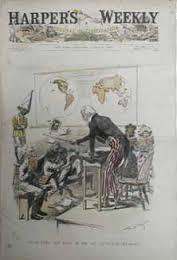 The circumstances depicted in the cartoon suggest that the cartoon was published in the immediate aftermath of...? A) The War of 1812. B) The Mexican-American War. C) The Spanish-American War. D) World War I | back 95 C |
front 96 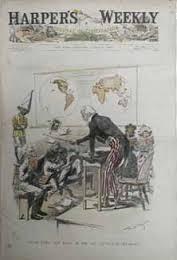 Which of the following reflects a main point of the political cartoon? A) The United States used excessive violence in suppressing independence movements in it recently acquired territories. B) The inhabitants of America's newly acquired colonial holding might not initially be able to handle self-government and would require some degree of long-term American control. C) American expansionistic efforts were misguided and costly; the United States would be well-advised to abandon its experiment in imperialism. D) The United States should extend citizenship rights to inhabitants of its newly acquired colonies; the Constitution should follow the flag. | back 96 B |
front 97 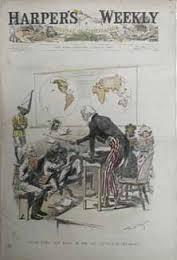 In the period following the events depicted in the cartoon the United States...? A) Formed multilateral agreements and regional alliances with developing nation. B) Withdrew from global affairs in the face of opposition at home and abroad to imperialistic ventures. C) Expanded its economic and military presence in the Caribbean, Latin America, and Asia. D) Insisted that the countries referred to in the cartoon improve their human rights records or suffer a reduction of foreign aid. | back 97 C |
front 98 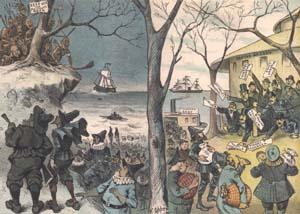 The 1883 cartoon above makes the point that...? A) The "new" immigrants from eastern and southern Europe, with their different customs and religious beliefs were just as dangerous to the American way of life as the American Indians were to the Pilgrims in the seventeenth century. B) The United States was getting filled up with people; additional immigrants would displace native born Americans, just as the seventeenth century Pilgrims displaced the American Indians. C) Among the "new immigrants" were many hard working men and women, but also many radicals, anarchists, revolutionaries, criminals and other "dangerous" elements. D) Incoming immigrants faced a gauntlet of dangers when they arrived in America, just as the the Pilgrims did when they arrived in the seventeenth century. | back 98 D |
front 99 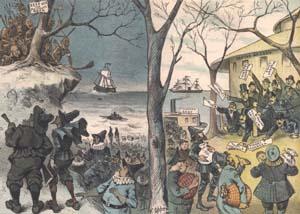 Which of the following best represents a continuity with the political sentiments expressed in the cartoon above? A) Jane Addams and Ellen Gates Starr founding Hull House in 1889. B) Madison Grant writing the book, The Passing of the Great Race (1916). C) Attorney General A. Mitchell Palmer carrying out deportation hearings during the "Red Scare" of the 1920's. D) Congressmen Albert Johnson and David Reed proposing the Immigration Act of 1924. | back 99 A |
front 100 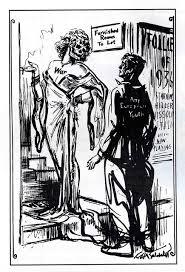 The 1936 cartoon above, from the New York Daily News, is making the point that...? A) Although European individuals and countries might be seduced into waging another major war, the United States would be wise to avoid participating. B) The policy of appeasement is a bankrupt policy that can only lead to more death and destruction. C) Munitions manufacturers, the so-called merchants of death, were pushing the world toward war in the name of profits. D) The weaponry of modern warfare had advanced to such a degree that future military engagements would result in unprecendented carnage. | back 100 A |
front 101 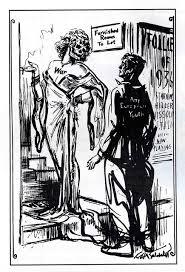 Which of the following political positions most closely parallels the political position reflected in the cartoon? A) Newspaper publisher William Randolph Hearst's position on declaring war on Spain in 1898. B) The Abraham Lincoln Brigade position on American intervention in the Spanish Civil War in 1937. C) Secretary of State Dean Acheson's position on United States intervention in the Korean War in 1950. D) Martin Luther King, Jr.'s position on the Vietnam War in 1967. | back 101 D |
front 102 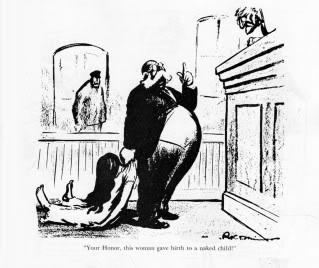 The political cartoon above is making the point that...? A) Government officials were taking their crusade against immoral behavior to extreme lengths. B) Unregulated immigration was leading to an increase in crime among men and women in urban centers. C) "Flappers" were imposing their standards of moral behavior on an unsuspecting public. D) THe court system was bogged down with insignificant complaints while perpetrators of major crimes were left untouched by the law. | back 102 A |
front 103 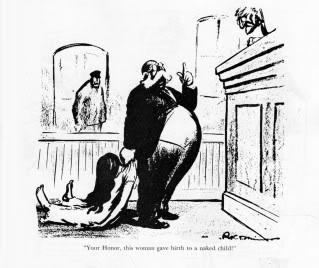 The cartoon reflects a point of view about which of the following continuities in United States history? A) Debates about immigration policy. B) Debates about the role of the federal government in regulating morality. C) Debates about access to healthcare for working-class women. D) Debates about the rights of the individuals accused of crimes. | back 103 B |
front 104 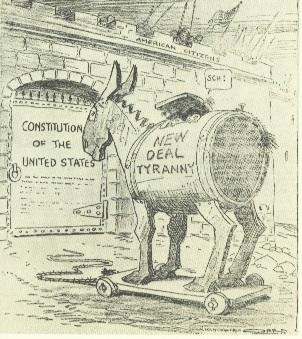 The 1933 political cartoon shown above makes the point that...? A) The New Deal's proposals for open immigration would threaten American democracy. B) The New Deal would be ineffective in addressing the problems of the Great Depression. C) The Supreme Court acted in a tyrannical way in declaring certain New Deal measures unconstitutional. D) New Deal programs would usher in unconstitutional restrictions on American freedoms and liberties. | back 104 D |
front 105 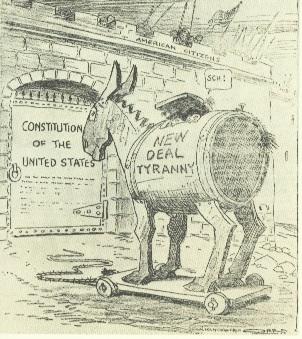 The sentiment reflected in the cartoon above was similar to which of the following political expressions? A) Support by the feminists for the Equal Rights Amendment in 1972. B) Opposition by the Republican Party to the creation of Great Society programs in the 1960's. C) Opposition by environmentalists to passage of the North American Free Trade Agreement in 1994. D) Opposition by Korean War veterans to the firing of General Douglas MacArthur by President Dwight D. Eisenhower in 1951. | back 105 B |