front 1
Are genes encoded by protein or DNA? Would you find proteins
or DNA in chromosomes? | back 1 -
Genes are encoded by DNA.
-
You would find both.
|
front 2
Describe the experiment of Hershey and Chase. | back 2 -
The Hershey-Chase experiment was attempting to figure
out whether genes contained DNA or proteins.
-
They used a virus called T2 which infects cells by
attaching to them and injecting its genes to the interior of the
cell, leaving behind its protein coat. They radioactively labeled
one population with phosphorus and one population with sulfur.
After the viruses infected E. coli cells, they sheared the capsids
off by agitating them. When the samples were spun in a centrifuge,
the small phage capsids remained in the solution while the cells
formed a pellet at the bottom of the centrifuge tube. They found
that all the radioactive protein was outside the cell in the
solution while almost all the radioactive DNA was inside the
cells.
|
front 3
Explain the reasoning behind the labeling in the Hershey and
Chase experiment. | back 3 The reasoning behind the labeling in their experiment was that DNA
contains phosphorus but not sulfur and proteins contain sulfur but not phosphorus. |
front 4
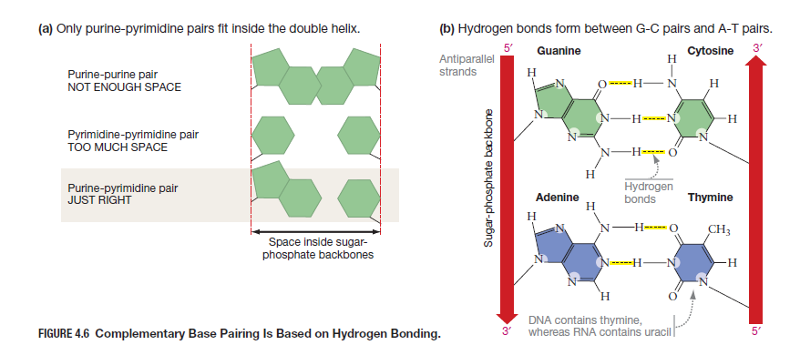
Illustrate the major features of DNA’s primary and secondary structure. | back 4 -
The primary structure consists of a backbone made up
of sugar and phosphate groups of deoxyribonucleotides and a series
of bases that project from the backbone.
-
The secondary structure is formed by hydrogen bonding
between complementary nitrogenous bases.
|
front 5
Explain the concept of DNA polarity. | back 5 -
Each strand has directionality of polarity, the two
strands line up in opposite directions
-
One strand has an exposed hydroxyl group on a 3’
carbon of a deoxyribose
-
One strand has an exposed phosphate group on a 5’
carbon
|
front 6
Describe the DNA synthesis reaction catalyzed by DNA
polymerase.
What does it mean to say that DNA is synthesized in the 5’ to
3’ direction? | back 6
DNA polymerase adds deoxyribonucleotides to the 3’ end
of a growing DNA chain therefore DNA is always synthesized in the 5’
to 3’ direction. |
front 7
Why is an RNA primer required during DNA synthesis?
What enzyme synthesizes the primer? | back 7 -
Since DNA polymerase cannot begin synthesizing from
scratch, the RNA primer places a short complementary strand that
allows DNA polymerase to attach new nucleotides to the free 3’ OH
group.
-
It is synthesized by primase.
|
front 8
List the proteins required for DNA synthesis in
E. coli , and describe the
function of each. Imagine a collection of mutant cells, each with a
mutation rendering one of these proteins non-functional. What would
happen at the replication fork in each of these mutants? | back 8 -
DNA polymerase III requires a single strand DNA and a
3’ end to extend from and synthesizes in the 5’ to 3’
direction
-
Both leading and lagging strand will not be
synthesized
-
Topoisomerase relieves twisting forces
-
A supercoil with too much tension will occur and
DNA will break
-
Helicase opens double helix
-
There would not be a replication fork
-
SSBPs (single stranded binding proteins) stabilize
single strands by attaching to them and preventing them from
binding back
-
Strands will bind back together on helicase and
replication fork will not exist
-
Primase synthesizes a short strand of RNA that acts
as a primer for DNA polymerase
-
DNA polymerase doesn’t have the OH on the 3’ end of
the primer to start synthesizing
-
DNA polymerase I removes RNA primer and replaces it
with DNA
-
Lagging strand will not be synthesized fully
because RNA primers aren’t being removed
-
DNA ligase catalyzes the formation of phosphodiester
bonds between okazaki fragments
-
It will result in fragmented strands
|
front 9
The error rate during DNA replication averages less than one
mistake per billion nucleotides (error rate < 1 x 10
-9 ). How is this extremely low error rate
achieved?
What happens when a DNA polymerase inserts the wrong base into
a sequence? | back 9 -
DNA polymerase III proofreads so if the
wrong base is added during DNA synthesis, the enzyme pauses
because geometry differs from correct base pairing and a
portion of DNA polymerase III called epsilon unit acts as an
exonuclease and removes deoxyribonucleotides form the ends of
the DNA strand.
|
front 10
When during the cell cycle does mismatch repair occur? | back 10
Mismatch repair occurs in the S phase. |
front 11
Why is it important for E.
coli cells to distinguish the “old” strand
from the “new” (i.e., newly synthesized) strand? How do they do so? | back 11 -
It is important to distinguish the old strand from
the new because the old strand is the correct template and the new
strand is the strand with the error.
-
Chemical marks (methylated bases) on the older strand
allow the enzymes to distinguish the old strand from the new
strand which has not gained the marks yet
|
| back 12 -
DNA can be damaged by sunlight, x-rays, and many
chemicals.
-
UV light can cause covalent bonding between
adjacent pyrimidine bases in the same strand causing a kink that
prevents DNA polymerase from replicating the DNA and causes the
cell to die.
|
front 13
Explain the mechanism by which damaged nucleotides are
recognized and repaired. | back 13 -
Nucleotide excision repair fixes errors such as
thymine dimers and other types of damage that distort the DNA
helix
-
First, an enzyme recognizes the kink in the DNA
double helix and another enzyme removes the section of single
stranded DNA containing the defective sequence
-
The intact DNA strand serves as a template for the
synthesis of a corrected strand and the 3’ hydroxyl of the DNA
strand next to the gap serves as a primer
-
DNA ligase links the newly synthesized DNA to the
original undamaged DNA
|
front 14
How could defects in DNA repair pathways increase the risk of
cancer? | back 14 -
If DNA damage in the genes involved in the cell cycle
go unrepaired, mutations that may allow the cell to grow in an
uncontrolled manner will result.
-
If the mutation rate in a cell increases due to
defects in DNA repair, mutations that trigger cancer become more
likely.
|
front 15
DNA polymerase cannot copy the end of the lagging strand of a
linear chromosome. Why not? | back 15 -
DNA polymerase cannot copy the end of the lagging
strand of a linear chromosome because the RNA primer is
removed.
|
front 16
How do some cells avoid the problem of telomere shortening? | back 16 -
Telomerase fixes this issue by binding to the
overhanging section of single-stranded DNA and extending the
parent DNA by adding deoxyribonucleotides. Primase, DNA polymerase
and ligase synthesize the lagging strand in the 5’ to 3’
direction.
-
Active in gametes and some cancer cells
|