Instructions for Side by Side Printing
- Print the notecards
- Fold each page in half along the solid vertical line
- Cut out the notecards by cutting along each horizontal dotted line
- Optional: Glue, tape or staple the ends of each notecard together
Needles, Layer closure, and Stapling Devices Chapter 11 (Nicola)
front 1 Needles can be described in terms of the following characteristics: | back 1 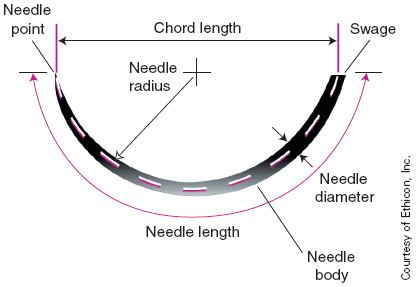 characteristics: eye, point, body, and shape |
front 2 What are the classifications of eyes, the portion of the needle where the suture strand is attached | back 2 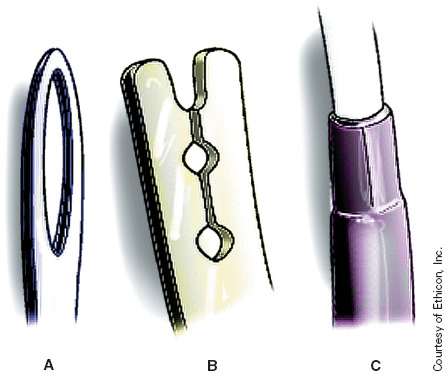 Closed-eyed
|
front 3 What may have round or square holes and are loaded by inserting the end of the suture material through the hole | back 3 Closed-eyed needles |
front 4 What is loaded by pulling the taut strand into a V-shaped area just above the eye. This type of needle is loaded more quickly than a closed-eyed needle, but still results in more tissue damage than the eyeless needle. | back 4 The French-eyed needle |
front 5 What are needles that are manufactured with suture strands inserted into one end, and are continuous with the suture strand, and the hole created in the tissue by the needle should be completely filled by the suture strand when suturing. | back 5 eyeless or swaged needles |
front 6 What may have a single-arm attachment or a double-arm attachment. | back 6 Eyeless needles |
front 7 What is a single needle swaged to the suture strand. These may by used for interrupted or continuous suturing | back 7 single-arm attachment
|
front 8 What has a needle swaged to each end of the suture strand, and are commonly used for anastomosis of vessels, allowing the center of the suture to be sewn to the center of the vessel with one suture end sewn to the left and the other to the right. The stitches meet in the middle on the opposite side of the vessel | back 8 Double arm attachment
|
front 9 What points are available for needles | back 9 Cutting, tapered, or blunt |
front 10 What needles are used for tough tissue that is difficult to penetrate. The sharp edges of this type of point actually cut the tissue as they penetrate it.
| back 10 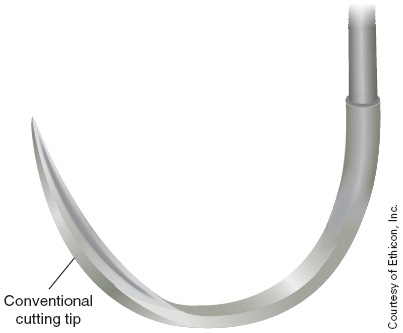 Cutting needles |
front 11 What needle consist of opposing cutting edges in a triangular configuration that extend into the full length of the shaft. They are used for the skin because they have a flat edge in the direction of the pull. This results in less tearing of tissue. | back 11 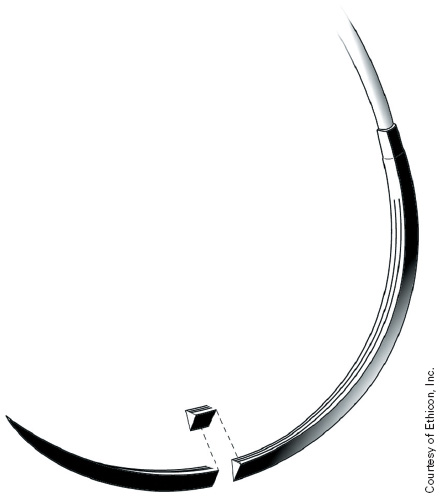 Reverse cutting needles |
front 12 What needles are used primarily for ophthalmic procedures because they will not penetrate into deeper tissues and separate the tissue layers during placement. | back 12 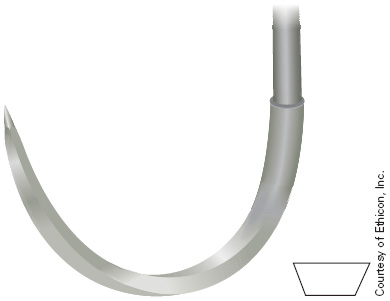 Side cutting needles |
front 13 What needles have a round shaft without a cutting edge, so they penetrate tissue without cutting it. These points are used for delicate tissues, such as the tissue of the gastrointestinal tract. | back 13 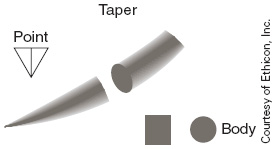 Tapered point needles |
front 14 What needles have a round shaft that ends in a blunt tip. These points are used primarily for the kidney or liver due to the tissue being so friable or weak. | back 14 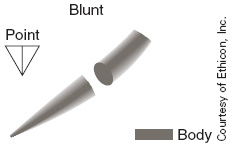 Blunt points |
front 15 What is located between the suture strand and the point. Its size and shape are variable and choice depends on the type of tissue to be sutured. Typically, the heavier the tissue, the heavier the body | back 15 The shaft, or body |
front 16 What determines the length of a needle | back 16 depth of the “bite” of the tissue to be sutured |
front 17 What are used to inject medications into tissues or intravenous tubing. Needle lengths range in size from V to 4 in., and gauge sizes range from 12 to 30, with smaller needles having the larger gauge number. | back 17 Hypodermic needles |
front 18 Which assemblies employ a needle to introduce a plastic indwelling catheter into a vessel (commonly called an IV in order to deliver IV fluids, blood, and/or blood products into the circulatory system). | back 18 Arterial or venous/cannula needle |
front 19 The Potts-Cournand needle/cannula assembly, are used to introduce diagnostic or angioplasty guiding catheters over guiding wires into the arterial system. Venous needles with an aspirating syringe are used to puncture large veins for the introduction of monitoring catheters, such as the Swan-Ganz. Heparin needles attached to syringes | back 19 Arterial needles |
front 20 What are not needles but a small-diameter cannulated tube attached to a plastic needle hub for placement on a syringe. | back 20 Irrigation needles |
front 21 Which needles are used to obtain tissue samples from within the body for biopsy. This type of biopsy is sometimes guided with the aid of CT scan or fluoroscopy. Examples of this type of needle include the Dorsey cannulated needle for biopsy of cerebral tissue through a burr hole, the Chiba biopsy needle for biopsy of lung tissue through the chest wall, the Franklin-Silverman cannulated biopsy needle with a “trap door” tip for biopsy of the liver and other internal organs, and the Tru-cut biopsy needle | back 21 Large percutaneous biopsy |
front 22 What are closed in layers. From inner to outer, these layers include the peritoneum, fascia, muscle, subcutaneous, subcuticular, and skin layers | back 22 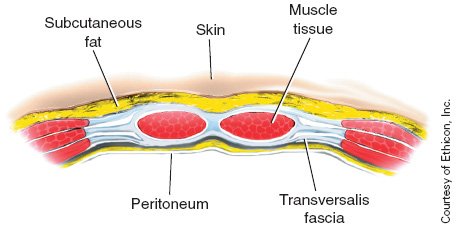 Abdominal wounds |
front 23 What is a fast healing thin membrane lining the abdominal cavity
| back 23 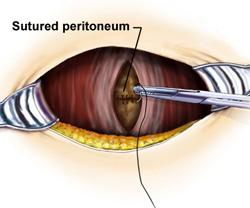 Peritoneum |
front 24 What is a tough connective tissue covering the muscle, this layer heals slowly and must endure the brunt of wound stress; therefore, interrupted, heavy-gauge, non absorbable multifilament suture is preferred for added strength, and polypropylene surgical mesh may be used | back 24 Fascia |
front 25 What is not typically closed with suture because they do not tolerate suture material, are usually separated or retracted and therefore do not need to be closed. | back 25 Muscle |
front 26 What does not tolerate sutures well, a few interrupted sutures into this layer to prevent dead space, especially for obese patients. Plain gut is often the preferred suture material | back 26 subcutaneous tissue |
front 27 What is an area of tough connective tissue just beneath the skin and just above the subcutaneous layer. Absorbable sutures are preferred, as they are often left inplace | back 27 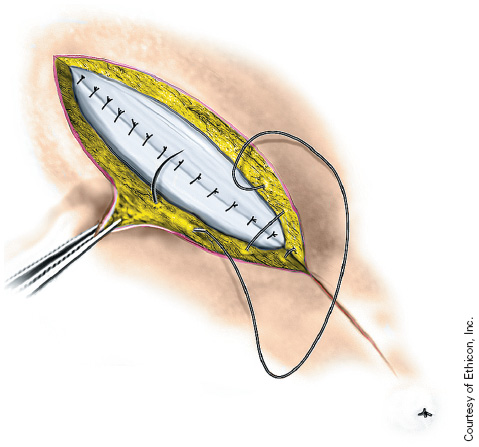 Subcuticular |
front 28 What may be close with interrupted or continuous monofiliment, nonabsorbable sutures on a cutting needle or with skin staples. Polypropylene or nylon are the preferred suture materials; however, stainless steel staples result in less tissue reaction. | back 28 Skin |
front 29 What is the main suture that approximates the wound edges for first intention healing to occur, typically placed in either an interrupted or continuous fashion | back 29 primary suture line |
front 30 What suture is a primary suture line consisting of a single strand of suture placed as a series of stitches often used for closure of long incisions, strand is tied after the first stitch is placed at one end and tied again after the last stitch is placed at the other end. Evenly distributed tension along the suture line is a hallmark of the continuous suture closure | back 30 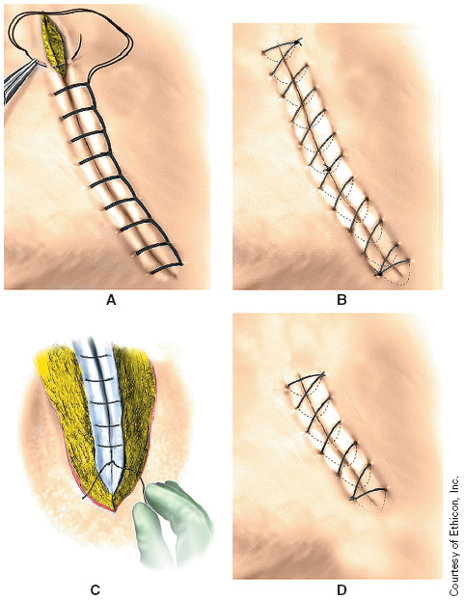 Continuous, or running, |
front 31 What suture is used for long straight incisions when the wound edges easily evert | back 31 Simple Continuous |
front 32 What suture is a variation of the simple continuous where the suture is locked prior to placement of the next throw | back 32 Continuous running/locking (blanket stitch) |
front 33 What suture is a single suture technique at end of wound; multiple bites are made opposite each other the length of the wound | back 33 Subcuticular (First throw ) |
front 34 What suture is placed in a circular fashion around a structure in such a way that pulling on the suture ends tightens and closes an opening | back 34 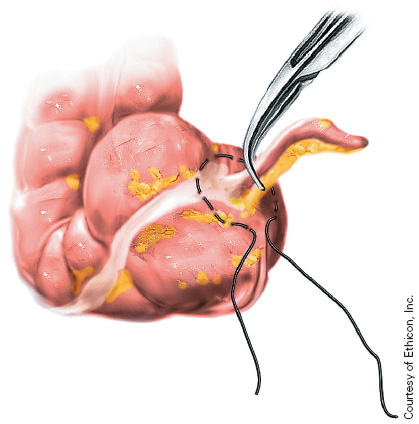 Pursestring (drawstring) |
front 35 What is the suture technique of choice to close infected tissues, stopping the pathway of bacteria, localizing the area of infection to a smaller area of the wound, and is the technique of choice to close tissues that are under tension | back 35 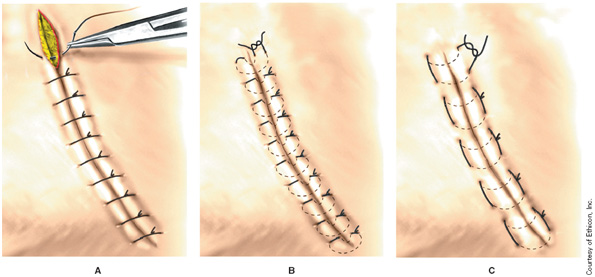 Interrupted suture |
front 36 What Interrupted suture techniques are available | back 36 Simple
|
front 37 What sutures are used to retract a structure that may not be easily retracted with a conventional retractor instrument, a non absorbable suture is placed and the ends clamped with a hemostat.
| back 37 Traction sutures |
front 38 What is useful for support of the primary suture line. It helps to ease tension on the primary suture line | back 38 Secondary suture line |
front 39 What are large-gauge, interrupted, nonabsorbable sutures placed lateral to a primary suture line for wound reinforcement. Used when wound may not heal or may be reopened due to coughing | back 39 Retention sutures |
front 40 What suture method actually refers to creating the knot outside the body prior to instrument transfer through the trocar cannula to the tissue site. | back 40 Extracorporeal suture
|
front 41 What method simply refers to the surgeon using instruments inserted through the trocar cannula to facilitate the internal suturing of tissues and knot tying | back 41 Intracor-poreal suture
|
front 42 What is used to ligate tissue pedicles during endoscopic procedures. A suture is inserted through a long, thin plastic tube, which is formed into a loop with a knot. When ligature is in position, the tube is pulled upward to tighten the loop and knot. | back 42 Endoloop ligature |
front 43 What is a single-use suturing device for the placement of interrupted or running stitches in soft tissue. The device has two jaws; the needle is loaded from a single-use loading unit; the needle can be passed between the jaws by closing the handles. The device also serves as the knot pusher to tighten the knot. | back 43 Endo Stitch |
front 44 What is a noninvasive, atraumetic device used for skin closure. It combines a zipper and two lateral adhesive strips, be 3-4 cm longer than the surgical wound | back 44 Wound zipper |
front 45 What is a synthetic adhesive used for skin closure; two commercial names are Dermabond™ (Ethicon product) and Indermil™ (Syneture product). A pencil-like device is held and a button on the side is pushed to deliver the chemical liquid glue, wears off in 7-10 days | back 45 Cyanoacrylate |
front 46 What is a biologic adhesive and hemostatic agent, its mixed calcium chloride and produces a clot | back 46 Fibrin glue |
front 47 What are plastic devices that help the closed incision. Retention suture ends are brought up through holes on each end of and tied at the middle. A circular tightening device allows tension to be adjusted on the retention sutures | back 47 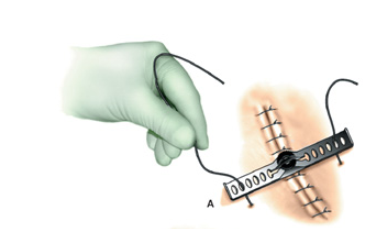 Bridges |
front 48 What are pieces of plastic or rubber tubing threaded over the retention suture ends before the ends are tied. Once tied, they cover the retention sutures and prevent them from cutting into the skin | back 48 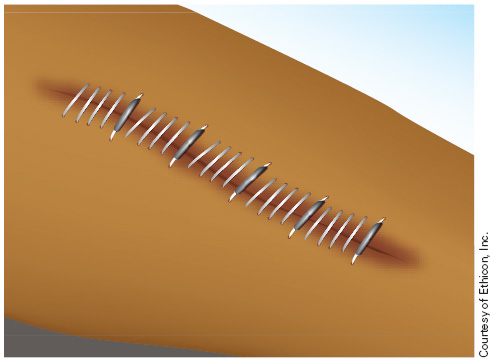 Bolsters |
front 49 Tendon sutures may be pulled through ........ and tied over a ...... to prevent tissue damage. Split lead shots may be clamped onto the ends of subcuticular sutures after skin closure. | back 49 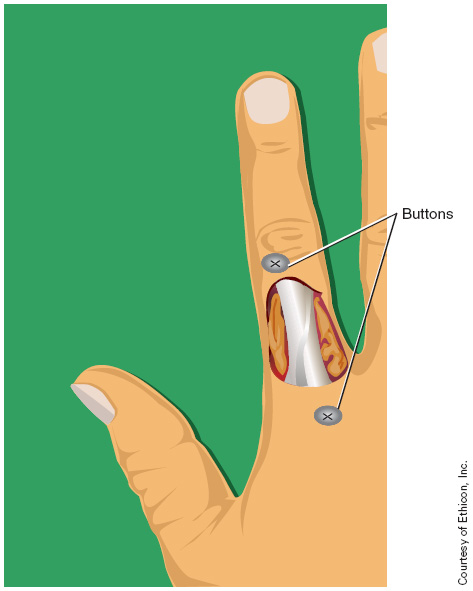 buttonholes / button |
front 50 What was once used to ligate the severed ends of the umbilical cord after childbirth. It is used in the OR as a retraction and isolation device for bowel, nerves, vessels, or ducts. Umbilical tape is usually packaged with two strands in a pink packet and is best used moistened with saline and loaded onto a hemostat. | back 50 Cotton umbilical tape |
front 51 What are used as isolation/retraction devices for vessels, nerves, or ducts. The elasticity of the vessel loops makes them ideal for retraction of delicate structures or for temporary occlusion of a vessel. Vessel loops are colored for easy identification of different adjacent structures. Typically, white and yellow loops are for nerves or ducts, red loops are for arteries, and blue loops are for veins. They are packaged in pairs. | back 51 Silicone vessel loops |
front 52 What are used in orthopedic surgery for fixing tendons and ligaments to bone. The device consists of the anchor, such as a screw made of metal or absorbable material, that is inserted into the bone and an eyelet through which the suture passes | back 52 Suture anchors |
front 53 What are adhesive-backed strips of nylon or polypropylene tapes used to reinforce a subcuticular skin closure or approximate wound edges of small incisions or superficial lacerations when sutures may not be necessary. Prepare skin with tincture of benzoin to help them stick | back 53 Skin closure tapes |
front 54 What is a sterile liquid that is applied topically. It is used on the surface of a wound that will not be under tension in place of adhesive skin closure tapes, staples, or suture | back 54 Skin adhesive |
front 55 Staples are frequently used during surgical procedures to anastomose or approximate tissue
| back 55 Stapling advantages over suturing |
front 56 What are used to approximate skin edges during skin closure. The surgeon everts (turns outward) and approximates the skin edges with Adson tissue forceps with teeth and the operator positions the stapler at the approximated edges with the aid of an arrow located on the stapler head | back 56 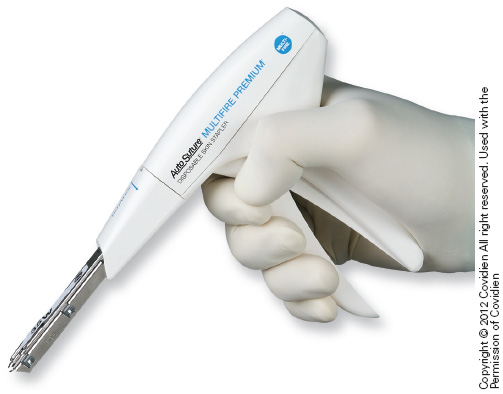 Skin staplers |
front 57 What are used to insert two straight, staggered, evenly spaced, parallel rows of staples into tissue, used to staple tissue to be transected within the alimentary tract or thoracic cavity, | back 57 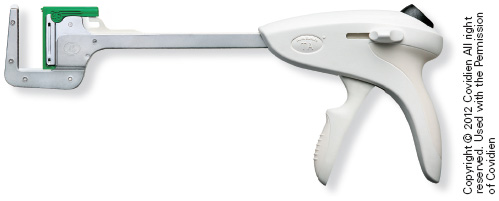 Linear staplers |
front 58 What is used to staple and transect the tissue, and deliver two double staple lines, and contain a knife blade that passes between the two staple lines, dividing the tissue, especially useful during gastrointestinal procedures. | back 58 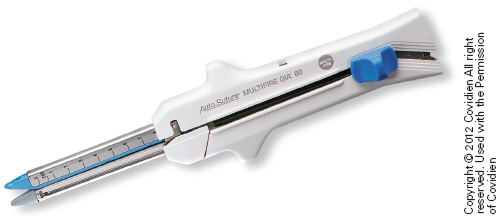 The linear cutter |
front 59 What is used to occlude a single small structure, such as a blood vessel or a duct. A structure to be divided must have at least two individual clips placed (one or more proximally and one or more distally). | back 59 Ligating clip |
front 60 What ejects two ligating clips side by side and then divides the tissue between the clips with a single activation. It is especially useful during gastrointestinal procedures for division of the greater omentum. | back 60 Linear dissecting stapler |
front 61 What are used to anastomose tubular structures within the gastrointestinal tract. This stapler fires a double row of circular staples and then trims the lumen with a knife located within the head of the stapler | back 61 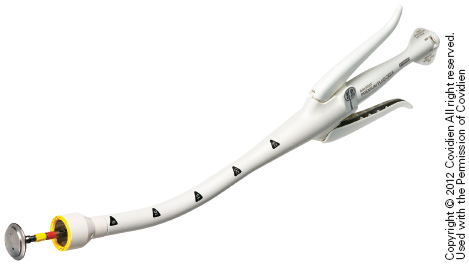 Intraluminal (circular) staples |
front 62 What can be used as a bridge for tissues that cannot be brought together without placing a great deal of tension on the tissues, and may also be used as a reinforcement for fascia defects
| back 62 Synthetic mesh |
front 63 Which is the least inert of the synthetic meshes, never be used in presence of infection, its multifilament fiber construction can harbor bacteria | back 63 Polyester fiber mesh |
front 64 What is rigid, hard to apply, resulting in discomfort for the patient. It is the most inert of mesh materials | back 64 Stainless steel mesh |
front 65 What is a soft flexible mesh, not absorbable, should not be used in presence of infection | back 65 Polytetrafluoroethylene (PTFE) mesh |
front 66 What is an absorbable material that provides temporary support during healing | back 66 Polyglactin 910 mesh |